So, The Rise of
Skywalker really wasn't that good. I think we're all agreed on
that at this point, right? Though I was generally positive (kind of)
in my original review, the more I thought over the film- and if
nothing else, recent (ahem) world
events have left us all with lots of time to think- the more it
soured. Revisiting just a sampling of the best novels written in the
old Extended Universe before Disney put the kabosh on it only
reinforced this, as the storytelling in the old EU, in its best
moments, has some moments of pure, exhilerating transcendance. Plus,
looking back, my initial worries about The Force Awakens after it
came out proved rather prescient; in the end, the new trilogy meant
to "finish" the entire grand, generations-in-the-making
saga of the Skywalkers.....actually kind of cheapens the original
trilogy now, since the official canon now says, in essence, "LOL
none of it mattered life is meaningless buy gold BUY GOLD!"
And
you know what? Screw that! Even if the overarching narrative of the
trilogy proved wanting, the new trilogy did, at the very least, give
us a great group of characters that deserved a hell of a lot more
than what they were given. So, in a fit of pique (and a touch of
Plague Madness), I decided to rewrite the whole damn thing. Yep.
I'm insane, and this probably won't be anywhere near good, and I'm
doing it anyway.
The
initial spark for this idea came to me when the storyboard and
concept art for what Colin Trevorrow (who was originally slated to
direct Episode IX) had planned was leaked and confirmed to be genuine. It's obviously very barebones, and of course, there is no
guarantee that either he or everyone else involved in the film's
making could have fleshed it out into an actual, good movie, but even
the basic plot concept was well above what we ended up getting, and
had far more potential to actually do justice to these characters and
give their arcs proper payoff.
So
I'm doing it. What will follow, in a currently-unknown number of
chapters, is me taking the basic structure of Trevorrow's original
story concept and fleshing out or altering it according to my own
personal whims. Not going to try and monetize or publicize it- I
have neither the time nor the cash reserves to afford a fight with
The Mouse- but it will be here for those who care enough to want to
read it and give me their feedback.
This
page will serve as the regularly-updated Table of Contents each time
I upload a new chapter, which, as of now, I plan to do once a month
to give me enough to write the story out in advance.
Enjoy!
Or don't. Either way.
This
is Star Wars, the TRUE Episode IX: Duel
of the Fates.
It's
hard, so very hard, to believe it, but the 2010's are now definitely
behind us, and a new decade has begun. For now, we can only hope
that this coming decade brings better news for the planet and
humanity than the last decade, but if there's one aspect of human
development that did not suffer the past ten years, it was at the
movies. This was a decade that, the best efforts of the Academy to
pretend otherwise notwithstanding, was simply bursting with new
talents and visionaries.
Making
this list was a painful process. There were so many good
movies that came out, and so many I personally adored, that I ended
up making a 25 Best list and STILL had to cut out reams of excellent,
inspiring films from consideration. So bear in mind throughout this
exercise in insanity that absence from this list is in no way shade-
there are literally dozens upon dozens of other movies others are
naming in their decade lists that I wholly agree with, but just
couldn't squeeze onto mine. This is an entirely personal list, the
movies that meant the most to me as an individual, meaning that many
of the choices here are highly unusual and incredibly idiosyncratic,
especially where the particular order is concerned.
This
will be a long process, trying to go back through 10 years' worth of
heady emotions, so I won't dally any longer. I will, however, take a
brief moment for a few honorable mentions, specifically for my two
favorite film trilogies of the decade. These were both cases where I
love all three films nearly equally, and singling out a single film
from any of them and sacrificing two additional spots on my main list
proved just too hard. Instead, the collective trilogies take the
place of what would otherwise be a robust "Honorable Mentions"
category.
Honorable
Mention #1: How To Train Your Dragon
How
fitting indeed that this particular series effectively encompasses
the entire decade on its own; the first HHTYD caught us all unawares
in March 2010, a year filled to the brim with amazing, groundbreaking
films; the sequel was released in the summer of 2014, almost exactly
halfway through the decade; and finally, in February 2019, The
Hidden World closed things out. This amazing timing allows the
films, when compared side-by-side, to serve as a fascinating time
capsule for how CGI animation and the use of 3D improved in scope,
size, and ambition over the past ten years. Each film got more
detailed, more technically proficient, without ever overshadowing what came before.
In
addition to its beauty and technical effectiveness (many still rank
the flying sequences in the first film as some of the best use of 3-D
ever), the films committed to taking characters and a premise that,
on its face, did not provide much fodder for a good story. In lesser
hands, these films would never have been able to give us the sort of
emotional narrative experience capable of making us care about
characters with bizarro names like "Hiccup" and
"Toothless." Thankfully, they put just the right people in
charge, and the result is a series of films that don't just sit idle,
each installment nothing more than rehash of what came before. Each
one builds off what the characters learned in the last one and
provide new challenges, new questions, new worries they have to grow
to meet. I've written before how much I admire the degree to which
the films center around the main characters losing something
precious, yet still having to find a way forward, and I still harbor
hope I can return to this subject in detail later on. For now, let
me just say that if you are still sleeping on these movies (and so
many still are), don't.
Honorable
Mention #2: John Wick
We
have definitely not seen the last of "Meester Weeck," but
for now, this is a trilogy, and by God is it so much fun. From its
satire-level beginning (a man's dog is killed by some jerk, so he
destroys the entire Russian mafia out of spite), these films have
provided a masterclass in building a whole new imaginary world from
the ground up. With so many other franchises and studios flaining at
recreating the lightning-in-a-bottle that was the MCU, the creators
of John Wick carved out a path all their own, leaving the rest of us
gasping in their wake. They are brutal and bloody films, so if you
are not on board with hard-core action, then these films are not for
you. For those of us who get that little adrenaline boost when an
astounding physical feat is performaned before us, there was little
else the past decade to beat these films.
And
now, on to the main show!
Brooklyn
(2015, John Crowley)
This
was the one where Saoirse Ronan stole my heart, and she still refuses
to give it back. Plus, as a movie about taking a chance and moving
to another country and another continent, where both joys and pains
aplenty are to be found, hit me on an intensely personal level. It
takes quite a lot for a movie to get me crying on a first viewing
(usually it takes at least three), but this one had me bawling by the
time Ronan's final monologue wrapped up.
Swiss
Army Man (2016, "The Daniels")
Daniel
Radcliffe and Paul Dano team up for one of the strangest and most
in-your-face-bizarre films I've ever seen. Grossout body humor
abounds, but beneath the literally corpse-like exterior lies a
beating heart of gold, where a lost soul finds a way back to human
contact and feeling they thought was lost to them forever. If you
can commit to this film, I guarantee you will never forget it for as
long as you live.
Tree
of Life (2011, Terrence Mallick)
Much
like 2001, a film that defies genre, that defies description,
that manages to feel so specific with its own characters and stories,
and yet somehow achieves a blinding sense of universality. This is
what happens when an artist is able to glimpse the geuinely divine
and provide us a window into the entirety of existence. Sean Penn,
Brad Pitt, and Jessica Chastain are all giving career-best
performances, and Mallick's ethereal, emotive sensibilities reach
audiovisual heights that no other film of his has yet managed to
recreate, though The New World and A Hidden Life come
the closest.
The
Big Short (2015, Adam McKay)
The
blisteringly, painfully funny adaptation of Michael Lewis' book of
the same name that comes closer than any other effort before or since
to allow the layman to grasp the skullfuckery that brought about the
greatest economic crisis since the Great Depression, one that our
society and politics are still unable to shake off. It is a wild,
seat-of-the-pants experience, both infuriating in its implications
while still being one of the funniest, most quotable movies to come
out this decade. Too few people saw this movie, fewer understood,
and we are on the precipice of repeating the same mistakes now. As
always, history repeats itself first as a tragedy, then as a farce,
then as Ryan Gosling looking straight at us and explaining just how
jacked to the tits he is.
Boyhood
(2014, Richard Linklater)
Richard
Linklater has long made it his business to take concepts that have
never been tried before and, somehow, finding the best way to turn
them into cinematic gold. He did it with Waking Life, he's
doing it with the Before series, and he pulled it off with
Boyhood, an unparalleled, literally-years-in-the-making homage
to nothing more than life, in all its disconnected weirdness. In
many ways, this film is something of a spiritual balance to Tree
of Life, with Linklater as grounded and down-to-earth in his
style as Mallick is drawn to the heavens in his.
True
Grit (2010, The Coen Brothers)
I'm
honestly not much for Westerns, at all, having seen next to none in
my life. Very little of the aesthetic or the sorts of characters
that inhabit those worlds appeals to me. Plus there's, you know, the
fact that this particular part of cinematic history has often been
especially racist. I would also not fight anyone who left this film
off a list of the truly great Coen flicks: Fargo, it is not.
And
yet. And yet. I can't explain why, but I can't get this movie out
of my head. It's one of the films of the decade I've rewatched the
most. Why is that? Is it the fact that it features one of Jeff
Bridges' finest performances, plus has one of the best breakout child
performances of all time? Is it the masterful, endlessly-subtle
score? The fact that it sticks to the book's downplayed, depressing
ending? The insanely good characterization of the gang of villains,
even though they barely get more than a few scenes? The absolute
perfection of the final shootout? Bear Guy?
Whatever
it is, I know it won't be too long before I find my way back to this
one, as inexplicable as it may be. It has, after all, taken my teeth.
Cabin
in the Woods (2011, Drew Goddard)
Rarely
has a movie succeeded so throughly at not only skewering its own
genre, but also ending up being a spot-perfect meta-commentary on the
nature and limitations of creating art in our world. This is a
criminally underrated screenwriting masterclass in subverting
expectations, all the way up to the absolutely insane explosion of
violence, betrayal, and revelation at the very end. It's a must-see
for anyone even remotely interested in horror movies, as it is packed
to the gills with references to the films it's parodying, but it's
also a cuttingly funny comedy about filmmaking-as-horror reduced to a
cut-and-paste game by schlubby middlemen. Above that, though, is the
incredible way the film succeeds to working as a meta-commentary for
the art of storytelling in just about any form, and how this most
human and most powerful of art forms is often hamstrung by societal
expectations of what makes for a "proper" story, in ways
that both hurt the art form, and ourselves.
Parasite
(2019, Bong Joon-Ho)
Praise
be to God, for the first in an age, the Oscar for Best Picture went
to the actual best picture to qualify. Bong Joon-Ho has been a
familiar name to internationally-minded cinephiles for years, but it
was so satisfying to see him finally break through into popular
awareness in a huge way. Parasite is a film very much of and
for our current age of Gilded Era politics and economics, where the
weathy can do what they want and the rest of us can get fucked, and
could not have been more timely. However, it's also just such a damn
joyride of note-perfect visual storytelling, with cutting music,
crisp editing, and a banger screenplay, that it will endure as a
universal masterpiece. The best movies, like all best stories, carry
a lot of the times that produced them, but also rise enough above
them to endure. And Parasite will endure for a very, very
long time.
Taste
of Cement (2018, Ziad Kalthoum)
A
visual poem of a film, one with sparse commentary from its unnamed
narrator, whose images indelibly bore into the viewer and make you
feel like you are in the middle of a warzone yourself. Though the
men seen on a construction site are not in immediate physical danger,
the placing of the camera makes clear their continued alienation and
isolation from the world around them, while at night, images on the
news bring back the still-unprocessed memories of the pain and
destruction that caused them to flee their homes in the first place.
Few films so simple in purpose and execution reach such powerful
heights.
ParaNorman
(2012, Chris Butler, Sam Fell)
One
of the best animated films ever made, this movie synthesizes what
makes Laika great in a way that only Kubo and the Two Strings
has otherwise managed to achieve. A clever play on the concept of a
cursed zombie apocalypse, as well as a hilarious riff on the
witch-oriented tourism market of Salem, Massachusetts, this is a
movie bursting with heart, as its loner and oddball characters
struggle to find the covered-up truth of why, exactly, the zombie
curse exists and what the titular Norman, with his strange and
largely unappreciated powers, should do about it. It is a
groundbreaking achievement in animation, it's funny and touching and
gets you thinking, and it still hasn't gotten its popular due. This
is the one that should have landed Laika their Oscar.
The
Death of Stalin (2018, Armando Iannuci)
Maybe
not the absolute best comedy of the decade, but a deeply personal
favorite of mine, this film is a who's who of aging, character-actor
Demigods who team up to portray the collective heads of the Soviet
Union at the time of Statin's death. Bumbling, unorganized, and in
so many ways every bit as trapped by the authoritarian strictures
around them that, in theory, should give them the power and freedom
that their subjects lack, we watch these bozos try to figure out what
in Stalin's name should happen to the Soviet Union following the big
man's undignified passing. So much of the comedy gains its heft from
the absurdity inherent in any authoritarian system, where survival
often requires one to look at a blue sky and proclaim it red. And in
a big plus, the plot is historically accurate to a rather astonishing degree.
Jupiter's
Moon (2017, Kornel Mundruczo)
It's
true- a Hungarian tackling the complex dynamics of the current
European refugee crisis made one of the best Superman movies of all
time. Although, given that Superman's own origin story effectively
has him arrive on Earth as a refugee as well, perhaps that shouldn't
be that surprising. Combining potent topical sociopolitical themes
with a sense of mysticism sorely lacking in most "real"
movies today, the very fact of flight in this movie seems like less
of a physical power and more of a reflection on how nearly all of us
have lost the capacity (or, perhaps, the desire) to just look up and
wonder at something beyond our comprehension. For all its basis in
the sordid underground world of criminal Budapest, this is a
profoundly spiritual film about human nature that can leave you
grappling with quite a lot once the credits role.
Thor:
Ragnarok (2017, Taika Waititi)
With
one exception, Marvel movies are at their best when they are fun,
breezy, and hilarious, and Thor: Ragnarok by New Zealand
wunderkind (and newly-minted Oscar-winner!!!!) Taika Waititi is the
funniest of them all. Chris Hemsworth and Tom Hiddleston perfect
both their own characterizations of Thor and Loki and the
nuclear-charisma-fueled dynamic between them, Mark Ruffalo turns in
one of his best performances to date, Cate Blanchett makes a
statement as a fantastic villain in a franchise sorely lacking in
that department, Tessa Thompson stakes her claim to being one of the
best supporting characters in the entire MCU, and, you guys, Jeff Freaking Goldblum. It would be more than enough if the movie
were simply content to remain one of the best comedies of the decade,
but Waititi is too smart for that. Somehow, he goes the extra mile,
and if you scratch just below the film's jaunty surface, there is a
world of meta-commentary on the colonialism and how whitewashing and
deliberate forgetting of the past makes it all the easier for a
society to set itself up for later collapse.
Scott
Pilgrim vs. The World (2010, Edgar Wright)
Edgar
Wright can do just about anything, including taking a then-unfinished
graphic novel series about a deadbeat hipster and morphing it into
the best video game movie to ever hit the big screen. Yes, better
than all other video game movies based on actual video games.
If
there's one thing Wright has down pat better than just about any
other director in the biz, it's his sense for how to fuse sharp
writing, quick editing, spot-on sound design, and just the right turn
of the camera to create a humor and feel that create a whole new
argument in favor of the existence of cinema. The thousand sound
cues combined with sudden lighting shifts or various visual effects that pepper this film just aren't possible in any other medium, and
without them this wouldn't be half the film that it is. Plus, the
multi-layered video-game setup notwithstanding, the fluid motion to
the action and the way the humans act just might give this film a
claim to also being the best live-action version of Japanese anime yet made.
The
cast is game too, with a staggering mix of young talent filling out
the screen, including the glorious big-screen reunion of Michael Cera
with his one, true love, Mae Whitman. Plus, now that I think
about it, Chris Evans' turn as the asshole of assholes in Knives
Out shouldn't have surprised people as much as it did. We all
praised him for showing a new side to his acting when, in reality,
all he did was resurrect Lucas Lee.
A
Silent Voice (2016, Naoko Yamada)
Directly
dealing with both physical disability and epidemics of schoolyard
bullying are huge taboos within Japanese society, so it's pretty
astonishing to not only see an incredible manga series come out
treating both with remarkable empathy, but to also see said manga
expertly adapted into an animated film that carries that same
profound emotional depth. This story weaves together the many,
endlessly complicated ways that bullying, disability, and social
restrictions can create threads of hatred, pain, and anger that
reverberate for years, leaving a widening circle of casualties in
their wake. The sound design of this film is a true wonder, a
delicate use of the very concept of hearing to reflect on the many
ways, including non-physical ones, people can be deaf to the world
and people around them.
Black
Panther (2018, Ryan Coogler)
Following
on the heels of Guardians of the Galaxy 2 and Thor:
Ragnarok, both of which redefined the capacity for superhero
movies to be vehicles of excellent comedy, one of the best rising
filmmakers in the game proceeded to redefine the genre's ability to
provide serious emotional and sociopolitical catharsis in the guise
of the classic hero's journey. From the movie's full-on embrace of
the color and vibrance of the African diaspora, to its phenomenal,
empowered female characters, its all-time-great score, and its
dynamite cast (highlighting, of course, by Michael B. Jordan), this
movie takes the tried-and-true formula of past fantasy stories and
hits every single note pretty much perfectly. This was the first of
the current generation of comic book movies to really prove what
amazing heights these stories can reach, if the people making them
are committed enough.
Inside
Llewyn Davis (2013, The Coen Brothers)
Like
all the very best movies the Coens make, the first time I saw this
film in theaters I wasn't entirely sure what to think; at their best,
the Coens are able to twist away from or avoid any sort of predictability, so
that the end result is never what you first thought it would be.
What that makes Inside Llewyn Davis is a perfect example of
this, a sublime creation that takes us through the
partially-self-inflicted travails of a musician with a penchant for
being in just the wrong place at just the wrong time.
Does
this film take place over a single day? A week? A looped eternity?
Llewyn himself sure doesn't seem to know. It was this role that put
Oscar Isaac firmly on my radar, and so far it remains one of his
absolute best (and, funnily enough, it was also my first exposure to
Adam Driver). Amazing production design, seductive
cinematography, an achingly haunting soundtrack, and one of the
decade's best screenplays; this is not just one of the best movies of
the decade, I feel confident it will stand the test of time as one of
the best films the Coens have ever made.
The
Social Network (2010, David Fincher)
My,
how the wheels of time have turned over the narrative around this
one. The Social Network was a major success from the start,
one of 2010's most heralded films and the winner of multiple Oscars.
Pretty soon, though, a sort of backlash began to form around the many
ways the film plays it loose with the facts around Facebook's actual
founding (which, to be fair, it does). Pretty soon, a fair number of
people assumed that the dystopian, cynical tone of the film
surrounding the rise of social media in general and Facebook and
Zuckerberg in particular was, on the whole, a bit much. Yes, it's a
gripping, slick thriller of a film, but Zuckerberg and his ilk surely
can't be that bad, right?
Whelp.....turns
out, yes! Turns out, Fincher might have even gone too soft on the
Tech Bros! As engaging and challening as this film was to experience
when it first came out- and as much as the sheer filmmaking technique
on display still holds up- on a deeper, meta level, it's truly
terrifying to revisit it now, in light of years of Trump
depravations, Zuckerberg's open pandering to the worst elements of
the far right, and Facebook as a whole basically allowing itself to
be turned into a nuclear weapon aimed against democracy, human
rights, and basic moral decency. We remain stuck in a world created,
defined, and more or less run by angsty, immature, man-boys who never
got over the women brave enough to say to their face what they are.
And so much of it is packed into the frames of this film, in details
both large and small, even though the events depicted took place over
a decade before the 2016 election. This is one of the best films of
the century, but it's one hell of a depressing time capsule.
Star
Wars, Episode VIII: The Last Jedi (2017, Rian Johnson)
Ah,
if only this had been the final film. Star Wars fandom was, quite
simply, not ready for Rian Johnson, but he came and gave us a
masterpiece anyway. Like The Empire Strikes Back, this one is
going to endure and get its due from enough people, but it still
blows that Disney was not able to just stick with this film and
defend it.
While
there is so much I love about this film, especially the powerfully
subtle ways Finn and Po undergo major character shifts by the end,
far and away my favorite scenes are everything between Rey and Luke.
I was more psyched to see Luke Skywalker again than for anything else
going into this new trilogy, and while the radically different
approach Johnson took jarred me to my core, I realized more and more
that that made his approach all the more meaningful. We never
remember the art that gives us exactly what we expected and wanted.
We remember that which shakes us, which forces us to confront
something elemental about ourselves or others, that which makes us
think. Sure, I love Luke Skywalker Badass Knight as much as anyone,
but I have the old books for that, and they aren't going anywhere.
This movie gave me something deeper and more permanent; resolve to
move forward into the uncertainty of the future.
Moonrise
Kingdom (2012, Wes Anderson)
While
Grand Budapest Hotel, as excellent as it was, was the film
that finally brought Wes Anderson major awards success, as far as I'm
concerned nothing else he's yet made can touch the bizarre, sad, and
poingant story of two children, both on the cusp of growing up,
carrying out one last insane adventure to a place that will soon be
lost forever, only to live on in memories. With its razor-sharp
screenplay, typically Andersonian crisp-to-a-fault cinematography and
editing, and one of the most stacked casts I've ever seen, this is a
transportive film from start to finish, one that never fails to
absolutely hypnotize me.
Plus,
this was the movie that introduced Lucas Hedges to the world, and
that, my friends, is the definition of an Absolute Good.
Silence
(2016, Martin Scorcese)
This
might be my most deeply personal selection on this list. I know
there are many who argue that not only is this film not among
Scorcese's best- in this decade alone, that honor is mostly given to
either The Irishman or The Wolf of Wall Street- there
are those who argue it isn't even that good, period.
I
can understand those arguments. And I, too, would not place this
atop a ranking of Scorcese's key filmography. But I also can't deny
that this film speaks to something profound within myself. It
undoubtedly has to do with the fact that I was raised Catholic, was
baptized and confirmed, and am even in the Knights of Columbus. It
probably has more to do with the fact that my Catholicism has grown
and changed and morphed into something unrecognizable over the years;
the common term most would use for me is "lapsed." It is
true that the form of my spirituality and my religion is
ever-shifting, that I viscerally oppose the worst teachings and
practices of the Church on Earth. It is also true that I struggle as
painfully with the silence of God in this world as the film's main
character. Maybe God does see him, and there is a meaning to the
suffering he witnesses and himself endures. Maybe he doesn't, and he
is simply insane, a victim of his own arrogance. Either way, he
can't know. All he can do is endure. And all faith can do is
endure, exist, even in a world that would deny its relevance.
Cloud
Atlas (2012, Tom Tykwer and the Wachowskis)
This
movie blew me away the very first time I saw it, and it's blown me
away every time I've seen it since then. This movie is, quite
simply, a miracle. There are many who deride it, who hate it, who
think it's stupid. There are also many people who paid money to see
the Transformers movies.
The
whole team behind this film committed from start to finish to not
only embracing the mythical reincarnation within the world of David
Mitchell's book, but enhancing it in ways only film can do, using
CGI, makeup, and a top-level cast to throw us through centuries time
and space. The major climaxes towards the end are a masterclass in
effective cross-cutting, allowing us to move back and forth between
several major events at once without ever losing sight of the bigger
picture. The whole thing should have spun off its axle right at the
start, but it didn't, and the end result never ceases to astound me.
Mad
Max: Fury Road (2015, George Miller)
WITNESS
MEEEEEEEE!!!!!!!!!!!!!!!
Few
films surprised us as gloriously as this one did in 2015, when it
tore into theaters on decked-out motorbikes, shredded the fourth
wall, and blared its flame-spewing guitar riffs right into our faces,
in all its orange-hued glory. Right in the middle of the glut of
comic book movies, rebooks, relaunches, and remakes, where it seems
studios wanted to do nothing but ape each other down to the pits of
hell, George Miller reminded us of the singular power that one wildly
imaginative film can contain. His was a true property relaunch, one
that used the name and trappings of its predecessors but expanded on
it, using modern filmmaking technology to not merely repeat the past,
but to recreate it entirely. The end result is a stunning example of
visual storytelling and staggering cinematic technique, a 21st-century opera. Every shot,
every cut, every musical cue, is absolutely perfect, from start to
finish. Even half a decade later, this movie still stares daggers at
the competition out of its rear-view mirror, kicking up sand as it
tears down the road, all the while repeating a single word;
"Mediocre!"
Spider-Man:
Into the Spider-Verse (2018, Peter Ramsey, Bob Persichetti, and
Rodney Rothman)
Much
like Black Panther, this movie isn't great because it somehow
rewrites the whole rulebook on superhero/coming-of-age heroism, but
rather because of how it reaffirms why said rulebook has persisted
throughout pretty much all of human history. When done right and
with conviction, this is the sort of tale that will endure for as
long as storytelling itself does. That the tale of growth our main
character undergoes can be conveyed with something as simple as an
untied shoe is a testament to how on-point every single person
working on this film was. Every conceivable emotion, from
gut-ripping laughs to tear-jerking moments of catharsis, is packed
into this movie's running time, and it's all accompanied by amazing
music, slick and entertaining action beats, a climax to beat them
all, and, most importantly for me, groundbreaking animation to top
the whole sundae off. We should all be as courageous in taking that
leap of faith in our daily lives as this movie is.
The
Tale of Princess Kaguya (2013, Isao Takahata)
Some
works of art, be they music, paintings, sculptures, novels, films, or
whatever else, cut straight to the core of what it means to exist,
what it means to be human. Some reach such astounding heights, and
seem to just waltz into our world fully-formed from some higher plane,
it's hard to imagine they were crafted by mortal hands. Some art
can't be fully described. It can only be experienced and held in
wonder. The Tale of Princess Kaguya, the last-ever movie made
by Isao Takahata, is one such work of art.
Its
grace, its quiet self-assuredness, its subtle yet limitless aesthetic
beauty, left me in awe the first time I saw it in theaters. It
overwhelmed me and left me gasping for breath; even over a half-hour
later, on the train home, my eyes were still tearing up. It won't do
much good for me to rehash the details of the film or of my many
thoughts on its style, tone, and thematic elements, especially since
I have already done so on this same site (and at great length) not just once, but twice. I can only, once again, express the depth of my
gratitude for having been able to have the experience of seeing this
movie on this big screen. It is for heights like these that I go to
the movies. And I will continue to seek them out, for as long as I
may live.
And now, the last chapter. With all
awards, yes, even the (amazingly good this time!) Oscars accounted
for and my Top Score list out, here it is. My final take on the
films of 2019.
It was a year that, a few exceptions
aside, felt rather empty and slow until the very end, when a crush of
amazing films all came out at once. Still, this year it was a rather
easy and straightforward process for me to make this list. As
always, the ranking are my own and purely subjective, so absence from
this list in no way means I didn't like whatever movie you now hate
me for not granting a top spot to. Let's get to it!
Honorable Mentions:Tell Me Who I Am (documentary), The Irishman, 1917,
I Lost My Body, Boy Soldiers: The Secret War in Okinawa
(documentary), A Hidden Life
10.
How To Train Your Dragon: The Hidden World (Dean
DeBlois)
Last chance for me to get this
franchise on a Top Ten list, and I ain't wasting it. All things
considered, the first film probably remains the best on an individual
level, but the degree to which this final installment committed in
following through on not ending with easy solutions, or things
turning out the way the heroes hoped, can only be lauded. There is always new life and
new love, but growing up in this world involves risk, and risk can't
always be faced without losing something one holds dear, and can
never really have back again. Never before has the story of a boy
and his dragon been told so truly and honestly.
9.
Us (Jordan Peele)
Peele's follow-up to his Oscar-winning
debut Get Out might not be on quite the same epic level-
though to be honest, that's par for the course when directors try to
follow a career-defining masterpiece- but Us is still a
challenging, unique use of the horror genre to force the audience to
question the complicated interactions between race, class, and
personal trauma in American society. All while finding yet more ways
to make shots of nothing more than a person's eyes genuinely
horrifying. Lupita Nyong'o adds another masterful double-lead
performance to her resume, further establishing herself as one of the
most insanely capable actresses in the business today. I could watch
these two team up forever.
8.
John Wick 3- Parabellum (Chad Stahelski)
The John Wick franchise continues to
be an insanely fun, no-holds-barred reinvention of the 80's genre of
Unstoppable Action Demigods. Keanu Reeves and his crew have managed
to not only reestablish himself as a star presence in the world, but
to also provide some of the most gripping, astounding, and
influential action sequences in the game this side of the superhero
arena. Each film finds more ways to leave action fans like myself
gaping in awe and wondering, "Who the hell thought THAT up?"
It's silly, it's so over-the-top, and I am so here for it.
7.
Knives Out (Rian Johnson)
Rian Johnson not only did not let the
utterly depressing level of hate The Last Jedi received get to him,
he came right back out of the gate swinging with his next film.
Knives Out is a broad riff on classic sleuth films, right down to
gloriously pompous closing-in shots of the master detective readying
his next monologue, and yet it keeps finding new ways to twist things
just enough to go places you don't quite expect. The writing and
filmmaking are sharp as, well, knives, and the entire cast is game,
especially the lovely Ana de Armas, plus Chris Evans doing a far, far
better job of casting off his Avengers persona than Robert
Downey Jr.
6.
Marriage Story (Noah Baumbach)
Noah Baumbach uses his own personal
history to help fuel arguably the best film he's yet made, headlined
by Adam Driver and Scarlett Johansson giving some of the best
performances they've yet achieved, and supported by a rock-solid
supporting cast, especially the Oscar-winning Laura Dern. Loaded
with filmmaking choices, writing, and nuanced bits of acting that
fill out the screen with a wealth of detail about two
mostly-sympathetic people utterly failing to bring their lives back
together- plus one of the year's best scores- you can't help but
get swept up by the emotions driving the story to its painful (though
not hopeless) end.
5.
Little Women (Greta Gerwig)
Greta Gerwig continues to amaze, and
Saoirse Ronan continues to refuse to give me my heart back. I've
still not read the original novel, nor have I seen any of the other
classic adaptations, so I came into this film entirely new, and it
swept me right off my feet, as if I, too, were dancing with Jo and
Laurie on a darkened porch in the middle of a party. This film is
imbibed with a love of the drive and passion that leads people to
create, and, most crucially, allows space for both the disappointment
and the elation that the process of creating and trying to find
success brings. It is a tender and loving story of people, trying to
live and thrive amidst disappointment and struggle, and I simply
adored it.
4.
The Lighthouse (Robert Eggers)
Hark, those who may enter here, for
toxic men we are, and toxic men we is! This most twisted and
deranged film of the year, featuring a dynamite duo of Pattinson and
Dafoe, can be interpreted on so many levels, a whole treatise could
be written on how the film manages to work in themes of mental
illness, repressed sexuality, restrictive and nonsensical social
mores, toxic masculinity, and even Greek mythology into one
incredible filmgoing experience. Brilliantly shot in a square frame,
using black-and-white imagery and featuring meticulously researched
dialogue, this film works as a period piece, as a blackbox character
drama, and as a Lovecraftian Fantasy/Horror mashup all at once. Let
no one dare question the quality of this film's lobster.
3.
Portrait of a Lady on Fire (Celine Sciamma)
This is one of those rare films that
is simply perfect- every piece of dialogue, every shot, the framing
of every scene, how lighting and music are used, how themes of fear,
longing, and loss are woven into every bit of the film's fabric- all
of it fits seamlessly together into the whole. Masterfully paced,
directed, and acted, this is a French lesbian love story that puts
male-gaze-oriented films like Blue Is The Warmest Color to
absolute shame. Not that the film is modest- not at all- but the
more downplayed way it paints the growing emotional (and eventually,
physical) passion of its heroines is all the more potently erotic as
a result. After seeing this, I knew I would never be able to listen
to Vivaldi the same way again.
2.
Parasite (Bong Joon-ho)
Ah what joy, when the top Oscars
actually go to one of the year's best and most ambitious films! For
one glorious year, justice reigned, for Parasite truly is one
of the year's absolute best, a cinematic tour de force that
swings wildly from genre to genre and tone to tone without ever
losing control of itself. Beyond its qualifications as an excellent
film, impeachable as they are, the movie also has an awful lot of
sociopolitical commentary packed into it, a direct challenge to
notions of capitalistic meritocracy that suffuse every frame,
especially in its bonkers second half.
1.
Jupiter's Moon (Kornel Mundruczo)
I still can't believe it, but somehow,
a Hungarian director following up a film about a literal dog uprising with one about a Syrian refugee ended up making possibly the
best Superman film yet made. Combining hard-core, ground-level
commentary on the plight of refugees and discrimination within modern
Europe with flights of visual fantasy, there is no other film that
uses the both the concept of flying and literal flight quite like
this. This film has only gotten extremely limited distribution and
so far, almost no one has seen it, which is a crying shame, because,
like Parasite, this is one of those gems everyone needs to
experience.
At long last, it is time; as much fun as I have piecing together my Top Ten Best Films list each year, I get just as much joy out of revisiting the best in new music from the year, since film music continues to be one of the most underappreciated plaes for original music these days. For my money, these were the films that had the most memorable musical contributions that not only made their respective films better, but stand out on their own as amazing artistic creations in their own right. Let's begin.
8. 1917 (Thomas Newman)
Much like the film itself, the score for 1917 really kicks into high gear when the main characters embark on their mission and enter the utter hellscape of No Man's Land. The entire sequence of them picking their way, step by excruciating step, through wave after wave of death and destruction, was made all the more intense by the music laying on an extra layer of unease and dread about what lay around every corner.
7. The Lighthouse (Mark Korven)
What a wild, strange, bizarro, and much-needed descent into toxic, masculine madness this film was, and the booming, bleary score underlying it perfected the atmosphere. The pounding sounds of the lighthouse itself are worked into the music, boring it into out heads just as much as it bores into the detiorating mind of Robert Pattinson.
6. Star Wars, Episode IX: The Rise of Skywalker (John Williams)
Alright, we all know that TROS dropped so many balls under its own feet, it slipped hard enough to fly off into the sun, Team Rocket style. However, if one part of the film never hit a wrong note (literally!), it was- what else?- John Williams giving us the very final chapter in what is not only one of the defining works of his career, but one of the best collections of music ever written. The entire Star Wars discography, every blessed bar of it, is and shall remain untouchable.
5. I Lost My Body (Dan Levy)
This amazing and wholle unique film (available on Netflix, so no excuses!) is a prime example of the incredible range of stories animation is able to tell. The music, a bizarre, synthetic, creation, mimics the strange vibes of the strange story, providing the perfect accompaniment.
4. Marriage Story (Randy Newman)
The two opening sequences of this film, parellel internal reflection of two people about to get divorced about what they originally loved about the other, showcase their respective themes for the film to come. In so many ways, it's like a reversal of the famous Up opening; rich, beautiful music overlaying a montage of a married life. Except here, it's merely the prelude to a very chaotic coming apart.
3. Parasite (Jung Jae-il)
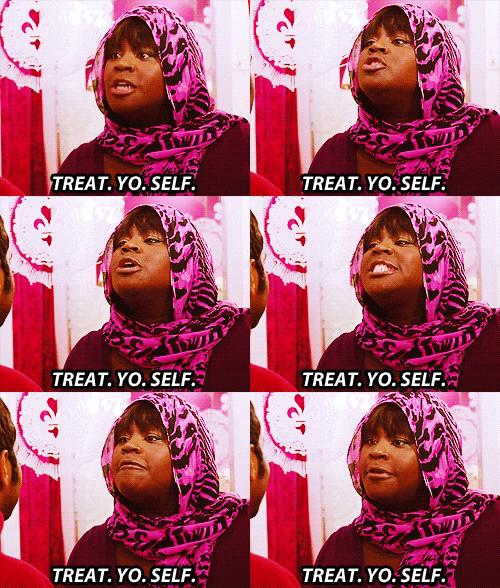
Parasite was just about perfect in every conceivable way, and its amazing score is no exception. Like the film itself, there's not much I can say about it except, if you haven't experienced it yet for yourself, then it's time to treat yo' self.
2. Little Women (Alexandre Desplat)
Desplat has consistently turned in some of the best scores in film the past few years, and his work on Little Women is no exception. It has the feel of a classical hollywood soundtrack, with its broad, sweeping orchestral sound. It has an energy and a jump and a joi de vivre to it, not unlike the irrepressible souls of the titular women we see grow up over the course of the film. Little Women as a whole was another soaring height in the careers of Greta Gerwig and her cast, and the same can be said for Desplat and his music.
1. How To Train Your Dragon 3: The Hidden World (John Powell)
Last time around to give this franchise the praise it's long deserved, particularly the singularly astounding music provided to each film by John Powell. Listening to each film's score makes me think of times and places lost to history, tinted nostalgic memories that call to me, but that can never be fully re-created. At its height, this is that rare breed of music that makes me physically feel like I am soaring over the clouds, though my feet be firmly on the ground. The movies themselves are fun and funny, but Powell's is on another level entirely. This is the sort of artistic creation human yearning is made of.