Saturday, November 28, 2020

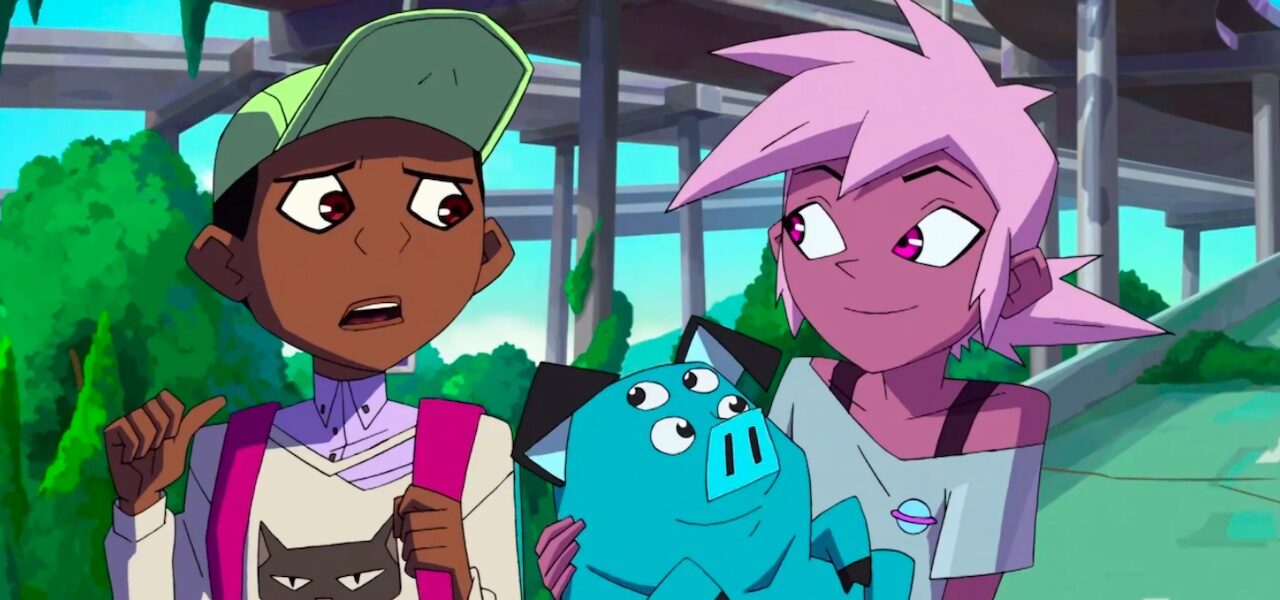
The Cincinnatus Trap: Kipo, Steven Universe, and the Necessity of Power


**the following articles contains some spoilers for Kipo and Steven Universe**

               Recently, I sat down and watched all three seasons of Kipo and the Age of Wonderbeasts, one of the few unabashedly good things to come out of 2020. A new animated series created by Radford Sechrist and based off his own webcomic of the same name, the show is the latest team-up of Netflix and Dreamworks following the massive (and wholly earned) success of the She-Ra reboot. It is also, alongside She-Ra and other recent works like The Dragon Prince (also Netflix) and Steven Universe (Cartoon Network), part of a refreshing trend of American animation breaking all sorts of glass ceilings by featuring significant numbers of characters who are non-white, queer, disabled, or some combination of the three. All else aside, the mere fact that these years have been truly groundbreaking in terms of broader represenation in children's television is a joy to behold.

               Most of these franchises wander the realms of sci-fi and fantasy (and often blend the two), but Kipo is a solidly Earth-bound, post-apocalyptic tale. It is several hundred years after the present and an unknown event (or events) in the past led to mutations among many of Earth's animals, with many species developing cognitive, speech, and motor abilities to match humans. All of these newly evolved creatures are referred to as Mutes. The grandest examples, like massive dogs, monkeys, or bunnies the size of large buildings, are dubbed "Mega Mutes." We learn quickly that, as a result of these mutations, humans long ago ceased to dominate the planet; while some still live on the surface in isolated patches, most were eventually driven to create hidden cities underground to survive in, dubbed "burrows".

               The main character, Kipo, is one of these "burrow people" who is swept out to the surface in an accident of some kind, forced to try and fend for herself in a hostile world she's never before experienced, and as a result picks up a crew of other main characters who agree to help her find her people again. However, Kipo is not just a typical girl and by no means as defenseless as she first feared; we learn in bits and pieces that her parents, as part of their scientific experiments, combined Kipo's DNA with Mute DNA, giving her incredible physical powers and even the ability to transform into a giant, hot-pink jaguar.

               This sets up Kipo's very existence as a key part in determining whether or not humans can leave the burrows and coexist peacefully with the Mutes on the surface, which defines the overall narrative arc of the show. It also means that Kipo has a number of special powers and attributes about her that give her a leg up on the show's villains; the first villain, a Mute Mandrill called Scarlemagne who seeks to dominate humans the way they once dominated animals, has special pheremones that allow him to basically control minds, but Kipo, given her uniquely-mixed DNA, is unaffected. The second, Dr. Emilia, a human scientist who seeks a "cure" she can use to eliminate all Mutes, does in fact develop an effective drug in the final season, but here again, because she relied on Kipo's genetic information to create it, Kipo is the one Mute immune to its effects.

               These are attributes unique to Kipo that, ultimately, she only has by chance; she herself did no special training or uncovered some new secret to give her these abilities. She simply has them by virtue of her existence. And in both cases, these repeatedly allow her to overcome or avoid dangers and obstacles that would otherwise have derailed the plot and allowed the villains easy victories. Scarlemagne gets a chance fairly quickly to douse Kipo with his pheremones; if she hadn't been immune, game over man. Similar story with the vaccine; her massive size in Mega Mute form makes her an easy target for bows shooting the vaccine, but she's also immune, so here too, a major risk is immediately avoided. In more than one instance she literally uses her body as a shield to prevent other Mutes from being "cured."

               Now granted, this is nothing new. Fantastical stories almost always rely on some sort of special characteristic of its hero (or heroes) that give them a way to triumph over evil. What I find fascinating is how this intersects with how Kipo is framed as, basically, an über-pacifist. She has incredible strength, but is genuinely reluctant to use it to fight, even when she has a clear opening to take down or eliminate an opponent. She only resorts to direct violence when repeatedly forced to. Otherwise, her character is defined by an overwhelming earnestness and a very pure-of-heart desire to create a society of perfect peace, where none of the old conflicts and rivalries between humans and Mutes remain. The show even has a scene commenting directly on this, where one character asks in confusion who could ever be gifted such power and NOT want to use to gain even more power. To which the others simply pause a moment before lowering their heads and saying, in a bemused tone, "Kipo..."

               Steven in Steven Universe operates in a similar vein. Steven has a whole slew of powers he inherits from his mother, including flight, super-strength, a shield and sword, and saliva that can literally heal the Earth itself. Plus, like Kipo, his mixed human-non-human heritage brings its own special sets of abilities beyond what either a regular human or typical Gem can accomplish. And yet, here too, though he could focus on developing into a fighter of incredible ability, his character is consistent in seeking to avoid, prevent, or refuse violent conflict as much as possible. Like with Kipo, he does ultimately succeed, but here too this is in no small part aided by the fact that Steven has a number of unique abilities on hand that give him a leg up on avoiding or defeating the schemes of the show's various villains.

               What I find interesting about instances like this is how the narrative and the presentation of the main characters intersects with their special powers. The framing in both shows is that Kipo and Steven are genuine heroes, whose goals and motivations are good things worth fighting for, and both shows ultimately end with the character achieving their desired ends. There is, in the end, no real subversion within either show to suggest that the characters are ignorant or naive, or that blindlessly pursuing the peaceful solution in EVERY instance doesn't carry some real dangers.

               Now obviously the salient reason this is the case is the simple fact that these are shows aimed primarily at children (and, full disclosure, I myself am about 6 years old at heart). There are plenty of more adult-oriented takes on this sort of material that make deeper use of nuance, complexity, subversion, and even cynicism to great effect. A product designed mainly for kids will usually be more straightforward.

               Which is fine! These are two great, well-made shows that have great lessons for kids to teach and a lot of artistic talent to appreciate. I simply can't help but ask myself the question- what happens when you take away the special powers of the main characters? What if you take the exact same approach used to achieve peace in the show and try to implement it in our world, where no one has the power to literally shield the bodies of the dispossessed, and global warming can't be mediated by kisses?

               It is an old quandary and one that I don't have an answer for, at least not in this short article, but it is something important to consider even while we celebrate great stories like these; how do we take inspiration from characters like Kipo and Steven and make it real in our world? The principle of disdaining power for its own sake, for being aware of its ability to corrupt, and to cultivate kindness, compassion, and tolerance in its place, are all great values worth teaching to kids. But even in the stories where our heroes win in unambiguous fashion, we can't seem to avoid enabling their victories, in part, by assuming that a) the good guys are able to access physical power inaccessible to others, and b) they are pure and good enough that we never worry about them one day abusing it. And I wonder- is there a danger in letting kids believe in that sort of thinking in their formative years? Does that set them up to be more passive in the face of injustice as adults? Or are my concerns unfounded, and is the opposite more likely to happen- that kids raised on these shows are more likely to see them as inspiration for fighting for tolerance and peace in our own world, and less likely to worry about the contradictions inherent in ideas like super powers?

               Maybe this worry is only a demon of my own mind and 2020 has finally driven me insane. But I do feel the question is worth considering.

-Noah Franc

Sunday, November 8, 2020

Star Wars, Duel of the Fates: Chapter Six- The Reckoning

 **for previous chapters, please refer to the Table of Contents***

               Something was very wrong. Kylo Ren slammed his fist into the side of ship in furious irritation. He was surrounded by the shredded, used-up bits and pieces of just about every type of medical supply he'd packed in his ship. Nothing had worked. The wounds in his face and side remained open, raw, and weeping.

               Even though he quickly remembered the way back out of the valley, everything from his injuries, to the steepness of the slope, to the loose and crumbly nature of the rocks and soil beneath his feet had made the return up to his ship feel immeasurably longer than his descent.

               The gashes themselves left by the shadow attacks burned as if he'd been lit on fire, and it had sure felt like he'd been torn through when they hit him, but in spite of all that, cuts did not appear to be terribly deep. The bleeding was a constant trickle, but blood loss never overwhelming enough that he wasn't able to keep moving.

               This apparent shallowness, however, made it all the stranger that they simply were not healing; despite the time it had taken him to return to the ship, in no part of any of the cuts had any clotting or scabbing began. The sense of bloody rawness, the ever-steady dripping of his life force, stayed at the same level the entire time, as if the wounds contained some strange poison that held back the ability of his body to mend itself.

               After finally making it back up to his ship, he'd immediately pulled out every med pack he'd had on board and starting applying anything, everything, to the wounds. Bandages or gauze of every sort blackened and dried up, and any liquids he tried to apply to disinfect the wounds and clean them of the red dust caked into them turned to hissing steam. This was no passive poison; whatever had attacked Ren was still shadowing him, malevolently refusing to let him heal. Sheer determination and strength of will had kept him going, but he knew that his body would give out eventually if he didn't get some answers.

               And that meant he needed Palpatine to explain to him what sort of sadistic trap he'd led Ren into. Treachery is the way of the Sith.

               Steadying himself once more, the stone in his left hand and his lightsaber in his right, he once more stepped out towards the ruined temple, walking back under the yawning scars that made up the remainder of its doorframe and roof.

               The holocron still sat, silent and dark, in the center of the room, but once Ren drew closer the lines of starlight appeared again. In moments, the visage of Palpatine, Lord Sidious, was once more before him.

               I see you retreived the necessary material, Kylo Ren, the voice intoned. Well done.

               Ren was about to respond when a fresh throb of pain shot through his face and side. Grimacing, he bit back against it until it began to fade before speaking.

               "And what about these?" he asked, gesturing at the gash on his face. "What was that that attacked me? What sort of power leaves injuries like this, and how can I heal myself?"

               A cruel, almost sarcastic, smile stretched across Sidious' face.  My dear boy, anyone who cannot overcome mere scratches is someone who can never ascend to the Sith mantle.

               "Enough!" Ren could hold back his fury no more. "I came to you asking for help, asking for your blessing and your teachings so as to ensure the Jedi remain dead, and all you do is play your stupid, inane mind games with me, and lure me into a death trap, only for the purpose of finding some blasted crystal!"

               With this, he raised the fist clutching the blasted stone and contemptuously hurled it towards the hodded figure, who remained silent and unmoving.

               "Here. I got your damned crystal, now tell me. How. To. Heal. This."

               With the end of his rampage, a silence even deader than before descended within the chamber. The figure waited a moment longer before it spoke again.

               The true power of the Sith resides in the single-minded will to bend everything in the universe- the Force, the stars, air, water, even individual atoms- to your own ends. If you desire it strongly enough, the hardest of rock must yield to your power. That you fail to see this disappoints me greatly, boy. For a moment, I really did believe you had the spirit of your grandfather within you. I now see I was wrong. Clearly, you will never be another Vader.

               At the moment he spoke that final word, an unmistakable snap-hiss rang out behind Kylo Ren. He turned, and beheld the midnight-black figure of Darth Vader, the hum of the lightsaber blending with the drawn-out, mechanical rumble of his breathing.

               Another Force vision, Ren thought immediately, but like his father earlier, this seemed all too clear and solid to be just a vision. This worrying thought was confirmed when he felt power whirl around the figure and it charged straight at him, a hammer in the Force seeking to pound him into nothingness.

               Giving over to fighting instinct, his own saber lept into his hand, ignited, and with every bit of fading strength he had left he met the charge head-on, the power of their first impact causing the temple remains around them to shake and moan from the tremors that rippled out in the Force from where their blades dug into each other.

               "Are you another ghost from my own head, then?" He spat at the figure through teeth gritted in concentration and pain.

               The robotic voice of his grandfather, that gutteral noise he'd only heard about from others who remembered it with dread, filled the cavernous hall.

               I...am your reckoning. If you cannot embrace the darkness, you will be condemned to it by others. If you cannot fulfill my legacy, then I will cast you down in judgment.

               Ren gritted his teeth. Not here. No way.

               "Try it then, old man," he spat through gritted teeth.

               With a flash they unlocked blades, each swinging an arc over their heads each other at the same moment. Their blades locked once, disenganged once more, and the next minutes were filled with blows and counter blows as each figure poured their rage into each strike.

               Even with his newfound fury feeding him, Ren could still feel the burning in his injuries; even now, in the heat of battle with the figure that had been everything he'd sought to achieve, he could feel his body slowly giving way. One step back from an incoming blow became another as he found himself injecting less and less power into each exchange. Sweat began to pour down his face, mingling with the grime in his wounds and further inflaming the pain that was slowly consuming his consciousness.

               The next blow from Vader he saw coming almost too late to respond to. Ducking beneath the hissing wave of fire, he summoned a burst of energy enough to fling himself backwards to gain enough distance to breath, just for a moment.

               For a second, no one moved, and no one spoke. The slow burn of the lightsabers was the only sound. The figure of Palpatine was motionless and silent.

               Then, the voice of Vader returned; If that is all you are capable of, then you truly are a failure. You can never carry my mantle.

               Ren began to open his mouth to respond, when another voice, from earlier, once again appeared behind him.  "I told you to leave all this be, kid."

               He turned to see the image of his father, once more, standing behind him. For another moment, silence descended. Even the still-activated lightsabers seemed muted. Ren stood between the three figures, the three people whose legacies and histories and desires had been suffocating him since before he had even been conceived.

               Then, something like a whisper brushed at the back of his mind. Turning in the direction he sensed it from, he spotted the red crystal he'd thrown on the floor earlier, still lying where it had fallen. Now, looking closely at it, the dull metallic glow seemed to brighten from within, as if it were carrying its own light. And as he regarded it in the Force, suddenly the worries and rages that had been filling his head this whole time seem to crystallize along the atomic structure of the shard, like it was the long-lost missing piece of a puzzle he'd been struggling his whole life to complete.

               Steadying his breathing, pushing back once more against the pain that still enflamed his left side, he looked back towards his father, one last time.

               "I already told you. I'm not like you or Leia. And I never will be."

               He then turned back towards the figure of Vader, still standing with its lightsaber in a guarded position.

               "And you. You never overcame your weakness. In the end, you let love bring you down. I won't make the same mistake."

               And then, taken over by an instinct he only dimply understood, he reached, deep into the Dark Side of the Force, and held his hand out towards the shard on the ground. With a screaming noise, it light up like a supernove and disintegrated into a stream of molten, red liquid that rushed in an arc through the air, striking into the gashes in Ren's side and face, burning away the dust, the blood, the poison that threatened to set in. In a searing moment, the open, bleeding, red injuries turned into black scars running up and down his body. Finally, Ren felt his body knit together, whole and in command of his full power once more. Refocusing within himself, the pain that had dogged him slowly fading to a dull, distant ache, he turned back towards Vader. The image of his father had vanished entirely.

               "Now," he said, his voice filled with the confidence of purpose he'd been seeking for so long, "you were saying something about being my reckoning."

               Without waiting for a response, he raised his saber, drew the Force about him like a black shield, and hurled himself towards Vader. With renewed vigor he struck into the mechanical shadow. This time, it was his pace that defined the blows, with Vader slowly finding himself forced back a step or two with each exchange.

               A counterblow came from Vader's upper left side, driving towards Ren's right shoulder. Seeing the sequence coming as in slow motion, he leaned into the strike to stop it. Bringing his blade up from beneath, he caught the top of Vader's hilt, right beneath the blade, with one of the guard parts of his own saber. In an instant, the blade vanished, as if it had never existed. The figure of Vader before him suddenly seemed smaller, dimished, weak, both physically and within the Force.

               Triumphantly, Ren grinned, "I did want your mantle for myself. Yes.....for so long, I wanted that."  He paused for a moment, reflecting on everything that had led him to this moment.  "But not anymore. Who cares about your mantle. You're dead. I will create my own legacy."

               With that, he raised his saber to strike a final blow, but in an instant, the figure of Vader hd vanished, leaving Ren staring at empty space.

               Behind him, at long last, the figure stirred.

               Excellent, boy. Most excellent.

               Ren turned around to face the holocron again, seeing a greedy smile beginning to form on Sidious' face.

               This was your ultimate test. I admit I doubted, but you have indeed shown your mettle. You will not be stopped. You will bend the elements themselves to your desires. You will strike anyone down; even your own blood.

               The yellow eyes seemed to glow with increasing fervor, making the image seem nearly alive.

               Yes, Kylo Ren. I believe you have the makings of a Sith Lord within you after all. Take one hour in your ship to rest your body and recover from your trials. After that, we shall begin.

Tuesday, October 27, 2020

Films for the Trump Years, Part 19: Totally Under Control


               At the moment I write this, total confirmed cases of COVID-19 in the US have surpassed 8.5 million, with over 220,000 dead. Both numbers, almost certainly undercounts, are set to increase even more in the coming weeks and months, as the latest numbers indicate that much of the US is about to experience a third wave of infection. By every conceivable metric, both in raw numbers and in rates of infection and death, the United States is far and away the worst-affected nation on Earth from the pandemic to date. The only countries that are anywhere close to matching the US in their failure to contain the virus, places like India, Brazil, or Russia, are not world-leading economies or global superpowers, but rather nations that are far poorer, less developed, or suffering under their own forms of tinpot autocracy or populist nationalism. In the most terrible of ways, the United States stands entirely alone.

               And it was all a choice.

               We can't afford to let ourselves be distracted from this simple fact; what we have spent the past year collectively witnessing is nothing less than the greatest domestic failure of a single administration in the history of the United States. Things like slavery, Native American genocide, and systematic racial and religious discrimination are obviously far deeper ingrained in American society, but these are generational sins that centuries of Americans of every political or religious affiliation bear responsibility for. Singular catastrophes like the Great Depression and the Secession Crisis and subsequent Civil War were aggravated by the actions or inactions of individual Presidents, but the causes of both ran far too deep to be laid on the solitary shoulders of James Buchanan or Herbert Hoover.

               No, COVID pandemic is on another plane entirely. Never before has a travesty on this scale occurred in the United States; where an entire political party, both at the federal level and in the states where it holds power, has so thoroughly and completely given up on taking any measures to protect any of its citizens from a specific threat. The entire country has been laid open for the virus to ravage when and where it can. And even though marginalized communities are obviously hit the hardest by this, no one can truly escape it. We will all bear the consequences of this failure for decades, and in many cases, lifetimes.

               As great as the dangers of the coronavirus are, we have learned enough to know that it is not some instoppable, immutable Black Death; we have the knowledge and the technology and, especially in the US, the money and resources to limit its damage. The weight of a pandemic would be a hard fight with real costs no matter what, but we have seen where and how sound government was able to stave off the worst. At no point did it have to be this way. The horror stories of hospitals overwhelmed, with doctors and nurses suffering PTSD from having to work punishing, life-threatening shifts and holding phones out to dying patients so that they can at least talk to, if not see, their families. The economic devastation of industries and stores and jobs being abandoned with absolutely no safety net big enough to save our poorest from deprivation and suffering. The lives that are now lost forever, surviving families and friends scarred and traumatized by sudden death. The survivors, who may very well suffer a lifetime of after-effects, all of which will cost money to treat, limit their ability to work and live and enjoy life, and who will carry all the pschological effects that this entails. The simple ability to enjoy a hug with someone you care about it, gone for the forseeable future.

               All of it was a choice.

               The fact that this is all still ongoing, and will heavily affect our daily lives for some time, means that there are still so many horrors we will have to endure and so many terrible truths left to be uncovered. But what counts the most, we already know; President Trump, Vice President Pence, and all of the most important leading figures within the Republican Party knew, almost from the start, that this disease was a serious threat that would harm lives. And they chose to not only do nothing to prepare, they have continued to actively oppose and hinder any form of effective, unified response to the virus. At the end of the day, nothing else matters. Nothing else we learn can alter or excuse this utterly heinous and evil dereliction of duty.

               And thanks to directors Alex Gibney, Ophelia Harutyunyan, and Suzanne Hillinger, we already have a first effort to capture at least some sense of the scale of this disaster. It's taken until Part 19, but this series now officially features a film literally made for and about the Trump years. Made under unique circumstances (the film touches a little bit on the technical challenges of filming under COVID and how the crew worked around them), the movie is primarily a collection of direct interviews with doctors and officials of various stripes that were involved in either federal or private efforts to track the spread of the disease and coordinate a response to it.

               As such, it's not a film that tries anything adventerous in its filmmaking or narration. It is barebones and straightforward and laser-focused on presenting a clear timeline of much of 2020 to date, tracking when what was known and the first key moments where the best chances at containment within the United States were irrevocably mishandled or ignored. It is one of the year's most infuriating and essential films.

               Perhaps what made me the angriest watching this film was to reflect on how, even after all this, so many of us still haven't learned a damn thing. That it took a tragedy of this magnitude to throw Trump off what so many assumed would be a waltz to reelection is sickening enough, but even after a quarter of a million dead, he will still get at least 40% percent of the vote in next week's election no matter what. I've been referring to the GOP and all of American conservatism as a death cult for some time now (and have taken some flak for it), but even I am utterly flabbergasted at just how enthusiastically so much of the country has leaned in to it.

               The film throws in a single credit right at the end mentioning that Trump tested positive for COVID mere days after they finished production, an almost ironic admission on the part of the filmmakers that events have long ago outstripped their capacity to convey the entirety of this mess within a single film. Honestly, no one book or movie or show can bear such a weight on its own. But this movie is a start. It is a first, significant public record of the greatest failure of government in American history, a warning of what is to come if we don't salvage and fix what is left in time to address other, even bigger challenges looming ahead like climate change.

               Hundreds of thousands have died.  Millions have gotten sick. Tens of millions of lives have been irrevocably thrown off course and out of balance in the fallout. And it was all a deliberate, conscious choice, made collectively by the Republican Party.

               I will never forget it. I will never forgive it. And neither should you.

-Noah Franc


Previously on Films for the Trump Years:

Part 1- Selma

Part 2- Good Night, and Good Luck

Part 3- 13th

Part 4- Get Out

Part 5- Chasing Ice/Chasing Coral

Part 6- The Big Short

Part 7- Human Flow

Part 8- Moonlight/Winter's Bone

Part 9- Black Panther

Part 10- Arrested Development

Part 11- Bowling for Columbine

Part 12- [T]error

Part 13- Angels in America

Part 14- Do The Right Thing

Part 15- All The President's Men

Part 16- Ken Burns' The Vietnam War

Part 17- Malcolm X

Part 18- Songs My Brothers Taught Me

Thursday, September 24, 2020

Review: Matthias & Maxime

Matthias & Maxime (2020): Written and directed by Xavier Dolan. Starring: Xavier Dolan, Gabriel D'Almeida Freitas, Pier-Luc Funk, Samuel Gauthier, Antoine Pilon, and Anne Dorval. Running Time: 119 minutes.

Rating: 3.5/4


               At its barest level, Matthias & Maxime is a romance story that follows familiar, well-worn beats; two characters insist that their relationship is platonic, but then a plot happenstance leads to a kiss that upends everything they thought they knew about each other, creating the will-they-won't-they dynamic that drives the rest of the story. And while this suffices as a one-sentence summary of the narrative structure of the film, it doesn't come anywhere close to capturing what makes this latest work by Canadian Wunderkind Xavier Dolan rise far beyond its parts into a sweet, effortlessly engaging experience that strikes a powerful balance between being funny, heartbreaking, sad, and joyous.

               Matthias (Gabriel Freitas) and Maxime (Dolan himself) are part of a clique of intensely close friends, all young adult men that have basically spent their whole lives together in this one, small town in Quebec. They grew up together, went to the same schools, graduated, and are all currently in varying early stages of their respective careers, but their weeks still revolve around regular get-togethers where they drink, smoke, eat, shoot the shit, and basically act as if time and the wider world can never touch them. It's an unspoken attitude of defiance that is part and parcel of youth, but that first inevitable wrinkle of getting older has already appeared; as the film starts, Maxime is waiting for a few things to be sorted out before he will leave for Australia for, at least, two years.

               At first this doesn't seem like something anyone is really bothered by, but then another wrinkle is thrown into the mix; the younger sister of one of the gang, a film student, tags along to one of the parties insisting that two of the guys fill in for a movie project of hers. Without thinking much about it, Maxime volunteers and Matthias is cajoled into joining him before either of them are told what they will have to do; make out on camera.

               The tension this creates has more to do with the insistance of both men that they're "just friends" than it does with either man's sexual identity. All of the guys in the group seem to be either gay or at least bisexual. Matthias himself currently has a girlfriend, but she exhibits no shock or surprise later on when she hears about the kiss, so this is not a coming-out movie about Matthias suddenly discovering he's gay. Nonetheless, he is clearly unsettled afterwards, as conveyed by a very on-the-nose swimming sequence he has the following morning. Things only get worse as the days until Maxime's flight tick down and his final departure approaches. Parties, dinners, final get-togethers, and gift-givings are planned, but Matthias becomes increasingly surly and withdrawn, until the point comes where he's barely able to look at Maxime or even be in the same room with him. Clearly, something has to give.

               Part of what keeps the experience of watching the film constantly engaging is the mixing up of editing styles, types of cameras, and framing to reflect the mood or feeling of a particular scene. All the sequences involving parties have a frenetic energy to them, as the editing speeds up to make hours go by in seconds. Moments like these effectively capture the sensation of these moments when you are young and having a wild time with good friends; specific details of what was done and said tend to blur together afterwards and become irrelevant. What matters is the sensation, or memory, of having been there.

               That said, the quieter or more introspective moments are not forgotten. The film finds all sorts of ways to mix sights, sounds, and music to great effect, not least of all in the aforementioned early-morning swim. One inspired shot early on of the two characters side-by-side comes from outside the house they are in; the only lit part of the image is their profiles within a tall, narrow window frame, and the rest of the screen is black.

               The cast is game too, with each member of the gang finding ways to stand out and be memorable in roles that could otherwise easily end up fading into the background. The relationships between each of them feel so real and intimate that I would almost swear Dolan wasn't even making a film, just sticking up cameras to make videos of him and his buddies that he later decided to make a movie with.

               If there is one major weak spot, it's that the female roles end up ill-defined or forgotten in most cases. This is something that many have noted in other Dolan films, and here too, the almost casual dismissal of where Matthias' girlfriend stands to be affected by the potential of her boyfriend leaving her for a man is a frustrating limitation to the film's otherwise remarkable emotional depth. The mothers of the group are all framed as being almost frighteningly twee, Maxime's mother is given no redeeming qualities whatsoever, and the film reacts to the aggressive "cool" and rapid-fire slang of the filmmaking younger sister with something approaching horror. The lone exception is Matthias' mother, who seems to have a relatively deep connection to Maxime, appears especially emotional over his departing, and may even suspect more than the others what is going on between Maxime and her son.

               Where the film is at its strongest is how well it establishes characters, history, arcs, and motivations with an absolute minimum of exposition. We learn very little concrete details about the character's pasts, but a great amount can be gleaned in bits and pieces of the dialogue, which throws out references, old jokes, and calls back past stories in an entirely natural way. No one monologues with their own family about everything that led to a given moment; rather, we constantly reveal little pieces of ourseves in casual conversations, an endless litany of "Remember Whens," ""That Time She," and "He Used Tos." Few films are able to capture and optimize on this dynamiy as effectively as Matthias & Maxime. The scenes where the film hits its greatest highs often hinge very explicitly on what is not said, rather than any line from the script.

               This is a movie that reflects on the passage of time and will get viewers thinking about their own nostalgia, the ways their lives have changed from what they once hoped and thought was possible. It suggests that time can indeed be wasted or pass us by, but also holds the potential to be salvaged at the right moment and with the right choice. What that right choice is, like with our two lead characters, is up to each of us.

-Noah Franc

Saturday, September 12, 2020

Star Wars, Duel of the Fates: Chapter Five- The Revelation

**For previous chapters, refer to the Table of Contents**

               Poe contemplated his hand a moment longer before nodding back at Finn.

               "Ok, you're up, buddy."

               Finn considered his own hand, then moved two more tokens from his pile towards the pot at the side of the table. Upping the bet yet again.

               "Alright, alright, playing dangerous" Poe muttered challengingly, speaking with the tone he would use if they were playing at a real sabacc table at a proper Corellian gambling joint, with actual money and genuine stakes at play.

               If only, Poe thought to himself in exapseration for probably the hundredth time, Stars, if only.

               Try as he might, Poe just could not get himself to adjust to the overwhelming lack of action that now pervaded their daily lives. He was a man constitutionally incapable of sitting still for too long before getting real antsy. With so little capacity left to communicate and move between worlds, the rebels had to limit flights and missions as much as possible to avoid detection. Even around Talrezan Four itself, Leia had decided to limit recon flights to the bare minimum, just in case First Order ships appeared in the system at the wrong time.

               The end result was a far more sedentary routine than Poe had ever known before. Even in the darkest days of the earlier rebellion, there was always some mission that needed doing, and he was always the first to jump at the chance to do them. Now, real activity was few and far between. Kuat had been the rare exception, and even though the mission ultimately went sideways by the end, Poe had relished the chance to be doing something again, to at leasy try and get the Rebellion back on solid ground. Since then, though, it had been back to days upon days at base camp, with no idea what would come next.

               Not that he didn't understand why Leia was being so careful. He'd learned the hard way the price of rashness, and with the Rebellion as strung out as it was now, any mistake on their part really could mean their end. Poe would rather die than let that happen.

               Didn't mean he had to like being grounded like this, though, and boy, did he not like it. He and Finn had, by now, resorted to coming up with about 50 of their own varieties of sabacc to try and kill time, inventing ever-more elaborite systems of betting money and riches they most definitely did not possess to give themselves a reason to play.

               If he didn't have Finn, or Rose, or Rey around to connect with like this, Poe thought, he would have gone completely insane by this point.

               After considering whether or not he wanted to risk pulling another card, Poe decided against it.

               "Alright, show hands," he said, laying down his cards; he had 21, nearly a perfect sabacc hand.

               Finn smiled and laid his down in response; 22.

               "Damn," Poe smiled, as Finn swept the "pot" towards his side, "got me again. How'd you get so good at this anyway? Until I taught you you'd never played this before."

               "Dunno," Finn replied sheepishly, clearly letting himself bask a bit. "Sixth sense, I guess."

               "At the sabacc table again, eh?" A warm, chuckling voice came up behind Poe. He turned around to see Lando Calrissian, beaming with that usual nuclear-powered smile of his.

               "Hey General. Yes sir. Gotta kill time somehow."

               "Care if I join you?"

               Poe laughed a bit, "With all due respect, General, we know your reputation. I don't think Finn and I would stand much of a chance."

               Lando beamed again and winked, "Yeah, you're probably right. Anyway, once you fellas are done, Leia would like a word. Any of you seen Rey today?"

               Poe shook his head no. "Not yet. Finn?"

               He shook his head too. "Me neither. Should I go look for her?"

               "Let's both look," Poe responded, gathering his deck back up, "I need to stretch my legs before they turn to stone."


               Rey was, at that moment, sitting cross-legged in her training glade, flipping through another of the crinkled Jedi books she'd brought with her from Ahch-To.

               Somewhere along the line this had become part of her morning routine; taking one of the tombs and flipping through at random, stopping every so often to read a brief passage here or there, to see if something caught her attention that could further her training and knowledge of the Force. Some days, she'd had moments of real inspiration, finding a new exercise to expand her skills, or a description of the powers of the Force that let her feel a sense of accomplishment, like she was actually making good on her promise to Luke to carry on with the Jedi order. Her discovery of the passages about lightsaber construction had been a particular high point.

               Those days, sadly, were few and far between, and she'd not had a single one of them since Kuat. It had been over a month now, Luke had not reappeared since their last (rather testy) conversation, and Rey once again felt like she was floundering in a sea of unknown depth and size, with no indication in which direction she should start swimming.

               It didn't help that the pages she was landing on today were proving especially, almost annoyingly unhelpful.

               In considereth of the boundless natures of the Force, the Jedi shall knoweth all the most sacred sacraments of the said nature of living organisms-

               Ugh. Nothing made clear the sheer age of these things like their very wordy, very old-fashioned style. Next. Flip.

               The edible plants to be utilized most in the gardens of the Jedi temple that shall yieldeth the caloric variety necessary-

               Old Jedi diet rules. Riveting. Flip.

               The younglings, upon rising with the first sunlight, are to be brought before breaking fast to-

               Youngling training guidelines. Also extremely not helpful. Flip.

               In this lower chamber resideth the Jedi Force beacon, with which the whole of the galaxy may be called-

               Maybe she should give Luke's first journal another go-

               Hang on, Rey thought suddenly, her hand frozen in the process of turning the page yet again, was that....

               Looking at the page she'd been about to lose track of with new intensity, she scanned it from the top before finding the passage she'd just read:

               In this lower chamber of the sacred Temple resideth the Jedi Force Beacon, with which the whole of the galaxy may be called for the defending of Coruscant and the Temple from the most graveth of threats. Through the Force, the whole galaxy and all life is forever boundeth. Thus, the first Jedi Council determined a method by which, within the Force, a summons may be transmitted instantly to every known corner of civilization. Utilizing the structure of the Temple itself, built to focus the Force within....

               What followed after, Rey confirmed with a quick scan, was a technical guide to this device, its construction, and instructions for its use; a remarkably old piece of technology that seemed to be specially designed to be a conduit for the Force to send a message on a unique quantum wavelength that would almost instantly reach the farthest parts of the galaxy.

               By all the stars, Rey thought, a slow, warm, feeling of euphoria beginning to wind its way through her body, this is it. A unique beacon in the depths of the Jedi Temple, capable, it seemed, of sending out a signal that First Order tech would not be able to jam quickly, if at all, a call to all potential friends and allies throughout the galaxy that everyone, this time, would definitely hear.

               If there was some way- any way- to pull off finding and using such a device, they could gather enough strength to retake Coruscant, maybe all of the Core Systems. That, surely, would send the First Order reeling, and the Rebellion could once again take the offensive.

               The only question was, how to even begin planning something this complex-

               "Rey? Hey, Rey!"

               Shaken from her thoughts quite suddenly, Rey turned to see Poe approaching her from the pathway, Finn close behind.

               "Thought you might be here. Lando told us that..."

               His voice trailed off as he noted the expression on her face, one that, Rey assumed, was of pretty obvious shock.

               "Rey, are you okay?"

               Slowly, Rey nodded, a grin starting to make its way up her face.

               "Yes. I think...I might finally have an idea."


               "The whole galaxy? Really? You're absolutely sure?" This sounded so good, too good, that Finn was almost afraid to believe his own ears.

               "That's what it says. I know this is our key. I can feel it." Rey looked over at Lando and Rose, sitting side-by-side and examining the page with the schematics of the beacon with looks of intense concentration. She turned towards Leia, who was yet to say a word. "Gen- Leia. What do you think?"

               Leia sat in chair with an almost nostalgic look on her face, one hand slowly rubbing her lower lip.

               After another moment, she spoke:

               "I remember....Luke told me about this, once, after he'd explored the Jedi Temple for the first time. He'd heard of it too and wanted to see it for himself. I don't know if he ever found it though. Lando, do you think it could really work?"

               Lando looked up finally from the book, while Rose continued to scan it. "It looks legit. Real old tech, sure, but if no one's messed with it it should still work."

               "Hm," Leia's mouth tightened, "how many crewable combat ships do we have right now?"

               "Enough to start a scrap. But we sure as hell don't have enough to finish one. Not without help."

               "Well, that's where hope will have to come in, I suppose."

               "General," Poe spoke up, "look, to be frank, we don't have much left to lose. Sabatoge missions aren't getting us anywhere, and as long as we don't have a way around First Order jamming, there's nothing big we can do anyway. If there's even the slightest chance this can work, we gotta take it."

               "But..." Finn, over his shock, could finally speak again, "what about Kylo Ren? He might not know about the beacon, but if he'll probably be on Coruscant anyway. Or at least his Knights will be."

               Rey nodded, "I know. But," here she glanced back at Leia with a worried look in her eyes, "I...assumed that from the start. One way or another, I'm going to have face him. There's no other way this can end."

               She turned fully to Leia now her voice dropping down almost to a whisper, "I'm sorry."

               Leia was silent for a moment more. Everyone present could feel the weight of the moment through her stillness. Then, she smiled, gentle and loving.

               "Don't be, Rey. I agree. This is the path we're on and we have to see it to the end. One way or another, this is it. We either succeed, or this will be the Rebellion's final stand." She looked at Rey with an expression that contained worlds. "I can feel it."

               Rey nodded slowly, "So can I."

               Finn felt a familiar trickle of worry run down his throat. That hidden, tickling sensation he'd spoken about with Rose before was still running around the back of his mind, and he still had no idea why or what he should do about it. He was with everyone here, to the death, but he would give anything to feel at least a modicum of assuredness that all these people he loved so dearly would make through okay.

               "Alright then," Leia was speaking again, and Finn snapped back to the present. "How do we go about this? We need a small team to infiltrate the planet the first and activate the beacon, then have a plan to coordinate and organize anyone who responds. Rey, you are going to have lead the ground team, there's no question about that. Who else should join you?"

               Rey smiled, "My friends. Finn, Rose, and Poe. I wouldn't trust my life to anyone else." The confidence in her voice allowed the concern in Finn's heart to loosen, just a bit. Damn right, he thought.

               Poe clapped his hands, clearly pumped at the idea, "Alright! So! How soon can we head out?"

               "Hold on, flyboy," Leia said, rather winkingly, "Rey's idea is fine, but my only overriding order is that you stay with the fleet. You're still my best pilot. We're bound to be outnumbered, at least at first, and our best hope lies in having every Poe and Lando and Chewie who can fly out until help arrives."

               Poe looked as if, instead of being given an order, Leia hat just smacked him across the face. Rey stood silently for a moment, then spoke up again.

               "Well, what if he flies us down into Coruscant airspace? We'll need to have someone smuggle us down anyway to avoid detection. Poe can pose as a shipper of some sort and let us off. It'll probably take us awhile to get into the Temple and find the beacon anyway. Plenty of time for him to fly offworld again and rejoin the rest of the fleet."

               Leia considered this for a moment. "I think I can live with that. Poe?"

               Poe thought a moment, then nodded. "Yeah. Anyone can get them onworld safely it's me, and I wouldn't miss a final battle with the First Order for the whole galaxy."

               He then turned to Rey, "But take BB8 with you- he'll have orders from me personally to keep an eye on you guys."

               Rey was about to smile when a tweedle-wheee sound came from behind Poe and the little droid itself came rolling in, almost as if on cue.

               Rey couldn't help herself but laugh. "Alright. But what about you? Doesn't BB8 fly all your missions with you?"

               "Yeah," Poe responded, "but this time I could fly out with R2. He's just as creative in a pinch, right buddy?" He glanced down at BB8.

               Whistling a decidedly affirmative sound, BB8 wiggled its head back and forth in a "yes" motion that was astoundingly human-like.

               "It's settled, then," said Leia, taking the conversation back over, "Poe will land the ground team and rejoin Lando, Chewie, the Falcon, and every ship we have at a pre-settled rendesvous point. Rey, if you can get the device working, your message will be for all friends and allies of the Rebellion and of freedom to head straight for Coruscant. Once that's done, we'll move in to kick-start the battle."

               "Lando," she then turned to the last of her old friends, "you and Poe have until tomorrow morning to settle on coordinates and relay them to the rest of the fleet. After that, Poe will head out with the ground team."

               "Ay-yay, general," Lando replied, his face already filling with swaggering confidence.

               Leia turned back to the rest of the group, looking at everyone's face in turn. No one said anything, waiting on her. "That's the plan, then. You have your orders. It's now or never."

               "May the Force be with us all, one last time."

Sunday, September 6, 2020

In Memoriam: Chadwick Boseman (1976-2020)


                Last month, in an announcement that shocked and stunned the world, Chadwick Boseman's family revealed that the beloved actor had been fighting advanced colon cancer for almost four years, and had now passed away as a result at the obscenely young age of 43. Saying goodbye to an icon is never easy, but it's especially bitter and painful when the icon in question is a young, fully-arrived superstar who should still have a whole life of achievements and accomplishments before them, capped by an extensive and hugely emotional tribute montage at an Oscars ceremony several decades from now. It feels particularly harsh right now, to lose such an incredible advocate for Black artists in the midst of **gestures at all the catastrophes currently being inflicted on minority communities by a Fascistic, racist Death Cult**.

                Chadwick Boseman had a life and career that has been cut far, far too short, but that makes it all the more astounding to realize just how much he managed to pack into his short time with us. Though the number of roles to his name will now remain criminally truncated, he is already assured a deep and enduring legacy. It wasn't for nothing that The Ringer published an article not too long ago saying, only partially in jest, that Boseman had already played (almost) every Black superhero. Attentive moviegoers were introduced to him when he became the man to finally portray Jackie Robinson in 42 and James Brown on Get On Up, both major, well-received biopics, but the world at large learned his name when he first appeared as T'Challa, the Black Panther, the first major Black superhero to head a major studio franchise. As good as he was in Captain America: Civil War (and as good as that movie was in general), that ended up being just a small taste of what he and the world of Black creators he was part of were about to present to the world.

                Black Panther, in the end, went far beyond being just another competently-produced, fun-to-watch comicbook movie. Between Marvel, DC, and their other competitors, the market is thoroughly saturated with those. No, it was something more; it was a genuine cultural moment, forcing everything and everyone else to respond to it going forward. At long last, Ryan Coogler, Chadwick Boseman, and the veritable army of Black artists around them had shown just how amazing and vibrant and beautiful a big-budget film made by Black filmmakers for (primarily) a Black audience could be. It also shattered box office records and remains one of the highest-grossing films of all time, an eternal rebuke to previous, often unspoken assumptions in the film business that "Black movies just don't make money." After Black Panther, there's no going back.

                Again, there is plenty of credit to go around as to why the film turned out so good, not the least of which being Coogler's direction and the sheer power present throughout the entire cast list (All hail Angela Bassett), but I've only recently come to appreciate the importance of Boseman's steady presence in the lead role. It's not a flashy performance, nor even the most noticeable within its own film; Michael B. Jordan's Killmonger and Letitia Wright's Shuri remain my personal favorites, as they steal every moment they spend on camera. Boseman doesn't employ the same kind of more traditional leading-man charisma that Chris Evans or Robert Downey Jr. brought to their superhero films, and I think that many, myself included, tended to downplay his part somewhat at first as a result of this. Revisiting the film now, though (and yes, the fact of his death certainly influenced this) I realized just how carefully the narrative is crafted around very small, easily-missed moments that show T'Challa going through a genuine hero's evolution over the course of the film. He begins with a more simplistic view of his father, of Wakandan tradition, and of his role, and is challenged repeatedly through hard choices and revealed truths in ways that force him to develop a previously-unimaginable new path for himself and his people. To deny Boseman's skill in giving us such a finely-crafted performance is to seriously undercut the artistic power of the film in favor of superficial, "Hey, Killmonger was actually right" hot-takes.

                I had also been unaware until now of how crucial he'd been behind the scenes in either making or advocating for some of the most important creative decisions behind the film's production, not the least of which was an insistance that none of the Wakandan characters would speak with Western accents. I can't even begin to imagine how that decision going the other way might have impacted the final product, but I am absolutely certain that it would have diminished it in a big way.

                I haven't even mentioned the fact that, in the midst of cementing his place within the first generation of the MCU, he also found both the time and the strength to add to his hero-resume by playing Thurgood Marshall in 2017's Marshall, yet another solid biopic film where he finally brought to the big screen a historical Black figure that, all too often, mainstream culture tends to forget about or misremember. It seemed there was no end to his capacity and willingness to push the boundaries of films for and about Black characters and stories.

                Sadly, his body and fate were not in agreement, and he has been taken from us in a cruel and arbitrary manner. I won't try to make a grand statement about what his life will mean going forward- as a White American, this is ultimately not my loss to mourn- but I do feel encouraged by remembering that the work he's done has already had a huge impact on American culture, and that isn't about to go anywhere. Plus, he wasn't the only one drawing a line in the sand and demanding that Black artists finally get their due; Ryan Coogler, Ava DuVernay, Dee Rees, Michael B. Jordan, Lupita Nyong'o, Jordan Peele, and so, so, so many others are still here and still fighting the good fight. So while Boseman may be gone, and his absense does hurt, his flame will live on. Of this, I am sure.

                Wakanda forever.

-Noah Franc

Friday, August 21, 2020

Films for the Trump Years, Part 18: Songs My Brothers Taught Me


               A great deal of this series to date has focused on the Black experience in America, specifically the ongoing legacies of racism and slavery. Given how foundational the genocide of African-American slavery is to the development of this country, one of its two fundamental Original Sins, this is not unreasonable. However, it is equally important for me to make the time to reflect on the legacy of our second Original Sin, the genocide of Native Americans that began with the first arrivals of Columbus and other white explorers, even before the introduction of slavery, and that continues, unchecked, to this day. Persistent poverty and lack of federal funding and support, along with continued efforts to desecrate Native lands with abominations like the Keystone Pipeline, are the most current iterations of this mistreatment, which in turn have directly worsened the effects of crisis like the COVID-19 pandemic, with the Navajo Nation in particular seeing some of the worst infection and mortality rates in the world.

                In large part, my delay in being able to tackle this topic stems from a profound lack of access to proper Native American representation in media; as woefully underrepresented as Black, Hispanic, and Asian-American persons are within the upper ranks of both government and cultural industries, Native American representation is even worse: the list of registered Native Americans who have served in Congress is woefully short, and it was only last year that the first two Native American women were sworn into office. Thought she didn't win her race, in that same election cycle Paulette Jordan in Idaho became the first ever Native American woman to be nominated by a major party for a governorship.

                This invisibility and erasure of Native Americans within American culture and politics extends to film as well, where the most well-known and lauded films with prominent depictions of Native American life tend to be White-oriented affairs like Dances With Wolves or Little Big Man, to say nothing of the looooong history of bigotry within the Western genres. As a result, it is extremely hard to find films made by Native American artists and starring Native American performers, since they never get widespread releases with big studio publicity and are usually not widely available on services like Netflix where most people watch their movies.

                Thankfully, I was finally able to procure access to one of the more highly-regarded Native-America-centered films of recent years, the 2015 directorial debut of Chloé Zhao. Though Zhao herself is Chinese, the film features an all-Native cast and is largely focused on a grounds' eye view of daily life on the Pine Ridge Indian Reservation in South Dakota, home to the Oglala Sioux Tribe.

                Taking place over the course of, perhaps, a few weeks within one of the reservation's towns, the film is essentially a slice-of-life exploration of how the lives of our two main characters, the young siblings Jashuan and John Winters, slowly begin to shift as a result of the death of their father in a fire. Over the course of the funeral and its related scenes, we learn that their father had had a long history of womanizing, regularly divorcing and re-marrying; he apparently had a total of 25 children by 9 different woman, most of whom Jashuan and John seem to have either only previously met in passing, or had never met at all. Slowly, the connections between these half-siblings, with wide age and experience gaps between them all, begin to open up new possibilities for Jashuan and John, both of whom seem to be just wandering through life at the beginning.

                The tragedy that sparks this is entirely random and cruel, mocking any effort to make sense of it. There is no closure, no body to be found. No proof is provided whether or not the fire was an accident or something more sinister. It simply happened, a father is gone, and the dispersed pieces of him left in the form of his many children have to decide for themselves what to make of it all. There will be no moment of clarity, of promise that everything will get better for these people. Just the resolve to keep living.

                It is to the film's credit that these metatextual ways in which the events of the film reflect on the general struggles of Native American communities are never directly referenced. They are simply there for the observant viewer. The land of the reservation itself appears dusty, dry, and very flat, stretching out in all directions. The desolate views are a constant reminder that few of the Tribes that still exist live anywhere near there actual, historical lands; all modern reservations are the remnants of generations upon generations of efforts to deliberately uproot Native communities and force them from one place to another. Not only that, it was also very much intentional that Tribes be removed, forcefully if need be, from any place with valuable resources or good farming land; they were to be shunted off to the barest, bleakest places imaginable, so that any land that offered a perceived bounty could be offered up to white settlers.

                Christianity and alcoholism play hugely important roles in the narrative as well. Jashuan and John's mother talks often of how she is trying to get over drinking by committing herself to the local church, to the point where her oldest child, a full brother to Jashuan and John who is currently serving out a prison sentence, snidely remarks that she better make sure she "doesn't use God as another man to abandon her kids for."

                Alcoholism, like many other diseases, is another legacy of colonialism that still plagues Native communities to this day, where deliberate efforts in the past to spread addiction within Tribes so as to weaken them mirror the same ways other drugs have been used against Black Americans in more recent decades, often in combination with our prison-industrial complex that seeks to use the "justice" system as another tool of oppression. At the beginning of the film, we learn that John already has a bit of a reputation with the police for hustling alcohol between towns, since it's one of the easiest ways for him to make a quick buck. Christianity, too, is something grafted on to tribal existences, as it was forced on Tribe after Tribe through forced conversions and even the kidnapping and indoctrination of Native children, right up into the 20th century.

                And yet, they are still here, and they still live their lives, speak their languages, and endure. That alone is a miracle, but it also needs to be more actively seen and heard and felt amongst the rest of us if we are to finally break the systematic chains that continue to hobble and harm Native American communities. No true realization of justice will be complete until ALL of America's sins are accounted for.

                I assumed at the beginning of the film that the focus would be on Jashuan and her relationship with John and her mother. It quickly becomes clear that this is not the case. Both she and John are in places of deep uncertainty regarding their futures that the death of father only accentuates, and both have lessons to learn from the extended family they reestablish a connection with in the wake of the funeral. Some offer advice gleaned from their more advanced years, some offer money or concrete jobs, but all have something to teach these two about living on the reservation, and about the enduring beauty of their land, their tribe, and above all else their family, that they hadn't truly seen before.

                This is a film of quiet moments and seren beauty, tinged with the sadness of lives and existences that have been made as hard as possible by the callousness of the ghosts of the past. And yet their is a power and a nobility in surviving and making the most of it that cannot be forgotten. Watch more films like these, talk about them, and let's all commit to being truly inclusive in our calls for a better future.

-Noah Franc


Previously on Films for the TrumpYears:

Part 1- Selma

Part 2- Good Night, and Good Luck

Part 3- 13th

Part 4- Get Out

Part 5- Chasing Ice/Chasing Coral

Part 6- The Big Short

Part 7- Human Flow

Part 8- Moonlight/Winter's Bone

Part 9- Black Panther

Part 10- Arrested Development

Part 11- Bowling for Columbine

Part 12- (T)error

Part 13- Angels in America

Part 14- Do The Right Thing

Part 15- All The President's Men

Part 16- Ken Burns' The Vietnam War

Part 17- Malcolm X