Friday, October 9, 2015

Review: The Martian

The Martian (2015): Written by Drew Goddard and directed by Ridley Scott.  Starring: Matt Damon, Jessica Chastain, Kristen Wiig, Jeff Daniels, Michael Pena, Kate Mara, Sean Bean, Sebastian Stan, Aksel Hennie, Chiwetel Ejiofor, and Donald Glover.  Running time: 141 minutes.  Based on the novel of the same name by Andy Weir. 

Rating: 3.5/4


            It’s always frustrating when a great and beloved artist comes out with something far below their usual (or “accepted”) standard.  It’s especially painful when it seems to happen with everything they do for an extended period, one round of disappointment after another.  At the worst of times it can leave erstwhile fans wondering if all the hype was for naught, if someone they admired has already peaked, and maybe wasn’t that great to begin with.  Ridley Scott has been caught in just such a spiral for some time now, with just about every major release of his over the past 5-10 years plagued by repeated production delays and/or constant script rewrites.  In a few cases, Scott seemed to morph into his own worst enemy, looking like he himself was never entirely sure what sort of movie he wanted to actually make. 

            Well, never fear fellow fans, because the Scott is back.  The Martian is easily the best film he has come out with in years, and right up there with some of the best works of 2015 so far, and will most likely walk away with a decent profit margin and a few bits of Oscar gold before all is said and done. 

            It’s just a tad bit into the future, and NASA has advanced enough to actually be able to send a small team to Mars for a brief mission.  However, the rise of a sudden sandstorm forces them to abort ahead of schedule, and the ensuing darkness created by the storm causes them to lose the team botanist, Mark Whitney, played by Matt Damon.  With no choice but to assume the worst, the team heads back weighted with guilt, while the PR people back home break the news to the public. 

            Whitney, however, is not dead, just injured by a satellite that cut the feed from his suit.  Finding himself as abandoned as a human being could possibly be, he almost immediately begins to work on finding some possible way to ensure his survival as long as possible.  I won’t go into all the many pathways this takes, since that would require me to spoil much of the second act, but the gist of the situation is this; he can’t expect another mission to arrive for at least a few years, he doesn’t have any way to contact NASA directly and ask for help (at least at first), and while the tech he has on hand could theoretically keep him breathing and hydrated indefinitely, the remaining foodstuffs he has would barely get him through a single year in isolation, let alone 3 or 4. 

            So he gets to work.  For the sake of future record-keeping, he films himself trying to mash together Martian sand, leftover feces, potato bits, and chemicals to make water so as to be able to grow his own food supply.  Funnily enough, this provides Matt Damon with a ready-made excuse to literally act right into the camera (and thus directly to us), wisecracking about how he’s besting every other accomplished astronaut to date and lamenting the questionable taste in music of his team captain, whose left-behind laptop is the only source of entertainment he has.  It’s the sort of wise-ass leading-man style we’ve gotten a lot of lately, especially in the world of comicbook blockbusters, but Damon never overdoes it, and he balances it out with a few appropriate moments of real emotional pathos, as the immensity of what he is doing (and where he is) inevitably overwhelms his otherwise extremely professional demeanor.  Damon has rarely been better in his career. 

            In the sense that the story is your basic survival narrative, it’s not unlike Gravity from a few years back, but with the added strength of not asking us to tolerate Matt Damon and no one else for two hours.  As we follow Whitney’s survival gambit, we learn that NASA finds out almost immediately via satellite imagery that he is definitely alive, and they immediately set about bringing in all manner of experts (including some Chinese ones towards the end) in what becomes a truly collective team effort to provide every sort of assistance they can, and eventually both they and the returning crew (simultaneously overjoyed Whitney is safe and horrified that they did indeed leave him there to die) come up with a daring rescue plan, leading to an immensely satisfying final act.  The plot itself never rises above its Castaway origins, but the polyglot cast is so good- the list of incredible talents they brought together for this is breathtaking to behold, and everyone delivers- and there are so many interesting moving parts to follow that I can’t imagine anyone walking away from this one without at least one scene or character they loved.  Nothing wrong with simplicity of substance if the execution is done with skill and grace. 

            The focus on team work, the importance of pooling collective expertise, and the need to never give up and never stop trying, even against overwhelming odds, are a continuation of the same theme of unstoppable optimism and hope for the future that pervaded both last year’s Interstellar and the aforementioned Gravity from the year before that.  If big-budget, visually-thrilling space adventures undergirded by upbeat messages about the future of mankind are a thing now, then count me in.  Given the current state of the world, this is exactly the kind of cinema we need. 

            If I had a nitpick, it would be that I couldn’t escape a sneaking suspicion that isolation that long, even with some limited means of communicating, should take a more obvious and visible toll on someone.  Matt Damon has a few moments where his cool-guy ‘tude fails him, and he nearly breaks, but they are always short and spaced far away from each other.  He doesn’t become mechanical though, and having him pull through psychologically as well as physically fits into the overall thesis of the movie that there really is nothing a person (or people) aren’t able to get through.  And as long as we never stop trying to solve the problems that come our way, we will inevitably come out the stronger for it. 

            Amen to that. 


-Noah Franc 

Saturday, September 26, 2015

Review: Queen of the Desert

Queen of the Desert (2015): Written and directed by Werner Herzog.  Starring: Nicole Kidman, James Franco, Damian Lewis, and Robert Pattinson.  Running Time: 128 minutes. 

Rating: 2/4


**for safety’s sake, a minor spoiler warning, since I can’t really talk about this movie without comparing it to the historical record**

            Gertrude Bell is easily one of the most remarkable, brilliant, fascinating, complex, and downright badass women you’ve never heard of.  Compelled early on to leave the straightjacket of Victorian English high society, she traveled extensively throughout the Middle East prior to, during, and immediately following World War 1, developing almost unparalleled knowledge of and appreciation for the rich cultural, architectural, and artistic history of the various Arab and Bedouin tribes she encountered.  She quickly became completely fluent in Arabic, and through her linguistic and diplomatic skills, she gained the personal trust of some of the most important and powerful Arab princes of the time.  After the fighting ended, she and her close friend T.E. Lawrence played perhaps the biggest role in creating the Middle East as we currently know it, helping define the modern-day (and entirely ahistorical) borders of Syria, Lebanon, Iraq, Jordan, Kuwait, and Saudi Arabia, ensuring that the prince Ibn Saud gained regency over Saudi Arabia, and seeing that two of her closest friends, the brothers Faisel and Abdullah Hussein, received rule over, respectively, newly-created Iraq and Jordan.   

            It is an incredible legacy to try to fully comprehend, one where her own personal triumphs are arguably overshadowed by the very dark and violent legacy her influence over the shaping of the region still has.  Saudi Arabia and Jordan are still ruled by these respective families to this day, and the Saudi family in particular has been and remains one of the biggest financiers of Islamic fundamentalism in the world.  The artificial borders she and other British officials insisted on creating, which threw together combustible mixes of religious and ethnic groups that had long been antagonistic towards each other, were combined with top-down, authoritarian styles of government that, together, have been the genesis of almost a century of violent, armed conflict, culminating in the violence we now see consuming Syria, Iraq, Lebanon, and Yemen. 

            I begin with this brief review of geopolitical history in order to provide you with at least a small idea of just how much ripe material for a great movie there is imbedded in the story of Gertrude Bell.  Her own experiences are remarkable enough, and when you also consider how her shadow still lingers over the Middle East to this day, you’ve got enough there to make another historical, socio-politically relevant masterpiece like Selma or 12 Years A Slave.  Or at the very least another Lawrence.  What we get, much to my disappointment, is considerably less than that. 

            We start with a very rushed and exposition-heavy opening, meant to establish Gertrude’s restlessness, reputation for getting into trouble, and fervent desire to escape Britain.  Her father, always willing to accommodate (until he isn’t at a later point in time) gets her an assignment with a relative in the consulate in Persia (today Iran).  This was the first encounter with the larger world that would lead Gertrude to set off on her later wanderings.  It was also the first of her several forays into romance (none of which ended happily)- she falls in love with one of the lower officials, Henry Cadogan (played here by a still-stoned James Franco), but since he is of neither money nor high birth, her father says no.  She returns to England for a time to try to convince him otherwise, but her plans are tossed completely in the air when word arrives that her beau has died quite suddenly and (of course) tragically. 

            It’s a breaking point, of sorts- with nothing to hold her back, she sets her sights on the larger Middle East, at this time still mostly under the heel of a dying Ottoman Empire.  With a few trusted Arab guides, she sets off on regular forays into the wastes of the desert, drawn to how dream-like and free her life there is.  It is during one of her first trips to a British excavation site that she meets a young T.E. Lawrence (Robert Pattinson), and the two strike up a deep, lifelong friendship, anchored by their mutual appreciation of Arabic culture and the immense amount of history to be found in the region.  Through a series of harrowing escapades, she identifies the key power players amongst the tribes, and as a result, she becomes increasingly invaluable to a British government hoping to divvy up the spoils of the coming war, even though her presence and expertise are about as divisive as you can imagine- some see her as a pestering nuisance, and others fall head-over-heels for her (literally). 

            Given the depth of narrative potential here (only some of which I’ve had the space to mention), it’s actually quite astonishing to me how little of it ends up on-screen.  I’m really kind of in shock.  Up to this point, I would have said Tomorrowland was the biggest disappointment of the year, but at least Tomorrowland had some sequences of true cinematic poetry.  Queen of the Desert, on the hand, wanders like Gertrude herself through the directionless desert, with no effort to wrestle the disparate and scattered moments from her life into anything resembling a cohesive narrative. 

            This is especially true in the second half.  We get bits of the information she gleans during her travels and are provided some sense of its later importance, and while I was able to piece together what was I was seeing, I think I have an unfair advantage over most viewers in that I have actually read the biography of Bell the screenplay was (largely) based on.  None of the many, many, MANY threads connecting the events surrounding Bell, Lawrence, and the war and our present world are touched on, except in the most cursory of blink-and-you’ve-missed-it ways.  Even the easy catch, telling her story as a heroic triumph of a kickass woman over that damn, silly patriarchy, is mostly ignored.  A few moments of her telling off British officials for presuming to give her orders are the sorts of scenes that should be definitive for a film like this (or at least Oscar-baiting), but because they occur with no setup and with no indication of how much she had to go through to get that point, they inevitably fall flat. 

            Perversely, the most structurally and tonally cohesive section of the entire film is the least interesting part of it, specifically Bell’s first dating misadventure with James Franco’s Cadogan at the Persian embassy, which takes up almost a third of the entire running time.  It is, perhaps, important to understanding what later motivated her, but it’s treated as an epically tragic short film in its own right (not to mention that it takes a VERY big, and in my opinion inexcusable, liberty with the circumstances of the man’s death).  And it’s just not that interesting, especially when compared with all the other heady stuff the film could have focused more on later. 

            All of this is a real shame, because the movie does at least look very good (this is still Herzog, after all), and the cast assembled (Franco aside) is more than up to the task of playing their respective characters.  This was a great role for Kidman, and I’m quite sorry she didn’t get more, less romance-obsessed material to work with.  And- although this will be heresy for many- Robert Pattinson continues to prove the Twilight films a fluke by holding his own quite well as Bell’s contemporary, the much-more-legendary T.E.  No, it’s no Peter O’Toole- no one can do Peter O’Toole- but he effectively elevates the criminally small number of scenes he’s in, and honestly, I would have gladly taken more. 

            Ultimately, the movie is not actively bad- I have certainly seen worse this year- but it doesn’t soar the way I’d hoped, the way it should have.  Viewers with no previous knowledge of Bell or of the history she was part of will hardly leave the theater better informed than before.  Which just might be the worst possible outcome for this type of film.  Gertrude Bell has gotten a shameful lack of attention in our culture, long deserving of her own biopic.  She deserves a better one that what she got here. 


-Noah Franc   

Tuesday, September 22, 2015

Review: Taxi

Taxi (2015): Written and directed by Jafar Panahi.  Starring: Jafar Panahi, Hana Saeidi.  Running time: 82 minutes. 

Rating: 3.5/4 


            There are obviously a lot of passionately divided opinions about the nature of the recent nuclear accord reached between the US and Iran.  It will be a long, long time before we can ultimately assess how positive or negative the effects of this deal will be, but I think it is already safe to say that they will be momentous either way, and like any sane person, I am hoping for the best outcome possible.  This is mostly for the obvious big-picture, geopolitical reasons, but I also have a smaller, personal motive for pulling for the agreement thing to succeed- maybe, just maybe, increased ties to the global order and greater economic prosperity will nudge the Iranian government towards loosening its restrictive domestic policies, and the director Jafar Panahi and other artists like him will finally be able to walk free, to create and tell the stories they currently have to keep hidden in the recesses of their minds. 

            Most Americans who know Panahi will likely know him for the Oscar-nominated This Is Not A Film, the title itself a biting play on the fact that Panahi was banned from making any films by the Iranian government following the failure of a series of post-election protests in 2009 (since then, he has been given tentative permission to “unofficially” make movies).  After that film received no small amount of international renown, he came out with Closed Curtains, about a man cooped up in a house covered in curtains (and from there the real-life parallels only get more obvious).  At the time, one critic wondered whether or not his prolonged captivity and the severe restrictions it places on his artistic freedom might eventually lead to him hitting a “creative wall.” 

            Now, though, Panahi has once again found his own unique way around the absurd circumstances he still finds himself subject to, proving, if nothing else, that true human creativity can never be contained, and will always out itself one way or another.  Indeed, why else would autocrats and dictators go to such extreme lengths to dominate, kill, or exile the artists before all others?  They know- even if many in the West have forgotten this- that true power to move and change the hearts and minds of an entire people comes not from scientific discoveries or rising stock indexes, but from the arts, and all the myriad and subtle tools they have access to that can shape our thoughts, words, and deeds. 

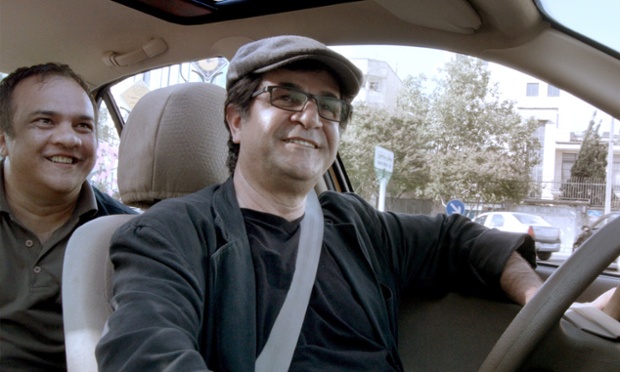
            Taxi is one of those films I would describe as a “meditation on existence,” if such a phrase makes sense.  With no apparent narrative thread in place, Panahi takes us into a typical Iranian taxi car, fixes a few cameras to the dashboard, and embarks on a day-long odyssey through the streets of Teheran.  Most of the film consists of short segments centered around one or a handful of passengers that get in, ask to be taken somewhere, and chat a bit with Panahi about pretty much anything under the sun before getting out.  There are two people that make extended appearances- in the first half, we get many earfuls on the benefits of selling pirated films from a street hustler, who instantly recognizes Panahi and knows he’s not a real taxi driver.  The second half is dominated by the presence of Panahi’s joyfully witty niece, who opens up by berating him for daring to pick her up in a mere taxi cab- it seems she’s been bragging to her classmates that her uncle is a famous filmmaker, and if they saw him now they would think she was lying.  As she puts it- “If you don’t want to think about your own career, then think about mine.” 

            I wrote “people” and not “characters” above because it’s not clear how much of the scenes and people presented are real things Panahi caught on film by chance, and how many of them were staged, or at least knew from the start they were in a film.  The hustler and a few other scenes with people that recognize Panahi, as well as the presence of his niece and her constant, almost fourth-wall-breaking chatter about filmmaking techniques and Iranian film laws, could certainly give off the impression that they had been directed at least somewhat.  Then again, a few other scenes come across as powerfully, viscerally real.  If they were real, it was an extraordinary stroke of luck that Panahi happened to pick the day for filming that he did.  If not, what a remarkable job he did in finding the perfect actors to play their respective roles.  Ultimately, whether or not all, some, or none of the scenes in the movie are real is a question I think I would rather not have answered.  At least, not yet. 

            If there is a key importance to this movie, it would be in how effectively it works in reminding viewers that, beneath all the rhetorical bluster about Satan and genocide exuded by the Iranian government, Iran remains a place like all other places- full of ordinary people, good and bad and in between, just trying to get by and create decent lives for themselves and their families.  This is especially the case with the women we encounter, who come in all shades of dress, age, and attitude, and will certainly relieve more than a few viewers of their own half-formed stereotypes about Iranian gender politics.  Each character- or person- is real in their own small way, and that is something beautiful.  It is such ordinary people that form the core of all nations and societies in this crazy world of ours.  And like all great movies, Taxi does its own small part to remind us of that. 


-Noah Franc 

Tuesday, September 8, 2015

Summer Blockbuster 2015 Report Card


            Another summer season ends, another school year begins.  And we all know what that means- REPORT CARD TIME! 

            Yes, after another round of studio and corporate pandering, it is time to assess whether any of the big-budget eye-spectacles we were forced to watch in 3D over the past few months lived up to the hype.  A proper blockbuster promises daring visual thrills, gut-wrenching chases, and seat-of-your-pants sci-fi/fantasy/comic-book action, plus enough zingers and one-liners to give the internet another winter’s worth of gifs and memes.  So today, we seek to assess which of 2015’s bloated cinematic miscreants are most worthy of the title “Summer Blockbuster Classic.”  And yes, I completely made that title up. 

            From here on in, a spoiler warning is officially in effect. 


Mad Max: Fury Road- A+


            Not only was Mad Max easily the best action film of the summer by far, in my book it still ranks as the best overall FILM that’s yet come out in 2015.  True, we still have four months’ worth of Oscar bait “prestige” pictures ahead of us (I am particularly excited to see Werner Herzog’s take on the life of Gertrude Bell), but all newcomers will have a tough time of it getting out from under this one’s shadow. 

            Given how insatiably exposition-heavy both the Marvel offerings and most other major action flicks of past years have gotten, Mad Max’s reliance on basic, clear, and precise visual design and cinematography to tell us everything we need to know in the first 15 minutes is something of a miracle to behold.   Tom Hardy carries himself with an incredible presence as Max, Charlize Theron’s Imperator Furiosa is a new gold standard for proper non-male action heroes, and the score is already on the shortlist for my Year’s Best list come awards season.  Plus, more than any other film on this year’s scorecard, Mad Max achieved the ultimate height of being just plain cool.  Cool to experience, cool to replay your mind afterwards, cool to see again, and cool to quote incessantly with your friends afterwards.  I mean, what else could you possibly want from the film? 

            Oh right.  That. 


Jupiter Ascending- A- (the “fun” version)


            Oh Jupiter Ascending.  What can I say?  It might be a bit unoriginal in its genre-mashing, but my God, what colors there are to behold here.  This movie not only has all the wheeling anime references we’re used to getting from the Wachowskis, it ALSO has one of the funniest shout-outs I’ve ever seen to Terry Gilliam’s 1985 classic, Brazil.  From start to finished, there is never a dull moment to be had here, from a hilariously outlandish airfight through downtown Chicago, to a swarm of royalty-smelling bees, to the wonderfully designed power station inside Jupiter itself, to…..Eddie Redmayne.  Oh dear, darling Eddie.  I thought we had learned our lesson after the Silver Linings/J-Law debacle, but our human memories truly do fail us, for we have once again awarded someone Oscar gold for the wrong performance.  That malleable face of yours has taught us a whole new level of joy, and we are forever in your debt. 


Avengers: Age of Ultron- B+


            Even though it does strain itself a bit too much by the end, and whether or not the franchise can move on from the original cast remains to be seen, there are still more than enough highs in this second Avengers go-around that I was quite glad I saw it.  Most of this can be credited to James Spader, whose salvaging of some shifty writing with his vocal work has provided us with easily the best, most fun single-movie villain we’ve gotten in one of these.  Its third act is a repetition of the NYC battle in the overall-better first one, but there are so many great moments to be had getting there that this was well worth the time spent by fans of the franchise. 


Tomorrowland- B


            Out of all the films on this list, Tomorrowland was easily the biggest personal disappointment for me.  I adore Brad Bird- I consider The Iron Giant, The Incredibles, and Ratatouille to be among the greatest animated works produced in the last 20 years (and yes, I am counting Ghibli films when I say that)- so there truly is no proper way to express how exuberantly happy I was when the trailers for his first original live-action work started making the internet rounds.   Which only compounded by faint disappointment when the movie itself turned out to be…well, quite good, and vastly more interested than something churned by a Studio Committee, but a far cry from the transcendent visual experience I had been expecting. 

            Which is a real shame, because the movie still has some genuine high-flying moments when it hits its stride; the first jet-pack ride in a Tomorrowland still under construction, the Eiffel Tower liftoff sequence, a robot attack on George Clooney’s home, and a vibrant, emotionally powerful final sequence acting as a broad call to greater civic engagement all stand out as moments of genius that deserve to endure.  Sadly, most of the character arcs and motivations make little to no sense, the plot meanders after a solid first half, and what should have been a grand final battle end up feeling a little rushed, and too reminiscent of the less-interesting stylistic designs of the later Spy Kids movies.  It succeeds in most areas though, so any Bird fan at the very least should check it out at some point.  Brad is the kind of filmmaker who, even when he falls short, still gives us something fascinating to experience. 


Jurassic World- B


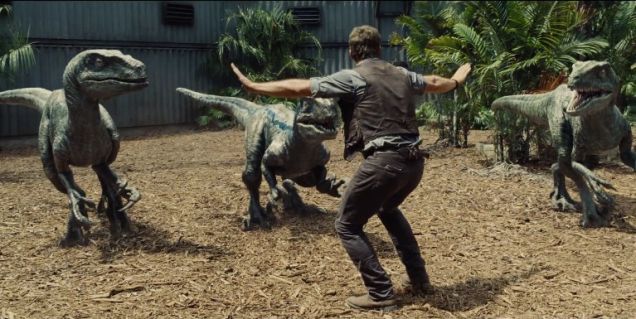
            Ah, the literal and figurative monster of the summer.  Jurassic World has already secured its place as one of the most wildly successful and profitable movies to date, and nothing I say for or against the film will alter that fact in any way, although it has not been without its controversies.  I can understand a lot of the complaints surrounding Bryce Dallas Howard’s character and how the story uses (or doesn’t use) her, although I have also seen plenty of strong arguments in her favor.  And yes, Chris Pratt is a far cry here from his scenery-chewing performance in last summer’s Guardians.  And yet, there is a nice reverence to the overall feel of the picture (my issues with the movie completely melted away any time they hearkened back to the original John Williams score), and the main action beats, when they do occur, are phenomenally breath-taking.  On the whole, it balanced out into a fun time at the movies.  Which is all I ask of these sorts of films. 


Ant-Man- B-


            I must confess- I am finding it harder and harder to write about Marvel movies.  Even at their best (Ironman 1, Avengers 1, Captain America 2), there is absolutely no deviation from story formula or character archetypes, and while that by no means makes them all bad, it does mean there’s a ceiling to how funny, original, or truly great any of them can get.  At least for now. 
                       
            That said, while there is a lot speculation as to whether or not one of these films truly bombing, or at least not functioning well within the ‘Verse, could bring down the whole house of cards being built, Ant-Man defied the cries of doom by Edgar Wright fans and turned out….pretty okay, really.  It was fun, and has its moments of brilliance; being the man-child raised on Shining Time Station that I am, I may have squealed a bit at the use of Thomas the Tank Engine toys in the final battle sequence.  On the other hand, the story and main character arc do not deviate from The Formula in the slightest, the side characters barely register, and the bad guy/evil plan combo is…..kind of terrible, now that I think about it.

            Plus, in a strange coincidence that I am still at a loss to explain, Evangeline Lilly’s character wears the same type of outfit, has the same haircut, is the same type of no-nonsense hardass, AND gets the same phoned-in romance subplot arbitrarily tossed in at the very end of the film as Bryce Dallas Howard from Jurassic World!  They look and are written so similar, I actually thought for the entire running time of Ant-Man that it was the exact same actress.  Seriously, look!  Blink and they are one!  

            Those critical points aside, as with all Marvel movies, I certainly don’t regret seeing it, but, as well as with most Marvel movies, I have no plans to revisit it again.   


Jupiter Ascending- D (the “serious” version)


            Oh Jupiter Ascending.  What can I say?  I had such high hopes for you.  I knew I was going to get a lot of bombastic over-the-topness (it IS the Wachowskis, after all), but given how much effort they usually put into making their fictional worlds make some form of metaphysical sense, I did expect at least SOME narrative cohesion.  After years of being able to digest the fallout from the Matrix trilogy, I would have thought they might have taken some lessons to heart on the importance of having your lead actors come across as at least partially human, or if not, at least having some of the side characters fleshed-out enough to pick up the slack.  There are rumors that whole chunks of the film, including some world-building and character development, got left on the cutting room floor, and while that would make me interested in seeing a director’s cut, I can’t use it as a justification to excuse the terrific flaws that tear this theatrical film apart, glorious design by glorious design. 

            And of course, there’s Eddie Redmayne.  Good God, we gave an Oscar to THAT?  How much lower are your standards going to sink, Academy? 

            Wait….shit, don’t answer that.  I forgot David O. Russell has a new movie coming out this year.  Lord save u…I mean, all hail the Russell! 


            All in all, this was hardly a summer of note, especially when compared to last year’s crop of great offerings.  Ah well.  At least we avoided the apocalyptic fate that would have awaited us had the release of Batman v. Superman not been delayed, which would have given us a year with Avengers, Jurassic Park, Star Wars, AND Batman/Superman duking it out for box office dominance.  Sometimes, it’s the little blessings in life that count. 


-Noah Franc 

Monday, August 24, 2015

Fare Thee Well, Jon Stewart


            Earlier this month, on August 6th, 2015, at 11pm EST, Jon Stewart aired his final episode as host of The Daily Show.  I had wanted to write something about this sooner, but honestly, I found I needed time to collect myself before doing so.  It hasn’t really sunk in.  Not yet.  There have been breaks in the show before, for various reasons and lengths of time.  Right now, it feels like just another summer break between seasons.  Maybe it won’t hit me until I tune in next month and see Trevor’s face where Jon’s is supposed to be.  And maybe even then, I won’t really feel it.  Maybe, like with the end of college, or with Chipper Jones’ retirement from baseball, I will slowly adapt to the new reality, sinking into its new sensations, aware at a deep, personal level that something has shifted, and that both I and the world around me are no longer the same. 

            And something is certainly different.  For 11 years, since right before the 2004 election, The Daily Show With Jon Stewart has been a single phrase in my mind, all capitals, words that should never be spoken separately from one another.  His crazy antics, increasingly elaborate penis jokes, and passionate pleas for more sanity in our crazed world have been as indelible and as constant a presence in my life as baseball, or summer road trips, or new weekly manga chapters.  True, I would stray from time to time- both the vagaries of student life and the demands of adjusting to the post-college world meant long stretches where the show was inaccessible, or when I just never had enough time.  Yet time and again I was drawn back, as water is drawn back into sea following the wave that cast it out.  When home, or whenever I had stable internet and a half-hour to kill, nothing made the time pass like sitting in front of either the TV or my laptop to soak the day’s news through the healing lens of comedy. 

            Even though it had been an irregular ritual for much of my life, the practice became all the more precious to me once we learned earlier this year that Jon would be hanging up his chair for good.  Whereas before I would often skip parts of the episodes I found boring, or interviews with guests I had no interest in, now every single show became something to be cherished and treasured.  But it’s always like this.  It rarely hits us how much we value something until after we lose it, or learn with certainty that we will lose it in short order. 

            That Jon Stewart helmed the show for 16 years in an era where “longevity” in television (and internet) celebrity is becoming a highly relative term is impressive enough.  What’s truly amazing is how he, by the end, was consistently ranked as one of the most-trusted sources of news in the country, beating out a variety of other, more “serious” journalistic networks.  He became a voice for the discontented in our society, the real silent majority, all those angered and frustrated to seemingly no end by the (in his own terms) varying degrees of bullshit that permeate human societies.  And not just discontent in general- few would argue against me saying that he was very much a voice for liberal discontent, in a world where Fox News and the wretched Tea Party seem ubiquitous, where the only voices heard loudly are the angry, reactionary, fearful ones.  And only he managed to gain a real following doing this.  MSNBC is a niche organization, and hardly considered a top-tier one in terms of its reporting.  Bill Maher has his audience, but he always had too sharp an edge, and more often than not came across as someone looking to score crass points for a joke that someone trying to make an earnest argument.  So why Jon Stewart? 

            I think there are a few reasons for this.  Comedy itself, when done well, is probably the best tool we have for fully processing our world, the safest way for us to hold a mirror up to our worst selves.  It’s the spoonful of sugar that helps us take the bitter medicine needed to creating a better, more wholesome world.  It can be a safe zone, where tragic or heartbreaking topics, or extremely sensitive or divisive ones, can be contemplated in as close to their entirety as we can get in this life.  So the fact that Jon Stewart was a talented comic gave him (as indeed it gives all comics) an ability to reach people faster and more deeply than most forms of “serious,” “objective” journalism. 

            His own abilities, of course, are only part of the story.  Jon Stewart also had a truly phenomenal staff behind him.  He himself has a wonderful instinct for humor and a razor-sharp mind, sure, but anyone in the business will tell you that, as far as keeping a whole show going for years on end, you need much more than the skill and zeal of one person.  You need the right mix of other artists, comics, producers, etc. working with you to hone every setup and every punchline, to reign in your excesses and supplement your strengths.  The final episode, where we got to reacquaint ourselves with every single correspondent that had ever appeared on the show, was a powerful testament to just how well the show gathered and cultivated great comedic minds, in many cases launching careers that have become as successful and influential as Stewart’s.  If anything, the finale was more of a celebration of the institution of the show than of Jon Stewart the person.    

            That was clearly how Jon wanted it, and that leads me to what, in my opinion, is the biggest reason that we all came to love him so much- Jon Stewart never put himself first.  He is a showman, obviously, and would do whatever he thought would get the biggest laugh or reaction from us, no matter how silly.  But it was never about him.  There is an earnest, genuine humility to what he does, and try as he might to cover it up with jokes, or fake bravado when taking on the gremlins of Fox News, it always shone through.  Regular viewers aside, anyone who watched more than a handful of his shows knew this.  Jon Stewart was always open with the fact that he considered himself extremely lucky to be where he was, that he never took one minute of his air time (or our viewership, support, and adulation) for granted. 

            His own constant self-effacing was proof enough of this, and the icing on the cake was watching him squirm endlessly when cornered on-air by Stephen Colbert during the finale, forced to accept the very genuine and heartfelt thanks of all the people he’d touched over the years.  More than that, while other outlets like Fox News clearly made a big deal out of his viewership, and often claimed that he was nothing more than a mouthpiece for extreme liberal rage (as if that’s a bad thing?), he himself never made any pretensions that he could move mountains, or that cracking jokes would solve all the problems on which he tried to shed some light.  He freaking dedicated an entire episode during his final week to skewering any notion that he made even the slightest difference in the world, essentially waving away his years behind the desk as time wasted laughing at dick jokes.   

            But, as all of us who loved watching him work know, that’s not really true.  Watching him was never time wasted, and he has made in a difference in the world, even if it’s only in small ways.  No, comedy can’t make ISIS go away, or make Putin grow a conscience, or make Tea Partyers grow brains.  While it may help us process complex issues, it certainly doesn’t guarantee that we will find a solution, and in most cases solving real problems isn’t a laughing matter at all.  There have been a number of criticisms leveled at Jon Stewart (and not just from Fox “Bullshit Mountain” News) that more or less say the following; that he had a chance to use his immense reach and influence to create a more reflective liberalism, that he could have been truly balanced in digging down into the shit on all sides of our political and social discourse, and that by never really challenging liberals the way he did conservatives (although the idea that he didn’t is a highly subjective one), his career ultimately ended as an opportunity wasted.  One writer even claimed that he had a "responsibility" to so do, that his duty was to create a new reflectiveness in American political discourse. 

            This misses the point of the show, and the point of what Jon Stewart was trying to do.  You can, of course, criticize how he ran the show, or argue he could have mixed criticism of conservatives with more criticism of liberals, and then he definitely favored one side over the other.  Fair enough.  But to claim that he somehow had a singular power and/or responsibility to rebuild civil society within American media is to both place a mantel on his shoulders that he never once claimed to have (and certainly did not want) and to take the lazy, excuse-ridden way out.  The United States is a pretty fucked-up place right now, and changing that requires active work from everyone. 

            One man could never reshape or fix all of this.  And while many individuals have taken it upon themselves to try, Jon Stewart was never one of them.   He is just as much as product of the times as we are, and he sought to make the best of it.  And in the end, as with all things, none of the political bullshit matters.  Jon Stewart made us laugh, and he made us want to engage more with the larger world around us.  He showed us true humility, and he showed us how to be passionate and active and intelligent while still always being aware of our own limits. 

            So now, over a decade in time having passed me by, I look back on what was.  I remember the many voices- his jittery, minion-esque Bush II laugh, the groucho cawing he used for Dick Cheney, and of course, his truly brilliant parodies of Glenn Beck’s awful, awful program.  With President Obama’s Presidency coming to a close, I think of Stewart’s first joke about him, way back when he first joined the Senate and even then was being treated as the liberal savior of the world.  I’ll never forget my sense of smug, hipster superiority when I could legitimately claim that, while the rest of my high school lost its collective shit when The Colbert Report first started, I had been watching (and loving) Stephen Colbert and his blessed God Machine years before any of those little cretins had ever heard of him.  Same goes for John Oliver, who had been a mainstay on the show long before he split for HBO to make fantastic videos about LGBT discrimination and related topics.  Another regular favorite of mine- Lewis Black, now literally become Anger embodied.  While all the correspondents were fun to watch, the most poignant correspondent’s moment for me was when Michael Che attempted to find the one place on Earth where a black man could feel safe (spoiler alert, there still isn’t). 

            I remember all of this- I will always remember it- and although I feel very, very sad, I am immensely grateful.  Maybe Jon Stewart didn’t change the world.  But he sure made us want to.  Millions and millions and millions of us.  And he enabled us to go our ways armed with the greatest weapons in the world- clever wit and raucous laughter. 

            Thank you Jon.  May God bless and keep you, and may you grace us with your presence again soon.  In the meantime, enjoy that drink.  You’ve earned it. 


-Noah Franc 

Friday, August 14, 2015

Review: Inside Out

Inside Out (2015): Written by Pete Doctor, Meg LeFauve, and Josh Cooley, directed by Pete Doctor and Ronnie del Carmen.  Starring: Amy Poehler, Phyllis Smith, Bill Hader, Lewis Black, Mindy Kaling, Richard Kind, Kaitlyn Dias, Diane Lane, Kyle MacLachlan, and, of course, John Ratzenberger.  Running Time: 94 minutes. 

Rating: 4/4


            I suppose I should start this with a weeping confession that I, too, had joined the ranks of heartbroken masses convinced that Pixar’s glory days, at least for now, were behind it.  Both the noticeable drop of quality in their works following Up and Toy Story 3 and the announcement that the coming years would mostly just bring a slew of unneeded and unasked-for sequels to earlier, greater works seemed to be unmistakable signs that the great animation powerhouse that rose to challenge Disney in the late 90’s was finally succumbing itself to Disney Syndrome, willing to sit back for a while and just rest on its laurels, yet still somehow roping in every Academy Award for animated movies simply through being the lone nominated film any of the voters bothered to see that year. 

            While that would, generally speaking, be true, I always found the hand-wringing over the “Fall of the House of Pixar” to be a bit overdramatic.  Sure, it looked like Pixar was drifting away from the focus of powerfully-written “original” ideas that became its hallmark in the 90’s and 2000’s, but it’s important to remember just how impossibly spoiled we were for a while there.  As fantastic as the run of Ratatouille, Monsters Inc., The Incredibles, Finding Nemo, Up, and the Toy Story franchise was, no studio can keep up a streak like that indefinitely.  So some uncertain times for the animation giant were always somewhere in the cards.  Nonetheless, it is indeed an immense relief to see that, even if the 2010’s end up being less definitive and revolutionary for American animation than the 2000’s were, Pixar is still capable of providing us with films like Inside Out, tales of immense and invaluable artistic integrity and beauty. 

            The twist this time around is that, while we do have a nominal human as a protagonist- a 11-year-old girl named Riley- the real characters of the story are Riley’s five core emotions, each represented as their own figure and personality, vying for control over how Riley interprets and responds to the world around her.  The details of how the movie visualizes something so ethereal is astounding to watch.  A central control panel is used to put ideas into words and actions, many of them provided by literal trains of thought that pop in and out of existence.  Experiences that become new memories roll down a shoot as a glowing, glass ball, and most of them are then shipped out while Riley sleeps to long-term memory.  Special ones, designated “core memories” that shape key aspects of Riley’s personality, are assigned a special storage rack of their own inside the central room where the core emotions reside.  They each, in turn, are the basis of each of Riley’s Islands of Personality.  At the beginning of the movie, she has five, although we eventually learn that the number of such islands one can have is not by any means fixed.  The emotions themselves are hypnotizing to look at, seemingly composed of endless tiny glowing light particles.  

            Each of the five voices cast are perfect fits for their respective emotions- there is the ebullient Joy (Amy Poehler), morose Sadness (Phyllis Smith), sneering Disgust (Mindy Kaling), over-wrought Fear (Bill Hader), and, my favorite of the bunch, Lewis “Smoking-Out-Of-His-Ears” Black as livid Anger.  While Disgust, Fear, and Anger get some of the movie’s better gags, the narrative heavy hitters are Joy and Sadness.  In a fitting parallel to the travails and growth of Riley as a whole person, each of the emotions is still learning their proper function as well.  Joy tries way too hard to run the show, seeking to shunt away Sadness and keep her from touching any of Riley’s memories, ESPECIALLY the now very precious ones from Minnesota (when one of the emotions directly touches a memory, especially a core one, they seem to “color” it with their essence, meaning that that emotion will be the one Riley will primarily feel whenever she recalls it). 

            However, Joy’s efforts to push away Sadness and keep Riley constantly happy grow increasingly impossible to manage, where the loud, cacophonous dissonance of Riley’s new circumstances seem to bring one problem after another.  Each bad or uncomfortable experience leaves Joy and the others befuddled about how to respond, until after one particularly bad incident results in Joy and Sadness are launched out of headquarters and into the endless shelves of Long-Term Memory.   

            Now, with only Anger, Disgust, and Fear at the helm, Riley starts to head down a very self-destructive path, one that breaks apart the core aspects of her personality we spent the first part of the film becoming familiar with.  Literally unable to feel either joy or sadness, and effectively falling into depression as a result, Riley is literally losing her entire sense of self.  Thus, Joy and Sadness have to put aside their differences and find their way back in time.  They even eventually get some help from Riley’s old imaginary friend, Bing Bong, who had been toiling away for years in Long-Term Memory, forgotten.  And along the way, each is forced to learn a bit more about their proper role in maintaining Riley’s sense of being.  

            Much has made of the “accuracy” with which Inside Out depicts the various interior workings of the conscious and subconscious mind, but I feel it bears remembering that, for all our advances in technological studies, the mind still remains a realm where both individual and broader cultural perspective matters immensely- the “Five Central Emotions” concept used here is just one interpretation of many in terms of how the mind operates, one that is not accepted globally.  There may come a time when future neuro-scientists look back at this movie as hilariously backwards and quant.   

            That said, how this movie depicts the literal machinations of the mind is ultimately far less important than what it has to say about life in general, and about the trials of growing up and learning to see the world through fuller, more mature, and more emotionally complex eyes.  Fittingly, it is a journey each of the emotions need just as much as Riley as a whole does.  At long last, we have a wonderfully made family film that lots of people are going to see that actively avoids simple answers for the problems of self and growth that it presents.  One of the core messages of the film is so simple, yet so forgotten by many, that it’s practically revolutionary- sometimes, you just need to feel sad for a bit to make happiness seem all the sweeter. 

            As with most Pixar works, Inside Out not only gets the core of visual and written storytelling right, it is also stuffed to the gills with lavish side details that fill out the film wonderfully.  A sequence where Joy, Sadness, and Bing Bong experience the stranger, more abstract mental states stands out as being some of the most creative and interesting animation we’ve yet seen in a CGI work.  Also, on the occasions where we jump out of Riley’s head and into the minds of other people, note how the control panels and emotions of each mind are arranged.  Note which emotions seem to occupy center stage (Joy in Riley’s case, but not so in others) and which ones are more to the side, suggesting which emotional states dominate the daily life of the individual concerned.  Also note that, while the 5 emotions seem to have the same form in every mind, within each person they all display some aspect of the real person’s physical appearance, regardless of whether or not said aspect fits to an emotion’s apparent “gender.” 

            While the whole movie is filled with great laugh moments, the character that provides the most consistently is easily Lewis Black as Anger, which deserves its own gold trophy for Perfect Casting.  Another favorite moment of mine happens towards the end.  I won’t spoil it, but will say that, speaking from personal experience, it perfectly encapsulates a large part of what being a hormone-ridden teenage boy feels like. 

            The movie has already been out for a while, so you have all heard the hype, but like with my other favorite film of the year, Mad Max: Fury Road, Inside Out earns every word of praise spoken in its honor and more.  If you missed it in theaters, make sure to treat yourself to the DVD the minute it comes out. 


-Noah Franc 

Wednesday, July 29, 2015

Nippon Reviews- Kumiko, The Treasure Hunter

Kumiko, The Treasure Hunter: Written by Nathan and David Zellner, directed by David Zellner.  Starring: Rinko Kikuchi, Nobuyuki Katsube, Kanako Higashi, Kyokaku Ichi, Ayaka Onishi, and David Zellner.  Running Time: 105 minutes. 

Rating: 3.5/4

            For years, there was an urban legend floating around the internet and the fringes of Cinephilopolis that Fargo, the Coen brothers classic from the 1990’s that jokingly claimed to be based on a true story, may have inadvertently killed someone.  A Japanese woman named Takako Konishi was found dead near a lake in Minnesota in 2001, and it was soon rumored that, tricked by the movie’s opening credits, she had gone there to hunt for the suitcase full of cash buried in the ice by Steve Buscemi in one of the movie’s final scenes.   

            This, of course, turned out to be completely false (the death the legend refers to was ruled a suicide, and there is no evidence she ever even knew of the film), but it’s still stuck around as a curious bit of cinematic pop quiz material for those interested in such minutiae.  Now, however, an American director (David Zellner, who appears in the movie in a late supporting role) has taken the bare bones of the urban legend, right down to Takako’s origins working for a travel agency and a confused misunderstanding with a local police officer, and reworked them around one of the most fascinating “what-if” premises for a movie I’ve heard of in some time- what if there really WAS someone fooled into thinking Fargo was real? 

            Roughly the first half of the film is spent introducing us to the almost amusingly pathetic daily life of Kumiko (played by Rinko Kikuchi).  It’s an almost too-standard picture of a person feeling their age, life, and career prospects spinning out of control- her boss is overbearing, regularly demanding to know why Kumiko is not actively applying for advanced positions within the company, and both he and her mother ask her astonishingly probing questions about whether or not she’s dating someone, or if she even has any interest in marriage or kids.  All her friends seem blissfully (and to Kumiko, horrifyingly) content with their very standard, average lives.  Her only real interests seem to be caring for her adorable pet rabbit (who later gets what is probably the most emotional scene in the entire film) and hunting down lost items with strange, obscure treasure maps. 

            The very first scene is one such hunt, where Kumiko delves into a small cave near the shore and finds a beaten-up, VHS copy of Fargo, dubbed into Japanese.  Who left it there?  What purpose was served by burying it and then making a map showing where to find it?  How did Kumiko even get her hands on such a curious item?  Or did she just swipe the video from the local rental store and fantasize that she found it as part of an epic beach hunt? 

            I suspect any answers to these questions are ultimately immaterial- she now has the movie, and that’s all that matters.  She watches and rewatches it over and over again after work, clearly becoming more and more convinced with each viewing that the treasure buried by Buscemi is real, and that she- and only she- has the cleverness and wherewithal to sniff it out.  And when events in her life push her just a bit too far over the edge, she makes what seems to be the first real choice of consequence she’s made in her life in years, and throws everything she has, both materially and mentally, into tracking down the briefcase. 

            It should quickly become obvious to most viewers that Kumiko is, at best, manically depressed, and at worst, completely unhinged from reality.  Her first stabs at determining the location of the treasure come off as adorably quirky, or even humorous (a shot showing how she tries to steal a map of the US from a library got more than a few belts of laughter from the audience I was with).  In some ways, she’s not unlike many of the psychologically lost souls populating most of the Coen brother’s works. But once she actually goes through with a terribly-thought-out plan and finds herself stranded in the Midwest without so much as a proper winter coat, the very real- and very terrifying- consequences of her actions hit home fast and hard. 

            At that point, a little more than halfway through the film, we are suddenly transported out of the rather darkly-zany world Kumiko has left behind and find ourselves in a David-Fincher-esque world of howling darkness.  Any marginally sane person would realize their failure at this point and give up, but not Kumiko- she just keeps going.  And the more lost she gets, the more bizarrely fascinating it is to see just how deep Kumiko is willing to sink in order to satisfy her sadly twisted belief that this, and only this, can give her life value.  We know how it will end- since many people that see this movie will likely know the legend, it’s easy to think that the movie will ultimately be too anti-climactic to be worth seeing- but in this particular case, the power of the movie comes not through a twist of the story, but in how it brings us to its inevitable conclusion.  We feel compelled to keep watching just to see what Kumiko will think of next.  Once you think she’s pulled the most insane stunt she possibly could, she goes out and does something even more off-the-wall-bonkers, a never-ending cycle of descending madness.   

            Rinko Kikuchi first broke into popular American consciousness with her role in the summer megahit Pacific Rim a few years ago, but it’s here that her powers as an actress are put on full display.  Hers is already one of my favorite performances of the year, in some ways mirroring Charlize Theron’s amazing turn as Furiosa in Mad Max: Fury Road- her expression and tone of voice almost never change, but there’s so much frustration and pain etched into every line of her face that it doesn’t matter.  She simply glances at something (or someone), and no words are needed.  She anchors the entire film, and gives it the tragic edge it needs to veer into the abyss of the final act. 

            Anyone expecting (or perhaps wanting) Kumiko to be a compendium of clever references to or quotes from the original film, or who go in planning a drinking game around how many times someone says, “You betcha,” will leave disappointed- at no point does Zellner try to ape either Fargo itself or any other Coen brothers works, which ends up being very much to the film’s benefit.  Only the Coen brothers can pull off the Coen brothers, and Zellner was wise to keep the focus of the film tightly on Kumiko and to utilize his own style.  It’s not a style that will work for all- the ending is sure to confuse, frustrate, or infuriate a good number of people who see the film (although I found it to be brilliant), and there are perhaps some arguments to be made that the way Kumiko’s agonizingly normal life in Japan is set up is a bit by the books.  No matter.  Kumiko, The Treasure Hunter is a great film from start to finish, and made for a properly fitting ending to this year’s Nippon Connection.  I can’t wait until next year. 


-Noah Franc