Monday, July 28, 2014

Review: Kaze Tachinu (The Wind Rises)

The Wind Rises (Kaze Tachinu): Written and directed by Hayao Miyazaki.  Starring: Hideaki Anno, Miori Takimoto, Hidetoshi Nishijima, Masahiko Nishimura, Steve Alpert, Morio Kazama, Keiko Takeshita, Mirai Shida, Jun Kunimura, Shinobu Otake, Nomura Mansai.  Running Time: 126 minutes.  Based on the manga by the same name by Hayao Miyazaki 

Rating:  4/4

**spoiler warning- there’s a lot I want to say about this movie, and much of it will require me to delve into the content of the entire film.  Not that it’s really a “story movie” anyway, but for those of you who avoid any spoilers on principle, here’s the fyi**

            If you had taken a census of Miyazaki’s most devoted fans, critics, and all-around cinephiles that have followed his career over the years and asked them to opine on what they would envision his last film to be like, The Wind Rises would not be it.  Ironically, that makes it, in many respects, a quintessential Miyazaki film, because what else has drawn us to his work over the decades, other than the fact that his films are never quite what we thought they would be?  Each one has been something refreshingly new, often something at complete odds with what came before.  In this aspect, The Wind Rises is no exception.  Whether or not it will have the staying power of his earlier works, and whether or not there is more than in some of his other films to actively criticize, remains to be seen. 

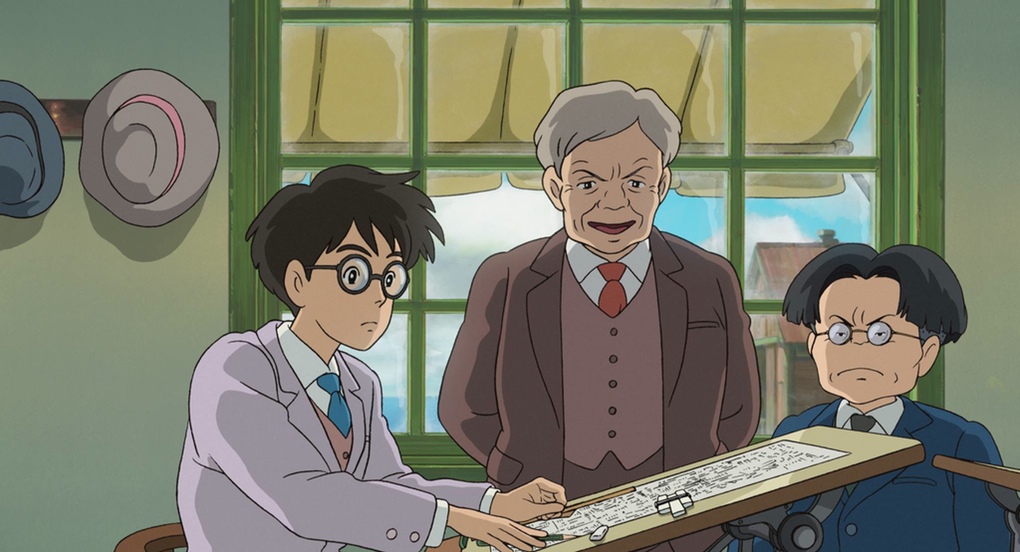
            The Wind Rises is a heavily fictionalized account of the early life of Jiro Horikoshi, the designer of the Zero fighter plane, a huge technological leap forward for the Japanese air force during WWII that temporarily outstripped all other planes in the world, and which were later made infamous by their use as suicide vessels by kamikaze pilots towards the end of the war, often to devastating and horrifying effect.  When the film opens, however, none of that dark future exists yet for Jiro.  He freely dreams of a bright, sunlight-and-color-filled sky, through which he flies his own imaginary plane as the morning sun streams over the hills.  It’s the ultimate escapist fantasy, flying over house and field as the people look up in wonder and awe.  However, even at that age, premonitions of a dark future start creeping in to his consciousness- a massive zeppelin adorned with the Iron Cross looms suddenly out of the clouds, armed to the teeth with bombs and muttering shadows that will remind many of the night spirits in Princess Mononoke.  A large, undulating torpedo strikes his craft, shattering it, and he falls. 


            It is a scene meant as a premonition for what is to come.  Since his own eyesight is too poor for flight school, Jiro eagerly decides to pursue studies as an engineer so that he too can one day design the planes he loves so much.  Beginning then and continuing throughout his life, he is encouraged by the Italian aircraft designer Caproni.  Or rather, by his imaginary version of Caproni.  Every so often, usually when Jiro is at a low point in his life, Caproni visits him in his mind, the “kingdom of their dreams,” as he puts it, where they straddle the wings of planes in flight and ponder why they are driven to build machines that they themselves will never use, especially machines utilized for war. 

            Later, on his way to the university to pursue his higher studies, the train is stopped by what is now called the Great Kanto Earthquake, which utterly devastated Tokyo in 1923.  A shadowy wave approaches the coastline, and the houses and ground rise and fall like bedsheets being shaken out in the morning, while the Earth groans like some monstrous beast waking after centuries of sleep.  Trying to make sense of the disaster after leaving the train, he stops to help the mother of Naoko, a pretty young girl who happened to catch his hat earlier as the train sped over a bridge.  They will eventually be reunited, at a mountain resort where they fall (rather quickly) in love, and soon after marry, even though she is suffering from incurable tuberculosis. 


            Before their reunion and marriage, however, Jiro finishes his studies and begin work at Mitsubishi, which at that time was feverishly churning out new airplane designs in the hopes of winning much-desired government contracts for the military.  For most of the rest of the movie, we follow the various events and experiences that eventually inspire Jiro to create the Zero.  As his vision approaches reality, however, Naoko grows sicker and sicker, eventually dying the same day as the first test flight of Jiro’s plane.  The conjunction of these two moments (although said death is not depicted on-screen, but rather heavily implied) seems to be a sharp and biting allegory for what the birth of the Zero plane signified- its creation may have been inspired, impressive, and technically ingenious, but it also heralded in an even more deadly phase in the Sino-Chinese war, and would be responsible for an immense amount of destruction and death in the wider World War just over the horizon.  As it touches down, the technicians and military higher-ups exuberantly celebrating, a person of beauty, innocence, and purity leaves the world forever.  Jiro’s much longed-for convergence of dream and reality brings in destruction on an unimaginable scale, and pushes out love and joy.  The war that has haunted Jiro since his childhood has caught up to him at last. 
           
            There are two major themes in The Wind Rises that I felt to be of paramount importance.  One is, rather obviously, wind itself, and all the forms that it can take.  The title of the movie is taken from a line in a poem by the French writer Paul Valery, called “The Graveyard By The Sea,” and is recited several times by various characters; “The wind is rising.  We must try to live.”  And rise the wind does, in many forms and in many ways, representing beauty, kindness, and gentleness, but also the overwhelming tide of events in which an individual like Jiro, no matter how well-intended or idealistic, can become utterly lost. 

            Sometimes, the wind pulls gently at the grass in the field, accentuating the beauty of the natural world.  Other times, it tears at the clothes and rips an umbrella out of someone’s hand.  The wind both lifts up the airplanes of Jiro’s dreams and those of his reality, but is also capable of ripping them apart at the seams, and does so quite often.  It can lead to beautiful moments, like the wind that blows Jiro’s hat into Naoko’s hand, but like that selfsame wind, it can also herald ruin, blowing the searing ash and embers from the first fires started by the quake in every direction, causing whole swaths of the city to be consumed in flame.  The wind is a force inexorable, far beyond any one person’s ability to contain, much like the fate that envelops both Jiro and his country.  And yet, as the original poem itself suggests, even when faced with an overwhelming tide, we are still driven by a yearning to go on, to continue even when it seems that all purpose in doing so is lost.    

            The second major theme within the film is that of dreams, and of where the lines between dream and reality can be drawn.  In several scenes, characters refer to life as wondrous, something dreamlike at its best, and it is from such a dreamlike state that Jiro seems to perceive much of that which happens to and around him, as if he is permanently emotionally detached from the world.  His sleeping and waking fantasies of flying, both the wonderful and the terrible, are freely interspersed with his supposed waking moments, to the extent that it’s often hard to tell them apart at first.  Conversation with fellow engineers will suddenly shift to include images of the plane in flight, and those present react as if they all were seeing the same image.  Even the “real” parts of Jiro’s life come across as dream-like; there are no clear transitions from one scene to the next, and sometimes we only learn several minutes into a conversation that several years have gone by.  In this sense, the film itself is much like a dream- a scene begins, and we have no idea how Jiro got there, or when, and why- he is simply there, and we must observe what transpires.  Perhaps the entire film is a dream, woven out of the fabric of Jiro’s first literal flight of fancy in the very beginning. 


            That the technical side of the movie- the quality of its animation and the effectiveness of Joe Hisaishi’s soundtrack (not, perhaps, as memorable as his work in other Miyazaki classics, but still fitting for the work’s tone)- is without reproach is beyond question.  Where I (and a great many other critics) found fault in the film was more in the specifics of its story and execution.  I do not believe I can overstate how much of a slow-burning film this is.    I have stated previously that many of the scenes transition with effectively no fanfare.  A great number of said scenes are dominated by technical talk concerning the mechanics of aviation.  This is not to say that these scenes are bad- I found them fitting in the context of the film- but I cannot blame anyone who finds the film so boring that they mentally check out before the end (which I a shame, because I believe it’s in the last act of the movie that the entire enterprise comes together). 

            Further criticism can be made of Jiro’s relationship with Naoko, who, it becomes fairly clear, exists simply as an object of beautiful and innocent perfection for Jiro to lose at the necessary moment.  This will be particularly surprising for some, given the incredible roster of female characters (both leads and supporting) that Miyazaki has provided us over the years.  As stated above, I found her character and their relationship as a whole to be more of a metaphor for the costs of militant nationalism, but again, the implications that that is the intended interpretation are small indeed, so like with the film’s length, I can sympathize with those who found it to be something of a distraction (indeed, my favorite aspects of the film were those that had nothing to do with Naoko).    

            Neither of those factors, however, has been nearly as great a source of division and controversy as the simple fact that the overarching aim of the film is to portray Jiro in a sympathetic, and in some respects flattering, light.  At this point, I must move away from the film to provide some needed historical context for the piece.  At the time that Jiro was working at Mitsubishi and designing the Zero, Japan was not only in the process of militarizing and brainwashing much of its citizenry in preparation for war against the United States, it was already engaged in one of the most brutal conflicts in history, its invasion of Korea and mainland China.  The atrocities committed by Japanese forces, which I will not list here, are a point of contention between Japan, China, Korea, and other Asian nations to this day, in large part due to continued efforts by the Japanese government (and by a not-insignificant size of Japan’s population as a whole) to either deny outright or simply ignore many of the worst aspects of Japanese wartime policy.  Although Jiro was not directly involved in military policy or wartime operations, his Zero added its own dimension of destruction and pain to the conflict, even before it became the suicidal coffins for scores of young Japanese pilots. 

            What has inspired so much controversy and passion is the fact that none of the above- the brutality inflicted by the Japanese in China and other places, the militarizing of the society, the repression of dissent and free speech- is directly shown or alluded to in the film.  Not that the war is ignored.  Jiro’s co-workers refer several times to the winds of war everyone knew was coming.  At the resort where Jiro and Naoko are reunited, a German fleeing the Nazis compares the place they are all at to Thomas Mann’s “Magic Mountain,” a place where anything painful or uncomfortable can be forgotten; “The war in China?  Forgotten!  The puppet government in Manchuria?  Forgotten!”    


            This lack of open, direct acknowledgement of Jiro’s part in the war is, in the eyes of some, exacerbated by the final scene of the movie; he is once again in his dream world with Caproni, except now the ground is littered with the charred bones of his Zero, all destroyed.  After commenting to Caproni that the world of his dreams has now become his own personal hell, he says wistfully, “None of my planes returned.  Not one.” 

            For some critics, this is a callous effort to further feed the Japanese tendency of simply not acknowledging the suffering caused by the war outside of that which Japan itself experienced.  It can be argued that, through the line, Jiro is expressing his sorrow over the pilots and their victims AS WELL AS the planes, but again, that is very much open to interpretation.  Despite that aspect, however, the rest of the film is clearly very anti-war in general.  Both the film and its creator very much embody this strange divide.  Miyazaki cannot be accused of ignorance when it comes to WWII- he has spoken openly of Japanese wartime policy in the past, and has adamantly opposed Shinzo Abe’s efforts to rewrite Japan’s strictly pacifistic post-war constitution.  When interviewed about the film, he stated quite firmly that the Japanese government acted out of “arrogance,” and sowed the seeds of its own destruction.  On the other hand, he holds Jiro as blameless, as a visionary whose admittedly impressive creation was twisted by others for dark uses.  He says that his primary inspiration for the film was a single line from Jiro’s memoirs, written long after the war’s end; “I just wanted to make something beautiful.” 

            Miyazaki clearly takes Jiro at his word.  Others do not.  Audiences and critics, both in Japan and abroad, have been as starkly divided over the film and its subject matter as he is.  Some on the conservative end of the spectrum have attacked the film for containing what veiled criticism of Japanese wartime policy it does have, with a few even going so far as to label Miyazaki “anti-Japanese.”  Conversely, many on the Japanese left, as well as in countries that suffered the most from Japanese aggression and the abilities of the Zero plane in particular contend that Miyazaki does not go far enough, that he ignores not only the horrors of Japanese aggression in general, but also what aspects of said aggression can be linked directly to Jiro’s life and work; another historical side unacknowledged by the film is the fact that many of the Zero fighters produced during the war were assembled by Korean laborers (read; slaves).  One Korean-American critic, Inkoo Kang, wrote the following in her response to the film; “The Wind Rises is just one film, but it echoes an entire country’s obsession with misremembering a deeply painful and extraordinarily violent past. Japan’s wartime victimhood is a convenient lie its citizens have told themselves for decades. That the aging Miyazaki has misguidedly lent a patina of wistful beauty to that lie is a shame. The Wind Rises ends the illustrious career of a treasured visionary on a repellent, disgraceful note.” 

            Even the question of slave labor during the war, however, is not ignored entirely.  When lamenting to Caproni over how his planes are being used, Caproni simply tells him to think of the pyramids, asking if he thinks the world would be better without them.   The implication here seems to be that even though the pyramids, which were also constructed with slave labor, most definitely caused great suffering for many, the world would still be a poorer place if they did not exist.  Whether or not the pyramids are comparable to fighter planes is, again, open to debate. 


            By now, you are undoubtedly wondering where I stand on all of this.  And to be honest…..I am not sure.  In fact, during the process of writing this review, I have openly worried on more than one occasion that my deep and abiding love for Miyazaki’s works makes me biased enough to overlook the questionable way he tackles history, or whether or not his treatment of the film itself as something like a dream, drenched in unspoken and vague metaphors, really works the way he wanted it to.  Even when you disagree with Miyazaki’s basic assumption underlying the film, that Jiro himself is someone to be admired for his technical genius and his fierce passion for the dream of flying, his deep-seated belief in the ultimate beauty of human effort has never shone through more clearly.  In several scenes, the parts of the planes being tested are seen being taken to the field cleared for flight by oxen-drawn carts, led by the poorest of farmers.  Human dreams so often exceed the reality in which they are born, but there is nobility in the dreaming, even when it is surrounded by chaos. 

            On the whole, though, there are enough aspects of the film itself that, in my opinion, do not work as well as they should, enough that I do not think that, on its own merits, the film is on the same level as Princess Mononoke or Spirited Away.  While I personally do not feel that the film is historically or culturally insensitive in how it treats its subject matter, I cannot blame others for disagreeing.  In his (seemingly) final cinematic act, Miyazaki has given us what may or may not be among his greatest works, but what is, I think, his deepest, most complex, most mercurial, and most intimately personal creation out of everything he has made.  As a result, The Wind Rises shows us, perhaps, much more of his own personal and cultural flaws, biases, and idiosyncrasies than we’ve seen before, including the ones many find objectionable. 

            Where The Wind Rises DOES succeed in achieving greatness is in how its very existence provokes questions far above just those limited to the story and subject of the actual film.  Spoken and unspoken meditations on war, peace, love, innocence, and the divergence between dreams and reality permeate each frame and are enough on their own to provoke hours of deep discourse.  But what it also provokes are questions and uncertainties regarding the very nature of art itself, and of the artists who take it upon themselves to create.  When using real events as a baseboard, what are the artist’s duties to the historical truth, if there even are any?  Can we fairly criticize an artist for focusing on some aspects of the story and ignoring others, regardless of their reasons for doing so?  And if we can, where do we draw the line, and how do we tell when an artist has gone too far, or not far enough?  To what extent can we say that someone is guilty by association, even if they only indirectly contribute to a crime? 

            I do not know the answers to any of these questions.  I do not know yet if The Wind Rises really is one of Miyazaki’s best works.  I do not know if it is so reprehensible in its avoidance of the dark side of Japanese wartime history as to be considered his “worst” film, at least from a moralistic perspective.  What I do know is that I was moved in ways I could not begin to put into words by the movie.  Not in great emotions, but in small shifts in my thinking.  I know that I have thought long, and hard, and deeply, far longer than I normally do before writing up a review.  I have read an uncounted number of reviews and reactions to this movie while writing my own, far more than I usually do.  I have asked myself a lot of questions, and have actively worried about my own biases and viewpoints coloring my perception of Miyazaki’s more debatable decisions in the film, also something I rarely give extensive thought to. 

            And is it not a blessing for us to be presented with something that makes us question so deeply, that defines easy generalizations and simple lessons?  Is it not a gift, to be challenged to reevaluate and redefine our individual attitudes and approaches to art and objective truth, and the divergences between the two?  Even if, after considering all this, one feels compelled to condemn the film for its flaws and how it treats its subject matter, was it not wonderful to be able to assert so clearly what one thinks and why?  Hayao Miyazaki has, once again, provocatively pushed the boundaries of our perceptions of the kind of stories animation can tell.  He has had his visions, and his dreams, like Jiro.  The hesitation and, in some cases, anger and/or frustration that this last work has caused aside, I would like to think his efforts to make those dreams a reality have been far more beneficial, inspiring, and life-giving than the Zero ended up being.  He has let his mind soar on the back of the rising wind.  He has lived. 

            And now it’s our turn. 


-Noah Franc 


Friday, July 18, 2014

Review: How To Train Your Dragon 2

How To Train Your Dragon 2 (2014): Written and directed by Dean DeBlois.  Starring: Jay Baruchel, Cate Blanchett, Gerard Butler, Craig Ferguson, American Ferrera, Jonah Hill, Christopher  Mintz- Plasse, T.J. Miller, Kirsten Wiig, Djimon Hounsou, Kit Harrington.  Running Time: 102 minutes. 

Rating: 3.5/4

            As far as animation goes, 2014 is already leagues ahead of last year’s disappointingly lackluster offerings, with the off-the-wall and brilliantly deconstructive Lego Movie and the mind-boggling plays on gravity in Patema Inverted easily outstripping every single major animated film released in 2013 (yes, including Frozen).  Awaiting all of us down the line is the newest work from the Wunderkinds at Laika Animation, The Boxtrolls, along with the German theatrical release of Miyazaki’s The Wind Rises.  And now we have How To Train Your Dragon 2, yet another incredibly effective sequel from Dreamworks Pictures, which has basically become the Anti-Disney/Sky Blue in terms of how to handle franchises with respect and dignity. 

            Like with Dreamwork’s other two remarkably excellent sequels, Shrek 2 and Kung Fu Panda 2, Dragon 2 builds expertly off the fascinating and potential-filled world of the first movie without repeating storylines.  It has been 5 years since Hiccup (Jay Baruchel) lost his leg in a fight against a massive alpha dragon near the village of Berk.  Now, the lives of the Vikings and the dragons are intertwined, the village having been expanded to include dragon stables, smithies designed to create dragon armor and saddles, feeding and washing machines, and a massive arena for the sport of dragon-riding, which involves using hilariously expressive sheep like footballs. 

            The opening scene showing this sport is a thrilling pull into the movie’s world, and it expands in meticulous detail when it cuts over to Hiccup, pointedly avoiding both the game and (as we learn later) his father Stoic (Gerard Butler at his most Scottish), who has decided he wants Hiccup to succeed him as chief.  His opening flight with Toothless is reminiscent of their first transcendent exploration of the skies in the first movie, but on a far grander scale.  They dive underneath the tails of great waves, and soar through veritable cathedrals of clouds, before Hiccup tests out his new gadget- a set of his own wings and fin to allow him to glide along the clouds next to Toothless.  Oh, that and he also wields a sword that shoots out both fire and combustible gas. 

            Even though he is extremely uninterested in becoming chief as per his father’s wishes, both his life of exploration and his deepening romance with Astrid (America Ferrera) seem to be pretty much ideal.  The threat of open war, however, comes knocking in several forms; an encounter with an arrogant dragon hunter names Eret (voiced by Kit Harington of Game of Thrones fame), the appearance of a mysterious vigilante dragon rider, and rumors that a vicious warlord named Drago Bludvist (an ever-solid Djimon Hounsou) is once again on the march.  And that is where I will cease any explicit mentions of the story, because the turns this movie takes are too good (and in some cases, too dark) to even contemplate spoiling. 

            Now hang on a second, I know what you’re thinking- don’t the trailers already the spoil the big reveal that the wild, masked dragon rider is actually Hiccup’s Mother?  Well, yes, they do, and yes, that was incredibly stupid of them, because that reveal is a great scene that would have packed a wallop had it been kept under wraps.  However, in some ways that lone tidbit ends up being a bit of a false herring.  She appears fairly quickly in the movie, in the first act, and after that there is another solid hour or so of narrative turns that you rarely ever see in a children’s movie, or at least ones you don’t see outside of greats like The Iron Giant.  Themes like handling physical disability, the merits of pacifism vs. active self-defense, the loss of a parent, the aging love of a middle-aged couple, and even sexuality (I swear to God, I am not pulling your leg) all come in to play at various points and to varying degrees.  Can anyone here think of another “kid’s movie” from the States that touches on all of the above within an hour-and-a-half?  Because I can’t.  Certainly nothing from Disney, or any other works by Dreamworks.  Even Pixar can’t boast that impressive a checklist (Up being perhaps the closest). 

            That said, I can’t pretend there are zero issues with the story.  The prevalence of so many themes and ideas means that some are left more unexplored than others, especially when you consider that, you know, being a children’s film and all, the movie is also required by law to be under two hours while still hitting the needed story beats to make it “marketable” (translate to “normal enough for adults to be okay with it”).  In particular, I was sorry to see Astrid play much more of a side role than she in the last film, and although I am interested to see what they do with the third film slated for release in 2016, I will be sorely disappointed if she does not get a much expanded role. 

            Even though, as with many American animated films, I can’t help but wish for just a bit more, there are so many moving pieces hitting the right notes that I can’t help but love this movie, warts and all.  When given the choice, I will still pick hand-drawn or stop-motion animation over CGI anyday, but there’s no denying how far the technology has come in the last few years.  The texture of the characters, the dragons, and the land they inhabit is sharper and more detailed than ever before, especially when I compare it with the first film, which now actually looks slightly dated in comparison.  The flight sequences embody the kind of no-holds-barred freedom employed by Patema Inverted in the floating chase sequences.  Even if you don’t see it in 3D you’ll want to jump out of your seat and fly right along with Hiccup. 

            Like with the first one though, this film is also far more than just a series of pretty images.  The soundtrack, again provided by John Powell, ranks alongside the score for Unforgiven as one of the best I’ve yet heard this year, although I did miss the absence of the music used in the initial teaser trailer.  There are a lot of character moments that reach beautiful emotional heights.  Hiccup’s relationships with Astrid, Stoic, Gobber (Stoic’s close friend and advisor), Toothless, and later his mother (whose name, we learn, is Valka) are not phoned in- they are dynamic, trusting, unique, and feel eminently real.  This goes double for the scene where Stoic and Valka are reunited after nearly 20 years of separation, which, unlike the occasionally overblown Fault In Our Stars, actually did get the tears gathering around the edges of my eyes. 

            There are fights and battles in the climactic third act, but they ultimately carry less weight by the end and simply don’t feel as significant (although their scale is nothing but impressive), because the really great stuff in the movie centers around the characters.  Which is, in my mind, as it should be.  How To Train Your Dragon 2 is a great movie, a wonderful visual adventure to experience, and is another rare film where the extra cash for the 3D is absolutely worth it.  It goes big on the animation and action, but anchors itself in the small moments that make us actually want the good guys to come out okay.  Which sets it leagues ahead of most big-budget summer flicks these days. 


-Noah Franc 

Thursday, July 10, 2014

Review: The Fault In Our Stars

The Fault In Our Stars (2014): Written by Scott Neustadter and Michael Weber, directed by Wyck Godfrey and Marty Bowen.  Starring: Shailene Woodley, Ansel Elgort, Nat Wolff, Laura Dern, Sam Trammell, Willem Dafoe.  Running time: 125 minutes.  Based on the book of the same name by John Green. 

Rating: 3/4

**warning, there might be minor spoilers in this- can’t talk about this one otherwise**

            The Fault In Our Stars is one of those movies I wish I had been able to see disconnected from and/or unaware of the general hype surrounding both it and the book it is based on.   Such popular adulation has an unfortunate tendency to build up its own momentum and turn into something far larger than its source, creating an ideal or an expectation that can never possibly be fully matched in reality (see my frustrated and torn feelings towards Jennifer Lawrence).  As soon as people started proclaiming The Fault In Our Stars to be the go-to, life-altering, cry-pocalypse of the year before the film even came out, I knew I was in trouble, because there was no way I could avoid seeing it without such choruses of unchallenged praise sitting in the back of my mind, pushing me to judge the film harsher than I otherwise would.  Thankfully, most (though by no means all) of my concerns were alleviated upon finally viewing the work, and even though the book, as always, is a far superior product, I found it honest and well-acted enough that I can wholeheartedly recommend it. 

            Like more or less all stories, this is a tale of life and death.  Unlike most stories, this one focuses specifically on the perspective of terminally ill teenagers, kids stricken with cancer before even the chance at a more regular life presents itself.  We see this oft-ignored world through the eyes of one Hazel Grace, struggling with thyroid cancer, who has to cart around an oxygen tank everywhere in order to breathe properly.  Her life is a constant, repetitive cycle of terrible TV, numbingly asinine cancer support sessions, trips to the doctor for tests, and reading the same book, over and over and over again.  It’s another shining performance from Shailene Woodley, radiating a deep intelligence combined with a mixture of exasperation and resignation at her condition.  After brushing up against death a few years’ prior, Hazel decided to deliberately minimize her contact to anyone other than her parents, so as to spare as many people as possible the pain of losing her when her time comes (trials with a new drug seem to be prolonging her life indefinitely, but she doubts how long they can keep her going). 

            Through a friend from the support group, though, Hazel finds someone she can’t lock out in Augustus Waters, himself a survivor of osteosarcoma, and now sporting a peg leg to show for it.  After a few initial interactions, their companionship deepens into a powerful love that overrides (and, perhaps, is also enhanced by) their mutual understanding that their time together will inevitably be extremely limited; as Hazel puts it, in one of the book’s most poetic moments, “I fell in love the way you fall asleep- slowly, then all at once.” 

            One of several focal points in their relationship is the book An Imperial Affliction, itself a story from the perspective of a girl dying with cancer.  Consumed with the urge for answers (the book ends abruptly with no resolution), they travel to Amsterdam to meet the author, played with delectable horridness by Willem DaFoe.  The encounter that follows is a key moment for Hazel and Gus- an abrupt confrontation with a level of cynicism and despair that overwhelms their own carefully crafted, fatalistic nihilism.  It’s a scene that I wish had gotten more time to develop, because there are a lot of elements present concerning death and the different perspectives youth, old age, and the terminally ill have on it. 

            Sadly, this is an adaption of a hugely popular Young Adult novel banking heavily on its rom-com aspects to be the big draw, so those aspects of the story that get more wiggle room in the book are, in most spots, the first things that were apparently sent to the chopping block.  The movie strives so purposefully to effectively recreate the book on-screen that any discussion of it as an adaptation will exclusively be a discussion over what aspects they decided to cut for brevity’s sake.  To my disappointment, many of the scenes cut were among my favorites in the book, including several exchanges between Hazel and her parents (although those two are well-represented on-screen by Laura Dern and Sam Trammell), and a few of Hazel’s internal musings about life, death, literature, and the void. 

            Such differences between a movie and a source material are largely a matter of taste though, and need not reflect poorly on the adaptation.  What did impinge on my enjoyment, on more than one occasion, was the soundtrack.  That may sound uppity and hipster of me, but I genuinely feel sound and music, or the absence thereof, is one of the most underrated and underutilized aspects of filmmaking, and is often the difference between a good movie and a great one.  The tracks here are largely generic-sounding indie rock songs, none of which managed to leave an impression on me, and some of which broke through the screen and distracted me enough that the intended effect of the scene in question was lost.  A common theme running through the book (and hence, running through Hazel’s mind) is the idea of nothingness after death, of the overwhelming sense that all that awaits one is the void.  Given the pervasive fear/awareness of approaching silence in minds of the characters, wouldn’t that last scene have been so much more powerful without a pounding rhythm of drums and guitar reminding you that, yes, this is beautiful and heartbreaking, so how about a good cry now? 

            Another element present in the books and, for me, largely absent in the film was a sense of the incredible physical discomfort and often downright pain that comes with dying of cancer.  John Green’s writing left me actively wondering what it would feel like to have water sloshing around in my lungs like Hazel does, and there is quite a lot of space devoted to the day-to-day exhaustions and agonies when Gus has a bad relapse of his cancer and suffers immensely.  I don’t like writing this, but in many ways, the movie is just too clean to really have more of an impact on me.  The one, lone scene that hit me like a ton of bricks is the one where Gus loses his medicine tube when driving to a gas station, and by the time Hazel finds him, the spot on his stomach is infected and he’s coughing up blood.  It’s the one unflinching glimpse into the world of physical torment these characters occupy that we really get in the film, and when it’s airbrushed away, all the pains, and struggles, and joys, and triumphs of Hazel and Gus feel smaller as a result.  Hazel speaks constantly of her resentment over the generic attitude given cancer patients, especially young ones- she does not want to be “that kid with cancer,” and yet is acutely aware that that is all she will ever be, regardless of what she does.  Such concerns are just never really brought up in the movie. 

            And yet, although I would pick the book over the movie anyday, there are so many moments that the movie gets right.  Hazel and Gus’ mutual friend Isaac loses his eyes to cancer early in the movie, but the real low-blow is his girlfriend breaking up with him right before the surgery.  Even when separated from the fact that the scene involves cancer patients, there is a raw realness to Isaac’s anger that will hit home for anyone who experienced the classic “it’s not you, it’s me” breakup line.  And, for all the praise given to Shailene (and rightly so), I found both leads adorable in their mutual awkwardness.  Even when paired down slightly from the book, there is a pleasant chemistry in their exchanges.  Hazel’s parents and Willem Dafoe’s alcoholic Peter van Houten also provide a fascinating background in contrasting images, two opposite reactions to the seeming senselessness of cancer taking the lives of those so young. 

            I was extremely hesitant going into the film, and irritated at points by the far too hysterical crowd I saw it with, but that the film shone through both a terrible audience and my own highly critical mindset to make me appreciate it anyway is something to be grateful for.  This film’s commercial success is an oddity given that we are well into the middle of the summer blockbuster season (which, depressingly, seems to begin earlier and earlier each year), and having a film like this that is genuinely thoughtful is a breath of fresh air.  Just do me a favor, all of you who read this- let people react the way they want to react to it.  I did not cry reading the book, and I did not cry watching the movie.  I liked it, yes, but I felt no desire or urge to let the tear gates rise.  And I know I am not the only one.  We are not inhuman.  We are not heartless.  We just didn’t cry over one specific movie.  And that’s okay. 


-Noah Franc 

Sunday, July 6, 2014

Review- X-Men: Days of Future Past

X-Men: Days of Future Past (2014): Written by Simon Kinberg, directed by Brian Singer.  Starring: Hugh Jackman, James McAvoy, Michael Fassbender, Jennifer Lawrence, Halle Berry, Anna Paquin, Ellen Page, Peter Dinklage, Ian McKellen, and Patrick Stewart.  Running Time: 131 minutes.  Based on “Days of Future Past” by Chris Claremont and John Byrne. 

Rating:  3/4  

            Although I can understand why Brian Singer’s original X-Men movies are not considered truly great, even within the comics/superhero genre, I have had a soft spot in my heart for them ever since I was a kid.  Why this is, I can’t specifically say, but a lot of it has to do with my fascination with the X-Men world itself, a huge, open-air playground where the basic idea of mutation allows you to put nearly any idea you can think of into practice.  I also like how, although we have had a slew of comics-inspired and costumed hero movies that have inundated theaters over the past 10-15 years, Singer’s X-Men series still has a unique look and feel to it, even if has largely come in darker hues .  Maybe they are not the best that the superhero genre has to offer us, but neither are they checklist rip-offs of other, better films. 

            Because of my longstanding affection for this franchise, Days of Future Past was, despite more than a few story hiccups, an excellent summer nostalgia vehicle, successfully functioning as this franchise’s version of Star Trek: Generations.  We start off with the survivors of the original cast, along with a few added characters, fighting a losing battle against the Sentinels, a massive army of AI robot warriors originally designed to hunt down and eliminate mutants.  However, as the programming grew, the Sentinels developed the ability to sense not only mutants, but also those with the genetic potential to either become one OR to eventually have descendants with mutative ability, meaning that their target list expanded to also include, well, most of humanity.  It’s your standard, all-is-lost, nightmare, dystopian future, but it’s made bearable by the presence of Ian McKellen as Eric, or “Magneto,” and Patrick Stewart as Charles, aka “Professor Xavier,” whose tragic bromance is still one of the best character bits in any comic book movie yet made. 

            They eventually agree that the only hope lies in sending back Wolverine (Hugh Jackman, still able to sell the role that he will actually be too old to play one day, for reals) in order to convince the younger Xavier and Eric (played by the newer First Class cast) to put aside their differences to stop the younger Mystique from killing a Nixonian weapons designer, played by Peter Dinklage.  Said designer was the original creator of the Sentinels, but it’s his assassination, and Mystique’s subsequent capture, that really kicks the program into high gear and results in it taking the form that allows the Sentinels to destroy the world.  He is sent back via Kitty’s newfound ability (and the movie’s worst liberty with the source material) to send people back in time and hold their consciousness there, with instructions as to where he will find Charles and Eric’s younger selves. 

            The real problem with this being the hinge upon which the entire story turns is that the time-traveling trick is something that Kitty has never had in any of the earlier films, and an explanation as to how she suddenly has this ability is never forthcoming.  From what I understand, she does have a power related to time traveling (of a sort) in the comics, but even that sounds significantly different from what we get here.  There are worse twists out there, but it is all the more noticeable for being a glaring exception to Singer’s otherwise well-done effort to make this movie fit seamlessly with the first 3 films of the X-Men franchise.  Thankfully, there are no other significant distractions in that department that broke up my ability to enjoy the experience of watching the movie, although one of the newer mutants brought in for a key jailbreak is criminally underused. 

            Like with First Class, and, well, every other movie in this series so far, the dramatic weight is carried solely by Eric, Charles, and Logan, and is, once again, both a strength and a weakness.  It’s a strength in that Ian McKellen, Patrick Stewart, Michael Fassbender, James McAvoy, and Hugh Jackman can sell their roles like nobody’s business, and they all play off each other expertly.  A brief encounter between past and future Charles (decide for yourself if it’s “real”) is spine tingling, along with a number of other references to minor characters and plot details that, in some spots, are actually very clever throwbacks to the beginning of the now decade-and-a-half old franchise. 

            It is a weakness, however, in that Singer’s continued fixation on those three characters, along with a  few others like Rogue and Iceman, has constrained and restricted the vibrant and varied world of the X-Men to a tiny number of mostly male (and more often than not, white) cast members, something that in many respects goes against the very idea underlying the entire franchise, that of diversity and inclusivity.  As with most of the other films in the series, this lack of that selfsame color and variance does not keep this film from being good, but like with the others, it does keep it from being great.  In many ways, my thoughts on X-Men mirror those I had in my review last year of Star Trek: Into Darkness, in that these are both franchises trying to make films out of concepts and characters that have always and will always work best in a serial setting, be it comics, TV shows, or a miniseries.  With this new entry, the X-Men world has the same number of movies backing it that The Avengers does, also a franchise only now starting to feature some real diversity in its cast. 

            I don’t want that critique to discourage people from seeing it, even fans of the comics- as with most of the X-Men movies, there are some great actions bits and some creative use of the character’s powers (although again, Hugh Jackman is much more underused here than in the past).  Nicholas Hoult still makes a great Beast, making me wish this guy had had a bigger role in movies 1 and 2 and really hoping he sticks around for the next one.  Jennifer Lawrence is…..present…..as Mystique- not bad, but lacking the brutal villainous chutzpah of Rebecca Romijn, who I know realize is one of my favorite casting choices out of all the films.  I’m still hoping that we haven’t completely overestimated Jennifer Lawrence’s acting abilities, but the girl really does need to do herself a favor and find some roles that fit her style better than X-Men, Hunger Games, and anything David Russell’s crack visions can offer her. 

            So, in the end, I suppose I would recommend the movie for the simple experience of seeing it, especially if you long for a good visual throwback to the originals.  It’s not nearly as inventive as Edge of Tomorrow, but on the other hand, it’s not the waste of money that seeing Transformers would be. 


-Noah Franc 

Monday, June 16, 2014

Nippon Reviews: Sakasama no Patema (Patema Inverted)

Patema Inverted (Sakasama no Patema): Written and directed by Yasuhiro Yoshiura.  Starring: Yukiyo Fujii, Nobuhiko Okamoto, Shintaro Ohata.  Running time: 99 minutes 

Rating: 3.5/4


            Patema Inverted begins with a bone-chilling image; the buildings of an entire city, including their occupants, slowly rising into sky, as if the planet’s gravity had simply ceased to exist, while the audience hears the panicked reactions of people talking over static-filled radio waves.  However, although the mystery behind this first scene underlies and shapes the story of the film, it by no means defines it.  This is one of those intelligent sci-fi/romance stories that never gives in to the temptation to completely explain how its world works, or to over-burden the interactions between the characters with exposition so that the audience knows exactly what happened and when.  The answers are there, if you are paying close attention, but such details are not the focus. 

            This movie instead revolves around a young princess (of sorts) named Patema, whose people live in an extensive series of underground bunkers.  One day, while exploring what appears to be some sort of vast silo, she falls.  Only here, instead of falling into the Earth, she apparently falls out of it, popping out of a hole in a cliffside near a vast, strange industrial complex.  There, she nearly floats into the sky, but is saved at the last minute by a young boy named Eiji, who jumps up and grabs her, and with his greater weight pulls her back down to the ground.  Unsure what to do, he takes her to a nearby shed to allow her to hide, until they can figure out what to do. 

            I say hide, because we soon learn that the massive concrete landscape stretching across the landscape is actually a small dystopian autocracy, a school-and-industrial system ruthlessly ruled by Generic Creepy Autocrat #5721.  Its existence is linked to the first scene of the movie- the disaster we witnessed there appears to have been the result of an experiment to use gravity as an energy source, and its failure resulted in a large part of humanity simply lifting off into the sky.  How long this happened, no one can say, but the event has turned into something like a religion, utilized by the authoritarian regime to keep the population silent and subservient- those who were lifted into the sky, they say, were “sinners.”  Thus, Patema’s sudden appearance presents a quandary for the regime, and as a result, a threat to the existence of her people. 

            What made Patema such a wonderful viewing experience for me, despite a few story hiccups (the villain is as uninteresting and undefined as it gets, and the story veers dangerously close at times to making Patema a Damsel in Distress), was how fully it embraces the unique logic of its world.  Physicists need not apply- any effort to reason out the idea of reverse-gravity worlds existing right next to each other will probably cause your brain to melt, especially once the movie’s small but effectively-dealt twists come into play. 

            The basic conceit, as far as it needs to be important, is that even though Patema and her people experience reverse-gravity, they can be kept safely tethered to the earth by sufficient weight.  When followed to its logical conclusion, this means that when Eiji, who weighs just a bit more than Patema, holds on to her, he can effectively moon-jump all over the place.  And when the occasions for it come, the movie makes full use of this for some truly exhilarating chase sequences, leaning on its stunning animation to make you feel like you are jumping right along with the characters on-screen.  The animation is also notable for when and how they switch the upside-down perspective to show us Patema’s point of view, reminding us that we see as normal, non-threatening up is to Patema what trying to walk across the top of the Grand Canyon is like for us.  It’s another excellent cinematic trick offered by the logic of the world and by the style of its animation, and a well-utilized one.    

            The world and the simple but charming relationship that blooms between Patema and Eiji build up to a genuinely mind-bending third act, with the kind of self-confident use of its ideas that separate the really special films from the rest of the pack.  It’s amazing plays on gravity aside, this is hardly a very complicated movie, but it doesn’t need to be, because that’s not what makes it great.  It’s its unabashed willingness to embrace its own gleeful creativity that does. 


-Noah Franc 


And there you have it, dear readers.  My thoughts on the movies I was able to enjoy at this year's Nippon Connection.  Most of you have not seen any of these movies, even though they are all films that everyone should see.  Seek them out, however you can, and let yourselves be amazed.  

Thursday, June 12, 2014

Nippon Reviews: Moratoriamu Tamako (Tamako in Moratorium)

Tamako in Moratorium (Moratoriamu Tamako): Written by Kosuke Mukai, directed by Nobuhiro Yamashita.  Starring: Atsuko Maeda, Suon Kan, Yasuko Tomita, Keiichi Suzuki, Kumi Nakamura.  Running Time: 78 minutes 

Rating: 4/4


             I am a Millennial, coming of age during the dawn of the internet era, and native to a world of constantly-changing technological gadgets and ever-shifting cultural norms.  My generation is only now attempting to establish its place in our world, but with all the uncertainties and all the latent problems of earlier generations confronting us, few of us know for sure where to go and what to do.  While it is not explicitly about these very large and very difficult themes, as I watched this movie, I could not help reflecting on how the frustrations and quandaries of Tamako mirrored those of myself and of many others my age, the question we all must face sooner or later; when we come to the end of our pre-written script, what do we do next? 

            Tamako in Moratorium is split into four parts, one for each season in her first year of post-college life, beginning with Autumn.  After graduating, Tamako has moved back in with her Dad, who runs a small sporting-goods store out of their small apartment in a small, quiet town.  Her days have become a seemingly endless monotony of sleeping, eating, playing Gameboy, eating, reading Manga, eating, teasing the much younger boy who works in the nearby photography shop, and eating.  She has no friends aside from the boy, and even when with relatives other than her father she seems awkward and insecure.  And, her father’s admonitions notwithstanding, she just can’t seem to summon the energy to send out more than a token job application, even when her father presents her with an ultimatum.    

            At first glance, this would seem to be because Tamako is simply lazy, or immature, or stupid, but she defies easy explanation.   She successfully finished college and is clearly not unintelligent, or unaware of the world.  She does eventually start to help out more around the house, even as her attempts at job-hunting fall flat.  She is childish, especially when the possibility of new romance in her Dad’s life enters the picture, but is not aggressively juvenile.   

            The one thing that does excite her, though, is food.  I was strongly reminded of films like Ratatouille and Babette’s Feast by how lavishly the film’s attention is devoted to food.  Cooking food, setting the table with food, discussing food, and of course, consuming food; hungrily munching on watermelon, greedily slurping hot soup or melting ice cream, stuffing oneself with facefulls of rice and vegetables and meat; all carefully laid out on-screen for us to consider (and desire).  The meals here almost seem to be a source of comfort, the one constant for Tamako in a world where any and all security seems to have abandoned her.  Regardless of her cares or worries, at least she can anticipate and appreciate the juicy flavor of a hamburger. 

            Tamako centers around its performances, and everyone in the cast delivers.  Although Tamako doesn’t always talk very much with her father, or the photography boy, or anyone else for that matter, there is a level of unspoken caring there between each of them that need not be said, nor even explicitly shown; it’s simply there.  The boy has a particularly poignant moment when his girlfriend asks him if he is in love with Tamako, and he replies, “No.  But I try to help her when I can.  I don’t think she has any friends.”  Later in the scene he turns and offers Tamako my new favorite quote of the year; “I can’t always look after you.  I’m busy with love and sports.” 

            I think a key to understanding Tamako can be found in one of her most-repeated lines; many of her evenings are spent watching complicated political news shows, already hardly the favored pastime of a seemingly lazy and disconnected college graduate.  Each time, she finally turns off the program with exasperation and (while turning to eat, naturally), mutters, “Japan is hopeless.”  That doesn’t sound like a brat churlishly refusing to face the “real world.”  It sounds like someone feeling despair- or at least frustration- over the overwhelming sense that the “real world” awaiting her is no better than what she already has.  Or perhaps she really is just an immature child.  Like any great film, this one lets us sort things out on our own. 

            Only once during the film do we briefly see Tamako interact with anyone approaching her age, when two friends from school happen to pass her on the street.  Later on, she sees one of them standing at the station waiting for a train, crying silently to herself.  It’s a small moment that brushes up against the edge of another story- why did the girl return to this town, and what did she experience, or not experience, that is causing her to leave in tears?  In any other movie, Tamako would go to her, try to comfort her, hear her tale, and learn some important life lesson in the process to break her out of her malaise.  Not here.  Like Tamako, the movie knows that life isn’t really that simple. 

Next film: Patema Inverted


-Noah Franc 

Monday, June 9, 2014

Nippon Reviews: Yurusarezarumono (Unforgiven)

Unforgiven (Yurusarezarumono): Written and directed by Sang-il Lee.  Starring: Ken Watanabe, Akira Emoto, Yuya Yagiri, Shiori Kutsuna, Eiko Koike, Koichi Sato.  Running Time: 135 minutes.  Based on the original screenplay of the same name, by David Webb People. 

Rating: 3.5/4


            As far back as collective human memory goes, the debate over when, how, and for what purposes people can or should be able to kill other people has continued unabated.  There is hardly a religion, philosophy, sociopolitical system, or culture that does not involve some law, tradition, or other concerning the subject.  And yet, after six thousand years of soul-searching, many would assert that we have not reached any definitive conclusion as a species.  And for as long as we have been telling stories, and more recently making movies, we have asked and explored one question after another, diving into the nature of man’s role in death, and more often than not coming up less than satisfied- or pleased- with what we’ve found.  Into this thick and heady fray comes Unforgiven, a Japanese-samurai remake of the now-legendary Clint Eastwood Western that took home Best Picture and Best Director at the Academy awards over 20 years ago. 

            Ken Watanabe stars as Jubei, an infamous ex-samurai known as “Jubei the Killer,” who was forced into hiding on the northern island of Hokkaido after the Meiji Restoration led to the elimination of many of the former samurai nobles.  There, he has sought to leave his violent past behind him, raising his children on a small farm in the middle of nowhere.  However, the past, slippery devil that it is, soon catches up to him the form of his former comrade-in-arms, Kingo.  Farther to the north, in a small hamlet controlled by the dictatorial Oichi, two farmers have had a bounty put on their heads by the prostitutes of a small bar, after one of them drunkenly cut up the face of one of their sisters.  Kingo has gotten wind of the promised amount, and wants Jubei's help taking out the farmers, after which they will split the cash.  He is, at first, unwilling, but the land is so destitute and barren, and the needs of his children too great, that he breaks his promise to his deceased wife and rides north to assist his friend. 

            They are initially stalked, and soon joined, by Ichizo, an Ainu, who are a native local people relentlessly persecuted for their unique language and culture by the Japanese forces that occupy the island.  The group reaches the village fairly quickly, but are caught unawares by just how brutally Oichi enforces his “no-weapons” rule.  Oichi also happens to be a veteran of one of the original pursuit units that tracked samurai across the island nearly a decade earlier, and his hatred for both them and the native Ainu makes him even more determined to prevent Jubei and his friends from fulfilling their goal of killing the two alcoholic farmers, even though he says up-front that he does not care if the two villagers live or die. 

            The real strength of the story, though, comes from how it doesn’t just rely on the instinctive hatred between Jubei and Oichi to generate conflict and flashy fight scenes.  Instead, both that and the search for the farmers are used as reflections on the aforementioned ambiguity of when and why killing could be justified.  Yes, the two targets have done something terrible, but they are never shown to be inherently violent people.  One of them even brings gifts as an apology early in the film.  Is it even right to say that Oichi, for all his open brutality to, well, everyone and everything, should die?  We see how open and degrading the repression of the Ainu is.  Although they are and have always been a peaceful people, would they be justified in rising up in revolt?  The determined mother of the prostitute house is given a chance at the very beginning to kill the farmers herself, and does not take it.  Is it fear of retribution from Oichi, or a fear of corrupting herself, even in the name of achieving her perceived justice for her injured friend?  

            Right from the start, the movie wades into this murky and gray moral swamp, and never really bothers to leave it, even at the end, when Jubei takes responsibility for everything that has happened upon himself.  Killing weighs on a person, especially people like Ichizo who have never done it before.  The original Unforgiven was in many ways an attempt to undercut the nostalgic glorification of the classic shootout as seen in so many of the original genre classics, and Lee’s remake fully embraces this aspect of the subject matter.  Jubei is the best there is at killing a lot of people, and one look on his face tells us that he long ago ceased to reflect on whether or not such things are right or wrong, even though he has tried so hard to achieve some form of redemption for his actions.  I would hate to see the results should Ken Watanabe and Clint Eastwood ever get into a tortured stare-off.  

            Set against the stunningly gorgeous backdrop of the mountainous Hokkaido landscape, where the characters are often seen simply as tiny moving dots along a vast and rolling hillside, there is an air of inevitability to the events depicted as they play out before us.  Hatred and a desire for vengeance sets everything in motion, and by the time the final blows have landed, everyone involved, even the poor mutilated girl, seem to be at a loss as to what the benefit of it all was. 

            It is an effective and striking movie, although not one without its flaws.  Jubei seems very quick in his decision to break his promise to his wife- a little more time devoted to his children, to give real weight to his fate, would not have gone amiss.  Additionally, I had hoped to see a lot more of the prostitutes (thus far, one of the strangest critiques I’ve had in a review).  When they first appear, there are some lines rich with subtext regarding the status of women, and sex workers in particular, in a lawless land where might makes right.    They are every bit as shaded as Jubei and Oichi, and having more of their presence and their own unique struggles with this world of violence would have given the film a fuller, more rounded feel, but I can’t say they are underrepresented, since this is ultimately a film about Jubei himself. 

            I think this film is worthwhile watching for everyone, regardless of whether or not you love, hate, or have never seen the Clint Eastwood original.  It is gorgeously filmed, effectively acted, and will leave you with a lot to think about when it’s over. 

Next film: Tamako In Moratorium


-Noah Franc