Wednesday, October 30, 2013

Video Game Review: Gone Home

Gone Home (2013): Designed by Steve Gaynor.  Developed by the Fullbright Company.  Original music composed by Chris Remo.  Also featuring music by Heavens to Betsy and Bratmobile. 


           A thought occurred to me during the two days I spent feverishly tearing through Gone Home, something that added a level of sad nostalgia to the experience of playing it; this is the sort of adventure that could never happen today.  In our 21st-century world of instant and unending communication, where calls are cheap, e-mail is free, and there are almost no areas on the planet where both are impossible, our main character could never arrive home after any length of absence with no knowledge whatsoever as to the whereabouts of her family.  I can’t say if this was intentional on the part of the makers of the game or not, but there’s a quiet irony to the fact that this game is very distinctly set in the mid-90’s, right before the internet and modern communication exploded onto the global scene.  It’s a story that depends on the game’s protagonist (and by extension us) coming from a place of near-total disconnect, and within the last 15 years, such a thing has, for better or for worse, become very nearly impossible.  

            Said protagonist is Kaitlin Greenbriar, a college girl who has just completed a year abroad in Europe.  The game begins around midnight, in the middle of a terrible thunderstorm, right after Kaitlin arrives in a taxi from the airport.  Before entering her family’s mansion of a house, Kaitlin finds a strange note from her sister (named Sam) apologizing that she can’t be there to greet her, and asking that she a) not look for clues as to where she’s gone, and b) not breathe a word to Mom and Dad about anything she does find.  She opens the door slowly, and the lights turn on to reveal the grand front hall of an utterly deserted house.  Not only is the house abandoned, but several of the rooms are in disarray, as if someone (or several persons) were in a hurry to leave. 

            Gone Home is a wonderful example of perfectly meshed story and gameplay, centered on very basic point-and-click exploration.  The setup perfectly fuses together player and character in shared ignorance.  Neither we nor Kaitlin have any idea where her family might be, and why her sister would leave such a cryptic note, so the only logical way for us to find out why is to systematically search the house for clues.  In another brilliant twist, we soon learn that the Greenbriars moved into this house after Kaitlin left for Europe; this is attested to by the mounds of still-unopened boxes that fill the closets and basement.  This means that Kaitlin is just as ignorant of the size and layout of the house as we are (and it’s a big, big house), so the only way to find the clues we need is to check each and every room to learn where everything is.  It’s also a convenient explanation for why Kaitlin doesn’t already have keys to the house’s several locked doors. 

            There is no clear linear progression the player is required to follow, although the locked doors occasionally prod the player in a particular direction, so most of games’ progress and speed comes down to whichever area the player feels like exploring in a given moment, and how obsessively they want to pick through each room (although even the slowest of players, like me, probably won’t need more than 3-4 hours to complete it).  We learn a few things about Kaitlin and her family that she would obviously know already, but those details are incidental and unimportant- the real question driving the game is what we don’t know, and it is through the exploration gameplay that he answers are slowly revealed to us. 

            These revelations come in the form of a collection of brief audio logs left behind by Sam, each of which are “discovered” when Kaitlin enters various parts of the house.  It is possible to find the logs non-chronologically, and thus jump around in the narration a bit, but most of them are placed fairly strategically throughout the house so that the player is most likely to find them in “proper” narrative order.  While this does seem to contradict Sam’s desire that no one find out what happened to her, it’s a minor complaint, a slight violation of the laws of realism necessitated by this being, after all, a game.  Of course, it’s also possible that Sam placed the logs there on purpose, knowing full well that telling her sister to not look for her would work about as well as commanding her to prance naked through the rain (and the conclusion of the game (no spoilers) does seem to confirm this interpretation, albeit indirectly). 

            This audio-only story revealed through the logs is what really makes Gone Home shine, and what elevates it to the level of true storytelling art.  I would love to delve into the specifics of the family life that Sam’s narration (excellently performed by Sarah Robertson) illuminates piecemeal, but to do so would utterly spoil the entire affair, along with some of the intriguing surprises it contains.  What unfolds as we explore the house is a story primarily about youth, rebellion, love, and friendship, but which also touches on marital fidelity, family dynamics, and the stress of failing to meet others’ expectations.  I have never felt so invested and interested in the story of a character you never even see, be it in a video game, movie, or play.  On top of its fantastic story and writing, however, the game creates an incredibly effective and unnervingly scary atmosphere without even having to try very hard-  exploring a massive, strange, dark, and empty house while thunder crashes outside every 5 minutes is just plain creepy, even if you know there’s no boogey man waiting around each hallway corner. 

            Gone Home was one of the most fascinating, engrossing, and engaging gaming experiences I have ever had, on par with Portal and the Civilization series, although I can’t yet say if it will have the same level of replay value for me as both of those titans do.  That’s beside the point, however.  Even if you only play this gem once, I am confident you won’t forget it for a long, long time.  I cannot recommend this game enough.  To anyone reading this who still doubts that video games are the next form of storytelling art, or that voice acting isn’t “real” acting, I would like to kindly direct your attention to Gone Home


-Noah Franc 


Friday, October 18, 2013

Review: Wadjda

Wadjda (2013): Written and directed by Haifaa al-Monsour.  Starring: Waad Mohammed, Reem Abdullah, and Abdulrahman al-Guhani.  Running Time: 98 Minutes

Rating: 3.5/4

            As I mull over Wadjda, I’m having a difficult time of it separating my thoughts on the film itself from my excitement over the importance of its mere existence; this is the first ever movie to be filmed entirely in Saudi Arabia AND to be helmed by a woman.  It’s already been listed as a potential nominee for the Best Foreign Language Oscar at next year’s Academy Awards, and has been garnering solid acclaim at film festivals, currently holding a 98% rating on Rotten Tomatoes.  Yes, it’s a small, small step compared to the long list of oppressive crimes committed by the stifling climate of Saudi royalism, but even piecemeal progress is better than no progress.  So the fact that Wadjda is a cultural milestone is hard to dispute.  The question then is, does the film itself deserve such lavish praise, and is it good enough to meet the expectations that many people will have after just hearing about it?  In my opinion, for the most part, yes, it absolutely does. 

            Wadjda is a young girl whose life is, in many ways, fairly typical- she goes to school, gets in trouble with the principal, both fights with and helps her mother, and teases a boy named Abdullah who lives nearby.  Happy in her childhood, she is smart and sharp-tongued, but lacks a goal until the day Adbullah shows off his new bicycle to her, and her dream suddenly crystalizes before her- she, too, wants a bike so that she and Abdullah can race (in a bit of topical poignancy, Saudi Arabia only just changed its laws barring women from riding bikes). 

            Even though what she wants is no longer technically illegal, girls riding bikes still goes against the social and moral norms of both her mother and her school’s strict, no-nonsense principal; when she first voices her desire out loud, her mother claims that girls lose the ability to bear children when they ride bikes.  Wadjda needs to find a way to overcome (or at least circumvent) said prejudices just as much as she has to overcome her dream bike’s exorbitant price tag.  While saving money from her illicit cloth-bracelet business at school, she also dedicates herself to Qu’ranic studies so that she can win the 1000 Riyal prize money at the school competition.  Here, she runs into more problems, as she’s never taken her studies seriously, and has never practiced singing the holy verses before. 

            It’s the little details that make Wadjda such a moving and enjoyable film to watch.  A girl cutting against the grain trying to fulfill a simple dream in a society legendary for its repressive policies towards women is the kind of story many would simply play for big, broad, social commentary.  Many writers or directors would portray Wadjda as a paragon of innocent virtue, taking a stand against the unbending ignorance of her elders.  At least, that’s the movie a great many Western directors would have made.  And perhaps it’s precisely because of the fact that this is not a Western movie that it never goes that route.  It is a movie that notes, and never ignores, many of the aspects of Saudi society that outsiders are likely to find distasteful, but it never obsesses over them- for the characters, this is simply how life is. 

            However, when they do pop up, they are always handled with a mature understanding- as with every society, once you scratch below the stereotypical surface, you find that life there is just as nuanced, varied, complex, and subtle as it is anywhere else in the world.  Wadjda and her mother are disappointed and hurt by the father’s constant absences and the threat of him leaving them for a new wife, but he’s never vilified by either them or the film; the last time we see him, he smiles at Wadjda and tells her how proud he is of her.  The principal, a character commonly stuffed into caricature suits in movies involving children, is also much more three-dimensional than one might expect.  She’s clearly very conservative, and threatens Wadjda with expulsion when her bracelet trade is uncovered, but she also willingly complements her when she sees how hard she studies for the competition (we also get a hint that she might not be so uptight privately as she is publicly). 

            The fact that Wadjda never plays itself up as something bigger than it is could be more of a weakness than a strength for plenty of people.  Because it never harps on the various social conflicts and norms that the characters experience, there’s no over-arching statement made by either the movie itself or its individual characters about gender roles or women’s rights, and that may disappoint some.  It’s a quiet movie that never goes for big emotions (although Wadjda and her mother do have some very sweet scenes together), and while nearly every aspect of the movie is well-made, that could somewhat mute the emotional impact it has on a number of viewers.  The movie is in Arabic, but because there were no OV showings where I was I had to see it in German, and in that version, the dialogue strays into being too expositional at times.  That could be a matter of some subtleties being lost in translation, but until I am able to see the movie in Arabic, I can’t say for sure.  Sadly, that’s always a factor when reviewing movies in another language- unless you speak said language yourself, you can’t be 100% certain you aren’t missing bits here and there. 


            The glue that holds everything together though is the main character.  Waad gives as good a performance as I’ve ever seen from a child actor, on par with Hailee Steinfeld in True Grit and the Khaki Scout gang from Moonrise Kingdom.  She’s cheerful, energetic, and witty, but also petty, angry, sad, and disobedient, like any other child.  Given the bevy of terrible acting and terrible writing that tends to perforate films with children as main characters, it’s always a relief to see one done right.  It’s also one reason that the movie doesn’t need any big, emotional moments other than those connected to the main story.  We are simply presented with images of several intertwined lives, in all their happiness, sadness, and complexity.  Wadjda is a fun, funny, and occasionally very touching story of a girl trying to bring a small dream to fruition.  If you have the chance to see this one in theaters, definitely check it out.  

-Noah Franc 

Saturday, October 12, 2013

Review: L'Écume des Jours

L'Écume des Jours (Mood Indigo, Der Schaum der Tage) (2013): Written by Michel Gondry and Luc Bossi, directed by Michel Gondry.  Starring: Romain Duris, Audrey Tautou, Gad Elmaleh, and Omar Sy.  Running Time: 125 minutes.  Based on Froth on the Daydream by Boris Vian. 

Rating: 4/4

            There are a number of questions one might be tempted to entertain after a viewing of L'Écume des Jours (Mood Indigo is the English title).  Why can the cook talk with the chef in the TV?  Who are all those people on typewriters?  Why does the food move?  Why is there a giant jet flying around inside Notre Dame with a black Jesus on it?  What was the purpose of those caged birds?  What was with those two randomly nude girls?  Shouldn’t gravity prevent that man from being able to run up stairs sideways?  Could those guns be any more phallic?  How big, exactly, is that mouse? 

            The answer to all these questions and more is, thankfully, rather simple- shut up.  Shut up, and enjoy your movie.  Mood Indigo doesn’t care for your need for familiarity, your logic, your rationality, your reason.  It is decidedly uninterested in your dull, predictable world, where legs bend sharply at the knees, where no one can elongate themselves at will, and where sunbeams can’t be played like finely-strung harps.  You like your laws of physical science?  Bah, says Michel Gondry.  Here’s a scene where it’s raining and sunny at the same time.  Deal with it.

            Colin is happy.  He has a large sum of money due to his perfect backstory of [file not found, or may have never existed], his new chef Nicola makes a new delicacy each day (when he can catch it out of the sink, that is), and his good friend Chick, obsessed with the writer Jean-Sol Partre, has just fallen in love with Nicola’s niece, Alise.  Learning that Nicola is also in love, Colin decides that he, too, must find the perfect soul mate.  One Duke Ellington song and one dance party of dreamily impractical proportions later, he has succeeded.  He has met Chloe (Audrey Tautou), an enchanting creature of wit, energy, and charm.  Before long, they are happily married (after go-kart racing Chick and Alise to the altar, naturally), and eagerly begin their mutual journey through that caged-bird-filled tunnel called Life. 

            Tragedy begins to set in almost immediately however.  On the night of their honeymoon, a water lily implants itself in Chloe’s chest, possibly as a result of a game Colin played involving a shoe and a manservant.  Treatable only with flowers, Colin’s money quickly begins to run out.  At the same time, Chick grows increasingly obsessed with Partre and neglects Alise, leading to friction between all involved.  Life becomes gloomier, and days darker.  Sun beams that once filtered through the window thick and clear can now only seep in piecemeal.  Dust, once non-existent in Colin’s apartment, now covers the walls and floors in thick mats, and the ceiling slowly descends closer to the floor, as the rows of typewriters clack away. 

            It is a true artistic relief to know that such a simple story about love, sickness, obsession, and a coldly impersonal society can be brought to the screen with such reckless imaginative abandon.  I have rarely seen a movie inhabit its crazy, music-video-style world so completely that its departures from what we see as “normal” are not only visually fascinating, but are, from an emotional point of view, entirely fitting.  Imagine you were to receive a call tomorrow that the person you love more than life itself was sick, possibly mortally so.  Would the walls not suddenly constrict around you?  Would day not instantly become night?  As you run to their side, would a large, dark shape not detach itself from the wall and follow you down every street and alley?  Would the sunlight not become less life-giving? 

            There is honestly very little I can say about this movie in a review, except to say, quite unambiguously, that Mood Indigo is one of the best movies I’ve seen this year.  Its story is so simple, its characters so intensely sincere (the acting on all fronts deserves praise, not just Tautou), and yet the world they inhabit is so completely unique and unlike anything I’ve ever seen, but in ways that make perfect sense.  There are not words adequate to the task of conveying why this film works, even though it really shouldn’t.  It is a strange and totally unpredictable journey.  Many people will find it incomprehensible.  Many will hate this movie, or immediately dismiss it as all show and no depth.  I wish I could convince such people that this film is so, so much more.  A movie shouldn’t be able to make me believe that a marriage causes the world to fill with 50 feet of fresh water, but Mood Indigo does. 


-Noah Franc 

Tuesday, October 8, 2013

Review: Gravity

Gravity (2013): Written by Alfonso Cuarón and Jonás Cuarón, directed by Alfonso CuarónStarring: Sandra Bullock, George Clooney, Ed Harris.  Running Time: 90 minutes. 

Rating: 4/4

            When you really think about it, every human endeavor involving space is an effort of utter insanity, an arrogant assertion that we can, and will, go where no life was meant to exist, or at least where no humans were meant to exist.  We shield ourselves in layers upon layers of plastics, metals, and fabrics, and through a series of controlled explosions, we push off from the relatively tiny rock that forms the basis of our entire collective consciousness and sense of self, striking out into total darkness.  Take a second to ponder that- without the Earth beneath our feet and gravity holding us to it, even such simple assertions as up/down and right/left cease to have any real meaning.  Life may be aggressive in proclaiming its existence, but take it out of its comfort zone, and its strength pales in comparison to the cold, brutal violence of the realm of non-life.  In a direct confrontation, the former has no chance whatsoever against the latter. 

            A reflection on that wondrous and terrifying fact is how Gravity opens- a brief introductory text reminds us of the complete lack of natural life at the altitude at which most satellites and space stations operate.  This then transitions into a silence-inducing image of the great, blue Earth, as a tiny shuttle repairing the majestic Hubble telescope comes into focus.  Our main characters, astronauts Ryan (Sandra Bullock) and Matt (George Clooney) are part of a crew updating and repairing the fabled telescope.  Their mission is ordered to abort when a cloud of space junk (which, for the record, is a very real issue) caused by a detonated Russian satellite begins crashing into other satellites, knocking out communications over a wide swath of the Earth, enlarging the cloud of debris, and setting it on a deadly collision course with the shuttle at about 50,000 miles an hour. 

            The scene of the debris field hitting the shuttle, killing most of the crew, and destroying the Hubble is horrifying, exhilarating, gripping, and awe-inducing, all at once.  There are no sounds of glass shattering, or bodies breaking- as the opening so aptly reminded us, no one can hear you scream in space, because there are no particles to carry sound waves.  We simply see the devastation, silently wrought all around Ryan as Matt tries to calm her via radio.  In one of the film’s best moments, the camera does not move or cut away from the terrible scene before us.  A long, marvelously unedited take pulls us towards Ryan as she spins away from the wreckage, and inserts itself inside her helmet, so we see exactly what she sees- just the Earth, massive and unyielding, spinning in and out her vision.  The take continues, pulling us back out between Ryan and the Earth, and from the audience’s perspective, she seems to be drifting off inexorably towards a faraway arm of the Milky Way.   

            She doesn’t drift too far though- Matt is able to reestablish radio contact and has her use her flashlight to guide him to her.  Left without a ship and with no means of calling for help or reentering Earth’s atmosphere, Matt decides they are to head to the International Space Station to see if there are a) any survivors there as well and b) any reentry vehicles leftover for them to use.  To make this dangerous trial even more risky, he calculates that they have about 90 minutes before the cloud of debris, still orbiting the earth at the same speed as before (according to the laws of inertia), circles back around to their position over the earth. 

            Story-wise, this is no more complicated than any other survival film you care to name, and, like most such movies, has no greater message to deliver other than, “We humans shall always endure.”  And yet, Gravity is one of the best films of the year, a powerful and dynamic cinematic achievement that should definitely be on the receiving end of at least a few Oscar nominations come January.  Why is this, given how simple the story and characters are? 

            Well, as with all movies that utilize a fairly standard storytelling formula, the key lies in its execution.  One thing that makes this movie a lot different from most survival stories, in my opinion, is the setting- space really is a much scarier scary place than anywhere on Earth when you think about just how easily your life can be snuffed out if your suit or helmet is broken, or if your suit/station/ship runs out of oxygen (breathable air is very high on the list of things most people take for granted).  Furthermore, any story in space, by necessity, brings the viewer to a realization of just how tiny we are as individuals compared to our Earth, much less the Solar System as a whole.  Both of these factors give a space movie a bit more emotional and philosophical heft than, say, being shipwrecked on a deserted island (not that that wasn’t difficult too, Mr. Hanks). 

            That said, this is obviously far from the only film to utilize space as the setting for a survival story- the filmmakers openly acknowledge this with ample tributes to 2001, and the voice of “Houston” down on earth is done by Ed Harris from Apollo 13.  What makes Gravity stand out even more, then, is the fact that it not only is a space movie, but is also a visual masterpiece.  The only word I can use to describe the cinematography, lighting, production design, and special effects is gorgeous.  Even the scenes of destruction have an ethereal beauty to them, and are a definitive rebuke to the notion that a camera has to shake to make action seem “real.”  Cuarón knows exactly when to bring us close to the characters, close enough that we can practically hear their hearts beating, and when to back away, letting the full size and scope of the Earth fill the screen, until the characters have disappeared into its vastness.  For only the fourth time in my life (yes, I am counting), I was genuinely glad I saw something in 3D, and plan to see it again on an IMAX screen as soon as possible.  This time, for once, the extra dollars really are worth it. 

            Gravity is more than just hour-and-a-half eye candy though- the technically masterful visuals are complemented perfectly by a wonderfully haunting soundtrack by Steven Price, easily the best of the year thus far.  The knockout punch of the film, however, is Sandra Bullock at a career best.  I don’t need to see this movie a second time to know that she’ll be duking it out with Cate Blanchett over which performance ends up being my favorite by an actress this year.  Carrying whole sections of a film on your own is no small feat, even for the most versatile and veteran of actors, but the way Bullock handles her role, you’d think she does movies like this every year (and I really, really wish she did).  It is the degree to which the audience can really sympathize with, and subsequently root for, Ryan that elevates this movie far beyond other visual pleasantries like Avatar or Life of PiWe completely get her instinctive terror whenever things start to go wrong (unlike Clooney’s 30-year-veteran Matt, this is her first-ever NASA mission).  We know why she feels like giving up sometimes, and that makes her own personal journey, and her ultimate determination to survive, more than enough reason for us to pull for her to make it.  There’s a world of difference between supporting a character we can genuinely understand and connect with, and characters we know we “should” support because “they’re, like, the main character, and stuff.” 

            Of course, almost no film is perfect, and there are plenty of nitpicks that can be had with Gravity.  A tragic backstory comes into play that will work for some, and not for others.  The level of scientific realism is (mostly) pretty solid- the depictions of how scientists operate in space is accurate, the idea of space junk knocking out satellites, as I said before, is a very real thing, and even one bit that seems like a cheap knockoff of Wall-E is also physically possible.  And there is one particular moment where the usual “anything that could possible go wrong WILL go wrong” rule goes a touch too far.  While I openly acknowledge these flaws, I posit that they are far from enough to ruin the experience of seeing the movie, nor do I believe that they lower the film’s quality as a whole when separated from the immediate sensation of watching it on the big screen.  Some people will agree with me, and others will disagree, but regardless of what you ultimately think of the movie after the fact, Gravity is an incredible, once-in-a-blue-moon experience, and an absolute you-have-to-see-this-NOW sort of film.  Once you finish this review, you need to get in your car, and get your butt into the nearest IMAX theater. 


-Noah Franc   

Wednesday, September 18, 2013

Review: The Congress

The Congress (2013): Written and directed by Ari Fulman.  Starring: Robin Wright, Harvey Keitel, Jon Hamm, Paul Giamatti, Kodi Smitt-McPhee, Danny Huston.  Running Time: 122 minutes.  Based on The Futurological Congress, by Stanislaw Lem. 

Rating: 3/4

            Be neither disheartened nor encouraged by the fraction you see above.  The Congress, the first film by Israeli director Ari Fulman since his 2008 masterpiece Waltz With Bashir, is a strange and enigmatic work that defies easy reviewing or explanation, and thus renders a numerical valuation of its cinematic merit even more futile than such a gesture normally is.  I’m honestly not sure whether or not I should begin this review with a spoiler warning.  I can’t delve into the themes of the movie without revealing critical moments in the little semblance of plot that it has.  On the other hand, even if I were to lay out, in detail, all that happens over the course of the film, I highly doubt it would provide a satisfactory answer to the ever-dangerous question, “What is this film about?”  Chronicling the story hardly captures the strange power The Congress has on the viewer- its bleak mutterings about the future of humanity, its arresting animation, the jarring shifts in atmosphere and setting, the haunting tones of the soundtrack (composed by Max Richter, who also scored Bashir).  Nonetheless, I shall make my most valiant of efforts. 

            Robin Wright is, well, Robin Wright, an aging former star who, according to her agent and her contact at “Miramount” (a completely unhidden play on Paramount), made “a lot of bad decisions,” effectively ruining her standing in the industry.  Now, living at the edge of an airfield with her daughter and son, Robin is offered one last chance- allow Miramount to completely “scan” her, allowing them to graphically insert her image into any and all movies they want to, guaranteeing it as a form of immorality for her.  She doesn’t have to show up on set to act- the company merely decides what movies “she” will be in, and when the time comes, an animator will insert her image into the film.  She, in the meantime, is banned for life from any stage appearances whatsoever, so that people don’t confuse her with the scanned Robin Wright (we learn, in a bit of meta-humor, that Keanu Reeves has already been scanned).  Years after she accepts their terms, she is invited to a congress of sorts, to celebrate the birth of a new chemical drug that allows people to enter into a shared animated universe.  Once in this shared universe, people can take further chemicals (obtained at “parties”) to change their “physical appearance” for a brief period of time- Clint Eastwood, Marilyn Monroe, Buddha, Zeus, Jesus, and even Robin Wright are among the forms people in the background spontaneously change into from time to time.  We soon learn, however, that some are adamantly and violently opposed to what this new technology could mean for humanity. 

            The technological and “chemical” capabilities that allow both the scanning and the shared animated world are completely unexplained, and rightfully so, since any attempt to justify the world of The Congress would immediately ruin the entire affair.  This is not a film meant to be logical, to have a strict progression of cause to effect, to be “understood” in the way we “understand” most movies.  It deliberately throws all it has at you, never stopping to explain itself, and never even bothers to care.  It’s less of a story movie and more of an allegorical warning, or at least it tries to be, at times.  There are snippets of dialogue that explain the journey Robin experiences in the chemical world (or do they?  That, too, is open-ended), buried beneath a veneer of aggressively vibrant visuals that look like the spirit world in Spirited Away and a Dali painting mated, and the resulting offspring went incurably insane. 

            So I suppose the question that should be asked about The Congress is not so much “What is it about” or even “What should it all mean,” but rather, “Does the film, as an experience, work?”  Does it leave you with something unforgettable, interesting, and engaging?  Here, too, I suspect any answer I give will be hopelessly inadequate.  Whether or not the experience of the film “works” depends entirely so on each individual and their tastes and expectations (more so than with most films).  This is one of those movies that will most likely confuse or bore a great many people, and more than a few will probably hate it.  Many who see it may walk away determined to get it out of their head as quickly as possible.  Others will adore it.  Some will call it a masterpiece.  It will probably develop a cult following amongst avid psychedelic drug users (the first images of the animated world look like a purged 60’s fever dream- keep an eye out for Titanic and Moby Dick shout-outs). 

            My apologies, I realize I’m prevaricating.  The only really important question for me to answer, as the reviewer describing this movie to you, is, “Did I like it?”  And yes, on the whole, I believe I did.  The acting in the real-world bits has moments of genuine power.  Robin herself is diminished somewhat by the animated sections, where her cartoon face is able to show very little emotion, making her seem way too passive and calm in the face of a (literally) decades-long acid-trip.  Max Richter’s soundtrack is as effective as it was in Bashir, a rippling undercurrent that whispers of sadness, and loss.  The movie’s strongest moments are where the animation stops moving so quickly and the script lets up on the heavy-handed messaging, and the viewer simply drifts through a series of images, impressions, and ideas, moments reminiscent of Terrence Malick’s quasi-spiritual cinematography in Tree of Life, New World, and To The Wonder.  I don’t know if the movie will stick with me the way Bashir does.  I doubt it.  There are so many threads flying around that a great many of them are simply forgotten.  But I do appreciate The Congress, as I must appreciate anything that causes me to pause, and reflect. 

-Noah Franc


Wednesday, September 11, 2013

Review: Blue Jasmine

Blue Jasmine (2013):  Written and directed by Woody Allen.  Starring: Cate Blanchett, Alec Baldwin, Bobby Canavale, Louis C.K., Andrew Dice Clay, Sally Hawkins, Peter Sarsgaard, and a very, very Serious Man.  Running Time: 98 minutes.  Based (largely) off of A Streetcar Named Desire by Tennessee Williams. 

Rating: 3.5/4

            I have never made a secret out of the fact that I strongly dislike Tennessee Williams’ ubiquitous “American Classic” A Streetcar Named Desire.  Perhaps that says less about the play itself and more about the stage of life I was in when I first read it.  Either way, something about its disparaging and aggressively bleak tone just didn’t appeal to me, and still doesn’t (not that that excuses the romantic liberties taken by the 1951 film).  That said, I do understand why it’s a classic, and why people still read it, perform it, watch it, and discuss it- be it fact or fiction, few things are as compulsively watchable as the tale of the fallen diva, the uppity jerk who’s self-centeredness brings about their own downfall.  Be it healthy or no, it’s our continuing cultural addiction to such stories that, in my personal opinion, is the primary reason why Streetcar still exerts such a powerful influence on American theater and film

            I begin by discussing Streetcar because it was clearly one of the springboards for the plot of Blue Jasmine, the latest effort by actor/director Woody Allen.  Although it’s not listed as a direct influence on the movie’s story, Cate Blanchett’s Jasmine (or is it Jeanette?) bears a noticeably strong resemblance to Blanche Dubois.  Like Blanche, Jasmine enters the film with assured swagger, projecting an aristocratic image of a woman confident in herself, her wealth, and her place in society.  And also like with Blanche, we almost immediately realize that this projection is merely that, and that not only is Jasmine no longer the woman of means she used to be, she’s also mentally unstable. 

            Part of her mental instability could be attributed to the fact that the life of vast excess she and her husband Hal (Alec Baldwin) enjoyed was built almost entirely on lies- Hal lied to his clients and partners (including Jasmine’s sister and her ex-husband) about the security of his business, lied to the government about its legitimacy, and lied to Jasmine about his fidelity.  Jasmine, in turn, lied to herself about her husband’s affairs, and lied to others about knowing how big a crook he was- she spends the entire film claiming ignorance of his deeds, but a telling moment in one scene suggests this is less than true.  Now that all the lies have fallen away and she has nothing left but debts (and her Louis Vuitton luggage, and a first-class plane ticket to San Fran), she appears to be both physically and mentally incapable of dealing with it and moving on.  However, in one of the movie’s many brilliant subtleties, it’s left open-ended how much of her mental state resulted from the breakup of her marriage, and how much of it had always been there, lurking beneath her veneer of first-class contentment. 

            The full story of her marriage with Hal (and its many, many disastrous consequences) is given to us piecemeal, in brief flashbacks scattered throughout the “main” story- after Hal goes to jail and hangs himself, Jasmine leaves New York behind and moves in with her sister Ginger in San Francisco.  The extreme normalcy of Ginger’s life and of her working-class, boxing-loving boyfriend Chili quickly start to offend Jasmine’s sense of what a “better life” should look like- her initial reaction to Ginger’s small, compact apartment is a sarcastic, “It looks so…homey!” 

            Jasmine’s horror at having to live below her perceived station and at what she sees as Chili’s shortcomings quickly starts to create rifts between herself and her sister, and even between her sister and Chili before too long.  Ginger (played by Sally Hawkins) perfectly captures the dilemma of someone trapped between the demands of both her family and her partner- she’s still angry and hurt about how she and her ex were cheated by Hal, but when Chili angrily demands to know why she’s still trying to help Jasmine (whose arrival in San Francisco has delayed his moving in with Ginger), she helplessly responds, “Because she’s my sister!” 

            In another marked parallel to Streetcar, Jasmine does make some tottering steps towards giving her life a new direction- she takes up a job as a dentist’s secretary (an affair that eventually goes horribly wrong) in order to pay for classes in computers and interior design.  She even manages to find a well-off, single guy in Dwight Westlake (Peter Sarsgaard), the proverbial Mitch who could offer her a way to come to terms with the past, but once again, her immense capacity for lies and self-delusion rears its ugly head, and starts to douse the bridge with oil before it’s even been fully built. 

            The acting in the movie is across-the-board excellent, easily the film’s greatest asset, and the highlight is Cate Blanchett’s multi-tiered performance as Jasmine, which (I believe) should guarantee her an early spot on the list of Oscar nominees.  Jasmine barely registers as sympathetic- an encounter with her wayward son, who disappeared after Hal’s crimes were unmasked, goes about as well for her as most would expect- but the indefagitable Blanchett still gets across that, sometimes, Jasmine isn’t quite so blind to how much she hurts both herself and others.  She’s not the only one to get a spotlight moment though- Bobby Canavale’s Chili gets not one, but two great scenes when he learns that Ginger (partially because of Jasmine’s urging) has started an affair with a guy she met at a party. 

            One of the movie’s recurring motifs is the song “Blue Moon”- as Jasmine explains to literally everyone, whether or not they’re listening, it was the song playing when she first met Hal at a party.  Its constant reintroduction in the background is almost like a personal Siren for her, calling her back into remembrance of and obsession over the past, a lost time she would love nothing more than to have back.  That, of course, is where her character’s greatest tragedy lies- she can’t have her former life back, and to some extent she realizes that.  Desire for a dream, however, can often prove far more alluring than acceptance of a "lesser" reality.  

            If there is one problem with Blue Jasmine, it’s the screenplay.  Woody Allen is known for sharp, funny, and often brutally dark dialogue, but while this movie has its moments of wit and humor, it also tends towards being overly repetitive and expositional.  I got tired hearing of about Hal being a crook, his affairs, the FBI investigation, his suicide, and Jasmine’s subsequent (and very public) mental breakdown by about the 5th time it was hashed out in a given scene, so the next 5 times it was discussed were just plain tiresome.  Thankfully, although it is a distraction, it’s never long or sustained enough to completely break the film, and as I said before, its saving grace is that no one in the cast is dead weight.  Blue Jasmine is one of the best English-language films of the year thus far, and has a better chance than The Butler of being on the shortlist for Oscar nominations.  Definitely see this one while it’s in theaters if you get the chance. 


-Noah Franc 

Sunday, September 8, 2013

Summer Blockbusters: The 2013 Report Card

           2013 had the misfortune of being the post-Avengers/Dark Knight Rises year, meaning that 1) few of the movies of this year benefited from the flood of eager anticipation that awaited those two titans, and 2) pretty much all of them were doomed to suffer from the “That’s-nice-but-other-movies-have-done-it-too” syndrome that plagues many an action franchise.  Personally, I thought it was an okay year for big-budget superhero movies.  There were a few I enjoyed, a few that set my teeth on edge, one that had me calling for more, and a few that I just could not care enough about to see.  Which ones fall into which categories?  I guess you’ll just have to keep reading to find out.  This is my personal report card for this year’s lineup of superhero/action flicks (no, I’m not waiting for Thor 2 to do this, the idea will get stale by then). 

            The following grades were determined using a variety of factors, including (but not limited to): level of contrivance/cliché/stealing in the story or plot, quality of lead acting, creativity in the action department, amount of shaky-cam, and which level of AWESOME each film succeeded in achieving (also known as the F*** YEAH test). 

            Oh yeah, and spoilers.  Just in case.  Each grade is followed by a link to my full review of the movie. 

Pacific Rim: A   (see full review)

            Yep, this is still the best action film of the year by far, and although I am genuinely excited about seeing Thor, Loki, and the Doctor square off against each other, I highly doubt it will top this loud, in-your-face, blessing of a monster flick.  I’ve never been a fan of the monster movie franchise, but if there was ever a film to get me into it, this would be it.  Creative set-up, interesting world that isn’t overly explained, simple but solid characters/relationships/conflicts, and fantastic action- I can’t ask more than that.  I was particularly glad that nearly all the fight scenes were shot at nighttime- the fact that we rarely completely see the monsters gave the Kaiju an extra level of mystery.  Del Toro has not ruled out a sequel, but I would be perfectly happy if they let this film be a great film and end it at that.  I’ve rarely cheered so loudly in a theater before. 

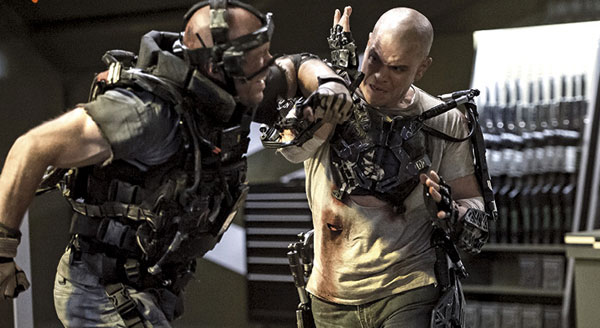
Elysium: B   (see full review)

        Honestly, the biggest thing that held this one back for me was the blessed shaky cam.  If Blomkamp had succeeded better in delivering top-notch, R-rated sci-fi smackdowns, I would be much more willing to forgive Elysium it’s various other flaws; the rushed character developments and conflicts, how little of Earth and Elysium we actually see, Jodie Foster completely phoning in her performance as the right-wing conspiracy theorist, those bizarre-ass cherry trees in the final fight scene (really?  Cherry trees in the middle of a warehouse?  And they just happen to be blooming NOW?), etc.  Sadly, even when the fight scenes do come around, aside from a few excellent bits involving guns that I want right now, it’s nearly all shaky and stirry and completely indecipherable until after the final blows have landed.  Better luck next time Niell. 

Ironman 3: B-   (see full review)

            I’m being very charitable with this one.  I enjoy Downey’s Tony-Stark-a-thon as much as anybody, but this is the movie where he finally stretches the persona to its douchebaggy breaking point (or that could have been the writers.  Who knows).  Plus, I’m really, really sick of seeing Pepper Pots (thus far the ONLY interesting female character in the entire Avengers franchise) get pushed to the side in increasingly insulting ways (yeah, I said it, the ONLY one.  Come at me bro).  I’ll give the film credit for bending over backwards to make up for that by literally having her save the day in place of Tony, but even that is almost immediately ruined by her horrible follow-up line- “Oh my God!  That was really dangerous!  Come Tony, protect me with your big, strong man arms!” 

            That said, the action was creative, especially the bits where Tony fights with only half his suit on, the finale does deliver on the ‘ol razzle-and-dazzle, the banter is as crackly as ever, and I personally enjoyed the slower second act, where Tony befriends a young admirer of his while in hiding.  And then there’s Ben Kingsley.  Who was perfection in a beer can.  So on the whole, I’ll give it a pass.     

            Oh yeah, and War Machine exists.  Not that anyone can really tell.  Ahem. 

Wolverine: N/A

            Didn’t see it.  Do not care.  See also Riddick, Furious 6, After Earth, The Lone Ranger, and Kickass 2

Star Trek Into Darkness: C   (see full review)

            Into Darkness has the dubious distinction of being, as far as I can remember, the first time I was actually glad I’d had the ending spoiled for me before going to the theater, because if I’d gone into it cold, it could very well have killed the entire film for me.  Not that the terrible, terrible ending was the only problem with the movie- screen time between the characters is horribly imbalanced, Kirk is never forced to actually take responsibility for his actions, and the f***ing lens flares all over the damn screen were big distractions, to name just a few.  I also heard later than Abrams had criticized the original Star Trek for being “too smart.”  I hope that’s not true, because if it is, I will need to find him and punch him.  Hard.  Despite all that, though, I still maintain it’s far from the worst Star Trek movie- the franchise has suffered plenty of sad excuses for films, and it will survive this one.  At least the actors are still bringing it- if it hadn’t been for the KHAAAAAN shout, Uhura’s and Scotty’s performances during Kirk’s death might have saved the scene from itself.  And the music is great. 

Man of Steel: D+   (see full review)

        I don’t hate this movie.  Really, I don’t- I’m not invested enough in any of the superhero franchises to be “hurt” by a particularly bad or problematic one.  However, this still gets the worst grade of the summer in my book because it’s the only action movie of the year that I honestly don’t ever want to see again (yes, I’d even rewatch Into Darkness, if only to laugh at it).  Some of the action is good, Shannon’s Zod is a blast to watch, and Cavill himself is a pretty decent Superman, but boy, did this movie need to lighten up.  A lot.  And it also really, really needed to drop the Lois Lane and the Daily Planet entirely.  I very much want to see a movie that turns me into a Superman fan.  Man of Steel came close, once- the scene where Clark finally pushes himself to fly was the only moment of pure magic the film had, and it was gone all too quickly.  

            And those are my grades for the only action movies of the year I could be bothered to see (and could afford to).  Will I ever watch any of the others, given the chance?  Possibly.  Except Lone Ranger.  And Furious 6.  Or Kickass 2.  Or Riddick.  So, probably none of them.

            Up next, my review of Blue Jasmine!  Finally, the great English-language films of the year are coming out.


-Noah Franc