Monday, November 16, 2015

Review: Omoide no Mani (When Marnie Was There)

When Marnie Was There (Omoide no Mani) (2015): Written by Keiko Niwa, Masashi Ando, and Hiromasa Yonebayashi, and directed by Hiromasa Yonebayashi.  Starring: Sara Takatsuki and Kasumi Arimura.  Running Time: 103 minutes.  Based on the novel of the same name by Joan G. Robinson. 

Rating: 3.5/4   


             There is a wonderful way in which movies produced by Studio Ghibli seem to breath, move, and live at their own special pace, even as you are watching them.  This is especially true for their quieter works that are consciously set in very normal, real-world settings, and many of which are lesser-known as a result.  Films like Whisper of the Heart, My Neighbor Totoro, Only Yesterday, Kiki’s Delivery Service, and Arrietty, while perhaps containing some fantasy or fairy-tale characters or elements, eschew the more overtly-astounding visuals and grander themes of Princess Mononoke, Spirited Away, or Grave of the Fireflies, choosing instead to focus on small stories in times and places you could easily imagine yourself occupying.  They are meditative, lavishing an almost heart-rending level of attention to every detail of the postcard-perfect worlds they create, making every frame seem like a home someone has lived in for a very long time.  When Marnie Was There, possibly (though not yet certainly) the last feature-length movie Studio Ghibli will gift to the world, falls into this category.  If it really is to be their last act, what a beautiful final movement it is. 

            As is overwhelmingly the case where Studio Ghibli is concerned, our main character is a young girl, a 12-year-old orphan named Anna.  We first meet her in the city of Sapporo, where she lives with her foster parents.  Anna is, to put it very mildly, not your usual innocent-and-happy-as-a-clam preteen Disney protagonist.  She struggles with depression, passive resentment towards her dead parents, and (this is hinted at later) a strong dislike of her somewhat-foreign physical appearance.  She sits apart from the other children at school so she can draw out the fantasies in her head, seeing herself as outside a circle occupied by everyone else.  Worried that the environment of the city is too much for her (she has asthma, and the film opens with her having a particularly bad attack), the mother decides to send her to spend the summer with some relatives of hers in a small seaside town, thinking a few months of fresh sea air will be just what she needs, both physically and mentally. 

            The place is charming enough when Anna arrives- the couple she is sent to stay with is jovial and friendly, and her room has a stunning view of a nearby cove.  When she first goes out to explore, she notes a grand, but aging, mansion across a marsh, and runs over to check it out.  Finding that is has clearly been empty for years, and noting that evening is upon her, she turns to leave, only to realize that the tide has come in and she is cut off from the other shore.  Thankfully, a local fisherman (known, we later learn, for almost never speaking) happened to be coming by on his way in, and he takes her back with him on his small boat.  Relieved, she turns back for one last glimpse of the house and….wait, are those lights in the upper bedroom window???

            This is the first of a number of major twists in the story; each one is expertly executed and, bit-by-bit, they build up a remarkably multi-layered mystery yarn.  When Anna goes back to the house, at first abandoned but then suddenly lit-up and new-looking again, she meets a cheerful, vivacious, blond-haired girl about her own age, named Marnie.  Marnie is everything Anna is not- lively, outgoing, and endlessly cheerful- but they immediately feel drawn to each other (indeed, Marnie drops hints she’s been expecting Anna), and as the days go by Anna starts to think only of when she will see Marnie next, and what sort of new adventures they will have together. 

            If an empty house suddenly coming alive with apparently real people only at night wasn’t enough of a tip-off for you, all is not as it seems.  Is Marnie a ghost?  An angel?  Something worse?  Or is Anna hallucinating the entire time?  As simple as the core narrative of the film is, much of its brilliance lies in how all but the best guessers will feel in the dark about what’s really going on right up until the scene of final revelation comes about at the end.   

            Tied into the central mysteries of the main story are a lot of side themes that, unfortunately, are for the most part only hinted at- issues surrounding depression, emotional abuse, crisis of identities, passive xenophobia, the struggles of being an orphan, and even sexuality can be glimpsed in scenes here and there.  Most of them ultimately center on Anna’s crisis of identity, and that is the main focus of the film by the end.  One of the biggest things she wrestles with throughout is her complicated feelings about not knowing her real parents, which are tied up into her equally complicated feelings about her foster parents.  Her foster mother, despite only appearing at the beginning and the end, leaves an especially big impression- we see so clearly how much she loves Anna, and how hurt she feels that she doesn’t know how to help her more.  A crucial moment at the very end between her and Anna (which I will not dare spoil here) is one of the film’s most powerful moments, an incredible example of brilliant character animation.   

            Speaking of the animation itself, this movie is, of course, visually stunning; this is Ghibli, after all, so what else would you expect?  Blues and greens are the order of the day, with the sea and sky combining with the greens of the island marches and forests to create a calming effect, which aids in the dreamy quality of many of the film’s best scenes. 

            Sadly, not all of the potential threads or problems the film sets up are brought to play at the end.  The silent fisherman, for example, looks like he might end up being someone important to the story of who (and what) Marnie really is, but whether or not that is the case is never really resolved.  And while the scene that, for the audience, answers all hanging questions is great, it’s undercut a bit by the fact that Anna herself apparently only puts the pieces together in another scene 5 minutes later.  It’s not a flaw or failing of the film, per say, but arranging the scenes that way was an odd choice, to say the least.  But with that said, even if you are ultimately not entirely satisfied (or maybe even more confused) by what explanations are offered by the end, When Marnie Was There is nonetheless an incredibly moving and beautifully rendered coming-of-age tale, easily one of the best animated films of the year thus far, and if it must be so, a graceful last note by the Meisters of Studio Ghibli. 


-Noah Franc 

Monday, October 26, 2015

Review: Er Ist Wieder Da (Look Who’s Back)

Er Ist Wieder Da (Look Who’s Back): Written and directed by David Wnendt.  Starring: Oliver Masucci, Fabian Busch, Katja Riemann, Christoph Maria Herbst, Franziska Wulf.  Running Time: 116 minutes.  Based on the novel of the same name by Timur Vermes. 

Rating: 3/4


            We all know who Adolf Hitler is (or at least we should know, and if any of you reading this don’t, get off my lawn).  We know about World War II, the Holocaust, the genesis of the Cold War, etc. etc.  We have memorials about the war and the victims, museums, and an entire country created expressly because of the targeted genocide of Jews.  And we have movies.  So, so, so, SO many movies, all together summing up a single, statement of purpose; this cannot happen again.  It WILL not happen again.  We know how bad it can get now.  We know how far off-kilter an entire country can go, and we know what all the warning signs look like, Hitler’s dead, and Jews have their own country, so now we’re good.  We know what we know, so all this shit can’t possible come about again. 

            But do we really know?  For all the lip service people (German especially) pay to these past events, all memories dim with time and death, so how can we be sure the mistakes that allowed Hitler to rise can’t possibly come about again?  And….wait, aren’t a lot of them happening again already?  These questions are the backbone of Timur Vermes’ 2011 bestseller, Er Ist Wieder Da, and now, 4 years later, it has come back to us in movie form. 

            It is 2014.  Adolf Hitler suddenly wakes up in the middle of Berlin.  Perfectly healthy and unwounded, but somehow a good 7 decades in the future, long after the end of the war and his presumed death.  The why is not addressed in the book, and it’s not addressed here, so don’t let that question stick in your head too long- he is simply here, and incredibly disoriented and confused.  He wanders the streets, unable to understand why no one can recognize him as their beloved Führer, until he happens across a small coffee stand run by an average Joe.  Thinking Hitler to just be a really extreme method actor, he puts him up for a few nights until one of his frequent customers, a recently-fired employee of the nearby television production company MyTV named Fabian Sawatzki, comes along and meets him as well.  He also thinks Hitler is just a really dedicated method-comedian, doing Hitler totally straight-faced to be “ironic.”  He and the stand manager both find it hilarious, and he hatches a scheme to use this person as his ticket back into the big house. 

            On his end, Hitler figures out very quickly he’s experienced some strange form of time travel and is most definitely not in Aryan Kansas anymore.  He is shocked and disheartened by how far back his goals and plans have been set (and more than offended when he uncovers the many attempts by actors to portray him over the years), but never one to give up, he decides to start from scratch, and decides to follow along with Sawatzki so as to use TV as the medium through which he will rebuild his following, taking each opportunity to rise further as it presents itself. 

            They start small, but things snowball quickly- a few scenes shot around the Germany with him just chatting with regular people are enough to get them a spot on one of MyTV’s premier shows, under the ever-watchful eyes of the company’s head producers (and mutual rivals) Katja Bellini and Christoph Sensenbrink, and aided by a gothic secretary named Krömeier, who may or may not have a crush on Sawatzki.  From there, through sheer dint of personality and his refusal to follow any of the shallow scripts the company writers provide for him, Hitler and his overt, outlandish style become a Youtube sensation, rapidly eclipsing the more established performers alongside him, and setting off one controversy after another with everything he says and does (including barging into the official HQ of a far-right German political party).  As his fanbase and popularity grows, the only question is how far things will go before someone- anyone- realizes the truth about who he is. 

            It’s hard to pin down precisely what kind of story this is.  It’s part satire of our modern, click-obsessed culture, where the more outlandish, graphic, or terrible something is, the better, part fish-out-of-water tale, part pitch-black comedy about how the worst elements in human nature rear their ugly heads again and again.  It’s also part TV-documentary, since large stretches of the film consist of raw-looking, handheld footage of Hitler just driving around Germany and talking to people, whose reactions to a Hitler-lookalike appearing in their midst vary widely (it’s clear some of these were made without the people knowing they were in an actual movie).  Most, like Sawatzki and his colleagues, just laugh it off or dismiss it as a crude publicity stunt, and happily sit down for him to sketch them.  It can’t be anything serious, because after all, they (and we) all know what we know- the REAL Hitler’s dead, and the lessons have been learned, so no harm, right? 

            On the surface, this may strike one as a major weakness with the whole plot- how can no one figure out that it really IS Hitler they are talking with?  Why does no one think to stop him?  Well…..would you?  We have become so skeptical as a society, and so ready to assume there must be a rational, logical reason for something we see or experience that, in a way, this movie works BECAUSE it fully copies our expectations of a wholly rational world where all can be known and explained, and then tosses in a simple fact diametrically opposed to it.  The clash between our 21st century mindset and the very existence of Hitler, back again against all possible explanation, are the meeting of an unstoppable force and an immovable object, and it’s the backbone of both most of the comedy and the more serious messages of the tale. 

            Since the movie is entirely driven by Hitler’s own perspective, this is the sort of film that lives or dies by the performance of its lead actor.  Fortunately, Oliver Masucci commits himself entirely to the role (something many people would not be remotely willing to consider), and it’s hypnotic to watch him go to town on hapless comedians, pedestrians, and politicians who literally haven’t the foggiest clue with whom they are speaking.  And like in the book, he’s really the only figure worth taking note of; the other characters above are present, but don’t really play any major role in the story other than to reflect aspects of its broad themes.  That said, there are some notable changes from the book, particularly where Sensenbrink and Sawatzki are concerned.  Sawatzki is a bit more of a pathetic, hapless figure with a much broader story arc (although revealing more than that would be a huge spoiler).  Sensenbrink is inexplicably made into a side villain, doing all sorts of petty things to derail Hitler and Sawatzki’s ascent into primetime, and failing spectacularly.  While it does lead to a direct and fantastically funny reference to Der Untergang (Downfall in English, which featured possibly the best-known film rendition of Hitler to date, excluding Chaplin’s), it also fails to be of any real relevance to the rest of the film, and is dropped entirely by the end. 

            Strangely enough, I found the movie to be at its best during the moments (especially during the mind-bending third act) when it deviated from the book entirely, even directly breaking the fourth wall on a few occasions.  The sections following the other characters and tracking Hitler’s rise as a TV/internet star, which hew very closely to the book, are certainly well-made, but also by the numbers, and they don’t gel well with the nuttier and more direct-messaging stuff in the rest of the running time.  It’s a dissonance that is, in my view, the film’s greatest weakness, but thankfully it’s never a fatal one. 

            Another key difference that will ultimately boil down to taste is how it takes the passive or latent themes and messages in the book and makes them much more obvious and front-and-center.  Even though it’s never stated (since we only ever hear Hitler’s perspective, and no others), the warning it’s trying to send is clear- the whole way we’ve gone about “learning” from events like WWII is all wrong.  We so often try to push the Holocaust and everything associated off onto the shoulders of Hitler and a few cohorts of his, making it out to be something unique to that person and time.  So as long as Hitler himself is around, it won’t happen again.  We know what we know, remember? 

            This is, of course, disingenuous at best and a bald-faced lie at worst.  Hitler was a product of his time, and as he himself reminds characters in the book and movie, he had (at least at first) legitimate popular sovereignty behind him.  His guilt is our guilt.  And yet, as he himself also points out, since he openly declared his plans and the people chose him anyway, “not EVERYTHING could have been so bad.”  How to reconcile this with our immediate moral revulsion to what really happened is the primary question the book and film present us with, and neither provide an answer.  You’ll be left chewing on it for a long time afterwards, with an uncomfortable aftertaste lingering at the back of the mouth.  If this is not the case, then you weren’t really paying attention the whole time, or you’re keeping yourself deliberately ignorant.  While the movie making this more explicit and in-your-face than the book certainly removes some of the novel’s brilliant subtlety, it also lends its powerful ending a more forceful urgency, which I did not find to be inappropriate given many recent world events. 

            But then again, maybe I’m overblowing the seriousness of this.  People suffered then, but it’s time to move on, right?  As Bellini points out herself in a final interview, hasn’t the shadow of the past been hanging over German spirits long enough?  Haven’t they earned the right to move forward?  We’ve recorded and memorialized everything, and we’ve stopped telling Jewish jokes, so time to strike out for the future.  It’s not like things that extreme could ever happen again, at least not here. 

            After all, we know what we know.  You know? 


-Noah Franc 

Wednesday, October 21, 2015

Review- Dragonball Z: Resurrection 'F'

Dragonball Z: Resurrection “F” (2015): Written by Akira Toriyama, directed by Tadayoshi Yamamuro.  Starring: Masako Nozawa, Ryo Horikawa, Toshio Furukawa, Ryusei Nakao, and Mayumi Tanaka.  Running Time: 94 minutes. 

Rating: This film cannot be rated

           I can honestly say that ever since I started writing film reviews, I never thought this day would come.  Despite the pretty lenient guidelines I give myself in terms of what I can count as a “new” film for my yearly counter, and thus be able to write a full review about, not once did I think that I would have the chance to write one about Dragonball Z, one of the foundational shows of my childhood.  And yet, here we are.  In April of this year, Dragonball Z: Resurrection “F” (from here on out referred to as DBZ:RF) received its theatrical release in Japan, and a mere 4 months later it got a brief and very limited release in the US.  Limited it may have been, but it still falls under my rules regarding theatrical releases, and therefore counts. 

            “Even the complete obliteration of his physical form can't stop the galaxy's most evil overlord. After years in spiritual purgatory, Frieza has been resurrected and plans to take his revenge on the Z-Fighters of Earth. Facing off against Frieza's powerful new form, and his army of 1,000 soldiers, Goku and Vegeta must reach new levels of strength in order to protect Earth from their vengeful nemesis.”  This is, literally, the entire title summation of this movie’s plot on Rotten Tomatoes.  And it is all you need to know.  There’s an beauty to be found in its poetic simplicity.  Perverse, almost.  Because this is Dragonball Z, and if you need any more reason or explanation, or any justification for why the walls of Death itself have no meaning, you’re watching the wrong movie.      

            To be fair, almost none of the DBZ movies (although some early ones are exceptions) count as films in any real sense, hence why applying any traditional rating to them is in an exercise in impossible futility.  They are nothing more than extended specials of the show- each assumes you already know the main characters, their backstories, and their relationships to each other, and simply conjures up a baddie otherwise completely unmentioned in the regular episodes for Goku (and it is always, inevitably, Goku, because) to beat the living shit out of before blowing him (and it is always, invariably, a him, because) to Kingdom Come.  Sometimes, there is an army of hapless minions for the others to pick apart.  Sometimes there is not. 

            It is a tired, staid, and sorry excuse for a narrative…and boy, was it one hell of a sweet nostalgia bomb to sink back into.  If I hadn’t seen Spy, Inside Out, and Trainwreck already, I would be proclaiming DBZ:RF  to be the funniest movie of 2015 to date.  The baddy we get to see smacked around this time is, as I’ve mentioned already, Freiza, which should be a joke given how stupidly-overpowered just about everyone is now compared with when he first appeared, but they duck around that in literally 5 seconds flat by revealing he simply never actually trained to increase his strength before, but since he finally knows how strong Saiyans can get, he will now do so.  He does.  The results are phenomenally funny. 

            But wait, you say, Freiza’s dead!  And not only is he dead, he was brought back before, and Gohan punched him and he literally exploded.  Remember when that happened?  Neither does Gohan, apparently, nor anyone else.  But I can’t nitpick that, since none of the movies have ever been treated as canon.  Anyway…

            If you need even a hint as to how Frieza was brought back to life, I recommend you double-check the title of this franchise.  He takes control of the remnants of his once-powerful forces and heads straight to Earth for the sole purpose of extracting revenge on Goku.  Because that worked out so well the last time.  Piccolo, Krillin, Gohan, Tien, and for some reason Master Roshi, plus Jaco the Galactic Policeman, are on hand to basically demolish the army while barely breaking a sweat, until Frieza finally makes him move.  He is stopped just in time when Vegeta and Goku are brought back to Earth by Whis and Beerus, with whom they have apparently been training since the end of the past movie. 

            This all happened in just over the first half of the movie.  So the rest of it is just Goku, Vegeta, and Frieza (but mostly Goku, because fuck Vegeta, amiright?) hashing things out with some staggeringly awful CGI fighting.  There are hints of lessons that both still need to learn as fighters, but to my disappointment, this ends up playing absolutely no role in the conclusion of the battle.  The day is saved, along with the Earth, nothing is learned, and everyone goes about their day.  And no, that is not a spoiler, because like I said, this is a DBZ movie.  They aren’t even going to try to make you guess how things will turn out, so why should I? 

            It was refreshing to see that somewhere between the end of the Majiin Buu Saga, by which time this franchise had officially been banned from the house by my parents, and the present day, the DBZ franchise has attained an almost nirvana-esque level of self-awareness.  The utter incompetence of Yamcha and Chiaotzu in a fight are admitted to right at the start, and the two never even make an appearance (while, again, MASTER ROSHI was considered strong enough to bring into the fray).  Even Frieza gets in on the winking fun- he directly names the toy based on his new form that, I am sure, has already been made, calling it the “Golden Frieza.”  When I was a kid, we would theorize about such forms existing for the various characters, and it’s nice to see the mind-readers in Toei Animation HQ took notice of us humble American brats.   

            In the end, the question of whether or not this film is worth your time if you were not an at least somewhat obsessive fan of the show is a moot one- of course it’s not.  What are you even doing here?  For those of us who could never get enough howling Kamehamehas, the question is- does this latest addition to the DBZ film series hit enough of the needed adrenaline points to be worth an hour and a half of your evening?  I would say it depends on your level of self-awareness.  I had a gay old time of it myself, but the overuse of CGI and reliance on an already-known villain, albeit an iconic one, do keep it from rising above its pulpy, TV-special origins.  That might make it too much for some to sit through.  Then again, for many of you, that might be exactly the point.    


-Noah Franc   

Friday, October 9, 2015

Review: The Martian

The Martian (2015): Written by Drew Goddard and directed by Ridley Scott.  Starring: Matt Damon, Jessica Chastain, Kristen Wiig, Jeff Daniels, Michael Pena, Kate Mara, Sean Bean, Sebastian Stan, Aksel Hennie, Chiwetel Ejiofor, and Donald Glover.  Running time: 141 minutes.  Based on the novel of the same name by Andy Weir. 

Rating: 3.5/4


            It’s always frustrating when a great and beloved artist comes out with something far below their usual (or “accepted”) standard.  It’s especially painful when it seems to happen with everything they do for an extended period, one round of disappointment after another.  At the worst of times it can leave erstwhile fans wondering if all the hype was for naught, if someone they admired has already peaked, and maybe wasn’t that great to begin with.  Ridley Scott has been caught in just such a spiral for some time now, with just about every major release of his over the past 5-10 years plagued by repeated production delays and/or constant script rewrites.  In a few cases, Scott seemed to morph into his own worst enemy, looking like he himself was never entirely sure what sort of movie he wanted to actually make. 

            Well, never fear fellow fans, because the Scott is back.  The Martian is easily the best film he has come out with in years, and right up there with some of the best works of 2015 so far, and will most likely walk away with a decent profit margin and a few bits of Oscar gold before all is said and done. 

            It’s just a tad bit into the future, and NASA has advanced enough to actually be able to send a small team to Mars for a brief mission.  However, the rise of a sudden sandstorm forces them to abort ahead of schedule, and the ensuing darkness created by the storm causes them to lose the team botanist, Mark Whitney, played by Matt Damon.  With no choice but to assume the worst, the team heads back weighted with guilt, while the PR people back home break the news to the public. 

            Whitney, however, is not dead, just injured by a satellite that cut the feed from his suit.  Finding himself as abandoned as a human being could possibly be, he almost immediately begins to work on finding some possible way to ensure his survival as long as possible.  I won’t go into all the many pathways this takes, since that would require me to spoil much of the second act, but the gist of the situation is this; he can’t expect another mission to arrive for at least a few years, he doesn’t have any way to contact NASA directly and ask for help (at least at first), and while the tech he has on hand could theoretically keep him breathing and hydrated indefinitely, the remaining foodstuffs he has would barely get him through a single year in isolation, let alone 3 or 4. 

            So he gets to work.  For the sake of future record-keeping, he films himself trying to mash together Martian sand, leftover feces, potato bits, and chemicals to make water so as to be able to grow his own food supply.  Funnily enough, this provides Matt Damon with a ready-made excuse to literally act right into the camera (and thus directly to us), wisecracking about how he’s besting every other accomplished astronaut to date and lamenting the questionable taste in music of his team captain, whose left-behind laptop is the only source of entertainment he has.  It’s the sort of wise-ass leading-man style we’ve gotten a lot of lately, especially in the world of comicbook blockbusters, but Damon never overdoes it, and he balances it out with a few appropriate moments of real emotional pathos, as the immensity of what he is doing (and where he is) inevitably overwhelms his otherwise extremely professional demeanor.  Damon has rarely been better in his career. 

            In the sense that the story is your basic survival narrative, it’s not unlike Gravity from a few years back, but with the added strength of not asking us to tolerate Matt Damon and no one else for two hours.  As we follow Whitney’s survival gambit, we learn that NASA finds out almost immediately via satellite imagery that he is definitely alive, and they immediately set about bringing in all manner of experts (including some Chinese ones towards the end) in what becomes a truly collective team effort to provide every sort of assistance they can, and eventually both they and the returning crew (simultaneously overjoyed Whitney is safe and horrified that they did indeed leave him there to die) come up with a daring rescue plan, leading to an immensely satisfying final act.  The plot itself never rises above its Castaway origins, but the polyglot cast is so good- the list of incredible talents they brought together for this is breathtaking to behold, and everyone delivers- and there are so many interesting moving parts to follow that I can’t imagine anyone walking away from this one without at least one scene or character they loved.  Nothing wrong with simplicity of substance if the execution is done with skill and grace. 

            The focus on team work, the importance of pooling collective expertise, and the need to never give up and never stop trying, even against overwhelming odds, are a continuation of the same theme of unstoppable optimism and hope for the future that pervaded both last year’s Interstellar and the aforementioned Gravity from the year before that.  If big-budget, visually-thrilling space adventures undergirded by upbeat messages about the future of mankind are a thing now, then count me in.  Given the current state of the world, this is exactly the kind of cinema we need. 

            If I had a nitpick, it would be that I couldn’t escape a sneaking suspicion that isolation that long, even with some limited means of communicating, should take a more obvious and visible toll on someone.  Matt Damon has a few moments where his cool-guy ‘tude fails him, and he nearly breaks, but they are always short and spaced far away from each other.  He doesn’t become mechanical though, and having him pull through psychologically as well as physically fits into the overall thesis of the movie that there really is nothing a person (or people) aren’t able to get through.  And as long as we never stop trying to solve the problems that come our way, we will inevitably come out the stronger for it. 

            Amen to that. 


-Noah Franc 

Saturday, September 26, 2015

Review: Queen of the Desert

Queen of the Desert (2015): Written and directed by Werner Herzog.  Starring: Nicole Kidman, James Franco, Damian Lewis, and Robert Pattinson.  Running Time: 128 minutes. 

Rating: 2/4


**for safety’s sake, a minor spoiler warning, since I can’t really talk about this movie without comparing it to the historical record**

            Gertrude Bell is easily one of the most remarkable, brilliant, fascinating, complex, and downright badass women you’ve never heard of.  Compelled early on to leave the straightjacket of Victorian English high society, she traveled extensively throughout the Middle East prior to, during, and immediately following World War 1, developing almost unparalleled knowledge of and appreciation for the rich cultural, architectural, and artistic history of the various Arab and Bedouin tribes she encountered.  She quickly became completely fluent in Arabic, and through her linguistic and diplomatic skills, she gained the personal trust of some of the most important and powerful Arab princes of the time.  After the fighting ended, she and her close friend T.E. Lawrence played perhaps the biggest role in creating the Middle East as we currently know it, helping define the modern-day (and entirely ahistorical) borders of Syria, Lebanon, Iraq, Jordan, Kuwait, and Saudi Arabia, ensuring that the prince Ibn Saud gained regency over Saudi Arabia, and seeing that two of her closest friends, the brothers Faisel and Abdullah Hussein, received rule over, respectively, newly-created Iraq and Jordan.   

            It is an incredible legacy to try to fully comprehend, one where her own personal triumphs are arguably overshadowed by the very dark and violent legacy her influence over the shaping of the region still has.  Saudi Arabia and Jordan are still ruled by these respective families to this day, and the Saudi family in particular has been and remains one of the biggest financiers of Islamic fundamentalism in the world.  The artificial borders she and other British officials insisted on creating, which threw together combustible mixes of religious and ethnic groups that had long been antagonistic towards each other, were combined with top-down, authoritarian styles of government that, together, have been the genesis of almost a century of violent, armed conflict, culminating in the violence we now see consuming Syria, Iraq, Lebanon, and Yemen. 

            I begin with this brief review of geopolitical history in order to provide you with at least a small idea of just how much ripe material for a great movie there is imbedded in the story of Gertrude Bell.  Her own experiences are remarkable enough, and when you also consider how her shadow still lingers over the Middle East to this day, you’ve got enough there to make another historical, socio-politically relevant masterpiece like Selma or 12 Years A Slave.  Or at the very least another Lawrence.  What we get, much to my disappointment, is considerably less than that. 

            We start with a very rushed and exposition-heavy opening, meant to establish Gertrude’s restlessness, reputation for getting into trouble, and fervent desire to escape Britain.  Her father, always willing to accommodate (until he isn’t at a later point in time) gets her an assignment with a relative in the consulate in Persia (today Iran).  This was the first encounter with the larger world that would lead Gertrude to set off on her later wanderings.  It was also the first of her several forays into romance (none of which ended happily)- she falls in love with one of the lower officials, Henry Cadogan (played here by a still-stoned James Franco), but since he is of neither money nor high birth, her father says no.  She returns to England for a time to try to convince him otherwise, but her plans are tossed completely in the air when word arrives that her beau has died quite suddenly and (of course) tragically. 

            It’s a breaking point, of sorts- with nothing to hold her back, she sets her sights on the larger Middle East, at this time still mostly under the heel of a dying Ottoman Empire.  With a few trusted Arab guides, she sets off on regular forays into the wastes of the desert, drawn to how dream-like and free her life there is.  It is during one of her first trips to a British excavation site that she meets a young T.E. Lawrence (Robert Pattinson), and the two strike up a deep, lifelong friendship, anchored by their mutual appreciation of Arabic culture and the immense amount of history to be found in the region.  Through a series of harrowing escapades, she identifies the key power players amongst the tribes, and as a result, she becomes increasingly invaluable to a British government hoping to divvy up the spoils of the coming war, even though her presence and expertise are about as divisive as you can imagine- some see her as a pestering nuisance, and others fall head-over-heels for her (literally). 

            Given the depth of narrative potential here (only some of which I’ve had the space to mention), it’s actually quite astonishing to me how little of it ends up on-screen.  I’m really kind of in shock.  Up to this point, I would have said Tomorrowland was the biggest disappointment of the year, but at least Tomorrowland had some sequences of true cinematic poetry.  Queen of the Desert, on the hand, wanders like Gertrude herself through the directionless desert, with no effort to wrestle the disparate and scattered moments from her life into anything resembling a cohesive narrative. 

            This is especially true in the second half.  We get bits of the information she gleans during her travels and are provided some sense of its later importance, and while I was able to piece together what was I was seeing, I think I have an unfair advantage over most viewers in that I have actually read the biography of Bell the screenplay was (largely) based on.  None of the many, many, MANY threads connecting the events surrounding Bell, Lawrence, and the war and our present world are touched on, except in the most cursory of blink-and-you’ve-missed-it ways.  Even the easy catch, telling her story as a heroic triumph of a kickass woman over that damn, silly patriarchy, is mostly ignored.  A few moments of her telling off British officials for presuming to give her orders are the sorts of scenes that should be definitive for a film like this (or at least Oscar-baiting), but because they occur with no setup and with no indication of how much she had to go through to get that point, they inevitably fall flat. 

            Perversely, the most structurally and tonally cohesive section of the entire film is the least interesting part of it, specifically Bell’s first dating misadventure with James Franco’s Cadogan at the Persian embassy, which takes up almost a third of the entire running time.  It is, perhaps, important to understanding what later motivated her, but it’s treated as an epically tragic short film in its own right (not to mention that it takes a VERY big, and in my opinion inexcusable, liberty with the circumstances of the man’s death).  And it’s just not that interesting, especially when compared with all the other heady stuff the film could have focused more on later. 

            All of this is a real shame, because the movie does at least look very good (this is still Herzog, after all), and the cast assembled (Franco aside) is more than up to the task of playing their respective characters.  This was a great role for Kidman, and I’m quite sorry she didn’t get more, less romance-obsessed material to work with.  And- although this will be heresy for many- Robert Pattinson continues to prove the Twilight films a fluke by holding his own quite well as Bell’s contemporary, the much-more-legendary T.E.  No, it’s no Peter O’Toole- no one can do Peter O’Toole- but he effectively elevates the criminally small number of scenes he’s in, and honestly, I would have gladly taken more. 

            Ultimately, the movie is not actively bad- I have certainly seen worse this year- but it doesn’t soar the way I’d hoped, the way it should have.  Viewers with no previous knowledge of Bell or of the history she was part of will hardly leave the theater better informed than before.  Which just might be the worst possible outcome for this type of film.  Gertrude Bell has gotten a shameful lack of attention in our culture, long deserving of her own biopic.  She deserves a better one that what she got here. 


-Noah Franc   

Tuesday, September 22, 2015

Review: Taxi

Taxi (2015): Written and directed by Jafar Panahi.  Starring: Jafar Panahi, Hana Saeidi.  Running time: 82 minutes. 

Rating: 3.5/4 


            There are obviously a lot of passionately divided opinions about the nature of the recent nuclear accord reached between the US and Iran.  It will be a long, long time before we can ultimately assess how positive or negative the effects of this deal will be, but I think it is already safe to say that they will be momentous either way, and like any sane person, I am hoping for the best outcome possible.  This is mostly for the obvious big-picture, geopolitical reasons, but I also have a smaller, personal motive for pulling for the agreement thing to succeed- maybe, just maybe, increased ties to the global order and greater economic prosperity will nudge the Iranian government towards loosening its restrictive domestic policies, and the director Jafar Panahi and other artists like him will finally be able to walk free, to create and tell the stories they currently have to keep hidden in the recesses of their minds. 

            Most Americans who know Panahi will likely know him for the Oscar-nominated This Is Not A Film, the title itself a biting play on the fact that Panahi was banned from making any films by the Iranian government following the failure of a series of post-election protests in 2009 (since then, he has been given tentative permission to “unofficially” make movies).  After that film received no small amount of international renown, he came out with Closed Curtains, about a man cooped up in a house covered in curtains (and from there the real-life parallels only get more obvious).  At the time, one critic wondered whether or not his prolonged captivity and the severe restrictions it places on his artistic freedom might eventually lead to him hitting a “creative wall.” 

            Now, though, Panahi has once again found his own unique way around the absurd circumstances he still finds himself subject to, proving, if nothing else, that true human creativity can never be contained, and will always out itself one way or another.  Indeed, why else would autocrats and dictators go to such extreme lengths to dominate, kill, or exile the artists before all others?  They know- even if many in the West have forgotten this- that true power to move and change the hearts and minds of an entire people comes not from scientific discoveries or rising stock indexes, but from the arts, and all the myriad and subtle tools they have access to that can shape our thoughts, words, and deeds. 

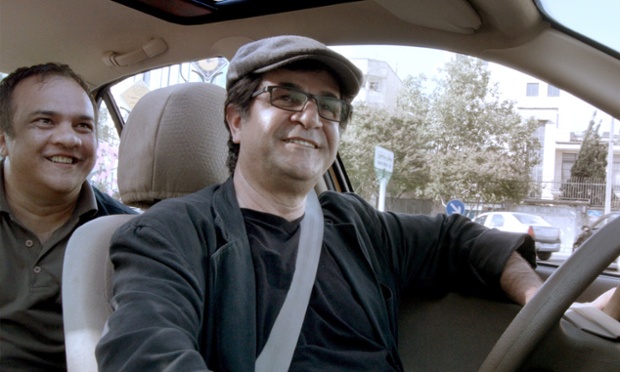
            Taxi is one of those films I would describe as a “meditation on existence,” if such a phrase makes sense.  With no apparent narrative thread in place, Panahi takes us into a typical Iranian taxi car, fixes a few cameras to the dashboard, and embarks on a day-long odyssey through the streets of Teheran.  Most of the film consists of short segments centered around one or a handful of passengers that get in, ask to be taken somewhere, and chat a bit with Panahi about pretty much anything under the sun before getting out.  There are two people that make extended appearances- in the first half, we get many earfuls on the benefits of selling pirated films from a street hustler, who instantly recognizes Panahi and knows he’s not a real taxi driver.  The second half is dominated by the presence of Panahi’s joyfully witty niece, who opens up by berating him for daring to pick her up in a mere taxi cab- it seems she’s been bragging to her classmates that her uncle is a famous filmmaker, and if they saw him now they would think she was lying.  As she puts it- “If you don’t want to think about your own career, then think about mine.” 

            I wrote “people” and not “characters” above because it’s not clear how much of the scenes and people presented are real things Panahi caught on film by chance, and how many of them were staged, or at least knew from the start they were in a film.  The hustler and a few other scenes with people that recognize Panahi, as well as the presence of his niece and her constant, almost fourth-wall-breaking chatter about filmmaking techniques and Iranian film laws, could certainly give off the impression that they had been directed at least somewhat.  Then again, a few other scenes come across as powerfully, viscerally real.  If they were real, it was an extraordinary stroke of luck that Panahi happened to pick the day for filming that he did.  If not, what a remarkable job he did in finding the perfect actors to play their respective roles.  Ultimately, whether or not all, some, or none of the scenes in the movie are real is a question I think I would rather not have answered.  At least, not yet. 

            If there is a key importance to this movie, it would be in how effectively it works in reminding viewers that, beneath all the rhetorical bluster about Satan and genocide exuded by the Iranian government, Iran remains a place like all other places- full of ordinary people, good and bad and in between, just trying to get by and create decent lives for themselves and their families.  This is especially the case with the women we encounter, who come in all shades of dress, age, and attitude, and will certainly relieve more than a few viewers of their own half-formed stereotypes about Iranian gender politics.  Each character- or person- is real in their own small way, and that is something beautiful.  It is such ordinary people that form the core of all nations and societies in this crazy world of ours.  And like all great movies, Taxi does its own small part to remind us of that. 


-Noah Franc 

Tuesday, September 8, 2015

Summer Blockbuster 2015 Report Card


            Another summer season ends, another school year begins.  And we all know what that means- REPORT CARD TIME! 

            Yes, after another round of studio and corporate pandering, it is time to assess whether any of the big-budget eye-spectacles we were forced to watch in 3D over the past few months lived up to the hype.  A proper blockbuster promises daring visual thrills, gut-wrenching chases, and seat-of-your-pants sci-fi/fantasy/comic-book action, plus enough zingers and one-liners to give the internet another winter’s worth of gifs and memes.  So today, we seek to assess which of 2015’s bloated cinematic miscreants are most worthy of the title “Summer Blockbuster Classic.”  And yes, I completely made that title up. 

            From here on in, a spoiler warning is officially in effect. 


Mad Max: Fury Road- A+


            Not only was Mad Max easily the best action film of the summer by far, in my book it still ranks as the best overall FILM that’s yet come out in 2015.  True, we still have four months’ worth of Oscar bait “prestige” pictures ahead of us (I am particularly excited to see Werner Herzog’s take on the life of Gertrude Bell), but all newcomers will have a tough time of it getting out from under this one’s shadow. 

            Given how insatiably exposition-heavy both the Marvel offerings and most other major action flicks of past years have gotten, Mad Max’s reliance on basic, clear, and precise visual design and cinematography to tell us everything we need to know in the first 15 minutes is something of a miracle to behold.   Tom Hardy carries himself with an incredible presence as Max, Charlize Theron’s Imperator Furiosa is a new gold standard for proper non-male action heroes, and the score is already on the shortlist for my Year’s Best list come awards season.  Plus, more than any other film on this year’s scorecard, Mad Max achieved the ultimate height of being just plain cool.  Cool to experience, cool to replay your mind afterwards, cool to see again, and cool to quote incessantly with your friends afterwards.  I mean, what else could you possibly want from the film? 

            Oh right.  That. 


Jupiter Ascending- A- (the “fun” version)


            Oh Jupiter Ascending.  What can I say?  It might be a bit unoriginal in its genre-mashing, but my God, what colors there are to behold here.  This movie not only has all the wheeling anime references we’re used to getting from the Wachowskis, it ALSO has one of the funniest shout-outs I’ve ever seen to Terry Gilliam’s 1985 classic, Brazil.  From start to finished, there is never a dull moment to be had here, from a hilariously outlandish airfight through downtown Chicago, to a swarm of royalty-smelling bees, to the wonderfully designed power station inside Jupiter itself, to…..Eddie Redmayne.  Oh dear, darling Eddie.  I thought we had learned our lesson after the Silver Linings/J-Law debacle, but our human memories truly do fail us, for we have once again awarded someone Oscar gold for the wrong performance.  That malleable face of yours has taught us a whole new level of joy, and we are forever in your debt. 


Avengers: Age of Ultron- B+


            Even though it does strain itself a bit too much by the end, and whether or not the franchise can move on from the original cast remains to be seen, there are still more than enough highs in this second Avengers go-around that I was quite glad I saw it.  Most of this can be credited to James Spader, whose salvaging of some shifty writing with his vocal work has provided us with easily the best, most fun single-movie villain we’ve gotten in one of these.  Its third act is a repetition of the NYC battle in the overall-better first one, but there are so many great moments to be had getting there that this was well worth the time spent by fans of the franchise. 


Tomorrowland- B


            Out of all the films on this list, Tomorrowland was easily the biggest personal disappointment for me.  I adore Brad Bird- I consider The Iron Giant, The Incredibles, and Ratatouille to be among the greatest animated works produced in the last 20 years (and yes, I am counting Ghibli films when I say that)- so there truly is no proper way to express how exuberantly happy I was when the trailers for his first original live-action work started making the internet rounds.   Which only compounded by faint disappointment when the movie itself turned out to be…well, quite good, and vastly more interested than something churned by a Studio Committee, but a far cry from the transcendent visual experience I had been expecting. 

            Which is a real shame, because the movie still has some genuine high-flying moments when it hits its stride; the first jet-pack ride in a Tomorrowland still under construction, the Eiffel Tower liftoff sequence, a robot attack on George Clooney’s home, and a vibrant, emotionally powerful final sequence acting as a broad call to greater civic engagement all stand out as moments of genius that deserve to endure.  Sadly, most of the character arcs and motivations make little to no sense, the plot meanders after a solid first half, and what should have been a grand final battle end up feeling a little rushed, and too reminiscent of the less-interesting stylistic designs of the later Spy Kids movies.  It succeeds in most areas though, so any Bird fan at the very least should check it out at some point.  Brad is the kind of filmmaker who, even when he falls short, still gives us something fascinating to experience. 


Jurassic World- B


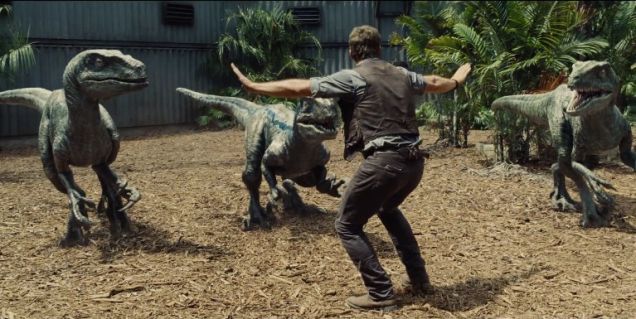
            Ah, the literal and figurative monster of the summer.  Jurassic World has already secured its place as one of the most wildly successful and profitable movies to date, and nothing I say for or against the film will alter that fact in any way, although it has not been without its controversies.  I can understand a lot of the complaints surrounding Bryce Dallas Howard’s character and how the story uses (or doesn’t use) her, although I have also seen plenty of strong arguments in her favor.  And yes, Chris Pratt is a far cry here from his scenery-chewing performance in last summer’s Guardians.  And yet, there is a nice reverence to the overall feel of the picture (my issues with the movie completely melted away any time they hearkened back to the original John Williams score), and the main action beats, when they do occur, are phenomenally breath-taking.  On the whole, it balanced out into a fun time at the movies.  Which is all I ask of these sorts of films. 


Ant-Man- B-


            I must confess- I am finding it harder and harder to write about Marvel movies.  Even at their best (Ironman 1, Avengers 1, Captain America 2), there is absolutely no deviation from story formula or character archetypes, and while that by no means makes them all bad, it does mean there’s a ceiling to how funny, original, or truly great any of them can get.  At least for now. 
                       
            That said, while there is a lot speculation as to whether or not one of these films truly bombing, or at least not functioning well within the ‘Verse, could bring down the whole house of cards being built, Ant-Man defied the cries of doom by Edgar Wright fans and turned out….pretty okay, really.  It was fun, and has its moments of brilliance; being the man-child raised on Shining Time Station that I am, I may have squealed a bit at the use of Thomas the Tank Engine toys in the final battle sequence.  On the other hand, the story and main character arc do not deviate from The Formula in the slightest, the side characters barely register, and the bad guy/evil plan combo is…..kind of terrible, now that I think about it.

            Plus, in a strange coincidence that I am still at a loss to explain, Evangeline Lilly’s character wears the same type of outfit, has the same haircut, is the same type of no-nonsense hardass, AND gets the same phoned-in romance subplot arbitrarily tossed in at the very end of the film as Bryce Dallas Howard from Jurassic World!  They look and are written so similar, I actually thought for the entire running time of Ant-Man that it was the exact same actress.  Seriously, look!  Blink and they are one!  

            Those critical points aside, as with all Marvel movies, I certainly don’t regret seeing it, but, as well as with most Marvel movies, I have no plans to revisit it again.   


Jupiter Ascending- D (the “serious” version)


            Oh Jupiter Ascending.  What can I say?  I had such high hopes for you.  I knew I was going to get a lot of bombastic over-the-topness (it IS the Wachowskis, after all), but given how much effort they usually put into making their fictional worlds make some form of metaphysical sense, I did expect at least SOME narrative cohesion.  After years of being able to digest the fallout from the Matrix trilogy, I would have thought they might have taken some lessons to heart on the importance of having your lead actors come across as at least partially human, or if not, at least having some of the side characters fleshed-out enough to pick up the slack.  There are rumors that whole chunks of the film, including some world-building and character development, got left on the cutting room floor, and while that would make me interested in seeing a director’s cut, I can’t use it as a justification to excuse the terrific flaws that tear this theatrical film apart, glorious design by glorious design. 

            And of course, there’s Eddie Redmayne.  Good God, we gave an Oscar to THAT?  How much lower are your standards going to sink, Academy? 

            Wait….shit, don’t answer that.  I forgot David O. Russell has a new movie coming out this year.  Lord save u…I mean, all hail the Russell! 


            All in all, this was hardly a summer of note, especially when compared to last year’s crop of great offerings.  Ah well.  At least we avoided the apocalyptic fate that would have awaited us had the release of Batman v. Superman not been delayed, which would have given us a year with Avengers, Jurassic Park, Star Wars, AND Batman/Superman duking it out for box office dominance.  Sometimes, it’s the little blessings in life that count. 


-Noah Franc