Friday, January 16, 2015

Reflections: The End of The Legend of Korra


**spoiler alert for anyone not yet up-to-date on the ending of Legend of Korra.  For my thoughts on Book 1, click here and here.  For Book 2, here.  For Book 3, here**

             “It’s been a bit of a bumpy ride, hasn’t it?” 
           
            “Yes.  But I’ve come to realize that life is one big, bumpy ride.” 

            The degree to which this exchange between Korra and Tenzin, right at the end of the very last episode of The Legend of Korra, reflects the turbulent and drawn-out events of the show’s creation and public release has me reasonably convinced that it was a deliberate bit of metaphysical, almost humorous reflection on the part of the show’s creators.  They have certainly had to backflip through an uncomfortably large number of flaming hoops to bring us this 4-season extension of the Avatar universe.  Given just how much Nickelodeon succeeded in making every wrong decision possible as far as their handling of this franchise is concerned, I am blown away by how excellent The Legend of Korra, as a whole, ended up being, especially these last two seasons.  This show has been a prime example of how studio mismanagement can directly affect the artistic quality of a final product.  Because of this, I give the Superhero Award of 2014 to Mike Dante DiMartino and Brian Konietzko, who have proven their storytelling chops by taking a franchise that almost seemed to be drowning by the middle of Book 2 and turning things around a full 180 degrees by the end.  Against all odds, they have once again given us something special, a grand tale that rises above the sum of its parts and that, I believe, will be remembered as something truly legendary. 

            I will admit it- I doubted.  After the disappointing ending to Book 1 and the hot mess of a middle act in Book 2, I was not sure that the series would be able to effectively right itself in time.  What a rush of a corrective this year was, with Book 3’s powerhouse of a trailer, the rapid release of Book 3 itself, and the start and conclusion of Book 4 shortly afterward, all taking place within 6 months.  Granted, the circumstances under which the releases happened were terrible, but in a way, that made the superbly high quality of the show’s writing all the more apparent, since it became obvious just how out of their element Nickelodeon was with a show that actually strove to make its viewers think. 

            Central to this turnaround was the fact that, after a bit of regression for some in Book 2, all the major characters started to click at the beginning of Book 3, both on their own and in tandem with each other, and this transformation was most noticeable (and therefore, all the more effective) with Korra herself.  My frustrations with her as a character were probably my biggest issue with the first two seasons.  She started out so cocky and aggressive, such a polar opposite of Aang.  A veritable savant when it came to fighting and bending, she had none of the spiritual or emotional strength needed to act as an effective Avatar.  She was abrasive and sometimes downright unlikable, whereas Aang started off funny and enjoyably childlike, but also already possessing the core of the emotional and moral strength he needed to defeat the Fire Lord and end the war.  Looking at The Last Airbender as a whole, it was fairly clear from the beginning what solution Aang would ultimately seek out to end the war.  All that remained was for him to develop enough bending and fighting ability to match Ozai in combat. 

             With Korra, we have observed the opposite journey.  She always had the sheer physical power needed to be the Avatar.  But at the end of every season, that is never enough for her to win.  As the finale of The Last Airbender showed us, simply winning a fight doesn’t mean you’ve won the war; you need to go deeper than that.  She first has to lose to Amon before she can catch him off-guard and expose him.  Her battle against Unalaq is only won after Jinora is able to find Raava’s spirit and return her to Korra.  Although able to hold off Zaheer at first, the poison continues to weaken her, until she is saved by the intervention of the airbenders.  And the final battle in Republic City against Kuvira’s mecha-suit is easily one of the best team-effort battles I have ever seen, with everyone needed, bender or no, to bring down the beast part by part.  And at the end, after the battle is all but won, only then does Korra go into the Avatar state, to save a life and possibly turn the mind an enemy, instead of simply killing her.  It is a tidy continuation of the final message of The Last Airbender- responding to evil by taking more lives is easy.  Finding ways to live on and build anew is hard. 


            At the end of each of the first 3 seasons Korra loses something, be it temporary or permanent.  Yet it’s through these losses that she learns, and grows, and even though she is still not whole by the end- her connection to the past Avatars is seemingly permanent now- we can see in her eyes and hear in her voice that she has risen above that to become something more.  She's gone from “I’M the Avatar, you gotta DEAL with it!” to “There’s so much more I want to learn and do.”  There are worlds of maturity and intelligence between these two statements.  It is this journey- through loss, through emotional turmoil, and after Book 3, through what is clearly depression and PTSD in all but name- that, more than anything else, raises The Legend of Korra far above most other animation of its kind, allowing it to transcend its flaws and become something very special indeed. 

            Given the success and pervasive love for The Last Airbender, this was a show that took a great deal of chances, and not just with its title character.  Mike and Brian could have gone the safe route, keeping the world in a cryogenic state, with little or no technological or social advancement having occurred since the end of the war, so that everything looked and sounded as much as possible like the original series.  Instead, they made deliberate choices about what advancements they thought could realistically occur over a 70-year period, including radio, cars, modern dress, and flight.  They worked out how the technology would be incorporated into the different storylines, and even thought up ways in which bending techniques themselves would have been developed, including a greater use of lightning and metal.  Even when it came to the music, they worked with Jeremy Zuckerman to find a balance between the traditional instruments present in The Last Airbender and newer instruments (the Book One soundtrack, a fantastic fusion of the original Airbender soundtrack and early 20’s jazz beats, is the best stand-alone example of this).  It was a jarring transition at first, but I value the show all the more for so effectively setting itself apart simply through the use of music and more modern visuals.  It was never what we, the fans, originally expected, meaning it was exactly what we needed. 


            On that note, how Legend of Korra relates itself to its predecessor overall is an accomplishment in and of itself.  As cases like the Star Wars prequels, and in recent years the Hobbit Trilogy show, follow-ups to massively influential, hugely popular movies or series always run the very considerable risk of being so overshadowed by (or over-compared to) what everyone saw years ago and already knows and loves.  In deliberately focusing on a cast of entirely new characters, there was always the possibility that they would either not click as a cast, or would simply not be able to win our affections the same way the original gang did.  Now, whether or not Korra and co. did worm their collective way into one’s heart by the end is, of course, up to individual taste (I hear there is a lot of Mako and Bolin hate floating around the internet), but from the looks of it, more than enough of the fans responded well to the new cast and loved them plenty.  I sure know I did (my personal favorites will follow in a later post). 

            That is not to say that the original series was ignored, which would have been just as ruinous as relying too heavily on the original characters.  Thankfully, Mike and Brian found the perfect balance, alluding to the original tale when needed, and even including Katara, Zuko, and Toph in spot moments, but never allowing them to shift focus from the new faces, stories, and themes they wanted to focus on.  Toph herself summed it up nicely- “At some point, you gotta leave it to the kids.”  I think my personal favorite example of this was the glorious shot we get of a photo of Aang, as a grown man and fully realized Avatar, still doing the same spinning-marble trick and still sporting that big, face-splitting grin. 

            If I had to pick my favorite aspect of the new world Korra inhabits, it’s how politically and militarily powerful women are a complete non-issue.  It is simply accepted, and never questioned or debated.  Avatar was from the start a great franchise for girl characters, but in The Last Airbender we never see any older women in positions of leadership, and we get plenty of episodes highlighting how female roles in many areas of the world were still traditionally restricted.  Here, though, we have, in addition to a female Avatar, the following; a female Fire Lord, a woman heading up the police force in Republic City, her sister presiding over a powerful sub-state nearby, a young woman running one of the most powerful and influential companies in the world, and a queen reigning alone over the Earth Kingdom.  After Book 2, we see that Eska is now jointly ruling the Northern Water Tribe with her brother, and watch as Jinora becomes the first airbending master in a generation, as well as learn of her extremely unusual and potent spiritual powers.  Between Books 3 and 4, with the Earth Kingdom descending into chaos, the first person the leaders of the world turn to is Suyin Beifong, and when she rejects the offer, they turn to another woman, her best lieutenant Kuvira, who as we all know proceeds to not only do the job well, but also develop into arguably the best villain the series has ever had (and now that it occurs to me, it would be pretty kick-ass to see her fight against Azula in her prime). 

            These characters all run the gamut of personality, age, and even body type.  There are several moments that draw attention to Korra’s extremely muscular physique, still something viewed by many in our world as unattractive or even unhealthy.  Lin and her sister are about or at least middle-aged, since they are both sporting gray hair.  Kuvira has all the complexity, determination, and intelligence of an Iago, or any other great, classic villain.  The character that would probably be considered the most “conventionally” beautiful (going by our culture’s standards) is Asami, who is tall, very light-skinned, slender, and curved, with long, flowing hair and full lips.  Yet, nearly every time we see her, she’s decked out in full-body mechanic outfits and workman gloves, and all the praise and attention she gets from others is based on either admiration and/or need for her brilliant engineering mind and business acumen.  This is a show that, even more than The Last Airbender, puts the power, skill, and complexity of its women on full display, not to be debated, but to be celebrated and admired. 


            Actually, there are a lot of topics and ideas that this show succeeded in including and doing justice to, while doing it in a way that never oversimplifies things and never talks down to its audience, but still breaks down and depicts things in a way that both younger AND older audiences can grasp, discuss, and appreciate.  Several articles have already devoted some time to this, so I will not try to list all of them here, but in addition to the truly wonderful variety of women in the story in roles devoid of traditional sexism, I am also a huge fan f how political the show got by the end.  The creators have repeatedly said that they never had a specific agenda in mind, nor do they subscribe to a certain ideology or political philosophy, but there is no denying how many parallels can be drawn between real-world figures, both historical and current, and the likes of Amon, Tarrlok, Zaheer, and Kuvira.  And again, at no point does the series tell the audience what to think- there are several challenging political discussions across the seasons that Korra is never able to fully handle.  We know the villains are wrong in at least some aspects, but since we only sporadically hear the characters themselves explain why, we must inevitably think of reasons ourselves.  And thus, we are brought to think about both the Avatar world and our own a little differently. 

            Alright, alright, now I’ll get to “the moment.”  I realize I have been prevaricating somewhat, but there were a lot of thoughts on the show as a whole I wanted to lay out before turning to Korrasami.  That said, let’s talk about Korrasami. 


            I have read/listened to a lot of views on how this was done, and how it was handled.  Without a doubt, it is a small landmark moment of sorts, and given that my girlfriend and I had started hoping for it during the last two seasons, I am personally really happy that it happened, and that the, as of right now, final Avatar series got to really break through another glass ceiling as far as children’s animation is concerned. 

            That said, I do also feel that it is an imperfect step.  More could have been done to set the relationship up, and I would love nothing more than a continuation of the story in some form that really explores how the relationship develops.  However, I also feel that the flaws in how this was handled reflect our continuing social hangups regarding homosexuality far more than they do any lack of ability or daring on the part of the writers.  They have now gone on the record as saying that as far back as Book 2, they started tossing this idea around.  However, they sat on it until it was almost too late, figuring that they would never get the green light from Nickelodeon.  And given how hard Nick screwed them towards the end, they had good ground to fear getting canceled entirely if they pushed too hard for more than the studio was willing to allow.  And when they finally did ask, they were given permission, but could not go as far as an actual kiss. 

            In a perfect world, free of the sexual hangups that still infest our society, none of those doubts or uncertainties would have surfaced, and Mike and Brian most likely would have done much more to set up the relationship by the end, or may have even started it sooner.  Hell, they may have planned to do so anyway, until Nick heinously robbed them of an extra episode halfway into the production of the final season.  All major “what ifs,” and sadly we will never know what the show could have done in less frustrating circumstances. 

            Yet, in a way, Korrasami is very much a perfect microcosm of the show as a whole.  It is a daring piece of work, hindered in its results somewhat by a bad mixture of cultural hangups, uncertainty on the part of the writers, and patently awful studio slip-ups, yet something that is still beautiful to behold despite, and in many cases because of, how flawed it is.  I think The Last Airbender comes away as the more solid show as a whole, which is largely a case of it being able to build and develop an overarching story in a perfectly paced manner, whereas Korra, by design, was meant to be a series of smaller, more compact arcs, with only unspoken themes connecting them.  It was another daring move on the part of the creators.  Like many daring artistic moves, it only fully works in some parts and less in others, but like all such creative risks, every minute of it is worth watching.  Thank God for this show. 

            This is by no means the last of my writings on the Avatar universe.  Once the rush of awards season is over and done with, I will be returning to this topic sometime in the Spring to do a series of posts about my favorite characters and moments from both The Last Airbender and The Legend of Korra, which will include a bevy of various Top 10 lists, along with my personal thoughts on which is the “superior” series.  Until then, enjoy the coming onslaught of Oscar coverage, last-minute 2014 reviews, and my own various Top 10/end-of-the-year reflections.  Stay tuned.    


-Noah Franc 

Tuesday, January 13, 2015

Reflections: The End of Naruto


            It was only a few months ago that I took to this page to vent about the many problems- both long-term and recent- that begun to have a seriously adverse effect on my ability to continue enjoying Naruto, which, up until the war started to get really bogged down, had continued to be one of my all-time favorite manga and animes.  It was already known at the time that Naruto was entering the final stretch, but I was not aware of just how soon the ending would come, and in early November, the series did indeed come to a close with its 700th chapter.  I won’t go back over the issues I discussed then, but given my still very deep feelings for the franchise, it would be remiss of me to not at least try to collect my thoughts about the final chapter. 

            If I had to be as concise as possible, I would probably say that the final chapter was good, but not nearly enough to close the story properly.  Naruto was always at its best when it was able to balance out the storylines and group dynamics of a large variety of the very colorful characters the story brought us, and in a way, that almost guaranteed from the start that the final chapter could never be truly big enough to feel fitting.  This was a grand tale set within a world of unique and fascinating powers and rules, where the history and nature of the ninja world was often as deep and mysterious and fascinating as the individual characters themselves.  One chapter set in the future could never have been enough to give us all the answers we wanted, covering all the characters that so many fans have grown to love. 

            That said, there are some loose ends that really are inexcusable.  The biggest and most problematic one is the completely unmentioned fate of Orochimaru, Karin, Jugo, and Suigetsu.  Both Jugo and Suigetsu had certain aspects of their backstories built up and referenced very consistently after they were introduced, and neither of them are addressed after they free themselves from the samurai.  Not that that’s such a bad thing, since neither had story focus long enough to really stick as parts of the overall narrative.  Karin was an awful character almost from day one, so there is no real loss in not having her brought back.  And none of them were ever powerful enough to pose any real threat to the world, even as a team.  But Orochimaru?  The man who had found so many ways of avoiding death that even some of the strongest characters could not permanently kill him?  It’s been easy to forget in recent years just how large Orochimaru loomed over the series for the first several hundred chapters (and episodes).  Until Tobi/Madara/Obito was shifted to main prominence in the second half of the series, it was Orochimaru whose actions and motivations drove whole reams of the plot, the most important of which was his convincing Sasuke to abandon Naruto, Sakura and the Leaf to go rogue.  And even after he was moved to the background, he still remained one of the creepiest and most identifiable figures of the franchise.  Ignore Hawk, by all means, since no one ever cared, but we friggin’ NEED to know what happened to Orochimaru, if only so that the nightmares of his arm-snakes coming to eat us can end. 

            The refusal to address or even hint at what happened to him is a massive whole in the chapter, but at least it’s the only major character ignored.  There are other, smaller figures like Yamato (always a favorite of mine) that go unseen, but in such cases I can understand leaving them out for the sake of conciseness.  So many minor or side figures were brought in at various points that it was inevitable a great majority would be left by the wayside.  So much, then, for what we don’t get, but what about what we do get? 

            As is typical in a great many stories like this, the vast majority of the final chapter comprises of establishing who married who, what their kids’ names are, and which parents the kids resemble most.  Most of the pairings are as expected, and it was especially healing to see that Naruto finally did return Hinata’s love, even if it did apparently occur off-panel.  I would expound on that, but the Weekly Manga Recap guys have already done a far funnier and more extensive job of that than I ever can, so I will leave that as it is.  I suppose the only surprising one would be Choji and Karui, since there were never really any hints those two knew each other at all while the war was going on, but they were smaller characters of relatively lesser importance, so there relationship was never something that needed expounding on. 

            That said, their marriage, along with that of Shikamaru and Temari, is a great indicator of the new interconnectedness of the world Naruto and his companions fought for- early on in the series we know only of the Leaf village, with the other major ninja nations shrouded in mystery.  It is a world so scarred from past wars that the only real interaction between the ninja worlds is the Chunin exam, which is itself fraught with tensions that turn deadly with sickening ease.  Most ninja would be born, live, and die solely within their respective villages, knowing shinobi and leaders from other villages only through clashing with them on the battlefield.  The sense one gets is that marriages between warriors from rival villages was something either unheard-of, or shunned as traitorous if it did happen. 

            Now though, it seems clear that more shinobi than ever before are traveling and marrying outside their traditional lands.  In the final shot of the chapter, we see the old village surrounded by tall skyscrapers that take up what used to be a thick forest occupied solely by soldiers defending the village from outsiders, buildings that seem to stretch on endlessly.  This probably means that the old practice of effectively sealing each village off from the outside world, with entrance permitted only through select gates, has been done away with, and that each land is now open to the others, allowing for a boom of prosperity never before seen.  A world of true peace has been established.  It was probably this aspect of the final chapter that affected me the most, the final assurance of the series that the yearning for peace we saw in Naruto himself is something that can be realized.  

            Sadly, while I wholeheartedly enjoyed these various smaller aspects of the final chapter, my feelings are much more mixed concerning the fate of our three main characters, Naruto, Sakura, and Sasuke.  I said in my last post, and will reiterate here, that the greatest failure of Naruto as a story was its inability to develop Sakura and her role on an equal footing with that of Sasuke and Naruto, and my impression of that was only worsened when all we see of Sakura afterwards is her being a housewife.  Not a leading doctor within the village, not someone who, like Tsunade before her, revolutionized battlefield and surgical medicine, just a housewife, dusting the bookcase.  The girl who could literally punch through a mountain, and who was trained just as intensely by one of the Sannin, is dumped into the most stereotypical female role imaginable.  What did she end up doing after the war?  For all we know, jack-all.  This, on top of the fact that she was given absolutely nothing to do story-wise after defeating Sasori at the start of Shippuden, and could not even get equal footing in the fight against the Demonic Lady in White in the big final fight, was the 10-ton ACME weight that shattered the camel’s spine for me. 

            Sad to say, that was not the final insult given to the once-promising doctor- the last and worst offense was the reveal that she did, in fact, marry Sasuke, and had children with him.  This is wrong on a great many levels, but primarily because it means that, ultimately, Sakura failed to grow or develop in any way as a character over the course of a 700-chapter epic.  When the series began, Sakura was a bratty teen obsessed with gaining the attention of a boy.  Sasuke was her be-all-and-end-all.  And, according to her handful of lines in the last chapter, nothing about that really changed by the end.  No real alteration of her goals, or of her self-image as a shinobi, woman, or individual.  No real exploration of her character other than, “Oh dear, how do I reconcile loving Sasuke with the fact that he’s now the most genetically evil person in the world?” 

            Let’s leave aside the fact that he tried to kill her several times, although that in and of itself should be enough to damn this union to eternal Hell.  Even if none of that had happened, and even if Sasuke had not been a terribly written character with no believable development after his fight with Itachi, there is the unavoidable fact that he never showed the slightest romantic interest in her.  There is not a single moment at any point of the series where you could credibly argue Sasuke appears to be developing anything approaching emotional love for Sakura.  For that matter, I don’t recall him showing romantic or even sexual interest in, well…anything.  As soon as he leaves the Leaf, he ceases to function as a human and looks, talks, and acts like a robot.  Nevermind Sakura, ANY pairing of this asshat with someone would have made zero sense.  It is shipping for shipping’s sake, doing the obvious thing just because it will please whatever twisted, demented sector of the population that managed to retain interest in Sasuke as a story presence. 

            Sasuke himself is, of course, the other major issue with the end.  His marrying Sakura is bad enough, but then there’s the fact that, as far as we can see, he never had to face any sort of reckoning whatsoever for his crimes.  This is a terrible betrayal of what had always been one of the series’ strong points- that crimes must and will be accounted for, and that the ninja world was one of death and hard sacrifice, and any use of power came with costs.  He never loses his sight or physical health from overusing the Sharingan.  He was, for some insane reason, actually offered a replacement arm for the one he lost fighting Naruto.  He was apparently never jailed or imprisoned in any manner.  And he never changed.  He never grew, and his parting words to the contrary, we have zero evidence he actually does feel any scrap of sorrow or regret for being a complete, amoral tool. 

            This is all exacerbated by the fact that Sasuke became a terrible character from the moment he finished fighting Naruto.  His motives became so blurred and confused by the end that he literally needed to resurrent Orochimaru and have him resurrect the Hokages so that THEY could tell him what to believe.  I have ranted about this at length before and do not have the strength to do so here.  Suffice it to say that it is the end for Sasuke that comes the closest to breaking the chapter for me. 

            And yet, it doesn’t ruin the chapter, and neither did it ruin the series as a whole for me, and the reason for that is simple; Naruto himself.  Naruto’s ending is the perfect one, the one the series built itself up to the entire time, and seeing it in actuality was enough satisfaction to smooth over nearly all of the flaws of the last few hundred chapters.  Naruto started out the least powerful, most annoying, and least compelling character in his own story, which would in many cases have been the death of it.  And in a way, that has made the growth he has undergone all the more compelling to see.  Even at his silliest, stupidest, most immature moments, there was always an authenticity to him as a character that shone through.  The focal point of the series, at least at first, was about the power of choice to shape destiny, and it was always Naruto’s choices that set him apart from the rest of the cold, brutal, and cynical shinobi world.  It is his choices that allowed him to reach world leaders and the Tailed Beasts in a way no one else could, and that made his progress from an in-over-his-head little kid to a truly powerful fighter not only emotionally satisfying, but believable as well.    

            This long journey of growth , surrounded as it is by outlandish character and villains, superpowered battles, and an endlessly detailed fantasy world, has been a treat to watch, and it really did hit home hard with the last few panels just how much we’ve experience with this story.  Its loop back to the start of the story closes in the proper fashion of a great legend.  For all its flaws, at least our title character got a fitting send-off. 

-Noah Franc  


**Note: I plan to revisit Naruto in a few months to expound on some of my favorite moments of the series as a whole.  I cannot right now, due to the crush of end-of-the-year listings and Oscar viewings I am trying to cram into a small window of time.  Once the busy time dies down, check back for more Naruto.**

Sunday, December 21, 2014

Review- The Hobbit: The Battle of the Five Armies

The Hobbit: The Battle of the Five Armies (2014): Written Fran Walsh, Peter Jackson, Philippa Boyens, Guillermo del Toro, directed by Peter Jackson.  Starring: Martin Freeman, Ian McKellen, Richard Armitage, Evangeline Lilly, Lee Pace, Luke Evans, Benedict Cumberbatch, Ken Stott, James Nesbitt, Cate Blanchett, Ian Holm, Christopher Lee, Hugo Weaving, Orlando Bloom.  Running Time: 144 minutes.  Based on The Hobbit, by J.R.R. Tolkien. 

Rating: 3/4 

            Well folks, this is it.  Two massive trilogies, each filmed back-to-back-to-back, costing a collective $1 billion to produce and generating over $5 billion and counting in box office revenue (both very rough estimates), 36 Oscar nominations and 17 wins (with at least few more nominations probably on the way), and it all comes down to this; the third installment of Peter Jackson’s still-hotly-debated trilogy of The Hobbit.  Was it all worth it, in the end?  Has the big-screen re-imagining of Middle Earth been enhanced or tarnished by several hours’ worth of extrapolation and narrative add-ons stuffed in by Jackson and his team?  How damaging of a miscalculation was it on the studio’s part to force Tauriel, easily the best invented character in all 6 movies (and I will fight you on that one), into an obviously shoehorned-in love triangle?  In the end, which wins out, the soaring high points, or the tiresome low ones? 

            For me, it’s the high points that come out on top.  I have loved too many moments and felt that sweet sting of nostalgia too often over the past 3 years to regret having seen each film multiple times in theaters.  Middle Earth is one of the greatest imaginative worlds of the past century, a land that has been filled with a history that so perfectly captures the indescribable sensation of something beautiful and essential beginning, reaching its time, and then leaving.  There is a power in the narratives Tolkien has crafted that can shine through any interpretation, no matter how faulty.  The Hobbit movies are not perfect- though truly, nothing is- but they are earnest endeavors, and I feel confident in saying that they will surely stand the test of time.  The Battle of the Five Armies effectively and movingly wraps up what will likely be our last filmed adventure in Middle Earth, and although I can certainly nitpick these films with the best of them, I am sad indeed to see them go. 

            It’s interesting to note that, for all the gripes that have been made regarding the wisdom of turning this slim volume into a trilogy and the issues of padded length that wore down the first two films somewhat, The Battle of Five Armies is actually the best-paced, quickest, and most tightly-written of the three films.  After a brief opening sequence showing Smaug’s enraged attack on Laketown and his subsequent death at the hands of Luke Evans’ Bard, the film settles down to its main focus- putting the pieces in place for, and then jumping gleefully into, the final, massive battle for control of the mountain between the human survivors of Laketown, the army of Elves under King Thranduil that arrives soon after the attack, Thorin, Bilblo, & co., the forces of Thorin’s cousin Dain, and a massive army of goblins and orcs, led by the Great White Albino himself, “Mad Dog” Azog. 

            Although the massive sequence of the battle never reaches the emotional heights of the Battle of Gondor in Return of the King, it is perhaps the most visually comprehensible battle out of all 6 movies, with the establishing shots well-utilized to show the tactics, maneuvers, and locations of each side of the battle.  Jackson stays quite true to his word of not straying for more than a minute or so from any of the main characters, but neither does the whole affair devolve into an incomprehensible brawl, for which I am immensely grateful.  And while it stretches the bounds of the battle’s context within the book, it builds up to an excellent climax on top of a frozen waterfall, a final confrontation between Thorin and Azog.  Fellow lovers of the book know what ultimately transpires here, but there is a nice touch that Jackson adds- the fate of one of the last sword fights rests on a conscious, sacrificial decision by one of the heroes.  Like many of the film’s best moments, it is small, but not unnoticed, one of a few gestures of genuine grace in a film filled with a great deal of admittedly unneeded noise. 

            Speaking of sacrifice, if there is one thing that kills many of the emotional vibes the movie succeeds in building up, it is the tragic treatment of Tauriel.  As I said above, Tauriel is among the best additions Jackson makes to the books, a tough-as-nails female fighter able to go toe-to-toe with Legolas, who in this movie reaches even higher levels of impossible awesome.  She was able to shine despite being the focus of an awful love triangle in the last movie, but sadly, the romance aspect in this one overwhelms everything else she is given to do, and the conclusion of her character arc is easily the weakest aspect of the otherwise very solid wrap-up at the end.  Evangeline Lilly did great work with what she was given, and deserved better.  

            As far as the wrap-up itself goes, no, it is not as drawn-out as the end of Return of the King, but it does almost feel a bit too cut back, as if Jackson was in a hurry to wrap things up, which is a shame, because as excellent as many moments as it has, including Bilbo’s reaction to the death of one character, his goodbye to the dwarves, and a perfect final scene back at Bag End, I could have used a bit more gravitas, or a few more quiet moments to add to the emotional weight.  Which is a shame, because this film actually succeeds in having far more and far better character moments than the last one, especially with Bilbo and Thorin.  Richard Armitage has really made Thorin his own character.  Overcome at the beginning of this by greed for the horde they have seized in the mountain, Thorin finally confronts his own demons in one of the series’ finest scenes, staring down at the golden floor created at the end of The Desolation of Smaug and imagining himself being swallowed whole in its shimmering depths.  It very nearly excused the drastic lengths the last movie went to in order to put the damn thing there.  All of his scenes with Bilbo are filled with emotions that make the film’s start color pallet glow with warmth.  They are too few and far between to lift the film from good to great, but their power is not diminished by that, and I am grateful for their presence. 

            In fact, I think that’s the best way I can sum up my mixed feelings towards the series as a whole; scenes or sequences of real brilliance and genuine cinematic magic, diminished somewhat by others that are less inspired and are, occasionally, atmosphere-breaking in their absurdity.  They never could measure up to LOTR, but I never expected them to, and that, perhaps, is one of the keys to my enjoyment of the films.  Another is my very strong love for the world of Middle Earth itself.  Ultimately, I love these movies simply because they allowed me to spend another 6 hours exploring the realms of dwarves, elves, hobbits, goblins, and men.  For such opportunities, I will endure very near anything.  My favorite of the trilogy is probably The Desolation of Smaug, mostly because of how excellent Smaug turns out.  I understand those who do not like them.  But I do, and it truly does pain me that this is likely the last journey we will get to take to Middle Earth on the big screen.  At least until the promised 72-part adaptation of The Silmarillion starts production. 

-Noah Franc


Friday, December 12, 2014

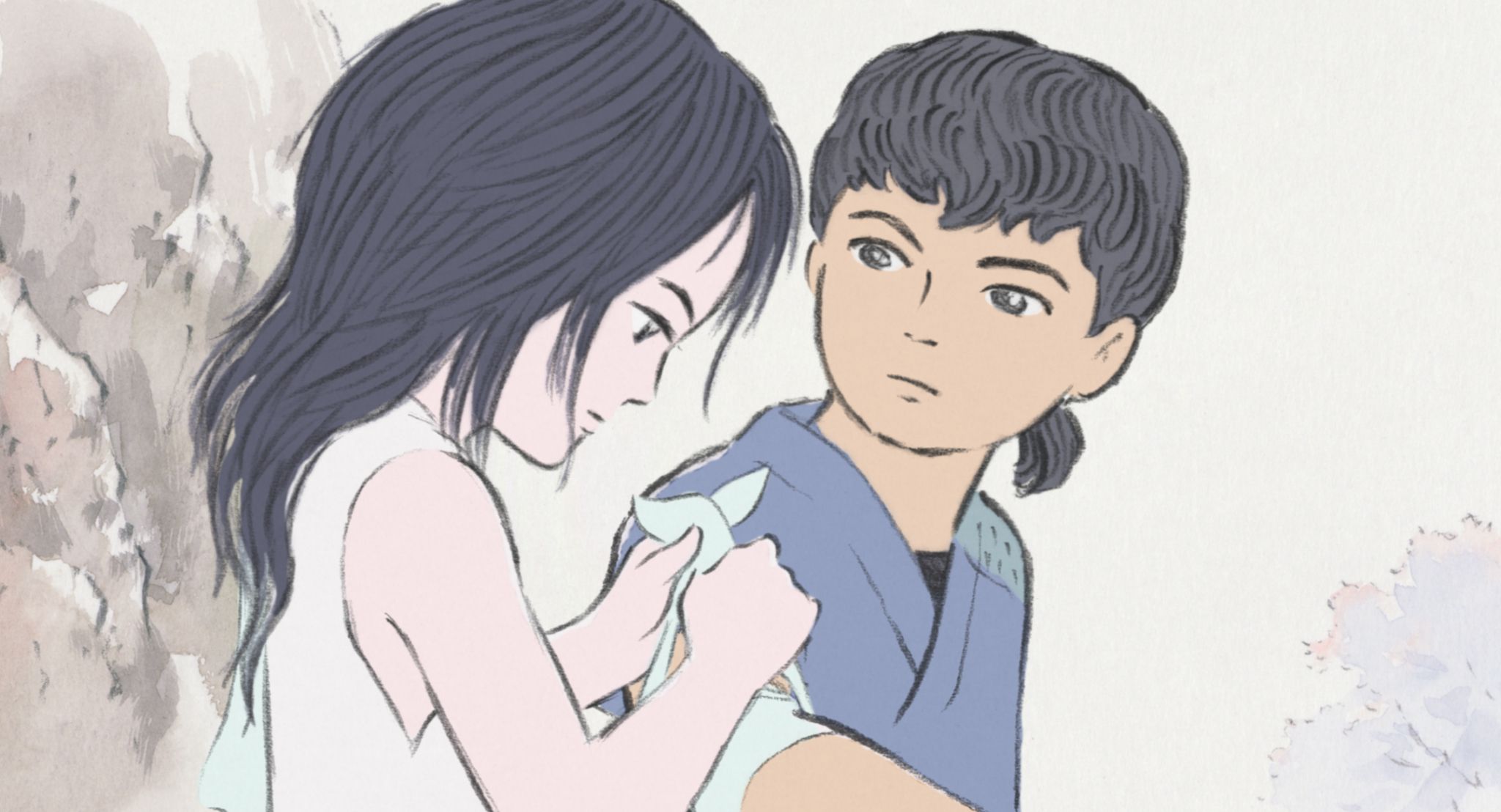
Review: Kaguya-hime no Monogatari (The Tale of Princess Kaguya)

The Tale of Princess Kaguya (Kaguya-hime no Monogatari): Written by Isao Takahata and Riko Sakaguchi, directed by Isao Takahata.  Starring: Aki Asakura, Kengo Kora, Takeo Chii, and Nobuko Miyamoto.  Running Time: 137 minutes.  Based on the folktale The Tale of the Bamboo Cutter. 

Rating: 4/4


            I will not mince words- The Tale of Princess Kaguya is not only the best animated film I have yet seen this year, it is the best film overall I have seen this year, period.  Over the past two decades, animation has been increasingly oriented towards CGI and greater, more “realistic” details and colors, and in many ways this is a good thing- the visual depth seen in many recent animated films is, on a purely technical level, unlike anything that has come before.  But as a work like this one reminds us, when we neglect the older, simpler, less-visually-stuffed hand-drawn styles of the past, something is lost in the process.  An ability to capture so much of the elementary nature of our existence with so little becomes that much harder to cultivate and attain.  Roger Ebert once wrote, in his review of Princess Mononoke, that “Animation…is freed from gravity, and the chains of the possible.  Realistic films show the physical world; animation shows its essence.”  If he is right, and I would argue forcefully that he is, then The Tale of Princess Kaguya is an essential tale indeed, one that encompasses themes of growth, familial love, the joys of youth, the sweet nostalgic aches of aging, and the core sensations that make our lives worth living. 

            This is the first feature-length film in 14 years to be directed by Isao Takahata, who co-founded Studio Ghibli with Hayao Miyazaki back in 1985 (his last film, released in 1999, was My Neighbors the Yamadas).  It is currently slated to be the one of the last feature films produced by Studio Ghibli for some time (the only other one slated for an upcoming release is When Marnie Was There, which first aired in Japan this past summer), although rumors that the studio’s production arm is being shut down permanently seem to have been premature.  How fitting then, especially if it does end up being true, that this latest work of his will rank alongside Grave of the Fireflies (also by him) and Miyazaki’s Spirited Away and Princess Mononoke as one of the greatest films the company has ever released. 

            Based off of an old Japanese legend, we witness the story of a spirit of some sort that appears inside a bamboo stalk before a simple farmer.  Astonished, he takes the tiny creature back to his wife, where it turns into a bawling, rapidly-growing human baby right before their very eyes.  Soon afterwards, the farmer’s wife finds she has milk for her despite her advanced age (and what a miracle it is, to finally have a film that treats breast-feeding as something beautiful instead of shameful).  The girl’s subsequent growth is astonishing; in a single scene, she goes from imitating sounds, to hopping, crawling, and walking, all within a few minutes.  Much later on in our story she is given the name “Princess Kaguya” in a formal ceremony, but for the other children in their small, remote village, she is called “Little Bamboo,” because her rapid growth resembles that of the bamboo stalks in which she appeared.  To the elderly couple, overjoyed at suddenly finding themselves parents (after a fashion), she is quite simply, “the Princess.” 


            Despite her mysterious origins and astonishing growth spurts, she is in every other respect a perfectly normal child, content to run, swim, climb trees, steal fruit, and hunt down fowl for dinner alongside the village lads, singing nursery rhymes all the while about the simple beauties of life.  Her biggest partner-in-crime is a somewhat older boy named Sutemaru, but due to her growth spurts they are soon close enough in age to wonder about what else their relationship could become.  These moments, depicting reckless childhood fun in the countryside, will evoke a great deal of nostalgia for older viewers, remembering times their limbs were just as limber and their thirst for adventure just as unquenchable. 

            This all comes to an abrupt end for her when her father announces that they are moving to the Capital, so that the Princess can be raised as a proper Japanese noblewoman, with respect paid to all the normal traditions.  Strongly possessive of her ever since he found her, her father becomes only more convinced that this is the “true” reason she was sent to them, and despite Kaguya’s pleas (and sometimes the objections of the mother as well), he persists in pushing for them to live in a splendid castle, lessons in music and calligraphy, the restricted movements and laughter of a “proper lady,” and plucked eyebrows and heavy makeup; in short, everything that will make them fit in with the upper classes.  The attempted physical and behavioral makeover of Kaguya is accompanied by other traditions as well; a raucous party when she receives her first period (boys only, of course- she is kept in a side room so that no one sees her), and lines of suitors promising her that she is worth more to them than all the treasures of the earth (again, all without ever having seen her). 

            The animation style we see here is quite different from what most Ghibli fans would expect.  Instead of the sharp and clear lines between characters, objects, and backgrounds that Miyazaki and most of his colleagues employ, both the characters and backgrounds seem to have been etched out and colored with chalk, and the dividing lines done with charcoal pens.  The edges are not smooth, the colors not perfectly uniform.  The evenness of the lines between people and backgrounds blur when there is motion, and sometimes, there simply are not very many details on-screen in an image- faces could lack features, and backgrounds could swirl together.  The effect shifts between being dreamlike, and resembling old pieces of artwork strung together along a wall to tell a story.  It is difficult to put into words why this style, so simple and yet so passionately energetic, has the effect it does.  Suffice it to say that I cannot imagine this story being shown in any other form. 


            This film has powerfully reinforced my already-firm belief that animation is, in certain respects, the superior form of cinematic storytelling.  As the above quote from Roger Ebert points out, live-action films are always crucially limited by having to show things that are “real-“ real sets, trees, houses, people, clothing, animals, weather events, etc. etc.  The purpose of art, conversely, is to break down or transcend all the barriers that our physical surroundings impose on us.  We cannot physically walk across the surface of the sun and live, but in our minds we can, and in our art we can capture the feelings and sensations of such an experience.  Here, a simple shot of a red flower opening to the dawn, or a butterfly pulling itself out of its cocoon, or a breathtaking sequence underneath a cherry tree in full bloom, capture the elegance and beauty of our world better than any high-res photograph could- the side details are not to be found, because they are not needed.  The superficiality of the object’s physical appearance is stripped away, leaving behind the true nature of the subject at hand. 

            Although the film starts off as a tale of childhood magic, it crosses over into the realm of an epic fantasy by the end.  We know that Kaguya’s origins are supernatural, but answers as to exactly what she is are offered only in pieces.  The movie does not last much longer than two hours, yet we seem to traverse years in people’s lives and miles upon miles of the Earth.  There are traditional morality tales to tell as well, especially when Kaguya challenges her suitors to prove their love by actually finding the magnificent artifacts they compare her to.  Many of the characters need to learn these lessons just as much as we, the viewers, do. 

            Above all else though, The Tale of Princess Kaguya is the story of a father and daughter, how their relationship grows and changes over time, and how both are hurt by the father’s stubborn insistence that his vision, his traditions, and his idea of proper happiness must also, quite naturally, be Kaguya’s as well.  Many may scoff at his simplemindedness, or criticize how old-fashioned he is, which is easy for us living in an age where no tradition, no old custom, is above ridicule, but tread carefully, dear reader, if you do so.  Yes, this conflict is here set within a particular time in Japanese history, but the central strife between the desires of the parent and the instincts of the child is truly timeless, bound to continue playing out for as long as humans exist.  There is no villain here- just people, living the only way they know how.  The father can be pig-headed, yes, but his simple, pure love for Kaguya shines through everything he does, and is heartbreaking in its intensity.  And what difference is there between Kaguya being compelled to pluck her eyebrows and move around only on her knees and Western women being compelled to force themselves into corsets, and to not aspire to being anything other than a housewife? 


            This film is a powerful rebuke to those who would claim that, when compared with modern animation technology, older hand-drawn styles no longer have a place in this world.  It looks like scratches and slight shadings compared to the overwhelming details in many of the year’s other great animated works, like The Lego Movie, The Boxtrolls, How To Train Your Dragon 2, and even the other major Ghibli release of the year, The Wind Rises.  It is not loud, and is only humorous in its effortlessly natural depiction of many of life’s little absurdities.  Its colors are subtle and light, and the only details on the characters or background are strictly that which is needed to differentiate one from the other.  The movement is, again, entirely natural, with none of the frenetic motion filling the edges in seemingly every other animated film (and increasingly many non-animated works) of the past few years. 

            And despite all that, or perhaps precisely because of it, The Tale of Princess Kaguya rises far above nearly all other films, large and small, that have been released this year.  Its story is a thousand-year-old legend in its home country, and this cinematic rendering of it is worth being remembered at least as long.  It is a rousing call to a life of fullness, of laughter, and of joy, that can somehow always find a reason to cast of the darkness that so easily weigh us down through the thousand-and-one cuts of daily living.  It recalls the things of beauty, pure and often painful in their intensity, that make humanity and human life, for all its tragedies and comedies, something truly awesome.  It is, in my opinion, the best film of this year, and of quite a few of the years preceding it. 


-Noah Franc 


Sunday, December 7, 2014

Review: The Hunger Games: Mockingjay- Part 1

The Hunger Games: Mockingjay- Part 1 (2014): Written by Danny Strong and Peter Craig, directed by Francis Lawrence.  Starring: Jennifer Lawrence, Josh Hutcherson, Liam Hemsworth, Woody Harrelson, Elizabeth Banks, Julianne Moore, Philip Seymour Hoffman, Jeffrey Wright, Stanley Tucci, and, of course, Donald “I sell this better than any of you mofos” Sutherland.  Running Time: 123 minutes.  Based on the third book of The Hunger Games trilogy, by Suzanne Collins. 

Rating: 3/4


            I am as skeptical as anyone regarding the newfound trend of splitting up the final volumes of definitive Children’s/Young Adult literature series when they are made into film form.  Not that the result has always been bad!  The Deathly Hallows Part 1, the first Harry Potter film since Chamber of Secrets not choked to the gills with plot ended up being probably my second-favorite of the entire franchise (Sorcerer’s Stone will always, ALWAYS come first).  What makes it hard to swallow is that it is always painfully obvious the decision to do so has nothing to do whatsoever with an artistic desire to be able to translate the source materials as accurately as possible- the studios just want more money.  But again, this does not necessarily make the resulting films bad; in fact, I consider Mockingjay Part 1 to be the best Hunger Games film yet. 

            I was especially pleased to see the films continue to slowly but surely expand the scope of the story and action, much as they did with last year’s Catching Fire.  After being rescued from the arena at the end of the last movie, Katniss (Jennifer Lawrence, if you have somehow contrived to remain oblivious to this fact) was informed by Jacob (sorry, Gale, my bad) that District 12 had been completely annihilated; a return visit to her hometown later on includes some of the most gruesome imagery I’ve ever seen in a PG-13 film, once again raising very fair questions about why we continue to hold on to such an archaic system. 

            But I digress.  She and the others who were saved have been taken to District 13, which they thought had been wiped out by the Capital long ago.  Instead, it turns out that they have been hiding in a series of deep bunkers that allow them to hold off against the worst the Capital can throw at them, where they have also stockpiled a decent amount of weaponry that allows them to defend themselves, but is not enough for them to take on the Capital alone.  That has all changed since Katniss’ public persona of the Mockingjay started to really take off in the different districts, leading to one protest and open rebellion after another.  The leaders of District 13, President Alma Coin and her chief strategist Plutarch Heavensbee (Julianne Moore and Philip Seymour Hoffman), see this as their chance to seize the initiative and finally topple the Capital, and after a bit of haggling are able to agree with Katniss to terms whereby she will agree to work as their poster child to inspire the Districts. 

            Something that I heartily enjoy about this franchise (and thankfully the films have improved in this regard as well) is how the usual action tropes regarding heroes, villains, and story twists are all subjected to the iron laws of reality TV, namely that perception is everything.  Every move the characters make is calculated to appeal to a wider audience, including several speeches offered by President Coin to the highly-regimented denizens of 13.  One of my favorite shots of the movie shows Plutarch mouthing the words of a speech that he clearly wrote himself in perfect time with Coin’s delivery.  A major part of the climax at the end hinges on a broadcast meant to be so fascinating in its implications it will distract the Capital from noticing a raid to rescue several of the victors from the last movie that were captured by the Capital after Plutarch made off with Katniss, including definitely-not-a-love-interest-oh-who-are-we-kidding Peeta, played by Josh Hutcherson, who over the course of the film completes his physical transformation into an even thinner version of Neil Patrick Harris, minus the charisma and singing chops. 

            It’s no psychology thesis, but the elements at play of how having to act for cameras almost nonstop can wreak havoc on your mental health and stability are great to see in a franchise aimed at teens.  I have lamented in the past that most of Jennifer Lawrence’s past film choices (including the first two films of this franchise) have done a poor job of tapping into her considerable acting skills (and yes, I am including her still-incredibly-baffling Oscar win), but at this point she really seems to have found a good balance with Katniss, and has grown into the character well.  That said, there is a hilarious scene where she (Katniss the character, that is) tries to act in a studio ad for 13’s PR team, and the result is an unholy fusion of her miscast performances in each of David Russell’s last two films. 

            This is a much slower and less active film than the first two (again, very much like Deathly Hallows Part 1), since it’s really just moving the major pieces into place for the INSANE stuff that goes down in the final battle (seriously, the books go to a very dark place here, and I am praying the movie producers don’t chicken out).  It’s real focus is on the PR war being waged between the Capital and the rebellion to win the hearts and minds of all the districts in between, with the rebels utilizing Katniss, who soon develops an ability to come up with perfect propaganda moments without even needing to try when she’s in the right setting, and the Capital using an obviously-tortured Peeta-as-Barney to plead with the rebels to surrender. 

            These developments, along with a major plot twist right before the end, all fuel Katniss’ continuing mental breakdown, something Jennifer has been doing an increasingly better job of bringing across.  I love how the first shot we have of our hero is of her having a massive panic attack and being forced to return to her quarters.  We have so many action movies that show off their heroes as totally cool badasses who can kick ass, take names, and carry on after the final boss has fallen as if nothing ever happened, when in reality, anyone who would actually do things like that would sooner or later end up like Katniss; whimpering on the floor of a medical facility. 

            I am on the fence about Julianne Moore as Coin at the moment; my thoughts about her character won’t yet be finished until I can see whether or not the filmmakers really do take the gutsy route with the finale (readers of the book know what I mean).  The same must be said regarding the others as well.  Katniss’ family barely registers, Gale and Peeta continue to compete for who can have the least amount of physical charisma when the cameras are rolling, and out of a team of filmmakers brought in to capture Katniss at her best, the only memorable one is the cameraman incapable of speaking (go figure, I guess?). 

            The lone exceptions to this are Donald Sutherland’s deliciously evil President Snow and, of course, Philip Seymour Hoffman as Plutarch.  After his death, I revisited my review of Catching Fire, and recalled being disappointed in his seeming utter lack of energy in the film.  I don’t know if that was connected to the increasing struggles that led to his death.  Maybe it was, or maybe it was something unrelated, but it seems he was able to shake it off for this one, because here he once again manages to take a character that in less-capable hands would be a total write-off and turn him into a sideshow all his own, never less than interesting to watch.  As the credits roll, we see a dedication to him, one that I hope they include in the final one as well (they were apparently finished with all but a single scene of his at the time of his death).  It is one final great performance from a master, and makes his passing even harder to bear. 

            The show must go on, of course, and the film rolls to a decent conclusion, but one that ultimately undercuts itself enough that I once again don’t feel comfortable labeling this a legitimately great film- it’s just a very good one.  There are reasons for this- some stilted acting, and a few very awkward directorial choices, including the fact that every speech of Coin’s ends with the citizens of 13 hooting like tailgaters at a football game.  But the saddest part is how the plot twist mentioned above also undermines it, mostly because the director decided that the film should just keep going for a bit afterwards.  If they had ended it at the twist, it would have been one of the ballsiest decisions of the year, leaving people furiously chomping at the bit for the final installment.  I understand why they did it- they choose instead to end on an image that is well-done and effecting on its own, but it inevitably pales in comparison to what just recently transpired, leaving things feeling a touch too safe by the time the credits roll. 

            But no matter.  This franchise keeps getting better with each film, and I am very much looking forward to next year’s big finale.  Here’s hoping they send Katniss out proper.  And maybe use some of this film’s massive profits to buy her boyfriends some Red Bull. 


-Noah Franc 

Friday, November 28, 2014

Review: Citizenfour

Citizenfour (2014): Directed by Laura Poitras.  Starring: Edward Snowden, Glenn Greenwald, William Binney, Jacob Appelbaum, Ewen MacAskill, and (very briefly) Julian Assange.  Running Time: 114 minutes. 

Rating: 4/4


            By a twist of circumstance, I had the chance to see Citizenfour the day after I saw The Imitation Game, and I was immediately struck by the parallels between the subject matter of the two movies.   Both ultimately conclude that the key to real power in this world is not, in the end, manpower, economic growth, or military strength, but information.  This can be and is heavily debated, obviously, but the cases presented here are overwhelmingly strong.  Have access to enough information, and you can win a war against all odds.  Have the means to obtain enough information, and your ability to rule, and even to oppress, can not only go unchallenged, but practically unnoticed.  Seeing both back-to-back was also a powerful reminder of the ripple effects of key events throughout history.  Even if its original purpose was to defeat Nazism, it cannot be forgotten that the modern means of spying revealed to such a stark degree by the Snowden documents would be impossible without the prevalence of digital communication, whose genesis can be found in the wartime work of Alan Turing.  The one would not, and indeed cannot, exist without the other. 

            Citizenfour is, hands-down, the most important film, documentary or otherwise, to come out this year.  Maybe in years.  It is literally watching history in the making, consisting in large part of on-the-spot recording of Edward Snowden’s first meetings with the journalists Glenn Greenwald and Ewen MacAskill (both working for The Guardian at the time).  These scenes alone will be primary source materials for years for anyone studying this particular aspect of early 21st-century history.  The issues and questions it raises regarding whether and how the relationship between governing and governed has been fundamentally altered by modern digital communication are ones that my generation especially ignores at its own peril, because events that already spin by us at top speed are only going to get faster.  It is also one of the straight-up best films of 2014, documentary or otherwise.  It can and should provoke endless debate and discussion over what Poitras chose to focus on, what she left out, how she portrays Snowden, and how bias- hers, Snowden’s, and ours- affect how each of us interprets the film’s key moments, and on top of all that, it’s quite simply an incredibly slick and expertly crafted thriller.  The use of closeups on Snowden, Greenwald, and MacAskill in that fateful hotel room in Hong Kong, smooth editing and establishing shots between scenes, and the eerie undercurrent of the film’s soundtrack can easily make one forget that we are watching actual historical events unfold in real-time, and not a mashup of the Bourne Trilogy and a David Fincher film (the comparison to Fincher is not without merit- the tracks heard were taken from a Nine Inch Nails album written by Trent Raznor and Atticus Ross). 

            The movie informs us right at the beginning that the film was already in the process of being made when Poitras was first contacted by Snowden.  One of the original main players in the film, and who is still in the final cut, is another NSA whistleblower named William Binney, who actually had his house raided in response to his leaks.  Obviously, the contact with Snowden and everything that followed greatly changed the nature and scope of the final product, which moved from focusing on a general look at post-9/11 government policy to focusing mostly on the revelations of the documents Snowden leaked and its immediate aftermath.  The title is drawn from the codename that Snowden used in his first contacts, to be able to preserve his anonymity as long as possible. A few of their most important mails, all sent via encryption programs, are read out loud by Poitras as an effective way to set a scene; the standout is her reading the mail with instructions on how she and Greenwald were to find and identify him in a restaurant near his hotel in Hong Kong.  Even without seeing what happened, we are transported into the world of a spy thriller, except this time around we know it actually happened, and just knowing that makes the viewer tense up.  But then they are in the room, the camera is on, and the first conversations begin. 

            Poitras herself is only glimpsed briefly in a mirror, but you can feel her gaze through the camera, in how close she films people and how distantly she films everything else, creating the sense of a large, immutably cold world threatening to crush the individuals on-screen.  Also of note is the use of the term “they” when describing the US government in general and the NSA in particular.  The viewer is reminded acutely of how much of our modern world cannot actually be seen or felt or heard, and yet is still there, all around us.  It is thrilling and unsettling all at once. 

            There are no new revelations contained in this film; everything discussed has been reported before.  What is important to recall though, and what makes this movie such riveting viewing, is to be reminded of how the affair played out on a day-by-day basis, and to see everything placed in its larger context, which is of course the purpose of a documentary film.  It is hard to say whether or not minds and hearts will be softened or hardened towards Snowden upon viewing this work.  It is ironic or fitting (or both) that, despite Snowden’s insistence that he does not want the focus to be on him, but rather to be on the extent of civil rights abuses he is revealing, both the film and the broader discussion over the past year have centered on him regardless.  Perhaps this was naiveté on his part, but in a way, in was also the inevitable result of any such individual reaction to a given situation.  Humans will always seek a face to place on an event, era, or movement, because it humanizes everything for us, and makes it smaller and understandable.  The Civil Rights movement was far more than MLK and Rosa Parks, but those are the figures we remember and honor the most.  Nelson Mandela was one of many activists who suffered for their opposition to Apartheid.  None of the others got a state funeral the likes of which the world has never seen.  Such is the nature of man. 

            Or perhaps he really did (or does) have a sinister agenda.  Maybe he really did just want the attention.  The respect (and some might claim adulation) that Poitras and Greenwald have for him is clear- they take him at his word.  Many others do, many do not, and some are indifferent, which is really the worst option of the three, because as the Snowden affair (and Snowden himself) makes clear, indifference is no longer an option in our world.  We must, inevitably, be either active in shaping it, or we surrender any claim to freedom and independence.  My own views on the man and his actions have been mixed, but if he is concealing some malicious intent he hides it expertly when the cameras are rolling.  Like it or not, in a world where large organizations can ever more easily oversee and control the means of communication at our disposal, we will continue to need people like Snowden, the occasional shock to the system that can tear through veils both known and unknown to allow us a glimpse of the truth. 

            I do not agree with every point the film implies, and there are sins of omission everywhere.  That hardly matters though, at least in terms of whether or not I like and respect the film.  It is, as another reviewer noted obliquely, “history written in lightning.”  Its bite is all the sharper for how clearly and unapologetically it presents itself and Snowden as something big, something important, and something necessary.  It is its biggest strength and its greatest weakness- perhaps Poitras wanted just as much as Snowden to shift focus onto the greater issues at stake, but could not resist the urge to turn him into another figure of civil rights history.  The details on how she came into contact with him are scarce, and there is no mention that she and the others had already received the bulk of the documents he had collected.  Remember, this was not like the Pentagon Papers, which had to be passed along by hand.  Every bit of this is digital. 

            One point within the film invited a greater skepticism on my part.  In a final scene between Greenwald and Snowden, they discuss new leaks by another whistleblower apparently inspired by Snowden’s example (something else he had hoped would follow from his public admittance of guilt).  Included in the new leaks is a chilling number- 1.2 million- specifying the number of people on NSA “watch lists.”  They scratch out the figures and info on sheets of paper, to avoid any eavesdropping, but a few are permitted to slide across the screen long enough to read, including a rough diagram of the line of decision-making regarding who is targeted by drone strikes.  At the top is a small box that says “POTUS,” and as Greenwald begins to rip up each sheet systematically for disposal, the camera lingers for just a bit on the torn scrap with the top box, the 5 block letters staring out like an accusation. 

            Scratch the “like” part, it IS an accusation, and its intent is clear, but is it a fair one?  To be sure, unless he takes a major shift over the next two years, the lack of action on Obama’s part to substantially reform or alter the post-9/11 intelligence systems he inherited from Bush outside of ending the torture program will go down as one of his greatest failures as President.  However, when you look at the bulk of the Snowden documents, and compare them with what we already knew or guessed and also a few general laws of physics, the picture that comes out is less that of a top-down, tightly organized campaign of terror and oppression, and more that of a bloated bureaucratic system that’s a little too used to going unchallenged that it’s developed an attitude of, “Why do it?  Because we can.  I guess.”   And like all such organizations (and the list of similar cases would be damn near endless), it instinctively seeks to protect and preserve its authority, be it actual or perceived, at all costs. 

            Not that that makes the current state of affairs any less dangerous or unacceptable.  And the importance of these events and of the threats inherent in our current system has only grown more pressing and relevant with time.  Just last week, a bill that would have ended the bulk data collection programs detailed in the leaks was defeated in the Senate by, what else, almost universal Republican opposition.  Senator Rubio (R-Florida) even went so far as to call allegations that the program was being abused a “theoretical threat.”  With the country now facing two entire years of Republican Senate control, it is to be severely doubted that any progress in this area will be made in the near future.  This makes viewing Citizenfour even more of an imperative for each and every person, US citizen or otherwise, who is not content to just be handed a future they are unable to shape or effectively take part in.  The future need not be bleak.  All it takes is our active participation.  And despite the controversy it will incite in viewers and the many points of contention that can be found within it, Citizenfour is a powerful call to attention and action.  It is one of the few films of 2014 that truly is, in every sense of the word, a must-see. 


-Noah Franc