The Tale of
Princess Kaguya (Kaguya-hime no Monogatari): Written by Isao Takahata and
Riko Sakaguchi, directed by Isao Takahata.
Starring: Aki Asakura, Kengo
Kora, Takeo Chii, and Nobuko Miyamoto. Running Time: 137 minutes. Based on the folktale The Tale of the Bamboo Cutter.
Rating: 4/4

I will not mince words- The Tale of Princess Kaguya is not only
the best animated film I have yet seen this year, it is the best film overall I
have seen this year, period. Over the
past two decades, animation has been increasingly oriented towards CGI and
greater, more “realistic” details and colors, and in many ways this is a good
thing- the visual depth seen in many recent animated films is, on a purely
technical level, unlike anything that has come before. But as a work like this one reminds us, when
we neglect the older, simpler, less-visually-stuffed hand-drawn styles of the
past, something is lost in the process. An
ability to capture so much of the elementary nature of our existence with so
little becomes that much harder to cultivate and attain. Roger Ebert once wrote, in his review of Princess Mononoke, that “Animation…is
freed from gravity, and the chains of the possible. Realistic films show the physical world;
animation shows its essence.” If he is
right, and I would argue forcefully that he is, then The Tale of Princess Kaguya is an essential tale indeed, one that
encompasses themes of growth, familial love, the joys of youth, the sweet
nostalgic aches of aging, and the core sensations that make our lives worth
living.
This is the first feature-length
film in 14 years to be directed by Isao Takahata, who co-founded Studio Ghibli
with Hayao Miyazaki back in 1985 (his last film, released in 1999, was My Neighbors the Yamadas). It is currently slated to be the one of the last feature
films produced by Studio Ghibli for some time (the only other one slated for an upcoming release is When Marnie Was There, which first aired in Japan this past summer), although rumors that the
studio’s production arm is being shut down permanently seem to have been premature. How fitting then, especially
if it does end up being true, that this latest work of his will rank alongside Grave of the Fireflies (also by him) and
Miyazaki’s Spirited Away and Princess Mononoke as one of the greatest
films the company has ever released.
Based off of an old Japanese legend,
we witness the story of a spirit of some sort that appears inside a bamboo
stalk before a simple farmer.
Astonished, he takes the tiny creature back to his wife, where it turns
into a bawling, rapidly-growing human baby right before their very eyes. Soon afterwards, the farmer’s wife finds she
has milk for her despite her advanced age (and what a miracle it is, to finally
have a film that treats breast-feeding as something beautiful instead of
shameful). The girl’s subsequent growth
is astonishing; in a single scene, she goes from imitating sounds, to hopping,
crawling, and walking, all within a few minutes. Much later on in our story she is given the
name “Princess Kaguya” in a formal ceremony, but for the other children in
their small, remote village, she is called “Little Bamboo,” because her rapid
growth resembles that of the bamboo stalks in which she appeared. To the elderly couple, overjoyed at suddenly
finding themselves parents (after a fashion), she is quite simply, “the Princess.”

Despite her mysterious origins and
astonishing growth spurts, she is in every other respect a perfectly normal
child, content to run, swim, climb trees, steal fruit, and hunt down fowl for
dinner alongside the village lads, singing nursery rhymes all the while about
the simple beauties of life. Her biggest
partner-in-crime is a somewhat older boy named Sutemaru, but due to her growth
spurts they are soon close enough in age to wonder about what else their
relationship could become. These
moments, depicting reckless childhood fun in the countryside, will evoke a
great deal of nostalgia for older viewers, remembering times their limbs were
just as limber and their thirst for adventure just as unquenchable.
This all comes to an abrupt end for
her when her father announces that they are moving to the Capital, so that the
Princess can be raised as a proper Japanese noblewoman, with respect paid to
all the normal traditions. Strongly
possessive of her ever since he found her, her father becomes only more
convinced that this is the “true” reason she was sent to them, and despite
Kaguya’s pleas (and sometimes the objections of the mother as well), he persists in pushing for them to live in a splendid castle, lessons in music and
calligraphy, the restricted movements and laughter of a “proper lady,” and
plucked eyebrows and heavy makeup; in short, everything that will make them fit
in with the upper classes. The attempted
physical and behavioral makeover of Kaguya is accompanied by other traditions
as well; a raucous party when she receives her first period (boys only, of
course- she is kept in a side room so that no one sees her), and lines of suitors
promising her that she is worth more to them than all the treasures of the
earth (again, all without ever having seen her).
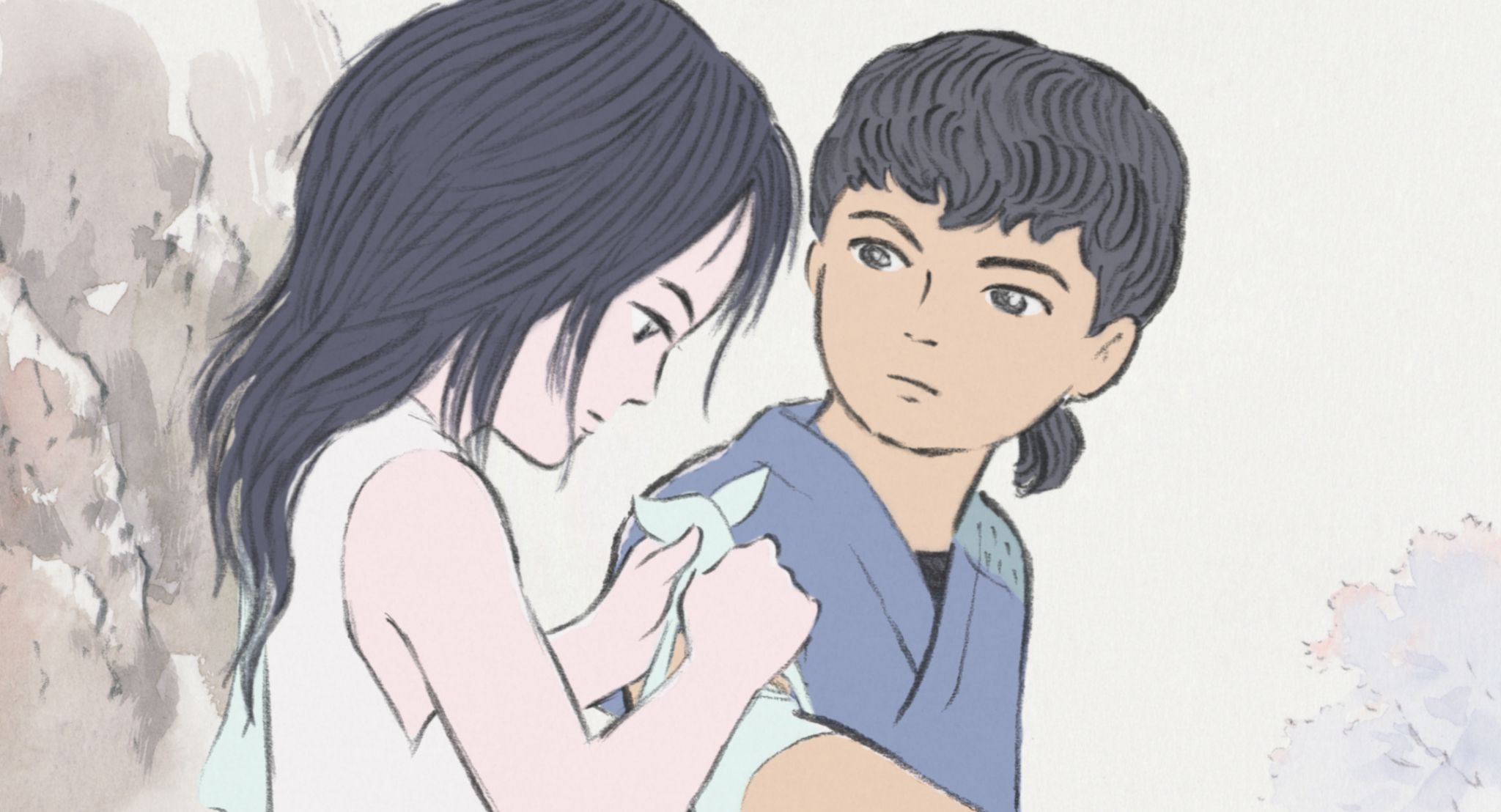
The animation style we see here is
quite different from what most Ghibli fans would expect. Instead of the sharp and clear lines between
characters, objects, and backgrounds that Miyazaki and most of his colleagues
employ, both the characters and backgrounds seem to have been etched out and
colored with chalk, and the dividing lines done with charcoal pens. The edges are not smooth, the colors not
perfectly uniform. The evenness of the
lines between people and backgrounds blur when there is motion, and sometimes,
there simply are not very many details on-screen in an image- faces could lack
features, and backgrounds could swirl together. The effect shifts between being dreamlike, and
resembling old pieces of artwork strung together along a wall to tell a
story. It is difficult to put into words
why this style, so simple and yet so passionately energetic, has the effect it
does. Suffice it to say that I cannot
imagine this story being shown in any other form.

This film has powerfully reinforced
my already-firm belief that animation is, in certain respects, the superior
form of cinematic storytelling. As the
above quote from Roger Ebert points out, live-action films are always crucially
limited by having to show things that are “real-“ real sets, trees, houses,
people, clothing, animals, weather events, etc. etc. The purpose of art, conversely, is to break
down or transcend all the barriers that our physical surroundings impose on
us. We cannot physically walk across the
surface of the sun and live, but in our minds we can, and in our art we can
capture the feelings and sensations of such an experience. Here, a simple shot of a red flower opening
to the dawn, or a butterfly pulling itself out of its cocoon, or a breathtaking
sequence underneath a cherry tree in full bloom, capture the elegance and
beauty of our world better than any high-res photograph could- the side details
are not to be found, because they are not needed. The superficiality of the object’s physical
appearance is stripped away, leaving behind the true nature of the subject at
hand.
Although the film starts off as a
tale of childhood magic, it crosses over into the realm of an epic fantasy by
the end. We know that Kaguya’s origins
are supernatural, but answers as to exactly what she is are offered only in pieces. The movie does not last much longer than two
hours, yet we seem to traverse years in people’s lives and miles upon miles of
the Earth. There are traditional
morality tales to tell as well, especially when Kaguya challenges her suitors
to prove their love by actually finding the magnificent artifacts they compare
her to. Many of the characters need to
learn these lessons just as much as we, the viewers, do.
Above all else though, The Tale of Princess Kaguya is the story
of a father and daughter, how their relationship grows and changes over time,
and how both are hurt by the father’s stubborn insistence that his vision, his
traditions, and his idea of proper happiness must also, quite naturally, be
Kaguya’s as well. Many may scoff at his
simplemindedness, or criticize how old-fashioned he is, which is easy for us
living in an age where no tradition, no old custom, is above ridicule, but
tread carefully, dear reader, if you do so.
Yes, this conflict is here set within a particular time in Japanese
history, but the central strife between the desires of the parent and the
instincts of the child is truly timeless, bound to continue playing out for as
long as humans exist. There is no
villain here- just people, living the only way they know how. The father can be pig-headed, yes, but his
simple, pure love for Kaguya shines through everything he does, and is heartbreaking
in its intensity. And what difference is
there between Kaguya being compelled to pluck her eyebrows and move around only
on her knees and Western women being compelled to force themselves into
corsets, and to not aspire to being anything other than a housewife?

This film is a powerful rebuke to
those who would claim that, when compared with modern animation technology,
older hand-drawn styles no longer have a place in this world. It looks like scratches and slight shadings compared
to the overwhelming details in many of the year’s other great animated works,
like The Lego Movie, The Boxtrolls, How To Train Your Dragon 2, and even the other major Ghibli release of the year, The Wind Rises. It is not loud, and is only
humorous in its effortlessly natural depiction of many of life’s little
absurdities. Its colors are subtle and
light, and the only details on the characters or background are strictly that
which is needed to differentiate one from the other. The movement is, again, entirely natural, with
none of the frenetic motion filling the edges in seemingly every other animated
film (and increasingly many non-animated works) of the past few years.
And despite all that, or perhaps
precisely because of it, The Tale of
Princess Kaguya rises far above nearly all other films, large and small,
that have been released this year. Its
story is a thousand-year-old legend in its home country, and this cinematic
rendering of it is worth being remembered at least as long. It is a rousing call to a life of fullness,
of laughter, and of joy, that can somehow always find a reason to cast of the
darkness that so easily weigh us down through the thousand-and-one cuts of
daily living. It recalls the things of
beauty, pure and often painful in their intensity, that make humanity and human
life, for all its tragedies and comedies, something truly awesome. It is, in my opinion, the best film of this
year, and of quite a few of the years preceding it.
-Noah
Franc