Tuesday, November 25, 2014

Review: The Imitation Game

The Imitation Game (2014): Written by Graham Moore, directed by Morten Tyldum.  Starring: Benedict Cumberbatch, Keira Knightley, Matthew Goode, Mark Strong, Charles Dance, Allen Leech, Matthew Beard, and Rory Kinnear.  Running Time: 114 minutes. 

Rating: 3/4


**in case you know nothing of the life of Alan Turing, and wish to see the film without knowing anything that happens beforehand, which is not the worst idea in the world in this instance, this review contains many spoilers.  No other way for me to really talk about what works/doesn’t work without being maddeningly vague.**

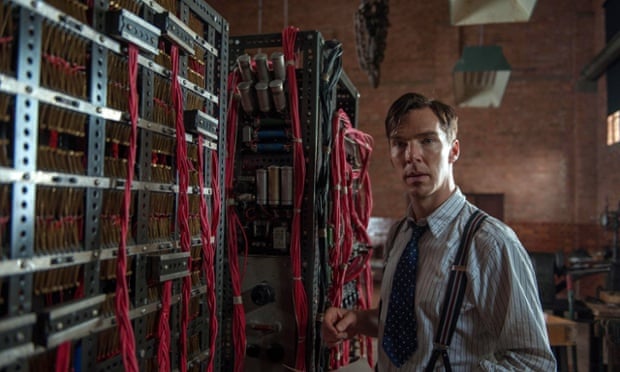
            Some of you may recall that I referred to Benedict Cumberbatch’s voice-over role as Smaug in the second Hobbit film as his best performance of 2013, and I still stand by that statement.  He became ubiquitous last year, appearing in nearly half a dozen screen roles, while also coming dangerously close to breaking the internet with a particularly shameless scene from Sherlock.  Sadly, many of the films ended up being not terribly good, or had a shockingly awful ending, or were just plain average, while his presence in the otherwise excellent Best-Picture-Winner 12 Years A Slave was spared the ignominy of being the film’s most out-of-place casting choice only by the late appearance of Brad Pitt’s hilariously awful stab at a Canadian accent.  This year he is testing the awards waters again, but this time around with the much sturdier choice of a historical biopic set in the Second World War, which, if the term “Oscar Bait” were a black hole, would form the singularity at the very center.  Thankfully, Alan Turing- a misunderstood and emotionally tortured yet singularly brilliant genius, whose utter lack of people skills and seeming absence of human empathy caused many people to hate him like a particularly virulent strain of the Black Death- turns out to be a much better fit for Cumberbatch’s unique talents than a southern plantation owner.  I can't possibly fathom why. 

            First, the story, for those of you who are not familiar with the Tragic Tale of Turing; Alan Turing, a math prodigy (or “maths,” as Britons still insist on calling it) was hired shortly after the war began to join a team of elite codebreakers with the sole task of cracking Enigma, the system used by the Germans to encode every single radio message they send involving troop movements, battle plans, etc.  The concept of cracking it is not that difficult- one merely has to test all possible combinations within the system- but since there are millions upon millions upon millions of possible solutions, and the entire system is reset every single night at midnight, there is nowhere near enough time for a team of human minds, no matter how sharp, to crack more than a few messages in a given day.  Hence the need for an alternative solution. 

            Turing had worked in the past on theories regarding the development a machine that would have the mechanical capacity to handle the calculations needed for just such a scenario, and despite opposition from others within his team (and from his constantly irate higher-ups), he pursues this objective with single-minded furor, eventually winning the respect and admiration from the others on his team and the precious friendship of the group’s lone female (to whom he briefly becomes engaged), Joan Clarke, who had to fight through her own barriers to get there.  After several years, they are successful in building the first of what come to be called “Turing Machines” (or as they are called today, “digital computers”), and are able to figure out the daily combinations of Enigma almost instantly.  It is estimated that the intelligence gleaned in this way shortened the war (the European war, that is) by as much as two years, saving tens of millions of additional lives in the process. 

            That is only part of the story being told, however.  In one of the film’s few moments of truly clever storytelling, much of the beginning is broken up between the war years, Turing’s childhood (when he was turned on to codebreaking), and his post-war years, when his homosexuality (still illegal at that time) was discovered by the law, leading to a sentence forcing him to undergo chemical castration, a process that ultimately broke him and led him to commit suicide at 41.  The edits between the different phases of his life are very well done, and will pack a decent punch for anyone who genuinely doesn’t know how the story will end

            It very is a typical historical biopic in this sense- slickly made and very well acted (the cast is excellent through and through), but very formulaic in its style and presentation, even including the scenes where Turing is first betrayed, and then stuck up for by his team of codebreakers later on, and numerous lines regarding his tastes and character there solely to be brought back as one-shot punchlines later on.  All of that was to be expected though.  What does drag are the sometimes rather random cuts to either reels of actual news footage, or digitally-enhanced flash shots of the aftermath of real battles, starkly tinted in such a way that none of them would look out of place in a Medal of Honor cut scene.  The effect is similar to if the otherwise-solid The King’s Speech had randomly spliced in clips from Ken Burns’ WWII documentary series. 

            That the scenes do not gel at all with the rest of the film is problematic enough, but they also tend to cut away the support of the biggest emotional punch the film has- as Turing points out in his narration, once they cracked the code, they then had to make the excruciating choice to not reveal even some of the most devastating attacks planned, since acting on more than a certain amount of intelligence (they use cold statistics to determine exactly how much) would quickly alert the Germans to the fact that Enigma has been cracked, and they would have to start from scratch yet again.  The first scene where they realize this is a powerful testament to how the horrors of war can stretch far beyond the battlefield, and cutting to scenes of actual battle actually lessens their effect in a number of cases. 

            However, as with any decent biopic, the linchpin is whether or not Cumberbatch is able to effectively bring across the triumphs and struggles of Alan Turing, and his performance alone is more than enough reason to see this movie.  The man can deliver a lot of emotion, and this time around, he finally has a character and script that give him the tools he needs.  And despite the expected inaccuracies, it is a welcome window onto a remarkable tale of one of the most important minds of the last century, someone who has only recently begun to receive his historical due.  It is far from my favorite film of the year, but I am grateful for its presence. 


-Noah Franc 

Wednesday, November 19, 2014

Review: Interstellar

Interstellar (2014): Written by Jonathan and Christopher Nolan, directed by Christopher Nolan.  Starring: Matthew McConaughey, Anne Hathaway, Jessica Chastain, Billy Irwin, Michael Caine, Ellen Burstyn.  Running Time: 169 minutes. 

Rating: 3/4


            Any of us who have avidly followed the trajectory of Chris Nolan’s career have no reason to be surprised at the subject matter of Interstellar.  The man has always eschewed the normal “rules” of storytelling; out of the 9 films he has helmed so far, only 3 (Insomnia, The Dark Knight, and The Dark Knight Rises) follow the typical pattern of presenting the story to us straight, from start to finish.  And Insomnia was a studio-ordered remake, not one of his original screenplays.  Given his tendency to break his narratives into as many pieces as rational sense would allow, it was only a matter of time before he threw all caution to the wind and proclaimed Time Itself to be his new stomping grounds.  It was an inevitable next step in the life of a man determined to cinematically question every facet of self-perception imaginable, and the result is Interstellar. 

            But I am getting ahead of myself.  We open on Earth an unknown number of years in the future.  A blight, possibly-though-never-explicitly aided by global warming (kudos to the film for not going for the easy points), has wiped out all crops on earth except for corn, which is heavily harvested by a small number of farmers in the American Midwest.  Times are so desperate that teachers and other authority figures openly refer to themselves as a “caretaker generation,” blatantly lying about past space exploration to keep their children focused on how to better cultivate the Earth.  None of this sits well with Cooper (Matthew McConaughey), a former NASA pilot and engineer who tries to raise his kids, especially his preternaturally brilliant daughter Murph, to have a sense of wonder at life and at the stars.  When strange goings-on (ghostlike, according to Murph’s description) in Murph’s room seem to be sending them coordinates of some sort in Morse code, they follow them to what, it turns out, is the remaining base of NASA, forced to operate in secret after the tide of public opinion forced governments to abandon any open support for space exploration.  There he finds his old mentor Dr. Brand (Michael Caine) and his daughter Amelia (Anne Hathaway).  From them he learns that another blight is soon to come, one that will both destroy all remaining corn and will also consume so much oxygen that the remainder of humanity will suffocate as a result. 

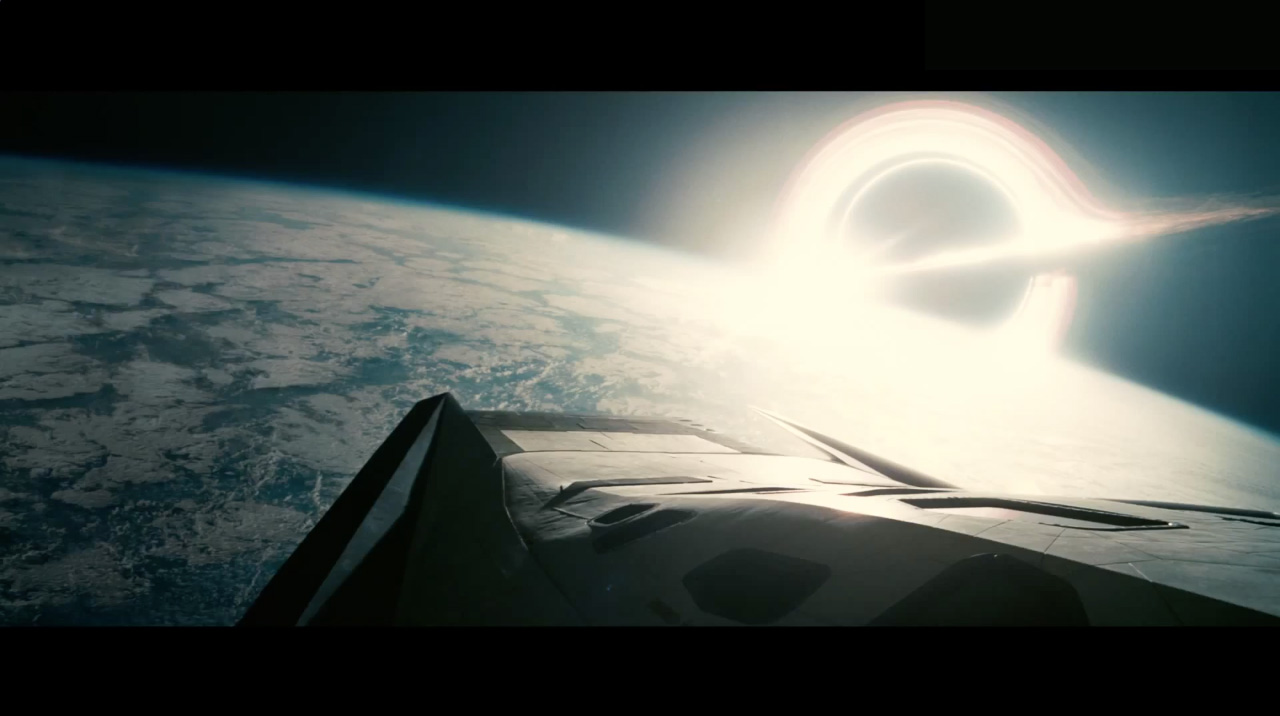
            That said, a lone form of salvation has appeared near Saturn- a wormhole leading to another galaxy, where a handful of potentially habitable world circle a massive black hole.  Cooper is convinced to lead the final team, which will include Amelia, to seek out the best one (several teams have been sent out before, and a few have sent back positive return signals).  The elder Brand will stay behind to complete an equation that should allow him to solve gravity itself, thus allowing humanity to leave Earth en masse in massive space stations before zero hour hits.  Murph is obviously heartbroken by her Dad’s decision to leave, and their agonizing separation is perfectly timed with the countdown for the final lift off.  As she sobs into her grandfather’s arms while Cooper drives off, we hear simultaneously hear the launch countdown.  The crew is lifted off into the recesses of space, preparing themselves for whatever they may find through the wormhole. 

            By now, a great number of cinephiles are solidly split between those who adore the general body of Chris Nolan’s work, and those who may admire his technical prowess but loathe his seemingly incontrollable urge to explain EVERYTHING about the complexities he thinks up for each of his films (the rest, to judge by appearances, do not give half a rat’s tail either way).  This film will change the minds of no one in either camp, and if anything is likely to reinforce and harden any preconceived notions or attitudes towards the man that a particular viewer walks into the film with.  The characters are, for the most part, the same stock archetypes of stoic professionalism willing to sacrifice their own humanity for any great ideal of their choosing.  This is very often the point in his films- his stories tend to both respect or even revere such a mentality while also being brutally honest about the price that must be paid as a result.  Thankfully, much to film’s salvation, Matthew McConaughey and Anne Hathaway end up being fairly inspired casting choices; both are able to bring along more than enough pathos to overcome the clunkier bits of exposition they are handed (and was there every any doubt that Michael Caine would sell his biggest scene like DiCaprio huckstering bad stocks?). 

            I was also rather amused to see the first effort we’ve ever gotten at straight humor from Chris Nolan (of the non-pitch-black variety, that is) in the form of…...a snarky AI robot (named TARS) voiced by Billy Irwin.  Like with his decision to finally turn to time itself as a plot device, it is ironically fitting that Nolan’s first comic character is not, in fact, a human, but a robot programmed to simulate human humor and emotion.  Interpret that as you will.  And the result is a character all its own in recent sci-fi memory, one that would easily outrank all the flesh-and-blood creatures gamboling about as the most emotionally-engaging persona on screen were it not for McConaughey opening up every last gate holding back his tear ducts.  This will be another factor in the film dividing audiences, but I enjoyed TARS immensely, not least because of the unique style of movement the designers came up with for how the robots move.  I’m not sure what’s supposed to hold their various constituent parts together, but based on my experience with a certain trick wallet, I would guess magnetism of some kind. 

            There are, to be sure, stumbles other than the standard Nolan-isms on full display, ones that are harder to ignore.  Unlike in a number of my past reviews, I will not delve into spoilers for this film- like many of Nolan’s films, there are several twists built into the story’s structure that are best experienced cold- but I sadly cannot ignore one smaller twist where two of the human characters (without saying who or where or why) turn antagonistic to Cooper’s mission, in ways that very much feel as if they are only there for the purpose of adding clearly identifiable bad guys with human faces.  Given that the stakes for the entire affair were already pretty damn high, this was entirely unnecessary, and is a strange distraction from the otherwise very solid third-act, where the various plot points and story pieces Nolan has set up come together beautifully in one of the most visually and thematically interesting mashups of actual scientific theory and more mythical sci-fi wonderings we’ve gotten in….hell, I can’t remember the last time we had a big-budget movie try to push a discussion like this.  This, combined with the looming threat of human extinction, was more than adequate for the purpose of creating dramatic and nervous tension.  The fistfight in spacesuits was just extraneous.   

            And yet…for all the ways Nolan seems to inadvertently trip over his own toes in his eagerness to match the transcendent splendor of the final sequences in Kubrick’s 2001, there is a staying power in the film’s more potent scenes that it’s slower parts and occasionally punishing length can never undo.  Cooper’s final goodbyes with his family, the buildup to and subsequent journey through the wormhole, a sequence involving a spinning station, and a major third-act segment involving the giant black hole itself are all the sort of scenes that could easily become sci-fi legend, given a little time for the film to make its impact felt.  There has been a bevy of criticism leveled at the film for the ways it holds itself back, and while many complaints are not without merit, it should bear remembering that the reason sci-fi as a genre exist in the first place is to make whatever leaps, however halting, into the future of both mankind in general and the art of cinema specifically a writer or director can dream up.  Interstellar takes more than a few leaps of logic and daring, and the simple experience of watching the jumps in action is its own special treat, even when it can’t always stick the landings. 


-Noah Franc  

Tuesday, November 11, 2014

Review: Im Labyrinth des Schweigens (In the Labyrinth of Silence)

In the Labyrinth of Silence (2014): Written by Giulio Ricciarelli and Elisabeth Bartel, directed by Giulio Ricciarelli.  Starring: Alexander Fehling, Johannes Kirsch, Friederike Becht, Hansi Jochmann, Johann von Buelow, Gert Voss, Robert Hunger-Buehler, and Andre Szymanski.  Running Time: 122 minutes. 

Rating: 3/4


            One of the most enduring debates in our world is how to approach reconciliation and healing after great crimes are committed, especially on a national or state level.  There is no one clear answer, no one path or set of rules that can be universally applied to all situations.  Sometimes great conflicts or crimes are maintained in an uneasy, “stable” status quo, like in Korea.  Some are only resolved when a particular side wins decisively on the field of battle, like in Sri Lanka.  Some societies choose to tackle the wounds of the past directly through formal organizations like South Africa’s Truth and Reconciliation Commission.  And some, like the German government in the years immediately following WWII and the revelations of the Holocaust, choose silence. 

            This is the world that a young lawyer, Johann Radmann, has grown up in, experiencing only the non-confrontational post-war world of Konrad Adenauer and the German “Economic Miracle.”  Currently paying his legal dues in the rather dull world of legal traffic violations, he yearns for the chance to do something of substance, inspired by the example set by his father, himself a lawyer prior to his disappearance during the War.  He seizes his chance when an aggressive journalist, Thomas Gnielka, confronts his colleagues with a claim by a friend of his, a survivor of Auschwitz survivor named Simon Kirsch.  Having been not old enough to grasp his circumstances during the war itself, he is almost completely unaware of the true extent of Nazi brutality, and holds only a hazy notion of Auschwitz as a POW camp of sorts. 

            Despite his profound naiveté, or perhaps because of it, a senior member of the office named Fritz Bauer enlists him, another lawyer, and a secretary to fully investigate all leads that the journalist and his friend can provide regarding any surviving guards from Auschwitz that can be tried murder.  And they have to have convincing proof that the people were either complicit in or fully aware of the extent of the killing that went on, since actual murder charges are the only ones not affected by a previously agreed-upon statute of limitations.  Bauer has been chomping at the bit for years, looking for the chance to strike back at the former Nazis he knows are still free at every level of German society, but has been helpless to do anything about it due to the agreement reached among the Western powers following the Nuremberg Trials that any further members of Hitler’s government would either be ignored, or if they proved useful against the growing strength of the Soviet Union, protected.  The goal is a single, massive trial, with as many survivors testifying against as many former SS members as possible, so as to finally break the veil of silence that has descended upon the country, resulting in a generation growing up entirely ignorant of the blood on their country’s hands. 

            Johann’s lack of comprehension of the scale of the tragedy is brutally rectified in his very first interview with another survivor.  Surprised at the blasé nature of his questions, the man stares incredulously at him and asks (through an interpreter), “You want to know what crimes I saw?  Do you not realize what Auschwitz was?  They murdered hundreds of thousands of people!”  After hearing this, a look of realization can be seen striking Johann right between the eyes; an abyss of unending darkness has opened up beneath his feet, and he almost dares not look down for fear of what he may see in the void below. 

            But look he must, and he does, even as the work begins to wear him down and affect his relationship with friends and his love for a young seamstress named Marlene.  Through his interviews with survivors and his scouring of leftover records in the IG-Farbenhaus in Frankfurt (now the official offices for the US 5th Corps), he slowly develops both the case they need and his own terrifying understanding of both the extent of German atrocities and of the parallel terrors of silence imposed on the topic since then.  He learns of the experiments (and continued freedom) of Josef Mengele, aka the Angel of Death, delves into his own father’s connection to the Nazi party, and as a result begins to lose his own ability to trust anyone he knows with even tangential connections to the war. 

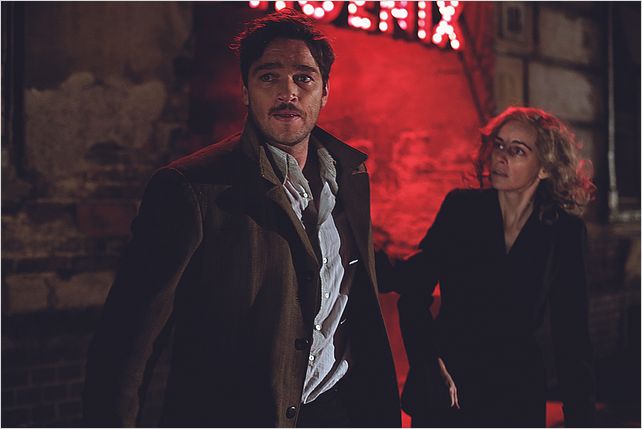
            Like with another German film from earlier this year, Phoenix, Im Labyrinth des Schweigens never needs to resort to explicit depictions of the sufferings of the camps to have the desired effect.  We have all seen the photos and the videos.  We have seen movies like Schindler’s List, making the horrors of Auschwitz more real to us than any book or documentary could.  Any piling on top of that would be redundant and numbing.  Instead, the director chose deliberately to focus on the people themselves, as they tell their stories, with long close-ups of their faces as they struggle to reconcile themselves with the terrible events they have no choice but to remember.  It’s almost a way to regain the humanity of those who suffered, to show them as individuals, something that can easily be lost amidst talk of the massive numbers of dead involved. 

            Johann’s emotional journey through the experience of preparing the trial, in many ways written to reflect the spiritual struggles of the entire country in its efforts to be able to face these crimes, is portrayed flawlessly by Alexander Fehling.  The man comes fully equipped at all times with a beautifully trembling lower lip for whenever a moment of pure, emotional pathos is needed.  His character is in many ways a stand-in for us as the audience.  Any of us raised with a proper understanding of history have had to experience the same moments he does: the unknowing innocence in our early years of what people are capable of, the sense of unspeakable horror when we first confront the darkness or potential in us and those around us, and the daily struggle to be able to reconcile the conflicting natures of humanity so as to not allow ourselves to be dragged down into the abyss as well. 

            Given that the film, the first feature-length work by Giulio Ricciarelli, is attempting to shed light on a crucial aspect of German social development and reconciliation during the Cold War that has been ignored up ‘til now, I do feel that it could have delved further into the legal and cultural challenges facing everyone involved in the process.  As a vehicle for conveying the evils of Nazism, it is certainly more muted in its approach than more explicit films dealing with the same subject matter, which will perhaps rob it of a deep emotional impact on many.  Nonetheless, this is also a part of the tale of Germany and the Holocaust, and is therefore every bit as much worth remembering as the chilling memories of death in the camps themselves.  It needs a place in our collective memories as an example of the little bits of good than can be done in our daily lives to counter such awful acts, to rebuild what others would destroy. 


-Noah Franc 

Saturday, November 1, 2014

A Few Thoughts On #GamerGate or Why It Needs To Die


            Up ‘til now, I had resolved to keep my silence on #GamerGate.  This was primarily because I am really nothing more than a casual gamer (with exception for Pokemon and Civilization, and a handful of gems like Portal and Gone Home), and therefore felt that I did not have the necessary depth of familiarity with the video games industry.  I had followed the general trends of events via several online presences whose intellectual and professional integrity I have nothing but the highest regard for, and noted more and more that not a single one of them had anything positive to say about it.  And over the past few weeks, with more and more tales of fear and threats surfacing almost daily, I began to feel that a turning point had been reached; #GamerGate is no longer a video games problem.  What’s more, it never was one to begin with- it’s a cultural problem.  And we need everyone to speak out against it. 

            I will not do a full recap of events, since that would take far more time than I currently have at my disposal.  For some different perspectives on this whole circus, many of which include links to further sources if you really want to wade into the swamp, I recommend taking a look at MovieBob’s most recent post on the subject, as well as a much-quoted response to the many defenses of the movement, a TIME article about the greater importance of this step in the development of video games, and the rebuttal to the movement posted by Todd in the Shadows to blog page for Nostalgia Chic’s website. 

            If you are reading this and are as of yet unaware of the general course of events over the past few months, please read the above links before continuing.  I am not concerned so much with how #GamerGate began, although that was sickening enough.  My worries center around where it is now, and the troubling signs I see in the near future. 

            As far as some have tried (some earnestly, some halfheartedly, some cynically) to turn #GamerGate from an attack on a single woman’s personal character into a general “reform movement” for gaming journalism, the primary problem with #GamerGate is this; it was and is too divided and too scattered to ever be effective in this regard.  In broad terms, the entire population of people (I won’t even bother using the term “gamers” here) who claim or have claimed support of any kind for #GamerGate or its appropriation of the #NotYourShield hashtag can be sifted into two general groups.  The far larger of the group is, most likely, people who are not bad people, who likely do not contribute to the waves of hate and threats that have sullied countless online forums, and who actually do believe that earnest efforts to reform the gaming industry are needed.  That said, actual statistics proving or disproving this are impossible to obtain, so in terms of the numbers on each side it is entirely possible that the reverse is true, and the second category of #GamerGaters are truly the majority of the movement.  Unless proof to that end is ever forthcoming, however, I will give humanity the benefit of the doubt, and assume that that is not the case.  I sure hope it isn’t. 

            The second group- the group that essentially started the movement and have been holding the reigns ever since- consists of a probably small, yet highly organized, group of racists, sexists, misogynists, trolls, ignoramuses, and small-minded, frightened man-children.  It is a group that senses the cultural and demographic shifts pushing them to minority, side-show status within an industry they have hitherto dominated.  It is a group that realizes that the true of future of games, like the true future of humanity, lies in plurality, in increasing diversity, where all stories of all kinds have the potential to find their way into games that reach the levels of high art achieved by other storytelling mediums like poetry, books, film, music, dance, and so on.  And it realizes that that journey into the realm of genuine art can only come about with the changing and, in many cases, elimination of many of the less-savory aspects of past and current gaming culture under the harsh light of public scrutiny.  And it fears this, more than it can put into words. 

            So they waited for the right opportunity to strike.  And when Zoe Quinn’s butthurt ex, whose name, if there is any justice in the world, will be lost to history, let loose his libelous diarrhea of adolescent rage, they saw their chance, and began striking out.  Not against any actual sources of questionable journalistic practices in gaming that do exist and should be dealt with, but rather against token developers and online personas who had been directly challenging for years their cherished worldview that there was nothing wrong whatsoever with the gaming environment they know and love today.  These people have acted with intent to emotionally harm, and quite possibly, with intent to physically harm as well.  Reform was never something to be taken seriously.  It was merely there to be used as a shield. 

            It pains me to use the word “they” in contexts like this, since it can easily lead one to exactly the kind of mental segregation of humanity I am so often railing against.  However, it is necessary now, as it sometimes is, to draw a distinction between those people directly (or even passively) involving themselves in the torrents of abuse, and those who have made genuine, albeit hopeless, efforts to rechannel the movements into something constructive.  We must be conscious about our use of the term, but in this case, it is necessary. 

            The result of all this- of the horridly graphic threats, the crashing of websites that refuse to bow down, the leaking of personal information of those who criticize them, and the cowing of others through implied threats of the same- has and can only be destructive.  It is a hindrance to the needed task of addressing real issues with modern video gaming.  It is driving creative, intellectual, and passionate people from the world of game design.  In a word, it is depriving this medium of exactly the sort of figures it needs to mature.  And it needs to stop NOW.  In fact, all you really need to do to fully understand what really drives this sludge is to note that the figures most often attacked and threatened in the most graphic ways….are all women.  Without exception.  That tells you everything you need to know. 

            Why care about this, if, as admitted above, I do no really consider myself part of any particular gaming community?  Simple- because I am a lover of film. 

            “And what the hell does that have to do with any of this?” you surely ask.  How can film, a form of entertainment over a century old and an indelible part of larger human culture, be compared with the new technology of video games?  Again, the answer is simple- film went through the exact same issues with sexism, racism, and general tolerance for diversity that video games are currently going through.  In fact, film is still going through it, because up until just recently the world of cinema has been blowing it big time when it comes to supporting genuine plurality.  And even now, the explosion of diversity in film we are seeing is being driven more by the levelling power of the internet than by any genuine, organized change effort.  We have had 86 Academy Awards thus far, which can roughly be used to date the existence of the film industry as it exists today, and only within the last 5 years have we seen a lone woman, a lone Hispanic, and a lone Asian (the latter two being men) win the Best Director trophy, and only this year did we finally see a film made by a black man win Best Picture.  Only within the past two years have box-office numbers statistically contradicted the assertions of big studios that action/big-budget fare starring women can’t ever be generally popular and make money.  You know that Avengers 2 trailer  everyone is gushing fire about?  How many seconds or footage are devoted to female/non-white characters?  5?  Maybe 7.5?  One of the most influential films ever made is Birth of a Nation, a morally offensive love letter to the KKK. 

            Yes sir, film has been humiliating itself big time for DECADES, if not longer.  And with all the benefits of hindsight we now have, video games are in a position to learn from the errors in the development of film as a medium.  The drivers of the industry can learn from the history of film and avoid many of the pitfalls that has led to cinema in general being shockingly regressive far too long into the 21st century.  That is, IF they can effectively push away and ignore the rants and tantrums of the petulant children claiming the shield of not being anyone’s shield.  This will be a turning point in the developing of video games either way.  It’s only a question of whether or not the turn will be positive or negative. 

            The real reason, however, why it is critical that EVERYONE understand what is happening with #GamerGate is that the real reasons why it exists, and the true forces pushing it to its horrifying extremes, are exactly same the same forces we see driving the Tea Party and the related partisanship that has paralyzed our government for the past 4 years.  While latent racism and conservative/social reactionism were not necessarily the initial cause of the Tea Party,  they were very much what kicked it into high gear once a black man (GASP!) won the Presidency and was able to push through the first piece of truly significant social legislation since Johnson’s Great Society initiative.  This, combined with the general fear within older, white, Christian voters that they are finally losing their very, very long vicegrip on American society, is what has allowed the demagogues of the movement to seize control over an entire party, pummeling its veteran leadership into acquiescing to their demands and exiling them from party leadership when they fail to comply, or simply for uttering the word “compromise.”  There is no other explanation able to bear scrutiny as to why Obama was the first President EVER to have his citizenship called into question, and why to this day a depressingly large percentage of Republican voters believe that he is either a Muslim, or the Antichrist, or both (I swear to God, I am not making this up).   

            With the Tea Party, we see this same basic dynamic- a tiny minority wholly unrepresentative of American society, terrified of seeing its influence inevitably waning, motivated by racism, sexism, xenophobia, and general fear of any form of change perceived as directly harmful to their interests, that has seized control of public means of discussion to bully as many as they can into either open support or silent assent.  A movement that employs language and ideas general and open enough to mask their real intentions and confer legitimacy on campaigns of harassment and cruelty (including, in the Tea Party’s case, vague arguments about deficits, the need to preserve tradition, and opaque claims that government in general is “bad”).  A movement that claims it wants “reform,” yet is unwilling (or unable) to provide any actual specifics about what it wants and how it wants to achieve them.  A movement that demonizes any critique or opposition to its maddeningly unclear goals, and kicks out any within its ranks that dares to disagree. 

            It is this movement that is primarily to blame for the radicalization of the Republican Party and the creation of a system more gridlocked and unproductive than any other Congress since before the Civil War.  It is the forces behind this movement that push against efforts to change cultures within sports, the military, universities, and others that encourage or passively accept sexual violence and harassment again women.  It is these forces that claim slavery was in the past, and is therefore no longer relevant in terms of why racial and economic disparity in the US is so high.  These are the forces continuing to seek ways to deny health coverage to the poor, who push for “voter reform laws” that, curiously, overwhelmingly restrict the ability of overwhelmingly Democratic groups to vote.  That claim that global warming, the greatest threat to humanity in history, does not exist. 

            But I digress.  Coming back to #GamerGate- the end result of the past few months is that the cultural development of video games has been substantially set back.  How far back, no one can say.  And as of right now, like with the Tea Party’s disgustingly outsized influence on our public debate, there is no effective counterweight to this.  All the people, including some dear friends of mine, that would like to have an actual conversation about how to improve gaming journalism have been thoroughly used and drowned out.  There is no real debate going on, just shady and half-formed accusations.  No steps have been taken or even brought forward about how to make actual, real improvement in how games are reported on. 

            What HAS happened is that websites and corporations have been virtually pummeled into submission and silence for doing or saying something- anything, really- that the organized #GamerGaters didn’t like.  What HAS happened is that, instead of inspiring the kind of open, spirited, and yes, painful and uncomfortable discussions that are essential for any change of positive consequence to occur, a climate of fear, anger, and mistrust has suffocated any attempt at real conversation.  The case of Felicia Day, one of the most positive and outspoken voices for games as a force for good, is as clear an example of this as anyone could provide; instead of voicing her own ideas about improving gaming journalism, she kept silent for months, out of fear.  And when she finally did speak, openly expressing her worries about where the movement is headed, she was punished, literally within minutes (on that note, if you haven’t, read Day’s silence-breaking post.  It is incredible, and brave, and wonderful).  What HAS happened is that women and their families have felt compelled to flee their homes, fearing for their very lives. 

            This means that #GamerGate as a social movement, as a reform movement, as a movement any different from a terrorism campaign (see this video as to why the use of the word “terrorism,” in this instance, is not without merit) is an utter failure, because from day one, the people pushing it the most were people who never cared one whit for tackling actual problems within the industry.  This is no different from the verbal assault that was rained down upon a female critic at a movie website for daring to spoil Guardians of the Galaxy’s perfect 100% rating on Rotten Tomato (which prompted a pitch-perfect response from the site’s editor).  This is no different from the leeches that obtained celebrity nude photos and launched The Fappening, or the gremlins that tortured Robin Williams’ daughter with photoshopped images of her dead dad.  The exact same forces have been at work here from day one, the same forces of cultural and social reactionism that drive dreck like the Tea Party and give Fox News a reason for existing.  And with #Gamergate, they have been allowed to spread even further.  Which is, finally, why I am arguing that this is a cultural problem.  Not a gaming one.  It is a cultural problem, and we must all be part of the solution.  Because there is no excuse- NONE- for us not to be outraged into action by opening up the news and reading about another woman fleeing for her very life, simply because she opened her mouth and spoke her mind.  There is NEVER an excuse for that to happen.  I don’t care if there ever WAS a conspiracy to hijack the gaming industry (more spoilers- there wasn’t, there isn’t, and there never will be). 

            #GamerGate must be abandoned.  All decent-minded people who actually do want to improve things within gaming must truly come together, get organized, form vetted, dependable leadership, and provide a narrative and a course of action other than what the wretches and misogynists have offered us thus far.  The hashtags have to be abandoned, and new hashtags, new monikers, new mottos and new rallying cries found, because #GamerGate and #NotYourShield are tainted beyond all salvation.  The vultures have come home to roost, and they are not leaving until every bone has been picked dry.  We have to admit, collectively, that #GamerGate is a failure, and start anew.  Otherwise, the same corrosive forces paralyzing our political system and stratifying our society will poison the bright future of games as the next great storytelling medium.  And I don’t want to see that happen. 


-Noah Franc 

Tuesday, October 21, 2014

Review: Gone Girl

Gone Girl (2014): Written by Gillian Flynn, directed by David Fincher.  Starring: Ben Affleck, Rosamund Pike, Niel Patrick Harris, Tyler Perry, Carrie Coon, Kim Dickens.  Running Time: 149 minutes.  Based on the novel of the same name by Gillian Flynn. 

Rating: 3.5/4 


            I think I may as well throw up the spoiler warning right here and now, because Gone Girl is one of those movies that cannot be discussed on any level of detail without having to delve into at least some of the major, major story turns that make it such a viscerally effective thriller.  I will try to refrain from specifics as much as possible, but as I write this, I cannot make any guarantees.  For anyone reading this that has not yet had the brutal pleasure of seeing this film, suffice it to say that Gone Girl is a technical masterpiece of suspenseful storytelling framed with remarkable performances from its cast, and is without a doubt one of the year’s better films so far.  If you have not yet seen it, you need to make doing so a priority before it leaves theaters.  For anyone else who knows the gritty details and is ready to dive in with me, let us now turn to the review.   

            Ben Affleck stars as Nick, a frustrated, middle-class writer living out another mirage of the American Dream in a typical postcard-perfect suburban town in Missouri.  We know right away he’s frustrated, and angry, and depressed, as he waltzes in to the bar he runs with his non-identical twin sister Margo (Carrie Coon), and asks for a drink at way-too-early-in-the-a.m.  Things then get a whole lot worse (and soon, a lot more dangerous) when he returns to find his wife, Amy (Rosamund Pike), missing, and the house looking as if someone carried out a not-so-convincing kidnapping scheme.  He immediately contacts the police, along with a detective named Rhonda Boney (Kim Dickens), and an investigation begins immediately. 

            The case does not stay small or local for very long.  It turns out that Amy was used by her oddly passively-manipulative parents as the poster child for a series of wildly popular children’s books during her growing up years called Amazing Amy.  As a result, Amy was already a minor child celebrity, and her disappearance (which very quickly starts to look like a murder case) becomes a national media phenomenon, reported on and followed by millions.  Nick and his sister are besieged by reporters camping outside the house, news pundits take turns trying to find increasingly mundane and insipid details about Nick obsess over, and all the while, an indefatigable Rhonda tries to put together the increasingly odd pieces of the puzzle.  

            From the start, Nick proclaims his innocence, but a series of increasingly strange and, in some cases, mind-jarringly bizarre developments make him more and more suspect in the eyes of both the public and the law.  While we see the present investigation and trial through his eyes, the past is revealed to us only through scattered bits of narrative journal entries done by Rosamund Pike in voiceover.  And it is in those moments, combined with the slow-burning editing, shadow-filled cinematography, and the eerie, heartbeat-like tones and rhythms of the score (more excellent work by Trent Raznor and Atticus Ross) that truly force the audience to question; is this case really as it seems?  Is anything? 

            Most movies bill themselves on a single, very basic premise- that what the main characters say on-screen (and what the editing, camerawork, and use of music suggest) is essentially the Truth, i.e., when a character proclaims their innocence, they are innocent (unless they have pedophilic facial hair and say it over a dissonant, harsh chord in the score, in which case we know they’re lying).  As a result, we can’t help but have certain expectations when seeing any and all that movies that, for the most part at least, what we see (and hear) is what we get. 

            And it is therein that the brilliance of Gone Girl lies.  Like many other great cinematic twisters, this film goes out of its way (at times breaking the bonds of rationality and logic to do so) to take each expectation we are provided with the start, flip it on its head, spin it around, and then toss it back in our face.  Then, it does it again, and for good measure it does it a few more times before finally calling it quits.  It is a commitment of a film to sit through, but the payoff is well worth it simply for the number of times the movie pulls another narrative rabbit out of the hat you probably should have seen coming but, in all likelihood, didn’t. 

            The first great fakeout (and it is here that all must fully heed my Spoiler Alert above), comes somewhere around the middle.  Up ‘til now, the story had presented itself as a not-too-complicated mystery about whether or not Nick actually did the deed.  The culmination of this segment is a properly spine-tingling shot of Nick, after having a sudden realization, finding his sister’s shed full of luxury items he has been accused of ordering, but had never actually ordered himself.  I don’t think I can adequately convey how much the scene chilled me (the frantic nature of the segment music had a lot to do with that).  And the movie immediately starts the one-upping of itself immediately afterwards, by revealing to us that not only was Amy not kidnapped, or murdered, but that she had merely faked her death.  Not only that, she had been planning to do so for ages, and set everything up with the express purpose of having Nick be accused and sentenced to death for her murder. 

            It is the first of a great many upendings, nearly all of which center around the increasingly awful depths to which Amy has sunk in the past, and can and is willing to sink in order to achieve…..actually, it’s rather opaque what it is, exactly, that she wants.  Does she just want adventure?  Does she want to forge her own brand of celebrity, one not controlled by her emotionally wooden parents?  Does she just want petty revenge for the fact that her marriage to Nick never ended up being as spectacularly perfect as it was in the beginning?  Was she always this deceitful, or has she been warped years of trying to live up to societal expectations of what a “real woman” is like?  Like with any great movie, we are offered no answers.  We merely see the end product- a bitter and merciless person that manipulates and brutalizes others out of sheer instinct.  Amy is one of the most fascinating and compulsively watchable villains to appear on-screen in years, and Rosamund Pike is likely an early contender for award nominations come January. 

            Unless, that is, the carrions of controversy scare off the Academy wildebeests, as they are often wont to do.  I consider Amy to be the villain (or at least the primary antagonist in a den of antagonists) of this work, but as I write this, debate is raging over whether or not her character (or even the film as a whole) could be labeled misogynistic by portraying a woman so evil, that it could justify or reinforce sexist or anti-feminist views of many men (and perhaps even of women as well).  One of the major justifications Amy provides for her actions (at least, her actions towards Nick) is how, once they were married, he seemed to very quickly lose interest in her as a person, quickly expecting her to carry all the weight around the house and becoming a deadbeat once he lost his job.  She speaks with barely contained fury over being “used” for sex, and tossed aside once Nick was finished with her.  Her rant against the expected roles set aside by men for women, and the ways she and other housewives are shoehorned into them, while unable to excuse many of her actions (remember, she is actively trying to get an innocent man sent to death row), makes her far more than just a ball of pure evil, and it certainly makes her more complex than I think some critics have taken her to be. 

            That, however, doesn’t touch on perhaps the most inflammatory aspect of her character; namely, that she frames several men for rape, causing one to be marked for society by life, and another to be….well, that’s one of the twists I feel I should not spoil.  Given the continuing problems college campuses, professional sports, and other areas of public awareness have of effectively dealing with rape, and considering how so, so often the defense of rapists is to cast doubt on the motivations of the women making accusations, I can understand entirely why this would set people off.  The last thing any decent-minded person wants is to provide more fodder, however unintentionally, for the ignorant misogynists of the world.  With that said, my interpretation of said moments was that they were intended to merely highlight how drastic Amy was willing to become in order to achieve whatever twisted end she wanted, and not to be connected to any broader discussion of how actual rape cases are treated.  But, given the movie’s ambiguity about so much, misinterpretation is fairly easy, and here too I can’t blame some for seeing the film in a harsher light as a result.  . 

            It must be remembered, though, that Amy’s level of monstrosity is merely a question of degrees.  She happens to reach lower than anyone else on-screen, but it would be a gross mistake to let that absolve the others.  Margo may be the only character on-screen who comes across as anything approaching a decent human being; Nick himself, while quite clearly not a murderer or rapist, is an adulterer, a loafer, coarse and prone to aggression; Amy’s parents seem emotionally dead whenever they’re on-screen; the detective strives for the truth but is clearly eager for the evidence to turn a certain way; the lawyer Nick eventually retains lauds his ability to rescue the innocent from the jaws of the often all-too-blind legal system, but makes no bones about bragging about his 100k retainer fee for doing so.   

            Although, now that I really think about it, perhaps the obviousness of making Amy out to be the villain is yet another red herring tossed our way, because in so many respects, the true force of darkness on display is us.  The people watching and obsessing over every single twist and turn in the case, fueling purely speculative and mean-spirited journalism, chanting hate speech to Nick one day and cheering his Perfect And Awesome Happy End the next, and gathering outside his bar every evening to take selfies (which were probably promptly uploaded to Facebook with the hashtag Killerpub), much like the audience gazing at Leonardo DiCaprio at the very end of The Wolf of Wall Street, are us.  How many murder trials and how many disappearances have we collectively obsessed over, simply to abandon thinking about them ever again once a) no clear answers were ever provided, or b) the incident ended “properly?”  I can remember more than I ever care to count.  We create the conditions that drive (or at least prod) people like Nick and Amy into believing, or perhaps simply wanting, to become falsified, artificial, superficial versions of themselves just for the sake of our approval.  Then, whenever shit really does hit the fan, we rant, and cheer, and rage, and take photos, and wonder tut-tuttingly how people could become so messed up. 

            This review has become far more extensive (and far more spoiler-filled) than originally planned, but I feel no regrets, because this movie is every bit as much of a think piece as some of this year’s other great works like Under The Skin and The Grand Budapest Hotel.  David Fincher is a technical genius at taking the most average and seemingly unnecessary shots and making them work together so tightly, and so seamlessly, that you can’t imagine the movie being stitched together any other way.  I don’t love it as much as I loved The Social Network, and it is by no means flawless- Amy only avoids a trial of her own through a spectacular jump in logic that causes a whole team of FBI agents to overlook some very massive holes in her story- but that is no matter, because the point of the movie isn’t to answer itself clearly or make straight statements.  It is there to make us jump, to make us laugh and cringe at the same time, and maybe – if we let it- cause us to look a little longer and little harder at ourselves the next time we pass a mirror. 


-Noah Franc 

Friday, October 10, 2014

Review: Phoenix

Phoenix (2014): Written by Christian Petzold, Harun Farocki, and Hubert Monteilhet, directed by Christian Petzold.  Starring: Nina Hoss, Ronald Zehrfeld, and Nina Kunzendorf.  Running Time: 98 minutes. 

Rating: 4/4


            I have long felt that movies centering around (or whose stories are in some way connected to) WWII, Holocaust, and/or other atrocities associated with that era of human history are among the easiest kinds of movies to make.  For clarity’s sake, before anyone reading this gets upset, let me stress that I do not mean that confronting the hard, terrible truths of that time are easy, or simple, or quickly dismissed.  I do not mean to come across as dismissive of the agony and suffering caused by the megalomaniacal, greedy, cruel, angry, or just plain frightened men that drove events, and obviously I am not saying that such acts can or should be easily forgiven.  Nor am I implying that the level of talent and effective collaboration necessary to make a good film about WWII is in any way less than that necessary for any other kind of film. 

            What I mean is that, since nearly all kinds of stories rely on conflict of some kind, WWII-related films are easy in that, when trying to tell a story about that time period, a conflict and/or readily identifiable bad guy (or bad guys) arrives practically gift-wrapped at your doorstep.  There is no need to embellish the acts of Hitler, or Stalin, or the SS, or the Japanese government.  There is no need to invent a villain or conflict.  The true events themselves are heinous enough that simply showing (or referencing) them as they really happened will inevitably cause anyone with a properly-functioning moral compass to recoil in horror, and to automatically sympathize with whichever victims said film has chosen to focus on.  I am not saying that this is a good or bad thing, simply observing how so many films/books/plays/video games/whathaveyou are able to easily lean back on the Nazis as go-to bad guys, almost automatically guaranteeing audience sympathy with their main characters (except, obviously, in cases where the film in question is deliberately upending or deconstructing this tendency, like in Saving Private Ryan or Inglorious Basterds).     

            It’s one small aspect of our continuing Western cultural obsession with the Nazis, a much broader topic of great enough importance to me that I am already considering how to tackle it more directly in a later series of posts.  The reason why I bring it up here is because Phoenix, a German film that centers around the post-war experiences of an Auschwitz survivor, is remarkable in part because of how it uses none of the now almost standard images of Nazi atrocities or the horrors of war to win us over to the heroine’s side.  Although we know the main character is a camp survivor, we are offered no memories, flashbacks, or nightmarish dreams (ala Shutter Island) that show exactly what she saw, suffered, and experienced.  Everything we need to know can be found in her tortured performance, in the pain etched into her eyes and in her shuffled, beaten walk.  No further explanation or display needed.    

            Said woman is named Nelly, (Nina Hoss), a German-Jewish singer who survived the camps, but not without having her face horribly ravaged.  A friend and fellow survivor, the angry and sadly bitter Lene, brings her through the American lines to the Western area of Berlin for reconstructive surgery.  In a strange metaphysical twist, the doctor who handles the surgery is played by Michael Maertens, who happened to play another doctor working with skin (albeit in a far creepier manner) in last year’s surreal Finsterworld.  She is offered the chance to take on a new face and a new identity, but her response is a shaky-but-firm no; she wants to look as much like she did before as possible. 

            Her reason for doing this is so that she can find and reunite with her husband, Johnny, who apparently survived the war as well (some of her other friends did not, and others, she is shocked to learn, were active Nazis).  This horrifies Lene, who sees emigration to Israel as the only option for Europe’s remaining Jews, but despite her fears, Nelly cannot conceive of doing anything else.  Wandering alone at night through the crime-ridden and waste-filled ruins of Berlin (as dreary a dystopia as one can imagine, filled with mountains of debris and lights that cast long, misshapen shadows), she eventually does find him working at a bar called the Phoenix (that this is the nominal inspiration for the film’s title is clear, but the obvious symbolic overtones will be lost on no one).  Unsurprisingly though, since her appearance was somewhat altered by surgery, he does not recognize her when they first encounter each other.  That said, he does admit that she bears a close resemblance to his “late” wife (his certainty of her death may be a psychological reason he does not realize it’s her), and immediately hatches a plan.  He will provide her with some of Nelly’s old clothes, teach her to walk and act like her, and have her memorize key facts of their marriage together.  Once that is accomplished, they will go to the authorities to show them that Nelly Lenz has returned. 

            Why all the chicanery?  Since Nelly had several very rich relatives, themselves Jewish, and since all of them died, she has quite an inheritance attached her name (said inheritance is, in fact, what she and Lene are living off of while she tries to get her husband to recognize her).  Johnny is aware of this, and as he has been down on his luck since the war’s end, he tells Nelly that once they win over the authorities and she receives the inheritance, they will split everything 50/50, and she will be free to go along her way. 

            It is a horridly pessimistic and cynical scheme, made hard to watch by how painfully and obviously Nelly yearns for her husband to recognize her.  Nina Hoss gives a stunning performance, conveying the right mix of utter brokenness with her hard-to-contain hope that somehow, someway, things can be as they once were.  Her only wish is to be able to sing once more with “her Johnny.”  Even her most fervent hopes, however, begin to be tested as she grows less and less certain of what really happened that led the authorities to her hiding place.  She had been secluded away near a friend’s house, and the family husband seems less than enthused when she returns.  Could they have turned her over?  Or perhaps there is a grimmer reason why her husband seems so, so certain that his wife is dead and gone?  The inevitable possibility that that thought leads to is never spoken, but you can see its implications creep into her eyes and demeanor over time. 

            The final moment of true realization, for both characters, is a moment of pure cinematic perfection.  Christian Petzold knew exactly how to utilize the cards in his hand, and he reveals them each, one by one, in perfect sequence.  I was a little unsure halfway through where, exactly, the film was going, and it can be somewhat aggravating how dense the husband is; once you’ve acknowledged how closely resembles a loved one, someone who automatically called you by a pet name, wouldn’t the bells start ringing once they show they can perfectly mimic that person’s handwriting without needing a sample beforehand?  That, however, is part of the point- even without a definitive answer to the questions posed above, the degree to which Johnny is unable to recognize his own wife in front of him can’t help but make one wonder. 

            Phoenix is a film that goes small but hard, dedicating itself wholeheartedly to the story at hand.  Like I wrote at the beginning of this review, not once does it feel the need to directly allude to the events of the Holocaust; all the suffering we need to see is in Nelly’s eyes.  And in a way, the film’s silence on the past mirrors the silence towards the war displayed by nearly everyone in the city, an unspoken critique of the brief postwar period of German amnesia towards Nazism.  As Johnny himself says, when Nelly worries about how detailed she should be in describing the camps to the authorities, he merely replies, “No one will ask.”    


-Noah Franc 

Monday, October 6, 2014

Review: Calvary

Calvary (2014): Written and directed by John Michael McDonagh.  Starring: Brendan Gleeson, Chris O’Dowd, Kelly Reilly, Aiden Gillen, Dylan Moran, Isaach de Bankole, M. Emmett Walsh, Marie-Josee Croze.  Running Time: 101 minutes. 

Rating: 3.5/4


            Taken collectively, many of the plays and films of Martin McDonagh  (In Bruges, Seven Psychopaths) and his brother John Michael, whose new film Calvary is a thematic sequel to his first full-length feature The Guard, present a rather bleak image of their home county of Galway in Ireland; a place of tiny towns occupied by every stock type of human cruelty, cynicism, amorality, and apathy you care to name, set amongst the most stunning vistas of green hills and gently curving beaches imaginable.  Several recurring themes from his brother’s plays are either front and center in this film, or are tucked away in the corners for those who know what to look for, including, among others, a hopelessly genuine priest, furiously repressed young men stifled by their country surroundings, pets as curious symbols of the paradoxes of human affections and aggressions, the institution of the Church as a catch-all metaphor for impotent failure, and a pervading sense that the veneer of Irish pleasantness draped across every scene is nothing but a wafer-thin façade, concealing a steely brutality of character just waiting for the right moment to reveal itself. 

            The center of this story is Brendan Gleeson’s Father James, a character not unlike the hapless Father Welsh in Martin McDonagh’s play The Lonesome West in that, for all his efforts, he seems unable to truly reach anyone in his willfully sinful little flock.  Included in this film’s gathering of social cast-offs are an ironically bitter Buddhist barkeeper, a butcher with a dismally dark sense of humor (Chris O’Dowd in an intriguingly serious turn), a young woman set in her carnal ways and her African boyfriend, a sexually desperate young man, a seemingly ancient American author, a defiantly unethical former banker, and an acerbically atheistic doctor (played by Aiden Gillen, instantly recognizable to any devoted GoT fan as Littlefinger).   

            That things have been spiritually trying for some time is clear.  However, things get vastly more complicated at the start of the film, when an unseen parishioner steps into the confessional only to inform Father James that he intends to kill him in a week’s time, as vengeance for the horrid abuse he suffered at from priests as a child.  Not that Father James himself is guilty of anything.   In fact, the unseen would-be murderer explains, that’s exactly the point; what surprise would there be killing a bad priest, when killing a good would send a much more jolting shock through society’s collective spine?  Understandably, this sets off an excruciating spiritual and emotional crisis for Father James, one that consumes the days he is given to organize his affairs.  Should he involve the police, or even the Church itself?  Should he actually wait out the week and go to the beach at the appointed time, or flee while he has the chance?  And if he does go, should he arm himself and fight back, or offer himself up to the vagaries of fate? 

            This film is strangely beautiful in how tragic it is, a sense of tragedy that is inevitable given the subject matter.  One scene in particular reminds the viewer that travesties of humanity like the child abuse scandals in the Church carry a terrible weight that reaches far beyond those immediately affected. About halfway through the movie, while Father James is wandering along a country road, he begins to idly chat with a girl picking flowers along the same path.  After a few minutes, their conversation is abruptly interrupted by the girl’s father, who whisks her away while shooting the well-meaning Father a look filled with pure venom.  Only after they leave does the full realization of what just happened seem to hit him, and the look that crosses his face is heart-rending.  Ultimately, though, the movie’s final thesis statement, a searing condemnation of both the Church and ourselves as an audience, of our tendency to ignore hard truths and to forget those we do acknowledge as quickly as possible, is contained in a few short lines within the film’s last scene.  It reminded me strongly of the final shot in The Wolf of Wall Street, a final flourish meant as a sucker punch for anyone in the audience who mistakenly believes they are about to be let off easy. 

            The cast in this film is magnificent from top to bottom.  Brendan Gleeson is one of the best screen presences in the business today, able to bear so much on those broad shoulders of his.  Kelly Reilly adds quiet grace as well as his daughter Fiona (he only joined the priesthood after his wife died), a brief visit of sanity from the outside.  And that fact alone- that Fiona seems to be the only person on-screen aside from Father James with her head screwed on straight- is an ironic twist in itself, since she herself is still recovering from a suicide attempt following yet another failed relationship.  In fact, all of the characters, including Father James, are emotionally and/or spiritually damaged in one way or another, be they male or female, young or old, priest or layman.  The film is not only an indictment of a particularly dark moment in Church history (which, I need hardly remind most people, is littered with dark moments), it is also a broad and humbling meditation on our inherently broken nature as humans.  In a phone call with his daughter after she leaves, Father James remarks that there’s probably been all too much talk about sins over the years, and not enough about virtues.  “What virtue is your favorite?”  Fiona asks.  “I think forgiveness has been given a short stick,” he replies. 

            I don’t know if I can lay the same amount of praise on the screenplay as I do on the cast.  John Michael has not given us something as tightly cohesive as his brother’s masterpiece In Bruges.  And the final reveal of who the intended killer is, meant as a plot twist of sorts, will probably pose no difficulties or shock for some.  Not that the film really tries to surprise us anyway- the shot telling us who it was in the confessional at the beginning is handled quickly, and without fanfare.  No, this movie has other things on its mind, things far more important than telling a simple story about a hellish-yet-pristine town in the Irish countryside.  It tries to pry open the box of collective silence, to let the cries of anguish and pain, hidden for decades (and perhaps for centuries), ring out into the open air.  They are cries that demand to be heard, and that should never be silenced. 


-Noah Franc