Monday, December 17, 2012

Review: Skyfall

Skyfall (2012): Written by Neal Pervis, Robert Wade, and John Logan.  Directed by Sam Mendes.  Starring:  Daniel Craig, Javier Bardem, Ralpf Fiennes, Naomie Harris, Ben Whishaw, Albert Finney, Judi Dench, and Wolf Blitzer.  Rated PG-13 for: violence, language, drug use, and Bardem’s patent creepiness.  Running Time: 143 minutes.  Based on the graphic novel series by Yvorne Mollywobbles. 

Rating:  2.5/4 stars


    I am not, as the saying goes, a “Bond fan”, or a “Bondian," as it were (Bondonite?  Bonder?).  Nothing personal, I just don’t like the guy.  The whole Cold-War mentality that initially inspired much of his character ceased to be relevant while I was still in diapers, and on top of that, I think both he and the films as a whole are horrid to women (though I am told that that has varied from one incarnation to the other).  So as you can imagine, while drawing up my list of films to see this year, the latest Bond-venture “Skyfall” ranked slightly above the last Twilight movie on the list of films I simply couldn’t be bothered about.  However!  Never let it be said that I am not willing to give franchises second chances!  After repeated assurances that this one was, indeed, quite good (and some time spent silencing the voices in my head), I thought, “Why not,” and sat down to give Skyfall a chance to sell me on the latest Bond-jovi romp. 

    And after seeing it, have I been converted?  Was Skyfall so good that it completely whitewashed my earlier hesitations towards the franchise, and turn me into a......”fan?” 

No. 

    Well, was it a solid, entertaining action film with enough good bit roles to make it a fun watch?  Yes, very much so. 

    We open with (what else) an extended chase across the rooftops of Istanbul (literally).  Bond, aided by Calypso from Pirates III (no, I can’t bring myself to call her by her real name), tries to retake a chip containing the ID’s of every single undercover British agent in the world from...someone wielding a gun and shooting at Bond.  Making him evil.  Why MI-6 thought it was a good idea to amass such sensitive information in a single item is never answered.  Budget cuts, perhaps. 

    Anyway, during the whole scene, it is established that Bond is still tough as nails, but maybe starting to slow with age, Calypso is eager but possibly not meant for field service, and M (the head of MI-6, played by Judi Dench) is a frigidly cold person to work for.  Seriously, the main arcs of the film revolve primarily around how brutally and unflinchingly she will do whatever she personally deems necessary to carry out MI-6’s objectives, and also about how she (pretty much) never bothers to apologize, even when the result is devastating for people she clearly cares about. 

    This is actually a nice atmospheric change for the Bond franchise, openly acknowledging the gray moral middle-ground that all intelligence agencies are inevitably forced to occupy.  And, rather than absolving its characters of their sins, they are forced to confront them in painful ways, especially Dench.  Furthermore, Bond himself is no longer the untouchable, bullet-proof one man machine of old, getting shot twice in the very first scene (much to my joy).  The entire first act of the movie is essentially a Dark Knight Rises-esque “Bond is way out of shape and has to get back in the game” montage, one that I wished had gotten a little more attention than it ultimately received.  Nonetheless, I was impressed by how willingly the film aged Bond.  Craig is no longer as dapper as he used to be, his face deeply lined and looking like he’s missed an awful lot of sleep.  Although he ends up being as un-killable as ever, he is not spared some moments of frustration or humiliation.  My favorite scene in the entire film is when Albert Finney calls him a “little shit”......to his face. 

    The murkier tone of the film is further enhanced by the presence of the villain, Javier Bardem, proving once more that few actors can be as determinedly creepy as he can.  His character, rather than being a simple power/money-hungry baron or Communist spy or whatever, is instead a former MI-6 agent, describing himself as essentially an earlier James Bond, but even better.  However, hurt (in more ways than one) by Dench, and bitterly disillusioned, he hatches an elaborate but not overly excessive plot meant simply to personally injure Dench as much as he can. 

    As much as I enjoyed the individual performances of Craig, Dench, Fiennes, and Whishaw as the various members of MI-6, Bardem is easily the film’s defining presence.  His tortured and insane character bears plenty of shades of Heath Ledger’s Joker, but is enough of his own creation to avoid being a complete copy/paste.  The moment he first enters the film (which is actually pretty late), I ceased to wonder why people are already declaring him one of the best Bond villains of all time.  If nothing else moves you to see this film, seeing Javier Bardem do what he does best- namely, scaring the bejeezers out of you- is reason enough to check this one out. 

    So, on the whole, I heartily enjoyed Skyfall, my earlier misgivings aside.  It never pushes its moral ambiguity to the depths that I tend to prefer, and Bond is ultimately far less interesting than Bardem, but it already takes some fairly big steps away from many of the earlier Bond films.  For me, that’s an improvement, and I hope future films in the series continue that trend.  I’ve also warmed to Craig as Bond.  I think it’s the eyes.  Craig’s icy-blue eyes, so distant and calculating, strike me as perfect for a character like Bond.  And while I was initially indifferent when I heard Adele’s cover for the movie, it actually fits together quite well with the grim, murky opening credits, and the song has only grown on me since.  And who knows?  Maybe, just maybe, I won't dismiss the next Bond flick so readily.  

-Judge Richard

Friday, December 14, 2012

Golden Globe Nominations: My Reactions AND My Votes

Well kids, it’s that time of year again.  Decorations are going up, presents are being wrapped, credit card limits are spiking.  And nominations for the biggest award ceremonies in film are starting to roll out like so many moldy, blood-red carpets.  Although the total number of festivals, organizations, guilds, and cities that have their own awards each year are beyond count, the two most “prestigious” ones (or at least the most well-known) are, obviously, the Golden Globes (for both movies and TV) and the Academy Awards, or Oscars (just for movies). 

    Now, it’s always important to remember at this time of year that, of course, there is no objectively “best” film, or score, or performance, or art direction, or makeup, etc. etc.  All these awards are purely subjective opinions of the people who vote for them (which are usually very small, VERY exclusive groups), so there is never any requirement to accept any of the awards these people give out as valid. 

    However, I would be lying if I said that I did not enjoy Awards season.  Not because I think the Academy and the Foreign Press Association are more “objective” than other film organizations (they aren’t) or because I agree with all of their choices (I don’t), but because awards season gives us all an excuse to take a pause and remember the truly great films of the year gone by, whether they get their proper due or not, and why.  If nothing else, the Golden Globes and Oscars are a great starting point for good discussion about what makes a “great” film, or the “best” film.  And for that, I appreciate what these people do, even if it sometimes sets my teeth on edge. 

    With that, on to the Golden Globes, whose nominees were announced earlier this week (the actual ceremony will take place on January 13).  A full breakdown of the categories and nominations can be found here. 

    So who are the major players this year, and who will end up getting snubbed?  The nominations are actually spread out pretty well, which the FPA is known for.  Lincoln, predictably (and deservedly) has the lead with 7 nominations (and will definitely win at least a couple).  Argo and Django Unchained (neither of which I have seen nor will see by next month) are up for 5 apiece, and Les Mis, Zero Dark Thirty, and Silver Linings Playbook are up in 4 separate categories.  Salmon Fishing In The Yemen, Life of Pi, and Moonrise Kingdom got a few nods as well. 

    I am quite pleased with the array of films present on the list, but, as always, there are plenty of “forgotten” films to go around, some predictable, others understandable (but no less frustrating).  The Master did not get nominated for Best Drama, Cabin In The Woods (still my personal #3 for the year) was ignored for Best Comedy, and Beasts of the Southern Wild is nowhere to be seen.  The two that bother me the most, however, is the complete absence of both Cloud Atlas and The Secret World of Arrietty.  Cloud Atlas was out there enough that I can understand the FPA overlooking it, but I sincerely hope the Academy rectifies that with their nomination list (which comes out next month, I am told).  And as for Arrietty, although I’m not convinced it’s the BEST animated film of the year, I do take umbrage with the fact that both it and Paranorman were passed over for Hotel Transylvania and Frankenweenie. 

    My own personal frustrations nonetheless, this is a pretty solid lineup of movies, and I am excited to see how things play out next year.  It’s a shame Ricky Gervais will not be 4-peating his brilliant performances of the last 3 years as host, but Amy Poehler and Tina Fey are a damn good alternative. 

    I’ve always found it to be particularly interesting to see how the FPA and the Academy diverge with who they give out accolades to.  There is plenty of overlap with who gets what, but every now and then they will split on the “major” awards.  Cameron’s Avatar took both Best Director and Best Drama in 2009, whereas the Oscars for both of those categories went to its big rival, The Hurt Locker.  The very next year, The Social Network took those same awards at the Globe, whereas the more straight-laced, traditional King’s Speech took the Academy Awards for both.  With the bevy of excellent films to choose from, along with the high praise being garnered by both Lincoln and Zero Dark Thirty, it should be another interesting year for both the FPA and the Academy. 

    To conclude this brief reflection, I present to you my personal ballot for the Golden Globes, who I would vote for were I a member of the FPA (note- I’m only voting for categories where I’ve seen enough of the films to be able to express a reasonable opinion).  Enjoy:

 Best Supporting Actress in a Series, Mini-Series or Motion Picture Made for Television:
Maggie Smith, “Downton Abbey” Come on.  Maggie Smith.  Please. 

Best Animated Feature:
“Wreck-It-Ralph”- I’d much rather vote for Arrietty, but, again, I don’t have that choice.  Brave was just a bit too hectic to get my vote.   

Best Original Score:
John Williams, “Lincoln”- It’s not his “biggest” soundtrack, but its subtleties compliment Spielberg’s direction perfectly, as always. 

Best Screenplay:
Mark Boal, “Zero Dark Thirty”

Best Supporting Actor:
Philip Seymour Hoffman, “The Master”

Best Supporting Actress:
Amy Adams, “The Master” AND Sally Field, “Lincoln”- I really don’t want to pick between these two.  Can’t we just call it a draw? 

Best Actor, Drama:
Daniel Day-Lewis, “Lincoln”- Sorry Joaquin.  I really am. 

Best Actress, Drama:
Jessica Chastain, “Zero Dark Thirty”

Best Director:
Steven Spielberg, “Lincoln”

Best Picture, Musical or Comedy:
“Moonrise Kingdom”

Best Picture, Drama:
“Lincoln”- QUALIFIER:  Pending my viewing of Zero Dark Thirty, this may change by the time the Oscars role around. 

Happy voting! 

-Judge Richard

Wednesday, December 5, 2012

Review: Life of Pi

Life of Pi (2012):  Written by David Magee and directed by Ang Lee.  Starring:  Suraj Sharma, Irrfan Khan, Adil Hussain, Gerard Depardieu, Rafe Spall.  Rated PG For:  Emotional content, occasional scary images.  Running Time:  127 Minutes.  Based on the novel by Yann Martel. 

Rating:  3/4 stars


    Life of Pi has been billed in its trailers (and by many who’ve reviewed it) as the next Avatar (Blue-Cat Avatar, not the REAL Avatar), mostly because its focus is on building a story out of stunning and groundbreaking visuals.  And, although I did not see it in 3D, the opening credits alone were enough to confirm for me the assurances of others that it is the first film since the said Cameron epic where the 3D actually enhances the film, rather than detracting from it.  Unfortunately, stunning special effects and an effective art design are not the only things Ang Lee’s latest project shares with Cameron’s last film. 

    We open up with a jump forward to after the main events of the film have ended.  A middle-aged Pi begins to tell his life story to a struggling writer, which he has heard will convince him of God’s existence.  Pi, we learn, is really named Piscine, which he changed early in life due to the subsequent “pissing” jokes he got from his fellow students.  His father was an entrepreneur who opened up a public zoo.  Both he and Pi’s mother consider themselves “new” Indians, concerned more with modern logic and reason and not traditional religion.  Pi does not think that way, however, and in his youth he eventually discovers (and adopts) Christianity and Islam in addition to his Hindu upbringing.  His father responds, disdainfully, that “a man who believes in everything believes in nothing.” 

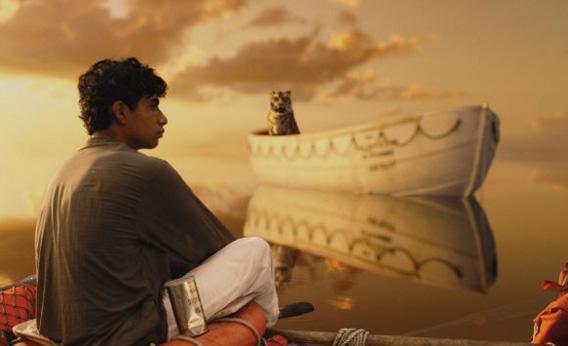
    Eventually, for.....some reason or another, Pi’s father decides that the family must leave India and go to the United States, bringing the animals with them to sell for the money to start a new life.  However, disaster strikes en route, and the entire ship (along with all the passengers) sink into the deepest trench in the ocean.  Pi, along with a zebra, an orangutang, a hyena, and a tiger, is the lone survivor, left drifting along on a stocked lifeboat.  Within a short span of time, the tiger has killed and eaten the other animals, leaving Pi to figure out how to survive both abandonment at sea AND the danger of a hungry, Bengal tiger. 

    This is easily the strongest part of the film, and thankfully it takes up the bulk of the running time.  It’s also where the art direction and visual effects budget is on full display.  Instead of one monotonous shot after another of waves rising and falling, Pi blends the ocean and sky together, so that it’s often impossible to tell where the earth ends and the heavens begin- the boat seems to simply float along in a whole other world from our own.  At night, with untold numbers of stars dotting the sky, the boat is surrounded by fluorescent fish and algae, bathing everything in a blue-green glow.  Pi never lacks for something to look at, and I honestly found the film to be visually more immersive and creative than Avatar. 

    The survival-at-sea tale is fairly well-done as well.  Unlike in many other man-and-beast movies, the tiger is never personified, or made out to be human in temperament.  The tiger enters and leaves the film as a wild animal, able to accept Pi as a fellow creature of survival, but never ceasing to be a constant danger to Pi’s existence. 

    For all of its clear strengths though, Pi, like Cameron’s Avatar, is held back from being a truly great film by relatively superficial characters and an overall plot that, in the end, fails to achieve real emotional resonance.  Aside from Pi, none of the other characters have more than a few scenes at the beginning and end of the film, leaving little room to offer them real depth.  And that would be fine if Pi were a strong central character.  And yet, even he never really comes across as a flesh-and-blood person.  After comparing the scenes of him as a child, young adult, and middle-aged man, there is little discernible difference between the three.  He never seems to change, even after living on a boat with a tiger for months on end.  Halfway through the film, he states that hunger can make one question everything, but we never see him go through any sort of sustained spiritual crisis.  His beliefs at the end of his voyage are exactly the same as they were at the beginning.  On top of that, the fact that the film opens up with Pi as a grown man removes pretty much all sense of real tension or danger from the otherwise solid survival story, because, no matter what, we know he’s going to pull through. 

    In addition, Pi (again, like Avatar) also suffers from a pronounced lack of subtlety.  The art direction on display is clearly strong enough for the movie to be able to show and not tell.  Even here, though, where the film is at its best, it still feels the need to over-explain everything.  Case in point: in one scene, something happens that (without spoiling it) is a huge blow to Pi’s efforts to survive, and visually so.  However, as the scene plays out before the our eyes, Pi’s voice cuts through the immense silence, to let us know that, yes, that was, in fact, a VERY bad thing that just happened.  I didn’t find Pi’s constant monologueing to be as much of an irritant as others have (the montage of him reading a survival manual is, I think, one of the film’s better parts), but it occasionally borders on the unnecessary or superfluous. 

    There is a slew of interesting ideas and designs playing out in the film, but few of them are ever explored in depth.  Pi’s assertion that Hinduism, Christianity, Islam, and Judaism need not be mutually exclusive is a great concept (one that I happen to agree with), but after a passing statement that they can coexist, the idea was never again addressed or explored, much to my disappointment.  There is an addendum to the tale at one point (not saying when) that offers a possible alternative interpretation of the whole movie as an interesting allegory for human nature, but, again, it’s done so fast and so late that it never has the time or space to develop. 

    I realize this review may come across as a bit harsh, which is unfortunate, because I really did like and enjoy Life of Pi.  I disagree with Roger Ebert that it’s one of the year’s best, but it’s creative, beautiful, and inventive, and has plenty of interesting things to say, even if it doesn’t quite say them the way I personally would.  My quips with the story and narrative structure only started to surface after I’d left the theater and the spectacular visuals started to fade from my eyes.  If you are up for a different kind of film, one that, even if you don’t like it, will at least leave you with something to chew on, you can do a lot worse than Life of Pi. 

-Judge Richard
   

Monday, November 26, 2012

Review: Wreck-It-Ralph

Wreck-It-Ralph (2012):  Written by Phil Johnston and Jennifer Lee, directed by Rich Moore.  Starring: John C. Reilly, Sarah Silverman, Jane Lynch, and Jack McBrayer.  Rated PG.  Running Time: 108 minutes.   

Rating:  3/4 stars


    It’s been a pretty decent year for animation thus far.  First we had Arrietty, the simple but solid latest entry from the wizards at Ghibli.  Next came Pixar’s latest project, Brave, somewhat schizophrenic, but beautifully made and full of interesting characters and ideas.  And although I was not able to see it while it was in theaters, I have heard nothing but good things about Paranorman, the newest film from the promising group that made Coraline.  Now, we have Wreck-It-Ralph, the video-game-centered nostalgia bomb from Walt Disney Studios. 

    Before my ignorance betrays itself, allow me to state for the record that I am not, and have never been, a gamer.  Having never owned a system of my own, my video game experience has been limited almost exclusively to Pokemon Red, Blue, Yellow, and Gold, Legen of Goku II, Civ III, Portal, and the occasional Brawl/Halo/COD team games at friends’ houses.  So, as you can tell, I do not fall within the primary demographics this film is clearly aimed at.  Thankfully, that turned out to not be an issue, as the film, though filled with gaming references, cameos, and side jokes, is well-made enough and the characters broad enough that this movie can be a joyride for just about anyone. 

    The movie begins by revealing that the individual characters of the various arcade games are all self-aware entities, for whom their game roles are basically day jobs (somewhat in the vain of Reboot, if anyone other than myself remembers that show).  They live within their respective game boxes and can travel to the other games and visit each other via the connecting cords and power strips.  This carries a danger though, since, while the characters can die and regenerate endlessly within their own games, if they die outside their game, that’s it, and the game will be unplugged, leaving the other characters completely job- and homeless in the central game hub (or so we are told by an animated Sonic the Hedgehog Poster).  

    The main character, Wreck-It-Ralph, at a wonderfully assorted gathering of old-school video-game villains at an AA-esque therapy and support group, explains that he’s grown tired of being treated as stupid and evil, not just during open hours, but also by his fellow characters after-hours.  After he awkwardly stumbles upon the rest of his game (including the irrepressibly noble “good-guy” character, Fix-It-Felix Jr.) celebrating the game’s 30th anniversary without him, he storms off determined to win a hero’s medal in another game so that the other characters will finally respect him.  After stumbling through the COD-style shooter Hero’s Duty, where he meets the hardline Sergeant Calhoun (voiced by Jane Lynch), he finds himself in Sugar Rush, a new, top-of-the-line racing game, where he befriends a small girl racer named Vanellope von Schweetz (played rather effectively by Sarah Silverman) and has to find his medal and get back home before his game is unplugged for good. 

    It’s a fairly basic story of friendship and self-confidence, built (for the most part) from the standard Disney formula, with just enough twists to keep it fresh.  John Reilly’s Ralph is sympathetic without being melodramatic or overly depressed, and I find it refreshing that the main character of a Disney film finally gets to do something other than be pulled into a finding-love-where-they-least-expect-it story arc (said arc being left to the side characters this time around).  Sarah Silverman as a little child, sounds, on paper, like the sort of odd-ball casting that would try too hard to be its own running gag, but she actually turns in a great performance, managing to balance between being an amusingly smart-aleck and a likeable character you genuinely want to see win her race.  The biggest accolades, however, go to Jane Lynch (surprise surprise), who can play the hardass fem-fatale like few others.  Here too, however, Lynch’s performance surpasses her character’s initial superficiality, giving Calhoun some real depth. 
   
    The fun characters aside (and they are all fun), the strength of the film is easily the video-game universe it invents for itself.  The characters from older games, even up close, move with old-fashioned herky-jerkiness, while the high res new characters are fully-formed and walk more naturally.  The film avoids drowning itself in its own nostalgia, including plenty of Easter eggs for the old-school gamers, but never to the point of obscuring its own humor from regular viewers (that said, I did get my fair share of the gaming humor- my favorite was a passing GLaDOS joke).  When the film is being serious, it’s really moving, and when it’s being funny, it’s friggin’ hilarious. 

    Sadly, it took me a lot longer to see Wreck-It-Ralph than I’d planned (thanks to Sandy), so showtimes for this film are already giving way to Twilight, Skyfall, and Lincoln, but it’s still pulling in a profit, so if you have the chance the next week or two and aren’t in the mood for Hitchcock, definitely go check this one out.  I had a blast, and I’m sure pretty much anyone else will too. 

-Judge Richard

Wednesday, November 21, 2012

Review: Lincoln


  Lincoln (2012):  Written by Tony Kushner and directed by Steven Spielberg.  Starring: Daniel Day-Lewis, Sally Field, Tommy Lee Jones, David Strathairn, Joseph Gordon-Levitt, James Spader, Hal Holbrook, and Jackie Earle Haley.  Rated PG-13 for: an intense scene of war violence, some images of carnage, and brief strong language.  Running Time: 150 minutes.  Based on Team of Rivals: The Political Genius of Abraham Lincoln, by Doris Kearns Goodwin.

Rating:  4/4 stars

 Abraham Lincoln has always been a difficult person to approach in any medium, be it fiction or historical.  How do you take one of the most well-known and beloved figures in American history, the man who led the United States through its greatest catastrophe, brought slavery to an end in the process, and ultimately paid for it with his life, and make him relate-able?  How do you reconcile the man whose poetic speeches rank as some of the greatest oratory of all time with the gangly, withdrawn lawyer who could reel off one lewd joke after another with relish?  How do you take the legend, and turn him into a man? 

    Lincoln, to my great joy, adroitly manages all of the above.  Day-Lewis, looking and sounding nothing like Daniel Plainview (thank Heavens) turns out one of the best performances of his career to date, ensuring himself at least a fifth nomination for Best Actor, and possibly his third win.  Abraham Lincoln is an easy person to portray simplistically, as a moral crusader ahead of his time, and a genius always above the mere mortals around him.  Spielberg’s masterful direction and Day-Lewis’ incredible acting, however, take us past the romanticizations and show us a man struggling with depression, a troubled marriage, and the unimaginable duress of trying to save a country literally tearing itself apart. 

    Based largely on the excellent biography by Doris Kearns Goodwin, Lincoln focuses on the last months of the man’s life in 1865, specifically the push to pass the Thirteenth Amendment to officially abolish slavery.  After winning an election that also saw Republicans gain huge majorities in the House and Senate, Lincoln faces a difficult choice- should he push for passage of the Amendment now, despite Democratic opposition in the House, or wait until after the inauguration, when huge Republican majorities in both Houses will allow him to do virtually anything he could want?  Believing immediate passage of the Amendment to be both a moral right and, pragmatically, another blow to the already reeling Confederacy, Lincoln decides to push for a bipartisan vote on the Amendment within a month, risking the success of the Amendment, his own reputation and legacy, and potentially the outcome of the war itself on what easily amounts to one of the biggest political gambits of his life. 

    Since passage by the lame-duck Congress would require at least 20 of the recently defeated Democrats to break ranks and vote “yay,” Lincoln, working closely with Secretary of State William Seward (played by Edward R. Murr....I mean, David Strathairn) and Thaddeus Stevens, leader of the pro-equality Radical Republicans (Tommy Lee Jones), engages in an endless string of behind-the-scenes convincing, strong-arming, and downright deception and bribery that jars wonderfully with his traditional “Honest Abe” moniker and shows off his genuine brilliance as a politician.  Tommy Lee Jones’ Stevens, as angry and in-your-face as Lincoln is calm and reserved, carries every scene he’s in, leaving small doubt as to why he was often called “the Dictator of Congress.” 

    While debate in the House rages (literally) over the coming vote, the audience is given the occasional glimpse into the personal lives of Lincoln and Mary Todd, still suffering from the early death of their son William (by that time two of their four children were dead).  While Day-Lewis’ performance is the most engrossing of the film, Sally Field’s as Mary Todd is easily the most haunting.  Sobbing inconsolably in a darkened room one scene and smiling cheerfully to guests in the next, Field brings home more than any actor in the film the tragedy that dogged her and her husband throughout their married life, and the strain it put on both them as public figures who were, at a deep, personal level, intensely private people. 

    And that’s one of the things I appreciated the most about this film; it doesn’t attempt to wave away or hide the many flaws, prejudices, and trials of its protagonists.  The Civil War leaders were some of the most remarkable people this country (and indeed the world) has ever seen, but they were also just as much products of their own times.  It’s all too easy, looking back now, to project our own 21st-century sensibilities onto 19th-century men and women.  For most people today, it is far more self-evident that, yes, all races ARE equal, and, yes, we all deserve the right to vote, live, and marry as we please (and though plenty may still think otherwise, few would dare say so out loud). 

    Such was not the case during the Civil War, and to forget that these people were both admirable and imperfect is to do a disservice to their memories, and thankfully this movie embraces that wholeheartedly.  Lincoln, although a life-long opponent of slavery, had much murkier (and more prejudiced) views on race equality and amalgamation, and vocally supported the idea of sending freed slaves to colonies like Liberia in Africa.  This more complex aspect of his character is captured in what could be one of the most under-appreciated scenes of the entire film; when Mary’s black maid directly asks Lincoln about what he thinks “her people” should do after emancipation, he quietly (one might say cagily) ducks around giving a direct answer.  In another scene, on the floor of the House, the mere suggestion that emancipation could lead to voting rights for not just blacks, but even WOMEN as well (gasp!) nearly causes a riot. 

    What the film also takes pains to remind us, though, is that such differences between our respective eras in no way diminishes the significance of the Thirteenth Amendment’s passing or its relevance to today, nor blight the legacies and characters of those who made it happen.  Progress, it gently reminds us, can be slow, agonizing, and painful, and even those with the best of characters and intentions can be hard-pressed to bring it about.  The passage of the Thirteenth Amendment did not “cure” the ills of racial prejudice and inequality that plagued America at the time, just as the ascension of a black man to the Presidency a century and a half later has not “cured” our own prejudices and inequalities.

    Lincoln is an opus of a film, easily one of the finest of Spielberg’s already stellar career, and will probably be a heavy favorite for Best Picture come Oscar time.  What one might easily imagine as a huge, sweeping, romantic love letter to one of the greatest Presidents in history is actually a tight and surprisingly intense political drama about one of the cleverest politicians this country has ever seen.  And I cannot recommend it enough.  Even if, and maybe especially if, you’re sick of the very thought of politics and Congressional bickering (and understandably so).  Sometimes, it’s worth remembering that ours are hardly the hardest of times.

-Judge Richard

Tuesday, November 13, 2012

Review: Cloud Atlas

Cloud Atlas (2012):  Written and directed by Tom Tykwer, Lana Wachowski, and Andy Wachowski.  Starring: Tom Hanks, Halle Berry, Jim Broadbent, Hugo Weaving, Jim Sturgess, Hugh Grant, Doona Bae, Ben Whishaw, and Susan Sarandon.  Rated R for: violence, language, sexuality, nudity, and some drug use.  Running Time: 172 minutes.  Based on the novel by David Mitchell.

Rating:  4/4 stars

    After an entire weekend spent brooding, I’m still not sure what to say about Cloud Atlas.  It is a film that many movies try to be, and very few actually succeed in becoming, taking the viewer on a unique, interesting, and visually dazzling journey that reaches across genres.  Is it the best movie of 2012?  I’m not sure yet.  However, I feel certain that it will be remembered as one of the most significant films of the past few years.  It is certainly one of the most ambitious I’ve ever seen.  The closest comparison my scrambling mind can come up with is the broken-timeline structure of Pulp Fiction, but even that cult classic can’t hold a candle to Cloud Atlas in terms of its sheer audacity and determination to fly in the face of storytelling convention. 

    As you can easily pick up on from the trailers, Cloud Atlas tells not just one story, but several (six, to be precise), encompassing a roughly 500-year time span, from the mid-19th century to after the Apocalypse.  On top of that, rather than simply showing these various stories chronologically, the film cuts in and out of each at powerful, climactic, or poignant moments, challenging the audience at each turn to keep up with six different narratives simultaneously.  That each of the six stories would function as perfectly good short films in their own right is impressive enough, but the film goes one step further of attempting to make the ideas and events in each one overlap with and reflect upon the others, creating a tapestry out of themes like love, reincarnation, human companionship, and the superficiality of race, gender, and sexuality.  And, even more amazingly, it works.  The editing and direction are clever and tight enough to keep the whole enterprise from spinning out of control, or buckling under its own dense weight. 

    On top of offering the audience a bevy of fun stories to follow along with, the movie further reinforces the constant theme of reincarnation by using primarily the same core group of actors as the main characters in each storyline, with each actor switching between main roles and brief cameos, good guys and bad guys, and, on occasion, appearing as different races and even genders.  Hugh Grant, Tom Hanks, Jim Sturgess, Hugo Weaving, and Halle Berry alone can be found in all six segments, and Jim Broadbent and Ben Whishaw are seen in five.  Thankfully, there is not a single dull or lackluster performance to be heard, as every single member of the cast brings their all to each and every role they’re given. 

    The aforementioned changes between historical eras, races, and genders are accomplished by a truly jaw-dropping variety of what are easily the best makeup effects of the year.  What’s truly wonderful to watch is how the makeup is just enough to convey the switch from the character’s previous role, but is always subtle enough that you can usually tell which actor is playing which character.  I will not spoil a single one of the major makeup accomplishments here.  Trust me, this film is better seen when you don’t know what’s coming.  Even if none of the actors get nomination nods come Oscar season, I can’t begin to imagine another film taking Best Makeup (if another one does, then the Academy is in more dire straights than I thought). 

    The end result of all this is something expansive, challenging, and immensely rewarding to sit through.  I was not bored or distracted for a minute watching this film- there was always something to look at, always a past scene to compare with what I was seeing, always something in the shot or dialogue to make me think.  Cloud Atlas is that rare film that genuinely makes me feel like I’ve been on a long, fascinating journey.  From the opening shot of an aged Tom Hanks ruminating over a fire to his final monologue, I sat in my chair in the middle of the theater and felt myself fly across the ages, from a classic ship adventure to a political thriller to a Matrix-style futuristic revolution and beyond.  And it was one hell of a ride.  
   
    Cloud Atlas is a film that many people will disagree on.  Plenty of viewers are certain to be turned off by the constant jumps between timelines and the subsequent demands made on one's attention.  Critics seem divided as well, with many panning the film for being shallow or too dense to really signify anything.  While everyone is free to have their own opinion, I must say I could not disagree more.  Cloud Atlas never lacks for things to say, and if the overarching, final “message” (if, indeed, there is one to be found) is not immediately obvious, all the better I say. 

    As I said before, I have not yet decided if this is my new Best Film of the year.  I don’t think it’s an objectively “better” movie than The Master, or Moonrise Kingdom, or even Seven Psychopaths.  What I do think is that it is a perfect example of the wonderful potential of the cinema.  It is a film that shoots for the stars, that lives large and takes huge risks.  But while making its broad strokes, it never forgets to fill in the smaller details that make watching it an act of discovery, and not just simple entertainment.  In the space of just under three hours, I felt joy, sadness, longing, awe, wonder, hope, and dread.  I would feel my heart break during one scene, and by the end of the next I’d be howling with laughter.  And, as the final shot of a star-filled sky faded away into darkness, my eyes began to fill with tears. 

    I can’t ask more from a movie that than.

-Judge Richard 

Sunday, November 4, 2012

Damnit, Sorkin

   I think it’s safe to say I’m pretty much over The Newsroom.  I mean, I knew it was never going to be a “good” show, strictly speaking.  The storylines were completely unoriginal, the characters were broad, paper-thin stereotypes who spoke and acted like aliens pretending to be humans, and Will McAvoy (despite the earnest efforts of Jeff Daniels) couldn’t respond to even the most simple of questions without churning out a hammy tirade about how “great” America used to be. 

    So no, I knew it would never be “good.”  But, honestly, I was willing to forgive all of that, for one, single reason- it was angry.  Angry at the flimsy circus our 24-hour news world has become.  Angry at the Tea Party.  Angry at Congressional gridlock.  Angry at all the utter junk that clogs up day to day life in this country.  It burned through the very fiber of Will McAvoy’s being.  And, since I share every bit of this anger, I was all on board.  The show could be as crappy as it wanted, so long as it provided catharsis. 

    Sadly, that has not happened.  Oh the rants are there, and they are great fun to watch (McAvoy’s deconstruction of the Tea Party as the “American Taliban” is my personal favorite).  The problem is that they are almost completely buried.  Buried in the bullshitty, who’s-sleeping-with-who drama that most of every episode has been devoted to.  Instead of being the focus of the show, the anger has been mere sprinkles on a greasy, tasteless donut. 
   
    Take the bit about the Tea Party, part of the very last episode of the first season.  All of the clips concerning the Tea Party, when combined, run for 6 strong minutes.  In the actual episode, however, those 6 minutes are spread out through the entire 45-minute plus episode, so far apart that when another segment comes up, you’ve forgotten what he talked about in the last one. 

    And what fills in the gaps between these tiny gems of political rage?  Relationship drama.  Some drug references.  And, astonishingly, a Sex In The City-themed subplot.  I wish I was making that up, but I’m sober.  And to top it all off, Sorkin pulls a Glee by refusing to close the cast-member couplings that are so obviously going to happen, just to leave enough filler-fuel for another season (or two, or three, or giiyaaaah...).  The characters that are clearly going to get together all say to each other some variant of the following;
“Yeah, we are clearly head-over-heels for each other!” 
“But we can’t be together now.” 
“Why?” 
“Hell if I know.” 

    I could go on listing my frustrations with this for some time, but the election isn’t over yet, so my blood pressure can’t take it.  Suffice it to say, I am disappointed.  It’s not even the fact that the filler in the show exists- all shows have filler of some kind (even Avatar).  What’s grating is how staggeringly unoriginal it is.  There is seriously nothing noteworthy about any of these characters outside of their astonishing self-righteousness.  And that just isn’t about to make a show worth watching. 

    So, in a nutshell.  I’m done.  I’m sure the show will remain popular for awhile, and may Sorkin get all the money he can out of the show.  I will no longer take part.  I will content myself with watching the good bits on Youtube (pretty much all of which can be found filler-free, thank God).  And while I have resigned myself to this, I still can’t help but feel that twinge of disappointment.  Goddamnit Sorkin.  You came so close. 

-Judge Richard