Tuesday, January 26, 2016

My Top 10 Films of 2015

            Aaaaaand we’re back!  It’s once again time for that great annual tradition of looking back and ranking the best of the best in cinema for 2015.  There were a lot of good ones that came out, so let’s get right down to it! 

            As in past years, my criteria for counting a film are as follows: any film that received either a festival screening or a limited and/or general theatrical release in either the USA (where I’m from) or Germany (where I currently live) can be counted, even if it got an earlier release in another country.  While this stretches the bounds a bit of what makes something a “2015” film, it also lets me make a list that’s a touch more unique. 

            Also bear in mind (if you are a new reader), for my Top 10s I don’t try to rank what I thought were the objectively best films of the year (since that will never not be a nebulous concept), but rather which films were my personal favorites.  There were a lot of excellent films I saw that are deservedly getting Top 10 mentions and/or awards nominations elsewhere (like Bridge of Spies, Carol, 45 Years, and Straight Outta Compton, among many others) but that, for various reasons, aren’t the sort of film I personally am inclined to sit down and watch again, which is my main way of determining whether or not I really love a film.  Some films just hit me harder on a personal level than others do, even if I can admit that those movies that do aren’t always the best.  So if you have a favorite you don’t see here, it in no way means I didn’t see it or didn’t like it, and if that is the case I would love to hear about it in the comments! 

            We will start things with a new category called Dishonorable Mentions.  I do everything possible to avoid seeing bad movies, so I never see enough disappointing or downright “bad” movies in a year to justify a full Top 10 Worst list.  However, there were a few that got by my best sensors and disappointed enough to merit one final smack before we wash our hands of 2015.  These are not necessarily terrible movies, but they were the main ones I saw that annoyed or frustrated me in some way, or just plain failed to impress. 

Dishonorable Mentions:  Joy, Jupiter Ascending, Queen of the Desert, Appleseed: Alpha, My Man

            And now, on to the honorables, the really fun and/or great movies that I just couldn’t quite justify squeezing onto my Top 10 list (and it was a great year, so there are a lot of them). 

Honorable Mentions: Kingsman: The Secret Service, StarWars Episode VII: The Force Awakens, The Salt of the Earth (documentary), The Revenant, Amy (documentary), Kumiko The Treasure Hunter, Spy, Mistress America, Room, Crimson Peak, Predestination, The Martian

            And now, the main event! 

10. Hello,Supernova (Yuichiro Konno)


            I have never seen a film like Hello Supernova before, and I honestly doubt I will ever see one like it again.  It’s a great example of how cinema, which we usually see as simply being a vehicle for explaining a story, can also an act of meditation.  There are no story arcs followed by the people we are introduced to in a small, strange city in Japan.  We are just offered moments and experiences.  And yet, we remember them.  They stick out in the mind.  It’s nothing like anyone would expect, so I anticipate some would be bored to tears by the seeming aimlessness of its wanderings, but for me, I was moved by this one in a way I can’t begin to describe.  There’s a beauty to that. 

9. WhenMarnie Was There (Hiromasa Yonebayashi)


            While The Wind Rises sparked a fair bit of controversy about its subject matter, and Princess Kaguya was rightfully praised up and down within the ranks of film critics, I am sorry to see that When Marnie Was There has garnered a much quieter and more downplayed reception since its release (it did manage to snag a nomination for Best Animated Feature, but we all know it won’t win).  Which I think is a right shame, because while it might not necessarily be on the same level as the best that Studio Ghibli has produced, it has a lot of deep subject material tucked in around the edges.  On the surface it’s a typical coming-of-age tale, but there is some heavy emotional stuff that gets unpacked in its best moments.  It also functioned better at being a strange mystery yarn/ghost story than any other film I saw this year.  While the conclusion might not live up to the build-up for some, I was entranced while I watched it, and I won’t forget the experience anytime soon. 

8. A Girl Walks Home Alone At Night (Ana Lily Amirpour)


            This should be the flick that brings back proper vampire stories.  Filmed entirely in black-and-white, with some of the best and smoothest cinematography in a year full of great camerawork, it slowly envelopes us in a seedy underworld of sex and drugs in a small, nowhere city, where a lone female vampire preys on criminals and abusers of women.  Taking its time to build up the tension bit by bit (the “full reveal” of the vampire is a good half-hour or so into the film), the movie only goes for a few big moments of fright, but when they hit, they hit hard, and are well-earned.  And yet, it also finds room to be strangely sweet in a few key scenes.  Take an evening to watch this one, and turn out the lights when you do. 

7. Pale Moon (Daihachi Yoshida) 


            Combining slick camerawork, one of the coolest-sounding scores of the year, and one of the best performances by a female lead, Pale Moon is a tale equal parts tragedy and comedy, as the main character bounces from one extreme to another in an effort to break out of the professional, cultural, and even ethical strictures placed on her by society by laundering her clients’ money for personal gain.  Is she a good person?  An awful person?  Neither, because existence is inherently meaningless and morality is dead?  The film is remarkably balanced, offering no judgment on her actions, letting us try to decide what we would have done in her stead.  This was one of the last films I saw at Nippon way back in June, and it’s stuck with me all the way through the year.  Absolutely worth a look. 

6. Ex Machina (Alex Garland)


            Ex Machina was easily the most creative, thrilling, and deeply thoughtful sci-fi film that I saw this year, as well as one of the most philosophical.  If AI is indeed possible, is it inevitable that we will project onto (or into?) it our own sexual, gender, and racial biases and archetypes?  Few films I’ve seen carry such challenging ideas about the nature of gender and how it is viewed and perpetuated in our world, and how that could easily affect the future to come (if you want a great think piece on the film, I highly recommend this gem from Feministing).  With all due respect to a certain other movie both Oscar Isaac and Domhnall Gleeson appeared in last month, here the two of them plus an astounding Alicia Vikander (whom the Academy nominated for the WRONG film) form the most compelling and fascinating trio of main characters in any feature I saw in 2015.   

5. The Big Short (Adam McKay)


            The Big Short is, in many ways, a spiritual successor to Wolf of Wall Street, carried along by the same frenetic energy and hectic pacing, but stripping out the drug- and sex-orgies so that its righteous anger can be more viscerally focused on the amoral f***ery that allowed the creation of the US housing bubble that, eventually, caused the global recession of 2007.  Anyone watching this with their eyes and ears open will come away angry at themselves for still not really understanding why the whole crisis happened, and how it is that those primarily responsible for a huge amount suffering in so many countries were allowed to walk away scot-free.  Like Wolf, it is a blast of an experience, but if your moral compass still works in any way by the time it’s done, your laughs will become hollow, and you will wonder if it’s ever possible that people will wake up enough to keep something like this from happening again. 

4. Chi-Raq (Spike Lee)


            Taking a lewd Greek comedy about sexism and gender roles that most people have never heard of (and fewer have actually read and understand) and using it as a springboard to rant about gang violence, inner-city degradation, broad societal racism, and the general failure of a country that claims to be based on ideals of freedom and equality to live up to those ideals in any meaningful way is the kind of bizarro, deliberately-provocative combination that could easily result in an utter disaster of a film.  But Spike Lee pulls it off.  He drives up to the edge of the precipice and wheels right over it with a brash and bawdy bravado that is remarkable to see play out.  It might not be as focused in its rage as The Big Short, but that in no way diminishes how powerful its best moments are.  Its resounding call at the end for everyone in this country to WAKE UP is one of the best endings to a film I saw all year.  While I can understand many of the criticisms of how Spike Lee approached the subject matter and whether or not choosing real-world Chicago as its setting was the most appropriate choice, I still argue that this is one of the genuine must-see films of the year, and I urge people to reserve judgment on it until they’ve seen it and thought about what it’s really saying. 

3. Inside Out (Pete Docter, Ronnie del Carmen)


            A blessed reminder that, despite the slew of less-than-stellar sequels coming out of the once unassailable giant, Pixar is in no way going to fall off the charts anytime soon.  Not only is this their best work since Up, it’s easily one of their best films ever.  It’s also (and please pardon the pun) one of their brainiest, creating a story that’s colorful and funny enough for kids to enjoy, but is also able to use remarkable subtlety and depth to convey complex ideas about psychology and personal growth, about how internal instincts and external events both effect and are affected by each other in complicated ways, and about the need to experience the full range of human emotions in order to truly mature as a person.  It was one of the funniest movies of the year, one of the most moving, and one of the most inspiring. 

2. Brooklyn (John Crowley)


            All due respect to Inside Out, which in true Pixar fashion tugs at the heartstrings relentlessly, but no other movie got me as emotional or made me cry as hard as Brooklyn did.  And I will fully admit (remember, I have no pretensions of being objective with this list) that this has a lot to do with the fact that I have recently been going through something very similar to what Eilis endures as she struggles to reconcile dual parts of her identity, having left her homeland behind to start a new life elsewhere, yet still feeling the tug of the other world and life that could be hers if she wanted. 

            I think there are two main aspects to this film and story that make it so affecting.  One is how matter-of-factly it presents the people, beliefs, and norms of the time period its set in, never making Eilis out to be a perfect model of a heroine, nor making any of her stumbles in life out to be the work of a nefarious villain.  She is a person, flawed and whole, same as the people she bumps into (and falls in love with) over the course of the film.  The second is its understanding of how frankly uncompromising some decisions in life must be- while everyone starts out with universes of possibility open to them, there are times when one path must be chosen over another, and it’s up to us to decide why we choose what we do, and to stick to it if we want to make something of ourselves.  The film’s understated embrace of this fundamental principle of life itself makes the ending vibrate with an emotional power and resonance that broke me.  Only the rarest of films achieve that. 

1. Mad Max: Fury Road (George Miller)


            You’re shocked, I know.  What can I say?  Put simply, Fury Road was hands-down my favorite movie of the year.  It crushed all competition in the category of best action movie of the year, with expertly-crafted set pieces that were stunningly beautiful to watch (and a big “f*** you” to all the Michael Bays of the world), yet still bone-crunchingly intense to experience.  It was one of 2015’s most daring films, with all the balls-to-the-wall nuttiness of its world on full display, no shame need apply.  Finally (and this counts for a lot in my book), the clever and detail-packed writing made for one of the most quotable scripts of the year.

            All of that taken on its own would have merited this film a spot on my Top 10 list.  However, it gets my number one spot because it doesn’t stand pat, content with simply being a two-hour, adrenaline-fueled joyride.  It goes the extra mile.  It might not have been the most “serious” film of the year, or directly tackled real-world issues (ala Chi-Raq, The Big Short, Spotlight, etc.), but beneath its crazy exterior lies a wealth of visual and thematic commentary on patriarchy and gender roles that made it, in my book at least, the best movie of the year to combine being both serious thought-piece inspiration AND a true cinematic experience.  It is the best kind of glorious spectacle to bear witness to.  


            And there you have it!  Another year gone, another Top 10 list.  Up soon will be my personal awards for 2015, as well as a brief run-down of my favorite soundtracks from the year, as well as my picks for the upcoming Oscars.  And after that, another year of film will open up to us.  I can’t wait to see what we get this time around. 


-Noah Franc 

Thursday, January 21, 2016

In Memoriam: Alan Rickman


            Screw you, Death. 

            Seriously, why you gotta have us starting EVERY year off like this?  Last year it was Spock, the year before we lost Uncle Phil and JewWario and The Hoff within about 6 weeks of each other, and this year starts off with us losing David Bowie, Alan Rickman, Brian Bedford, AND Glenn Frey over a span of just 8 freakin’ days.  I think your quota of cultural heartbreak has been officially filled for 2016, okay Death?  Just please leave Don Bluth alone long enough for him to finish making the Dragon’s Lair movie.  PLEASE.

            At any rate, here we are, and we once again find ourselves in the uncomfortable position of having to reflect on our own mortality through the knowledge that even the seemingly untouchable figures that, in their own right, are cultural touchstones for generations of humanity, must eventually leave us for whatever comes next. 

            I will mostly be writing about Alan Rickman here, since this is a film blog, and I was never really into work of either David Bowie or Brian Bedford enough to justify calling myself an informed fan of either of them.  For personal reasons, I must include a personal farewell to Glenn Frey, since the Eagles were a big part of my high school years, but even there his loss doesn’t hit quite so personally for me as losing the face that has defined Slytherin House for me since I was 11. 

            I had the immense pleasure of getting to briefly meet Alan Rickman in New York City about 4 years ago, after attending a performance of his in Seminar, one of his last major stage appearances (this was right before he was replaced in the cast with Jeff Goldblum, and the show promptly tanked).  Although it was freezing cold in the City, and the rest of the cast was waiting on him, he took the time to go around to those of us at the perimeter to sign anything we had, take pictures with those who asked, and shake a few hands.  He signed my show program, and when I asked if I could shake his hand, he graciously smiled and allowed me to do so.  I asked him if he had a preference between either stage or film work, and he said he really didn’t, “he just does one, then the other.” 

            These are such odd moments, when I think about them.  For the celebrity, something like that happens a thousand times a day, and the regular parts of anyone’s day, no matter how extraordinary they seem from the outside, always eventually become a bit repetitive , mundane, and often forgettable.  So I have no reason to expect he ever recalled that brief exchange, or that he would have recognized my face had we ever crossed paths again.  But for me, that will always be MY Alan Rickman moment, the time I spoke with him, however briefly, and he said something to me.  And thus, that will always have value to me, even if nothing of substance passed between us. 

            Not that Alan Rickman didn’t also have the capacity to make someone else’s day by remembering them when they thought he wouldn’t.  A friend of mine, who had obsessively went to every performance of Seminar she could while it was on Broadway, related to me once that Alan Rickman commented to her when she shook his hand after her fourth viewing that he thought he recognized her, and she told him she had already seen the show several times.  When she went back a fifth time, and was again waiting out back to see him, he saw her again.  When he did, she said, “Remember me?  I’ve already seen the show 4 times!”  To which he replied, “I know you have.” 

            And so, moving forward, as with other deaths of recent years, we are going to have a lot of moments over the next few years where this collective loss hits us all over again.  My memory of craning my head from the far side of the front row at my first theater viewing of The Sorceror’s Stone will be shaded, just a bit.  Our annual Christmas tradition of watching Love, Actually will hurt, just a bit.  And the crumpled, signed program I have tucked away with my other memorabilia in my grandpa’s old suitcase now has a new importance attached to it. 

            In the words of a tiny, green Jedi Master, “That is the way of things.”  The loss of so many great figures in such a short span of time has been hard to process.  All deaths have an immediate impact on those closest to them, but there are some, like these, that resonate across the world, because in their own small ways they were able to touch on common features of humanity that we all share.  Alan Rickman was one of those people, and he will be sorely missed.  Rest in peace, sir.  We will make sure you are always remembered.  Always. 


-Noah Franc  

Thursday, January 14, 2016

Review: Chi-Raq

Chi-Raq (2015): Written by Spike Lee and Kevin Willmott, directed by Spike Lee.  Starring: Teyonah Parris, Nick Cannon, Wesley Snipes, Jennifer Hudson, Angela Bassett, John Cusack, Samuel L. Jackson.  Running Time: 127 minutes.  Based on the Greek play Lysistrata, by Aristophanes. 

Rating: 4/4 


            Chi-Raq is the sort of work of art that succeeds in being both wildly fun and entertaining to experience while simultaneously using its very existence as a blunt weapon to force any viewer paying attention to confront a world of uncomfortable hurts and truths they would rather ignore.  In its best moments, it walks right up to the line of being shallow exploitation merely dressing itself up as a message piece as an excuse, but always parlays its outlandish visual style and over-the-top tone into real thematic depth, making a slew of loud and challenging proclamations that those who wish to see a better world must WAKE UP, and take the initiative themselves to make it happen.  It lets no one off the hook, and spares none in its criticism.  It is controversial, it pushes every boundary it can, and many will be offended and/or turned off by the deliberately provocative title and how it treats its subject matter.  But because this is precisely what art is supposed to do, and because it does so with such amazingly self-assured style, I believe it is one of the best and most important movies of 2015. 

            The core story (though the film shoots off on quite a few tangents before the end), is based on the 2,400-year-old Greek comedy Lysistrata (which, fun aside, translates to “Army Disbander” in Ancient Greek), about a woman of the same name who convinces the women of Athens and Sparta to go on a sex strike until their husbands agree to end the Peloponnesian War.  Here, Spike Lee has transplanted the same tale onto the streets of Chicago, where, instead of city-states, we bear witness to the fighting and cost of a 21st-century gang war. 

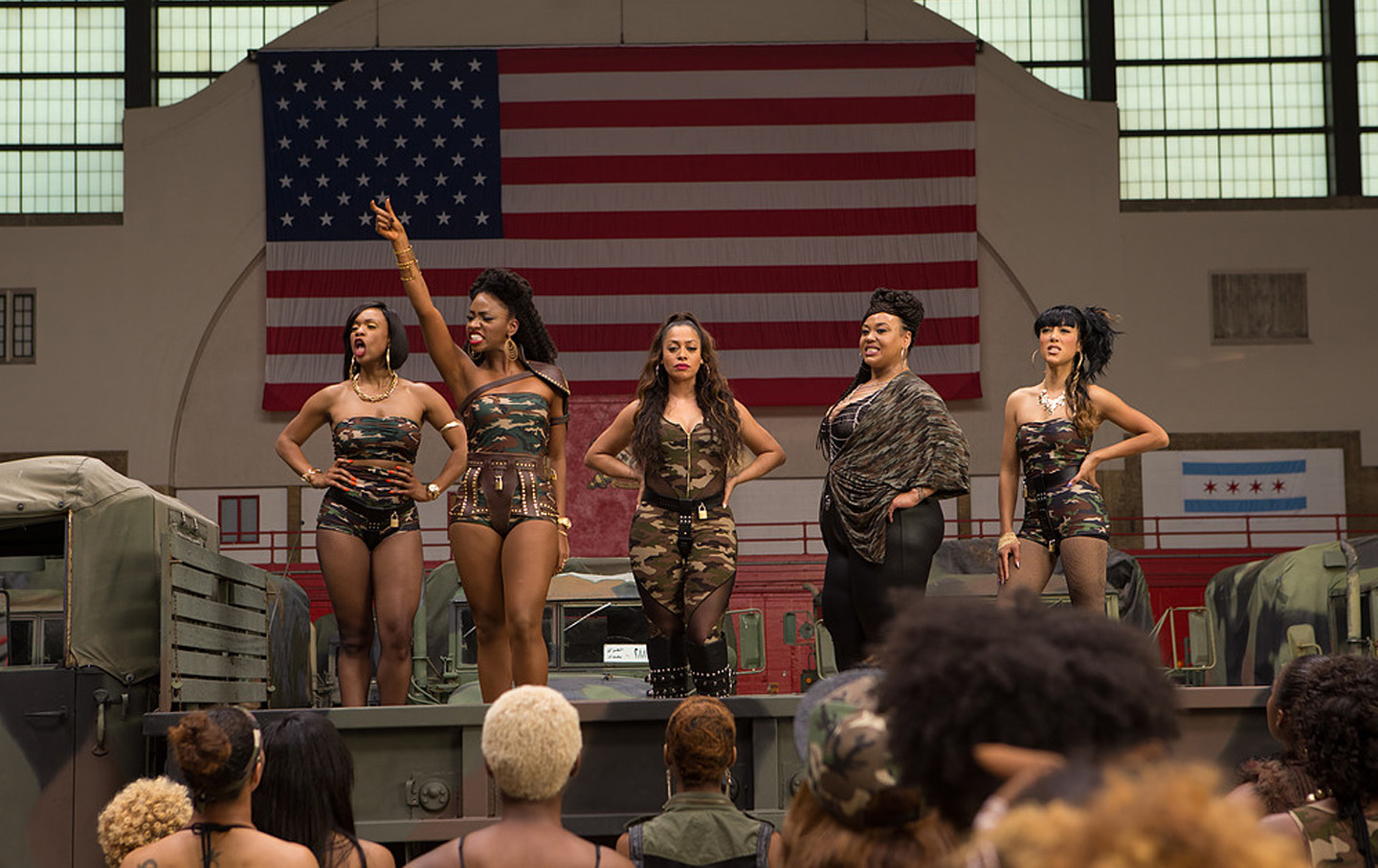
            Here, our Lysistrata (an award-worthy Teyonah Parris) is the lanky, sharply-dressed girlfriend of Demetrius (Nick Cannon), aspiring rapper and leader of the Spartans.  The first sequences of the film are some of the best I’ve seen in years.  We are first shown a map of the US, made up entirely of guns colored red, white, and blue, and then switch to a black screen that shows us only the words of the opening musical number, a plea for humanity in the midst of terrible suffering.  After some statistics are shown comparing the number of victims of gun violence in Chicago to the number of soldiers killed in Iraq and Afghanistan (hence the reference to the city as “Chi-Raq”), we transition to a dark, atmospheric, and rocking opening scene in an underground club, where Demetrius raps about all the ways he will crush Cyclops (Wesley Snipes), leader of the Trojans, while his adoring fans bang their heads in time to the beat and wave purple glowsticks (just about every piece of the costumes and sets possible are color-coded; purple means Spartan, orange means Trojan). 

            Lysistrata is right up there in the front, loving all of it- her man will be on top of the world soon, this is her life, this is her scene- until several events in quick succession shake her to her core.  The opening rap number is interrupted by a Trojan observer opening fire in an attempt to kill Demetrius, but instead hits one of his friends, who in turn fires back and strikes down the attacker. 

            Later that night, the Trojans strike again by lighting fire to Demetrius’ house, causing both him and Lysistrata to flee naked into the streets, with Demetrius firing back at his nemesis.  The next day, a young girl named Patti is found dead on the sidewalk, and the visible agony of her mother (Jennifer Hudson, who gets some of the movie’s most powerful scenes) drives Lysistrata to seek the advice of Miss Helen, who convinces her to lead the women of Chicago (and later, as we are shown in news clips, the entire world) in a massive sex strike, with one, overriding goal- world peace. 

            Guiding us through the affair is Dolmedes, played by a Samuel L. Jackson having an enviably palpable sense of fun strutting around the city in the brightest, eye-popping suits you can imagine.  His dialogue- in fact, nearly the entire film- is written in verse, but not your old-school, classic-sounding Shakespearean.  It’s packed with so many slang terms, all piled on top of each other and delivered with such quick, clean, and confident precision by a cast brimming with raw charisma and talent that I would honestly recommend watching it with subtitles, just to make sure you don’t miss something.  This is the sort of movie that completely renews my awe (and rekindles my needling insecurities) as a writer at the incredible craft needed to make a truly great screenplay. 

            Now, many are already aware of the intense controversy the trailer for the film sparked, particularly regarding the movie title.  My guess, however, is that much of this stemmed from the way the trailer presented the film and the fact that many of its harshest critics admitted having never heard of the original play before seeing the trailer.  And that fact is key, because without knowledge of the play and what it’s actual message is, it’s hard to pierce through the bawdy surface of this film and see what it’s really playing at. 

            Just going off of the trailer and nothing else, I can see why some people would have the impression that the film takes a terrible, complicated, and emotionally wrenching topic and boils it down to just sex, just about gang violence, and ignores larger social constructs of racism, state oppression, and generational inequality.  But by doing so, and not looking at the tradition of the play itself, and without seeing the actual FILM (which a number of the trailer’s critics did own up to) means you will miss how Lee takes the trappings of the ancient play and expands UPON it, veering from one commentary to another.  Granted, this does lead to the film often being a bit unfocused, and leaving a lot of themes and topics less developed and explored than others, but it does such a good job of sweeping you up with its endless energy that I couldn’t find it in myself to fault it for that.    

            Here’s the thing- people often like to punctuate debates or controversies about stuff like this with statements of “X, Y, and/or Z shouldn’t be happening now because it’s the 21st century, man!”  Declarations like this rest on the assumption that, just because we are now in a later time period compared to earlier eras of human history, there ought to be something fundamentally different about human behavior and society.  Something fundamentally better.  And if that were the case, then yes, Spike Lee’s decision to base his tale of modern sexism, racism, gun violence, and economic disparity on a millennia-old comedy about women forcing peace by withholding sex from men who can’t control themselves otherwise would indeed be silly, offensive, derivative, and backwards-looking.  It would indeed be both culturally and historically irrelevant and inappropriate. 

            But this is so clearly not the case.  Both the original play and this movie are not an accusation leveled against women that THEY are and have always been the ones responsible for bringing about peace, that they MUST be the adults in the room, because we poor men just can’t handle our own sexual urges with maturity.  It is in no way suggesting that the only value of a woman, the only contribution she can make, lies in her body and sexual abilities and how she utilizes them.  Of COURSE it’s absurd to think that women simply coming together and shutting men down via sex can or should solve all world problems.  It is absurd to have a society so restrictively patriarchal that, outside of the bedroom, men reflexively ignore or reject everything women have to say or contribute.  And yet, that is clearly the type of society we have had for some time, and it’s patently unhealthy.  That is the entire point Spike Lee is making…..and it’s the exact same one Aristophanes was making thousands of years ago.  Things really haven’t changed all that much in the interim.  And this makes Spike Lee’s storytelling and artistic choices all the more striking.    

            There are so many moments this film creates that will stay with me for a long time.  Jennifer Hudson trying to scrub the blood of her own daughter off the street.  Lysistrata, dressed to kill, ripping down a Confederate flag in the office of a rabid old general.  The last scene in particular ends with a wonderful subversion of the famous opening monologue from the classic war movie Patton, where, in one of the most indelible images in film history, he stands in front of a massive American flag covering the entire screen and gives a rousing speech about patriotism and the glories of war.  Here, Sam Jackson steps out in front of what could be the same damn flag for a different kind of speech, one calling for love above all else as the path to peace, and the flag falls to reveal….well, I guess I won’t spoil everything here. 

            Now, all this being said, I feel it would irresponsible for me to not confess my own limitations in understanding how some people would be upset by this, or indeed any, movie for using the very tragic and very real issue of inner-city gang violence as the setting for a satire like Chi-Raq.  I am a white man who has never lived in any inner city and have thus never been directly exposed to the true effects of systemic racism and gang violence.  People who are black (or indeed from any minority, or any subgroup that faces discrimination) and who have lost loved ones this way may very well react to the film completely differently, and wholly disagree with me.  I can’t blame someone honestly finding the subject inexcusable for comedic purposes (even if I strongly disagree with such a stance), regardless of the artistic skill on display (and some may even find the film as a film straight-up bad). 

            So I can’t dismiss the possibility (nay, the probability) that my race has a part in how I view the film.  I can also understand some critiques that Spike Lee might have shot himself in the foot by explicitly making Chicago his setting, even though the type of gang war he depicts is more relevant in other parts of the country and doesn't accurately reflect the particular circumstances of history of the city he gladly takes the title from.  Fair enough.  However, while I can understand people not liking the film because of the subject matter, I do disagree with those (and there have been a few) who claim that it lets whites off the hook, or that by taking the track it does it dismisses the very real and very wonderful work already being done on the ground by communities in Chicago and other cities to combat street violence.  I think, if you watch carefully, you will see a message of profound sorrow at the costs of all forms of racism, gun violence, and equality.  I think this is a film we need, a film worth seeing and worth debating about, because there is a clear anger and passion that shines through, even in its most flawed moments.  As one reviewer noted, with people literally dying on the streets of America, we don’t have the time to worry about politeness and decorum. 


-Noah Franc 

Sunday, January 10, 2016

Review: The Hateful Eight

The Hateful Eight (2015): Written and directed by Quentin Tarantino.  Starring: Samuel L. Jackson, Kurt Russell, Jennifer Jason Leigh, Walton Goggins, Demain Bichir, Tim Roth, Michael Madsen, and Bruce Dern.  Running Time: 167 minutes (187 minutes if you are watching the Roadshow version). 

Rating: 3.5/4


            Trying to review a Tarantino movie is never an easy task for the uninitiated, often because one can’t escape the sense that his movies contain layers of meaning and potential “in-jokes” that you just aren’t getting.  And if there’s a reason for that, that’s because that is often exactly what’s going on- Tarantino’s profound knowledge of the history of film, especially lesser-known pulpy subgenres, is already legendary, and far exceeds that which most people will ever have in their lifetime, so for all the controversies he sparks with his choices of subject matter, it’s hard to argue with the fact that he is clearly one of the smartest filmmakers in the game today, even if that can sometimes work against him.    

            Tarantino’s ability to weave subtle (and sometimes not-so-subtle) themes of the art of storytelling itself into the narratives of his films was something I was not yet able to appreciate when I saw Inglorious Basterds (a movie I owe it to myself to revisit) but that did strike me profoundly in both Pulp Fiction and his previous work, Django Unchained.  His newest foray into self-referencing film history, The Hateful Eight, takes this to a whole new level by centering almost entirely around the stories our characters tell about both themselves and each other, and since neither those on-screen nor those of us sitting in the audience have any solid evidence for anything we are told, deciding what to believe rests entirely in our own hands. 

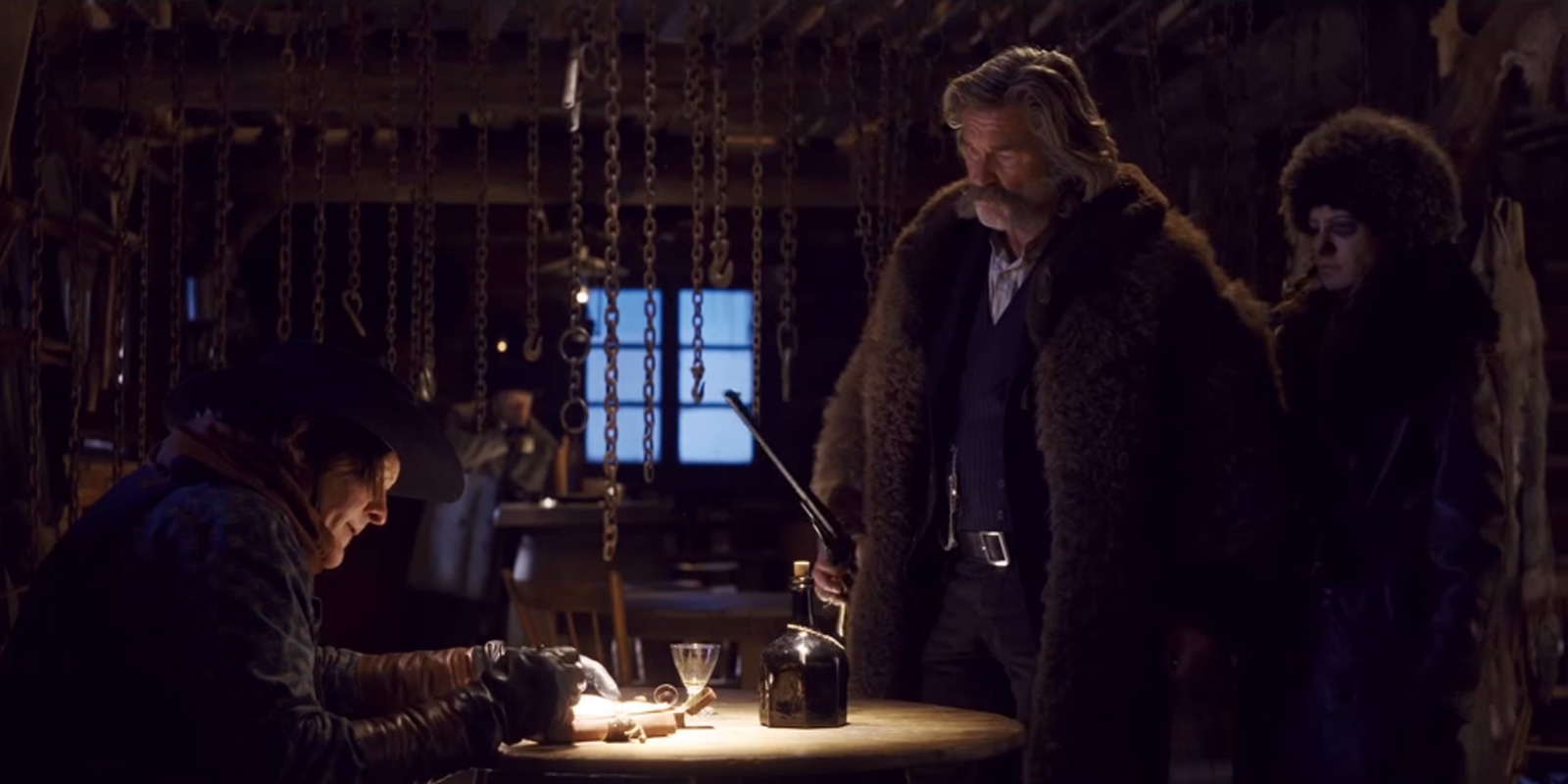
            Any such judgment must be made carefully, of course, since the core eight characters of our little yarn are, as the title implies, very hateful figures indeed (and that word itself is probably putting it lightly), so there is no real reason to trust much of anything they say.  Forced to take shelter from an approaching blizzard out in the middle of Wyoming, John “The Hangman” Ruth (Kurt Russell) decides to wait out the storm in a small mountain hideaway called Minnie’s Haberdashery with his bounty, a crude-mouthed murderess called Daisy Domergue (Jennifer Jason Leigh).  Along the way, he picks up two stragglers; Major Warren (Samuel L. Jackson), a former Union cavalry officer in the recently-ended Civil War (and now a fellow bounty hunter), and Chris Mannix (Walter Goggins), the son of a Confederate fanatic who specialized in laying waste to freedman towns of former slaves. 

            When they arrive at the Haberdashery, things seem off.  The door is broken and has to be nailed shut, and instead of finding Minnie and her husband sitting around as usual, they instead find a lone Mexican (named “Bob”) who claims to be in charge of things.  There are also 3 additional guests, which particularly irks Ruth, since he wants as few people as possible knowing who he has chained to his wrist and why.  These include an oily-sounding Brit claiming to be the local hangman, a former Confederate general famed for massacring captured black soldiers (so as you might expect, both Mannix and Warren recognize him on sight), and a lonesome-looking cowboy named Joe Gage, who prefers to sit off by himself.  They bring us to our total of 8 “hateful” characters- the driver Ruth hired doesn’t really count, as he seems to be the only decent soul around for miles.  Not that that will spare him the fate reserved for nearly all who inhabit a Tarantino film. 

            Having made an uneasy alliance with Warren to protect each other’s bounties as long as they are traveling together, and harboring a mutual hatred and mistrust of strangers in general (and Mannix specifically), they both agree that at least one person in the house, if not more, has lied about their identity.  Ruth is convinced that the rat (or rats) is an associate of Daisy’s, looking for a chance to free her.  Obviously, this is not the sort of environment one would willingly bunker down into, but as we learned at the beginning, there’s a fierce blizzard a-comin’, so everyone is stuck there for at least a day or two until the weather clears over, and the game is afoot to see who will blink first. 

            That’s the premise at its most basic form, but as anyone who has seen more than one Tarantino film can tell you, it’s just a jumping off point.  Sticking to one kind of story per film is the sort of thing Tarantino is incapable of doing, so once the main pieces are in play, things veer off in wildly different (and, of course, horribly violent and/or crude) directions by the time the inevitably blood-and-brains-soaked conclusion arrives.  The trailer bills the film as a Western, but it enthusiastically mixes in elements of closed-room mystery yarns, exploitation flicks, and psychothrillers.  It is such a meticulously crafted piece of work (as indeed all of Tarantino’s films are) that it’s worth seeing just to see the level of remarkable artistry in play, even if you can’t get past or find any sense of redemptive purpose in the tremendous amount of carnage he forces you to endure.  Without spoiling anything, it must be acknowledged that this movie has the highest casualty rate of anything I saw in or out of theaters in 2015. 

            A big part of how the film itself is made and presented lies in Tarantino's particular choice to use 70 mm film, which was much-trumpeted in the marketing, and serves mostly to highlight an incredible amount of detail in the world around the characters.  Film is, in so many ways, the art of illusion- we always know we are seeing something fake, something being acted out in front of us, but only the best films are able to wholly override such knowledge during their run times, and make us feel like we are seeing real people in real places.  This is strengthened in The Hateful Eight by (and this is also par for the course with Tarantino) an absurdly well-put-together cast.  Everyone delivers perfectly on their respective characters.  You all know Samuel Jackson will be great (although here he doesn’t play nearly as sympathetic a character as some might want to believe at first), but Kurt Russell, Bruce Dern, and Jennifer Leigh in particular all match him beat for beat, and Walter Goggins redefines the concept of “scene-stealing” with almost every line he utters. 

            I must admit that I did find myself wishing as I walked out of the theater that the movie had been a bit more thematically heavier than it actually is.  Part of this is the nature of the story itself that is being told.  Pulp Fiction deliberately ended with a twist revelation that lent an air of possible moral rescue from the morbid scenes we had seen earlier in the movie, and both Inglorious Basterds and Django Unchained deliberately touched on hugely emotional and broad historical and cultural themes that lent greater symbolism to their every story turn.  The Hateful Eight does not rest within such a larger framework.  Yes, the setting and time period, plus the forced co-existence of a black Union officer and two holdovers from the defunct Confederacy, means that race plays a HUGE factor in a lot of the dialogue and character interactions (and is also key to the fate of at least one of the main "hatefuls"), but unlike in Django, there’s no message attached to it- it’s just there.  Taken as a whole, the film’s setup of throwing 8 of the worst examples of humanity together (Matt Zoller Seitz explicitly compared them in his review to a bucket of scorpions) into a confined space just to see how things play out is precisely what we get.  There is no salvation for anyone here.  There is no broader message.  Just a lot of death to behold, make of it what you will. 

            I don’t mean this as a criticism of the movie itself, but I think it is fair to say that it makes the film less memorable in some ways than Tarantino’s last two works, which will have a big influence on how it’s remembered outside of the realm of dedicated cinephiledom.  There is also the particular question of how the film treats Jennifer Leigh’s Daisy, the only female included amongst the main cast.  There is already some backlash against the film being indefensibly exploitative of her character- Ruth and Warren beat her mercilessly several times, she has snow and food thrown in her face, is called the “B-word” as often as Warren is called the “N-word,” and is deliberately shown in the ugliest, most unflattering light possible- but while I feel that these scenes were merely meant as confirmation of the irredeemability of everyone else on screen, the lack of any clear moral framework within the world itself makes that hard to parse out, and I feel I can’t fault anyone who disagrees and finds it excessive. 

            Ultimately, though, it’s hard to deny this movie its due- The Hateful Eight is another masterstroke by one of the best insane geniuses in the world of cinema today, one of the most thought-provoking works to come out in a year filled with thought-provoking works, and the sort of film I highly recommend seeing with in a group so you don’t have to think through it alone afterwards. 


-Noah Franc 

Monday, December 28, 2015

Review: Star Wars, Episode VII: The Force Awakens

Star Wars, Episode VII: The Force Awakens (2015): Written by Lawrence Kasdan, J. J. Abrams, and Michael Arndt, and directed by J. J. Abrams.  Starring: Daisy Ridley, John Boyega, Oscar Isaac, Harrison Ford, Carrie Fischer, Mark Hamill, Adam Driver, Lupita Nyong’o, Andy Serkis, and Domhnall Gleeson.  Running Time: 135 minutes. 

Rating: 3/4

            Okay, here’s the short version- it’s very good.  More than good, it’s damn near great, easily the best movie yet with Abrams’ name attached to it (thanks in no small part to an absence of his usually ubiquitous lens flare).  It takes the best in technical improvements that we got from the prequels but sticks to the main formula that made the originals so great, specifically focusing on well-written, well-acted core characters to carry us through the larger, heavier plot swirling around them.  It’s not perfect- the action is mostly forgettable, and the larger story contains a number of huge holes and question marks that can’t be fully assessed or critiqued until the movies are all out and we know what, exactly, they are building up to with what they show us here- but as far as starting us off on a new round of exciting Star Wars adventures is concerned, it does its job.  I had immense fun watching it, I think most people that see it will too, and I am now even more psyched for the next two films than I was before, which is basically all the movie needed to accomplish in order to be deemed a success. 

            And from here on in, spoilers.  Spoilers spoilers spoilers spoilers.  I won’t reveal everything, but I am going to delve in pretty deep here and discuss at least one major event in the film, so if you haven’t seen it already, I will not warn you again.  For my money, it’s worth seeing cold. 

            So.  Some 40-odd years after the events of Return of the Jedi, our old gang has split up within a galaxy once again experiencing war.  The fanatical First Order is spreading its influence, determined to rebuild the Empire-That-Was, and they are opposed by both the New Republic and an internal resistance, led by Leia.  Luke Skywalker has disappeared entirely, with both sides desperately seeking him out.  Leia needs him back so that he can rebuild the Jedi in order to maintain balance (an earlier effort apparently ended in failure), and the First Order wishes to, what else, destroy him so as to remove any lingering threat of the Jedi rising again, all the while constructing yet-another massive superweapon, this one capable of destroying multiple planets at once. 

            These are the broad strokes of the plot, but much like with A New Hope (which this movie’s story structure apes almost wholesale), the larger details we get are light, and are clearly just pieces of build-up for the later films.  For this first installment, nearly all of the running time is devoted to letting us get to know (and love) our new trio of core characters; Poe Dameron (Oscar Isaac), a hotshot pilot, Finn (John Boyega), a Stormtrooper with the First Order who defects after an ordered village massacre in the beginning of the film opens his eyes, and Rey (Daisy Ridley), a scavenger living on a desert world that is most certainly NOT Tatooine.  In a series of homages to the original trilogy (some pleasantly well-done, some overblown), the three come into contact through a series of apparently-random circumstances that can only be excused in the realm of mythical fantasy, and are later joined by none other than Han Solo himself, as they try to return a certain droid bearing certain key information to Leia and the Resistance before the new superweapon of the First Order is able to destroy their home base. 

            I know I am not alone in feeling this, but if there is one drawback to this new series, it is that it will be very difficult to separate them in my mind from the longer-running, more detailed, and better-established Expanded Universe that was only recently deemed by the Disney Gods to be non-canon.  I know, it’s a lost cause and there’s no going back, so just let this be my one written farewell to my long-suffering and ultimately futile hopes of ever seeing Grand Admiral Thrawn, Gilad Pellaeon, Mara Jade, Jaina Solo, or Corran Horn on the big screen. 

            Not that this trilogy starting its own timeline is a bad thing, but I did find the wholesale abandonment of the richness of the EU particularly frustrating with this movie because, if there is one main issue I have with it, it’s that what little information we do get about the larger events in the galaxy since Return of the Jedi leaves some gaping questions open about why, exactly, despite all that was sacrificed and achieved in the original films, we are (at least, so it seems) right back where we started in A New Hope; a desperately under-equipped and outnumbered Resistance is the only hope against an impossibly Nazi-esque group of bad guys, led by a red-saber-wielding Dark Jedi (Adam Driver’s Kylo Ren). 

            Was anything of good achieved in the interim period between movies?  How did Luke end up apparently making the exact same mistakes Yoda and Obi-Wan did?  Why is that Leia never developed her force powers, at least a bit?  When the First Order fires up their weapon and claim to have destroyed “the capital and the fleet” of the New Republic, does that mean that we actually just saw Coruscant go up in flames?  Are the handful of fighter pilots we see at the end REALLY all that the good guys have on their side now?  TOO MANY QUESTIONS, TOO FEW ANSWERS. 

            Now, obviously, this is by clear, Disney-committee design, to whet our appetite for the next few films, but it’s perhaps a bit too slavish in sticking to the New Hope formula; given the huge emotions people have wrapped up in the original trilogy, just a little bit more information on what happened over the past few decades would not have been amiss.  Then again, since this is Abrams we’re talking about, and I am still nursing scars from Into Darkness, I can’t (yet) dismiss the possibility that some of this was thought up by him for show without thinking through the larger implications.  

            However, as aggravating as I personally find these questions, it must be said that they only marginally detract from what is still an excellent film, thanks mostly to an incredible cast.  Boyega, Ridley, and Isaac acquit themselves wonderfully as our new trio of main characters.  Finn and Rey blend wonderfully with Han Solo and Chewbacca, which is particularly crucial as their scenes together take up much of the running time.  Even if the rest of the film had been absolute shit, I would still be looking forward to the rest of the series just to see if those two get through okay.  Oscar Isaac will, hopefully, FINALLY end up as the household name he deserves to be, as his Po is one of the most fun things on screen, a daring ace pilot who combines the best of what Han Solo was and what Anakin Skywalker should have been.  Driver’s Kylo Ren (and no, I won’t go into his background here just yet) intrigues me, but we haven’t seen enough of him yet for me to be really sold.  I think I see the idea behind his character, and am very interested to see what they do with it, but he needs to get fleshed out a bit more first before we can be certain there’s more to him than just his emo Twitter feed. 

            In the end, not much else can be said about this one without waiting to see how they build on this new foundation they’ve created.  As you’ve read, I have my issues and qualms with the story as it currently If this is only the jumping off point, and the real story weight and plot details are awaiting us in the next two movies, and the possibilities of Po, Rey, and Finn are fully realized, then this movie will stand the test of time and be remembered as the start of something special.  If not, it will be remembered as the start of just another franchise let-down that failed to live up to its potential. 

            Neither, of course, can be predicted with any certainly at this point though, so for now, let’s all just come together again and enjoy a new, raucously fun Star Wars adventure.  It’ll be a bit before the next one comes out, and until then it is on us to hold back either too-early celebratory hype or premature dismissal of this new series as another vapid and empty cash-grab.  After all, my friends, extremism of any flavor is the path to the Dark Side. 

            May the Force once again be with this franchise, at long last. 


-Noah Franc 

Thursday, December 24, 2015

Reflections: The Success of Welcome To Night Vale


            I find it eerily appropriate that my fresh copy of the Welcome To Night Vale novel arrived at my doorstep  at the tail-end of October, right before the weather shifted into full-on Autumn mode, and we spent a week drenched in a pervasive, endless, clammy, cold fog.  Sometimes the universe (and sometimes the World Government) sends us odd signs to mark off moments in our lives. 

            It has been well over 3 years since the first episode introducing us to the bizarre world of Night Vale aired, beginning with a warning to never approach a certain Dog Park, and featuring a “weather report” by none other than Joseph Fink himself.  Since then, what began as a small passion project has grown into genuine online phenomenon, with the bi-monthly podcasts now being supplemented by a host of constantly-changing merchandise, a series of unique live shows that have toured in North America extensively and are even starting to foray into Europe and Australia, and finally now in real-live book form.  Having taken up the podcast on a whim over 2.5 years ago, right around the release of the two-part Sandstorm episode, I am now one small part of a growing (and global) fandom. 

            The fun thing about being part of this kind of cult following is that you get to sort of drift through the world with your own private love of something, encountering fellow fans only in chance or in passing.  It is not all-pervasive like Harry Potter, or Lord of the Rings, or gaggles of mysterious Hooded Figures.  You either know WTNV or you don’t.  You are in or you are out.  No all-powerful movie franchise or Trilogy phenomenon to eternally bind together the Hardcores and the general citizenry.  Just you, the device/website you use to download each episode, and the Void.  This could very well change in the future; the writers have expressed their general openness to all sorts of Night Vale-related projects, including a possible film, so who knows what could happen?  But for now, for all the millions of downloads and all the sold-out live shows (and the fact that the novel cracked the Top 5 Best Seller’s list on Amazon when it came out), there is still a beautiful sense of quietness, of privacy, and intimacy that reigns every two weeks when you sit down to listen to each new episode.  For all the wide appeal the show has, it still feels remarkably personal in its touch. 

            Part of this is thanks the incredible number of inside jokes, quotes, and references that are so off-the-wall insane out of context that they can only possibly have meanings to fans of the series.  An example; guess what my instant reaction was when my place of work, whose corporate colors perfectly match the purple of the show’s logo, announced we were switching over to a new IT program called “The Cloud?” 

            It has also inserted itself heartily into the growing “convention culture” that has been enabled by the Internet, where fans of even the most obscure things can find ways and means to meet and connect.  The live shows have a festival-like atmosphere not unlike an anime or comic convention, with many dressing up as their favorite characters (or conscious entities, or bodies of matter).  We casually dismiss haters and sceptics as people who “just don’t get it” when they scoff at our obsession.  And, perhaps most tellingly, the growing cast of characters have developed their own fanfolk bases within our curious little community.  

            Why?  Why this show?  Is it the oddness of the writing?  Have its myriad themes and philosophical ramblings tapped into some unspoken part of the Zeitgeist?  Has StrexCorp been forcing our hands all this time?  Or is it just the sexy voice (and no shame if it is)? 

            I have often wondered if much of the show’s popularity can be tied to its embrace (at least, on a surface level) of an almost post-modern, anti-religion/philosophy/ideology view of the nature of things.  We are caught in the flux of a time of immense, global change, and as part of that so many older social, political, and cultural strictures/traditions/norms are falling away.  Old ways of thinking are inadequate for the stormy present, but no new sets of beliefs or ideologies have risen to replace them.  Cool detachment and wholesale rejection of any dogma or system of belief (and I include any here, not just religious ones) are both the order of the day.   

            While it is highly debatable whether or not this is intentional on the part of the writers, much of the content of the show speaks to this current vibe of our time.  How many lines of Cecil’s proclaim an existentially empty existence, declaring humankind’s life utterly devoid of meaning?  I’ve lost count.  Through an explosion in our development, science is fast replacing religion as the accepted source of truth, and our expanded knowledge has brought us a comprehension of our smallness that was never truly possible before.  This, too, is a constant rumination in Night Vale- the universe is vast and inimitably complex, there can be no grasping for meaning, no finding of God, perhaps no God at all, for things are simply too big for that, and we too small, and the only comfort we have is the silence of the Void.  Are people drawn to the show because we all secretly (or not so secretly) agree that all we experience is nothing, and nothing is all there is? 

            Possibly, at least for some.  Although given that no two people on the planet share the exact same beliefs about anything, I doubt it, and the show’s creators have never given any indication they are trying to form a system of thought or belief of any kind. 

            Another possibility- is Night Vale merely riding the new wave of acceptance of the fluid nature of human identity sweeping much of the West?  Cecil himself comes out as gay not more than 5 minutes into the very first episode, and his ongoing relationship with Carlos has been a staple of the Night Vale universe for years without ever being overly emphasized.  It’s never been hammered into listeners as THIS IS SOMETHING MEANT TO MAKE A POINT.  It is simply accepted by everyone in the show, and by all of us as well, as something perfectly normal.  Many of the episodes deal with the illusion of physical differences, and while trans, queer, gender, or racial topics are only sometimes, if ever, addressed directly or by name, there are clear parallels in many episodic stories, describing a world that is open, inclusive, and representative. 

            The new novel has a prime example of this- the struggles of Diane Crayton’s emotionally normal teenage son Josh with just about every aspect of his physical, mental, and emotional identity is made explicit in how his physical body literally changes form, shape, and size almost every time she looks at him.  It makes the show a particularly refreshing escape from our own world, where we still have so much to work on before these issues cease to be seen as problems or “not normal.”  The world of Night Vale is inclusive, in ways, that, for the foreseeable future, ours can only dream of being.  And if that is not precisely the sort of escapism the realms of sci-fi and fantasy are meant to provide us, what is? 

            All of these are points in the show’s favor, and all are probably core aspects of its success (that, and the generous funding the writers secretly receive from the Apache Tracker).  But in my opinion, there’s another, less conscious reason why we have fallen for this show; WTNV, and other recent works like it in the booming podcast market, have become the conduit for us Millenials to uncover, in our own way, the joys and artistic power of spoken-word storytelling. 

            This despite past predictions to the contrary; the growing pervasiveness of camera phones of various stripes, laptops, and the rising cultural presence of gaming and online video were, until recently, taken as signs that my generation and those following us would be increasingly visual-oriented in our outlook on the world.  Pictures, short texts/memes, and videos have rapidly grown into the hottest forms of global communication, and this convinced many that industries like radio, as well as older oral traditions, would fall by the wayside, dying and forgotten as the world hurtles forward towards God knows what. 

            In one sense, this is not entirely untrue- the traditional forms of radio no longer hold the place they used to (no President, for example, will ever again think of using fireside chats as a way to plug policy ideas), and the possibilities for video art and general communication enabled by the internet are only just beginning.  Plus, the spread of technology (and a certain level of accompanying cultural homogenization) means that many oral traditions, some tens of thousands of years old, are becoming harder and harder to maintain, and many will inevitably die out. 

            But none of this means that simple speaking can’t still have force in our world.  Quite the opposite, in fact, and WTNV is proof.  We are animals that can never be solely visual.  In much the same way that music lovers and producers (regardless of age) are rediscovering the beauties of analog recordings amidst a torrent of digitalization, and certain stalwarts in the film industry fight to maintain use of old-school film, the spread of shows and podcasts like this one makes it clear that the incredible effect of listening to a tale woven with just sound can’t be erased from the world, or entirely forgotten, no matter how marginalized it might become.  There is remarkable power to be found in using nothing but our words and our attached collective meanings for them to create something both communally enjoyable and intimately personal.  Joseph Fink gives us words.  From them, we each weave our own, unlimited galaxies into existence. 

            The show’s deliberate play on language is not just a part of its trademark, bizarre humor, but rather its key feature- all the words it uses are real, English words in our world, but many of them have entirely different meanings and connotations in the universe of Night Vale than they do here (“librarian,” “antique,” and the concept of what closing up a shop entails spring to mind, to provide just a few examples).  It’s a hilarious, conscious, and brilliantly-executed play on the collective meanings of language, and the various social constructs we create for ourselves and unquestioningly accept as “the way things are.”  Cecil starts talking about something that we have one set of associations with in our world, but in bits and pieces (or sometimes all at once) we learn that the topic or word means something completely different over there. 

            And that is the primary reason why the world of Night Vale is best conveyed through spoken (and now also written) word, and not images- part of the excitement is listening for what surprises lie in store for us, what literally unimaginable aspects of the world are waiting for us to uncover in this week’s episode.  If the show were a film or TV or Youtube series, the oddities and differences would all be immediately visually apparent, and it would be that much harder and more complicated to create the never-ending cascade of surprises to our mental and imaginative senses that make the show so much damn fun to listen to. 

            I suppose I didn’t accomplish what I sent out to do with this post.  I’ve rambled on like a drunken Five-Headed Dragon, and I fear am no closer to understanding why Welcome To Night Vale is as beloved as it is.  Perhaps there is no one reason.  We are all here, together, in this metaphysical space of endless imagination, for different reasons and ends, and we arrived here along radically different paths.  But here we are, and here I very much hope we remain for a while yet.  Night Vale might be dangerous, and very often deadly (especially if you’re planning an intern anytime soon), but there is something compulsive and compelling about its characters and its strangeness, and the magnetic force of the words it’s built upon, that make me confident it will stand for some time to come.  Until, at the latest, the end of all things, whatever form that may take. 


-Noah Franc