Sunday, December 21, 2014

Review- The Hobbit: The Battle of the Five Armies

The Hobbit: The Battle of the Five Armies (2014): Written Fran Walsh, Peter Jackson, Philippa Boyens, Guillermo del Toro, directed by Peter Jackson.  Starring: Martin Freeman, Ian McKellen, Richard Armitage, Evangeline Lilly, Lee Pace, Luke Evans, Benedict Cumberbatch, Ken Stott, James Nesbitt, Cate Blanchett, Ian Holm, Christopher Lee, Hugo Weaving, Orlando Bloom.  Running Time: 144 minutes.  Based on The Hobbit, by J.R.R. Tolkien. 

Rating: 3/4 

            Well folks, this is it.  Two massive trilogies, each filmed back-to-back-to-back, costing a collective $1 billion to produce and generating over $5 billion and counting in box office revenue (both very rough estimates), 36 Oscar nominations and 17 wins (with at least few more nominations probably on the way), and it all comes down to this; the third installment of Peter Jackson’s still-hotly-debated trilogy of The Hobbit.  Was it all worth it, in the end?  Has the big-screen re-imagining of Middle Earth been enhanced or tarnished by several hours’ worth of extrapolation and narrative add-ons stuffed in by Jackson and his team?  How damaging of a miscalculation was it on the studio’s part to force Tauriel, easily the best invented character in all 6 movies (and I will fight you on that one), into an obviously shoehorned-in love triangle?  In the end, which wins out, the soaring high points, or the tiresome low ones? 

            For me, it’s the high points that come out on top.  I have loved too many moments and felt that sweet sting of nostalgia too often over the past 3 years to regret having seen each film multiple times in theaters.  Middle Earth is one of the greatest imaginative worlds of the past century, a land that has been filled with a history that so perfectly captures the indescribable sensation of something beautiful and essential beginning, reaching its time, and then leaving.  There is a power in the narratives Tolkien has crafted that can shine through any interpretation, no matter how faulty.  The Hobbit movies are not perfect- though truly, nothing is- but they are earnest endeavors, and I feel confident in saying that they will surely stand the test of time.  The Battle of the Five Armies effectively and movingly wraps up what will likely be our last filmed adventure in Middle Earth, and although I can certainly nitpick these films with the best of them, I am sad indeed to see them go. 

            It’s interesting to note that, for all the gripes that have been made regarding the wisdom of turning this slim volume into a trilogy and the issues of padded length that wore down the first two films somewhat, The Battle of Five Armies is actually the best-paced, quickest, and most tightly-written of the three films.  After a brief opening sequence showing Smaug’s enraged attack on Laketown and his subsequent death at the hands of Luke Evans’ Bard, the film settles down to its main focus- putting the pieces in place for, and then jumping gleefully into, the final, massive battle for control of the mountain between the human survivors of Laketown, the army of Elves under King Thranduil that arrives soon after the attack, Thorin, Bilblo, & co., the forces of Thorin’s cousin Dain, and a massive army of goblins and orcs, led by the Great White Albino himself, “Mad Dog” Azog. 

            Although the massive sequence of the battle never reaches the emotional heights of the Battle of Gondor in Return of the King, it is perhaps the most visually comprehensible battle out of all 6 movies, with the establishing shots well-utilized to show the tactics, maneuvers, and locations of each side of the battle.  Jackson stays quite true to his word of not straying for more than a minute or so from any of the main characters, but neither does the whole affair devolve into an incomprehensible brawl, for which I am immensely grateful.  And while it stretches the bounds of the battle’s context within the book, it builds up to an excellent climax on top of a frozen waterfall, a final confrontation between Thorin and Azog.  Fellow lovers of the book know what ultimately transpires here, but there is a nice touch that Jackson adds- the fate of one of the last sword fights rests on a conscious, sacrificial decision by one of the heroes.  Like many of the film’s best moments, it is small, but not unnoticed, one of a few gestures of genuine grace in a film filled with a great deal of admittedly unneeded noise. 

            Speaking of sacrifice, if there is one thing that kills many of the emotional vibes the movie succeeds in building up, it is the tragic treatment of Tauriel.  As I said above, Tauriel is among the best additions Jackson makes to the books, a tough-as-nails female fighter able to go toe-to-toe with Legolas, who in this movie reaches even higher levels of impossible awesome.  She was able to shine despite being the focus of an awful love triangle in the last movie, but sadly, the romance aspect in this one overwhelms everything else she is given to do, and the conclusion of her character arc is easily the weakest aspect of the otherwise very solid wrap-up at the end.  Evangeline Lilly did great work with what she was given, and deserved better.  

            As far as the wrap-up itself goes, no, it is not as drawn-out as the end of Return of the King, but it does almost feel a bit too cut back, as if Jackson was in a hurry to wrap things up, which is a shame, because as excellent as many moments as it has, including Bilbo’s reaction to the death of one character, his goodbye to the dwarves, and a perfect final scene back at Bag End, I could have used a bit more gravitas, or a few more quiet moments to add to the emotional weight.  Which is a shame, because this film actually succeeds in having far more and far better character moments than the last one, especially with Bilbo and Thorin.  Richard Armitage has really made Thorin his own character.  Overcome at the beginning of this by greed for the horde they have seized in the mountain, Thorin finally confronts his own demons in one of the series’ finest scenes, staring down at the golden floor created at the end of The Desolation of Smaug and imagining himself being swallowed whole in its shimmering depths.  It very nearly excused the drastic lengths the last movie went to in order to put the damn thing there.  All of his scenes with Bilbo are filled with emotions that make the film’s start color pallet glow with warmth.  They are too few and far between to lift the film from good to great, but their power is not diminished by that, and I am grateful for their presence. 

            In fact, I think that’s the best way I can sum up my mixed feelings towards the series as a whole; scenes or sequences of real brilliance and genuine cinematic magic, diminished somewhat by others that are less inspired and are, occasionally, atmosphere-breaking in their absurdity.  They never could measure up to LOTR, but I never expected them to, and that, perhaps, is one of the keys to my enjoyment of the films.  Another is my very strong love for the world of Middle Earth itself.  Ultimately, I love these movies simply because they allowed me to spend another 6 hours exploring the realms of dwarves, elves, hobbits, goblins, and men.  For such opportunities, I will endure very near anything.  My favorite of the trilogy is probably The Desolation of Smaug, mostly because of how excellent Smaug turns out.  I understand those who do not like them.  But I do, and it truly does pain me that this is likely the last journey we will get to take to Middle Earth on the big screen.  At least until the promised 72-part adaptation of The Silmarillion starts production. 

-Noah Franc


Friday, December 12, 2014

Review: Kaguya-hime no Monogatari (The Tale of Princess Kaguya)

The Tale of Princess Kaguya (Kaguya-hime no Monogatari): Written by Isao Takahata and Riko Sakaguchi, directed by Isao Takahata.  Starring: Aki Asakura, Kengo Kora, Takeo Chii, and Nobuko Miyamoto.  Running Time: 137 minutes.  Based on the folktale The Tale of the Bamboo Cutter. 

Rating: 4/4


            I will not mince words- The Tale of Princess Kaguya is not only the best animated film I have yet seen this year, it is the best film overall I have seen this year, period.  Over the past two decades, animation has been increasingly oriented towards CGI and greater, more “realistic” details and colors, and in many ways this is a good thing- the visual depth seen in many recent animated films is, on a purely technical level, unlike anything that has come before.  But as a work like this one reminds us, when we neglect the older, simpler, less-visually-stuffed hand-drawn styles of the past, something is lost in the process.  An ability to capture so much of the elementary nature of our existence with so little becomes that much harder to cultivate and attain.  Roger Ebert once wrote, in his review of Princess Mononoke, that “Animation…is freed from gravity, and the chains of the possible.  Realistic films show the physical world; animation shows its essence.”  If he is right, and I would argue forcefully that he is, then The Tale of Princess Kaguya is an essential tale indeed, one that encompasses themes of growth, familial love, the joys of youth, the sweet nostalgic aches of aging, and the core sensations that make our lives worth living. 

            This is the first feature-length film in 14 years to be directed by Isao Takahata, who co-founded Studio Ghibli with Hayao Miyazaki back in 1985 (his last film, released in 1999, was My Neighbors the Yamadas).  It is currently slated to be the one of the last feature films produced by Studio Ghibli for some time (the only other one slated for an upcoming release is When Marnie Was There, which first aired in Japan this past summer), although rumors that the studio’s production arm is being shut down permanently seem to have been premature.  How fitting then, especially if it does end up being true, that this latest work of his will rank alongside Grave of the Fireflies (also by him) and Miyazaki’s Spirited Away and Princess Mononoke as one of the greatest films the company has ever released. 

            Based off of an old Japanese legend, we witness the story of a spirit of some sort that appears inside a bamboo stalk before a simple farmer.  Astonished, he takes the tiny creature back to his wife, where it turns into a bawling, rapidly-growing human baby right before their very eyes.  Soon afterwards, the farmer’s wife finds she has milk for her despite her advanced age (and what a miracle it is, to finally have a film that treats breast-feeding as something beautiful instead of shameful).  The girl’s subsequent growth is astonishing; in a single scene, she goes from imitating sounds, to hopping, crawling, and walking, all within a few minutes.  Much later on in our story she is given the name “Princess Kaguya” in a formal ceremony, but for the other children in their small, remote village, she is called “Little Bamboo,” because her rapid growth resembles that of the bamboo stalks in which she appeared.  To the elderly couple, overjoyed at suddenly finding themselves parents (after a fashion), she is quite simply, “the Princess.” 


            Despite her mysterious origins and astonishing growth spurts, she is in every other respect a perfectly normal child, content to run, swim, climb trees, steal fruit, and hunt down fowl for dinner alongside the village lads, singing nursery rhymes all the while about the simple beauties of life.  Her biggest partner-in-crime is a somewhat older boy named Sutemaru, but due to her growth spurts they are soon close enough in age to wonder about what else their relationship could become.  These moments, depicting reckless childhood fun in the countryside, will evoke a great deal of nostalgia for older viewers, remembering times their limbs were just as limber and their thirst for adventure just as unquenchable. 

            This all comes to an abrupt end for her when her father announces that they are moving to the Capital, so that the Princess can be raised as a proper Japanese noblewoman, with respect paid to all the normal traditions.  Strongly possessive of her ever since he found her, her father becomes only more convinced that this is the “true” reason she was sent to them, and despite Kaguya’s pleas (and sometimes the objections of the mother as well), he persists in pushing for them to live in a splendid castle, lessons in music and calligraphy, the restricted movements and laughter of a “proper lady,” and plucked eyebrows and heavy makeup; in short, everything that will make them fit in with the upper classes.  The attempted physical and behavioral makeover of Kaguya is accompanied by other traditions as well; a raucous party when she receives her first period (boys only, of course- she is kept in a side room so that no one sees her), and lines of suitors promising her that she is worth more to them than all the treasures of the earth (again, all without ever having seen her). 

            The animation style we see here is quite different from what most Ghibli fans would expect.  Instead of the sharp and clear lines between characters, objects, and backgrounds that Miyazaki and most of his colleagues employ, both the characters and backgrounds seem to have been etched out and colored with chalk, and the dividing lines done with charcoal pens.  The edges are not smooth, the colors not perfectly uniform.  The evenness of the lines between people and backgrounds blur when there is motion, and sometimes, there simply are not very many details on-screen in an image- faces could lack features, and backgrounds could swirl together.  The effect shifts between being dreamlike, and resembling old pieces of artwork strung together along a wall to tell a story.  It is difficult to put into words why this style, so simple and yet so passionately energetic, has the effect it does.  Suffice it to say that I cannot imagine this story being shown in any other form. 


            This film has powerfully reinforced my already-firm belief that animation is, in certain respects, the superior form of cinematic storytelling.  As the above quote from Roger Ebert points out, live-action films are always crucially limited by having to show things that are “real-“ real sets, trees, houses, people, clothing, animals, weather events, etc. etc.  The purpose of art, conversely, is to break down or transcend all the barriers that our physical surroundings impose on us.  We cannot physically walk across the surface of the sun and live, but in our minds we can, and in our art we can capture the feelings and sensations of such an experience.  Here, a simple shot of a red flower opening to the dawn, or a butterfly pulling itself out of its cocoon, or a breathtaking sequence underneath a cherry tree in full bloom, capture the elegance and beauty of our world better than any high-res photograph could- the side details are not to be found, because they are not needed.  The superficiality of the object’s physical appearance is stripped away, leaving behind the true nature of the subject at hand. 

            Although the film starts off as a tale of childhood magic, it crosses over into the realm of an epic fantasy by the end.  We know that Kaguya’s origins are supernatural, but answers as to exactly what she is are offered only in pieces.  The movie does not last much longer than two hours, yet we seem to traverse years in people’s lives and miles upon miles of the Earth.  There are traditional morality tales to tell as well, especially when Kaguya challenges her suitors to prove their love by actually finding the magnificent artifacts they compare her to.  Many of the characters need to learn these lessons just as much as we, the viewers, do. 

            Above all else though, The Tale of Princess Kaguya is the story of a father and daughter, how their relationship grows and changes over time, and how both are hurt by the father’s stubborn insistence that his vision, his traditions, and his idea of proper happiness must also, quite naturally, be Kaguya’s as well.  Many may scoff at his simplemindedness, or criticize how old-fashioned he is, which is easy for us living in an age where no tradition, no old custom, is above ridicule, but tread carefully, dear reader, if you do so.  Yes, this conflict is here set within a particular time in Japanese history, but the central strife between the desires of the parent and the instincts of the child is truly timeless, bound to continue playing out for as long as humans exist.  There is no villain here- just people, living the only way they know how.  The father can be pig-headed, yes, but his simple, pure love for Kaguya shines through everything he does, and is heartbreaking in its intensity.  And what difference is there between Kaguya being compelled to pluck her eyebrows and move around only on her knees and Western women being compelled to force themselves into corsets, and to not aspire to being anything other than a housewife? 


            This film is a powerful rebuke to those who would claim that, when compared with modern animation technology, older hand-drawn styles no longer have a place in this world.  It looks like scratches and slight shadings compared to the overwhelming details in many of the year’s other great animated works, like The Lego Movie, The Boxtrolls, How To Train Your Dragon 2, and even the other major Ghibli release of the year, The Wind Rises.  It is not loud, and is only humorous in its effortlessly natural depiction of many of life’s little absurdities.  Its colors are subtle and light, and the only details on the characters or background are strictly that which is needed to differentiate one from the other.  The movement is, again, entirely natural, with none of the frenetic motion filling the edges in seemingly every other animated film (and increasingly many non-animated works) of the past few years. 

            And despite all that, or perhaps precisely because of it, The Tale of Princess Kaguya rises far above nearly all other films, large and small, that have been released this year.  Its story is a thousand-year-old legend in its home country, and this cinematic rendering of it is worth being remembered at least as long.  It is a rousing call to a life of fullness, of laughter, and of joy, that can somehow always find a reason to cast of the darkness that so easily weigh us down through the thousand-and-one cuts of daily living.  It recalls the things of beauty, pure and often painful in their intensity, that make humanity and human life, for all its tragedies and comedies, something truly awesome.  It is, in my opinion, the best film of this year, and of quite a few of the years preceding it. 


-Noah Franc 


Sunday, December 7, 2014

Review: The Hunger Games: Mockingjay- Part 1

The Hunger Games: Mockingjay- Part 1 (2014): Written by Danny Strong and Peter Craig, directed by Francis Lawrence.  Starring: Jennifer Lawrence, Josh Hutcherson, Liam Hemsworth, Woody Harrelson, Elizabeth Banks, Julianne Moore, Philip Seymour Hoffman, Jeffrey Wright, Stanley Tucci, and, of course, Donald “I sell this better than any of you mofos” Sutherland.  Running Time: 123 minutes.  Based on the third book of The Hunger Games trilogy, by Suzanne Collins. 

Rating: 3/4


            I am as skeptical as anyone regarding the newfound trend of splitting up the final volumes of definitive Children’s/Young Adult literature series when they are made into film form.  Not that the result has always been bad!  The Deathly Hallows Part 1, the first Harry Potter film since Chamber of Secrets not choked to the gills with plot ended up being probably my second-favorite of the entire franchise (Sorcerer’s Stone will always, ALWAYS come first).  What makes it hard to swallow is that it is always painfully obvious the decision to do so has nothing to do whatsoever with an artistic desire to be able to translate the source materials as accurately as possible- the studios just want more money.  But again, this does not necessarily make the resulting films bad; in fact, I consider Mockingjay Part 1 to be the best Hunger Games film yet. 

            I was especially pleased to see the films continue to slowly but surely expand the scope of the story and action, much as they did with last year’s Catching Fire.  After being rescued from the arena at the end of the last movie, Katniss (Jennifer Lawrence, if you have somehow contrived to remain oblivious to this fact) was informed by Jacob (sorry, Gale, my bad) that District 12 had been completely annihilated; a return visit to her hometown later on includes some of the most gruesome imagery I’ve ever seen in a PG-13 film, once again raising very fair questions about why we continue to hold on to such an archaic system. 

            But I digress.  She and the others who were saved have been taken to District 13, which they thought had been wiped out by the Capital long ago.  Instead, it turns out that they have been hiding in a series of deep bunkers that allow them to hold off against the worst the Capital can throw at them, where they have also stockpiled a decent amount of weaponry that allows them to defend themselves, but is not enough for them to take on the Capital alone.  That has all changed since Katniss’ public persona of the Mockingjay started to really take off in the different districts, leading to one protest and open rebellion after another.  The leaders of District 13, President Alma Coin and her chief strategist Plutarch Heavensbee (Julianne Moore and Philip Seymour Hoffman), see this as their chance to seize the initiative and finally topple the Capital, and after a bit of haggling are able to agree with Katniss to terms whereby she will agree to work as their poster child to inspire the Districts. 

            Something that I heartily enjoy about this franchise (and thankfully the films have improved in this regard as well) is how the usual action tropes regarding heroes, villains, and story twists are all subjected to the iron laws of reality TV, namely that perception is everything.  Every move the characters make is calculated to appeal to a wider audience, including several speeches offered by President Coin to the highly-regimented denizens of 13.  One of my favorite shots of the movie shows Plutarch mouthing the words of a speech that he clearly wrote himself in perfect time with Coin’s delivery.  A major part of the climax at the end hinges on a broadcast meant to be so fascinating in its implications it will distract the Capital from noticing a raid to rescue several of the victors from the last movie that were captured by the Capital after Plutarch made off with Katniss, including definitely-not-a-love-interest-oh-who-are-we-kidding Peeta, played by Josh Hutcherson, who over the course of the film completes his physical transformation into an even thinner version of Neil Patrick Harris, minus the charisma and singing chops. 

            It’s no psychology thesis, but the elements at play of how having to act for cameras almost nonstop can wreak havoc on your mental health and stability are great to see in a franchise aimed at teens.  I have lamented in the past that most of Jennifer Lawrence’s past film choices (including the first two films of this franchise) have done a poor job of tapping into her considerable acting skills (and yes, I am including her still-incredibly-baffling Oscar win), but at this point she really seems to have found a good balance with Katniss, and has grown into the character well.  That said, there is a hilarious scene where she (Katniss the character, that is) tries to act in a studio ad for 13’s PR team, and the result is an unholy fusion of her miscast performances in each of David Russell’s last two films. 

            This is a much slower and less active film than the first two (again, very much like Deathly Hallows Part 1), since it’s really just moving the major pieces into place for the INSANE stuff that goes down in the final battle (seriously, the books go to a very dark place here, and I am praying the movie producers don’t chicken out).  It’s real focus is on the PR war being waged between the Capital and the rebellion to win the hearts and minds of all the districts in between, with the rebels utilizing Katniss, who soon develops an ability to come up with perfect propaganda moments without even needing to try when she’s in the right setting, and the Capital using an obviously-tortured Peeta-as-Barney to plead with the rebels to surrender. 

            These developments, along with a major plot twist right before the end, all fuel Katniss’ continuing mental breakdown, something Jennifer has been doing an increasingly better job of bringing across.  I love how the first shot we have of our hero is of her having a massive panic attack and being forced to return to her quarters.  We have so many action movies that show off their heroes as totally cool badasses who can kick ass, take names, and carry on after the final boss has fallen as if nothing ever happened, when in reality, anyone who would actually do things like that would sooner or later end up like Katniss; whimpering on the floor of a medical facility. 

            I am on the fence about Julianne Moore as Coin at the moment; my thoughts about her character won’t yet be finished until I can see whether or not the filmmakers really do take the gutsy route with the finale (readers of the book know what I mean).  The same must be said regarding the others as well.  Katniss’ family barely registers, Gale and Peeta continue to compete for who can have the least amount of physical charisma when the cameras are rolling, and out of a team of filmmakers brought in to capture Katniss at her best, the only memorable one is the cameraman incapable of speaking (go figure, I guess?). 

            The lone exceptions to this are Donald Sutherland’s deliciously evil President Snow and, of course, Philip Seymour Hoffman as Plutarch.  After his death, I revisited my review of Catching Fire, and recalled being disappointed in his seeming utter lack of energy in the film.  I don’t know if that was connected to the increasing struggles that led to his death.  Maybe it was, or maybe it was something unrelated, but it seems he was able to shake it off for this one, because here he once again manages to take a character that in less-capable hands would be a total write-off and turn him into a sideshow all his own, never less than interesting to watch.  As the credits roll, we see a dedication to him, one that I hope they include in the final one as well (they were apparently finished with all but a single scene of his at the time of his death).  It is one final great performance from a master, and makes his passing even harder to bear. 

            The show must go on, of course, and the film rolls to a decent conclusion, but one that ultimately undercuts itself enough that I once again don’t feel comfortable labeling this a legitimately great film- it’s just a very good one.  There are reasons for this- some stilted acting, and a few very awkward directorial choices, including the fact that every speech of Coin’s ends with the citizens of 13 hooting like tailgaters at a football game.  But the saddest part is how the plot twist mentioned above also undermines it, mostly because the director decided that the film should just keep going for a bit afterwards.  If they had ended it at the twist, it would have been one of the ballsiest decisions of the year, leaving people furiously chomping at the bit for the final installment.  I understand why they did it- they choose instead to end on an image that is well-done and effecting on its own, but it inevitably pales in comparison to what just recently transpired, leaving things feeling a touch too safe by the time the credits roll. 

            But no matter.  This franchise keeps getting better with each film, and I am very much looking forward to next year’s big finale.  Here’s hoping they send Katniss out proper.  And maybe use some of this film’s massive profits to buy her boyfriends some Red Bull. 


-Noah Franc 

Friday, November 28, 2014

Review: Citizenfour

Citizenfour (2014): Directed by Laura Poitras.  Starring: Edward Snowden, Glenn Greenwald, William Binney, Jacob Appelbaum, Ewen MacAskill, and (very briefly) Julian Assange.  Running Time: 114 minutes. 

Rating: 4/4


            By a twist of circumstance, I had the chance to see Citizenfour the day after I saw The Imitation Game, and I was immediately struck by the parallels between the subject matter of the two movies.   Both ultimately conclude that the key to real power in this world is not, in the end, manpower, economic growth, or military strength, but information.  This can be and is heavily debated, obviously, but the cases presented here are overwhelmingly strong.  Have access to enough information, and you can win a war against all odds.  Have the means to obtain enough information, and your ability to rule, and even to oppress, can not only go unchallenged, but practically unnoticed.  Seeing both back-to-back was also a powerful reminder of the ripple effects of key events throughout history.  Even if its original purpose was to defeat Nazism, it cannot be forgotten that the modern means of spying revealed to such a stark degree by the Snowden documents would be impossible without the prevalence of digital communication, whose genesis can be found in the wartime work of Alan Turing.  The one would not, and indeed cannot, exist without the other. 

            Citizenfour is, hands-down, the most important film, documentary or otherwise, to come out this year.  Maybe in years.  It is literally watching history in the making, consisting in large part of on-the-spot recording of Edward Snowden’s first meetings with the journalists Glenn Greenwald and Ewen MacAskill (both working for The Guardian at the time).  These scenes alone will be primary source materials for years for anyone studying this particular aspect of early 21st-century history.  The issues and questions it raises regarding whether and how the relationship between governing and governed has been fundamentally altered by modern digital communication are ones that my generation especially ignores at its own peril, because events that already spin by us at top speed are only going to get faster.  It is also one of the straight-up best films of 2014, documentary or otherwise.  It can and should provoke endless debate and discussion over what Poitras chose to focus on, what she left out, how she portrays Snowden, and how bias- hers, Snowden’s, and ours- affect how each of us interprets the film’s key moments, and on top of all that, it’s quite simply an incredibly slick and expertly crafted thriller.  The use of closeups on Snowden, Greenwald, and MacAskill in that fateful hotel room in Hong Kong, smooth editing and establishing shots between scenes, and the eerie undercurrent of the film’s soundtrack can easily make one forget that we are watching actual historical events unfold in real-time, and not a mashup of the Bourne Trilogy and a David Fincher film (the comparison to Fincher is not without merit- the tracks heard were taken from a Nine Inch Nails album written by Trent Raznor and Atticus Ross). 

            The movie informs us right at the beginning that the film was already in the process of being made when Poitras was first contacted by Snowden.  One of the original main players in the film, and who is still in the final cut, is another NSA whistleblower named William Binney, who actually had his house raided in response to his leaks.  Obviously, the contact with Snowden and everything that followed greatly changed the nature and scope of the final product, which moved from focusing on a general look at post-9/11 government policy to focusing mostly on the revelations of the documents Snowden leaked and its immediate aftermath.  The title is drawn from the codename that Snowden used in his first contacts, to be able to preserve his anonymity as long as possible. A few of their most important mails, all sent via encryption programs, are read out loud by Poitras as an effective way to set a scene; the standout is her reading the mail with instructions on how she and Greenwald were to find and identify him in a restaurant near his hotel in Hong Kong.  Even without seeing what happened, we are transported into the world of a spy thriller, except this time around we know it actually happened, and just knowing that makes the viewer tense up.  But then they are in the room, the camera is on, and the first conversations begin. 

            Poitras herself is only glimpsed briefly in a mirror, but you can feel her gaze through the camera, in how close she films people and how distantly she films everything else, creating the sense of a large, immutably cold world threatening to crush the individuals on-screen.  Also of note is the use of the term “they” when describing the US government in general and the NSA in particular.  The viewer is reminded acutely of how much of our modern world cannot actually be seen or felt or heard, and yet is still there, all around us.  It is thrilling and unsettling all at once. 

            There are no new revelations contained in this film; everything discussed has been reported before.  What is important to recall though, and what makes this movie such riveting viewing, is to be reminded of how the affair played out on a day-by-day basis, and to see everything placed in its larger context, which is of course the purpose of a documentary film.  It is hard to say whether or not minds and hearts will be softened or hardened towards Snowden upon viewing this work.  It is ironic or fitting (or both) that, despite Snowden’s insistence that he does not want the focus to be on him, but rather to be on the extent of civil rights abuses he is revealing, both the film and the broader discussion over the past year have centered on him regardless.  Perhaps this was naiveté on his part, but in a way, in was also the inevitable result of any such individual reaction to a given situation.  Humans will always seek a face to place on an event, era, or movement, because it humanizes everything for us, and makes it smaller and understandable.  The Civil Rights movement was far more than MLK and Rosa Parks, but those are the figures we remember and honor the most.  Nelson Mandela was one of many activists who suffered for their opposition to Apartheid.  None of the others got a state funeral the likes of which the world has never seen.  Such is the nature of man. 

            Or perhaps he really did (or does) have a sinister agenda.  Maybe he really did just want the attention.  The respect (and some might claim adulation) that Poitras and Greenwald have for him is clear- they take him at his word.  Many others do, many do not, and some are indifferent, which is really the worst option of the three, because as the Snowden affair (and Snowden himself) makes clear, indifference is no longer an option in our world.  We must, inevitably, be either active in shaping it, or we surrender any claim to freedom and independence.  My own views on the man and his actions have been mixed, but if he is concealing some malicious intent he hides it expertly when the cameras are rolling.  Like it or not, in a world where large organizations can ever more easily oversee and control the means of communication at our disposal, we will continue to need people like Snowden, the occasional shock to the system that can tear through veils both known and unknown to allow us a glimpse of the truth. 

            I do not agree with every point the film implies, and there are sins of omission everywhere.  That hardly matters though, at least in terms of whether or not I like and respect the film.  It is, as another reviewer noted obliquely, “history written in lightning.”  Its bite is all the sharper for how clearly and unapologetically it presents itself and Snowden as something big, something important, and something necessary.  It is its biggest strength and its greatest weakness- perhaps Poitras wanted just as much as Snowden to shift focus onto the greater issues at stake, but could not resist the urge to turn him into another figure of civil rights history.  The details on how she came into contact with him are scarce, and there is no mention that she and the others had already received the bulk of the documents he had collected.  Remember, this was not like the Pentagon Papers, which had to be passed along by hand.  Every bit of this is digital. 

            One point within the film invited a greater skepticism on my part.  In a final scene between Greenwald and Snowden, they discuss new leaks by another whistleblower apparently inspired by Snowden’s example (something else he had hoped would follow from his public admittance of guilt).  Included in the new leaks is a chilling number- 1.2 million- specifying the number of people on NSA “watch lists.”  They scratch out the figures and info on sheets of paper, to avoid any eavesdropping, but a few are permitted to slide across the screen long enough to read, including a rough diagram of the line of decision-making regarding who is targeted by drone strikes.  At the top is a small box that says “POTUS,” and as Greenwald begins to rip up each sheet systematically for disposal, the camera lingers for just a bit on the torn scrap with the top box, the 5 block letters staring out like an accusation. 

            Scratch the “like” part, it IS an accusation, and its intent is clear, but is it a fair one?  To be sure, unless he takes a major shift over the next two years, the lack of action on Obama’s part to substantially reform or alter the post-9/11 intelligence systems he inherited from Bush outside of ending the torture program will go down as one of his greatest failures as President.  However, when you look at the bulk of the Snowden documents, and compare them with what we already knew or guessed and also a few general laws of physics, the picture that comes out is less that of a top-down, tightly organized campaign of terror and oppression, and more that of a bloated bureaucratic system that’s a little too used to going unchallenged that it’s developed an attitude of, “Why do it?  Because we can.  I guess.”   And like all such organizations (and the list of similar cases would be damn near endless), it instinctively seeks to protect and preserve its authority, be it actual or perceived, at all costs. 

            Not that that makes the current state of affairs any less dangerous or unacceptable.  And the importance of these events and of the threats inherent in our current system has only grown more pressing and relevant with time.  Just last week, a bill that would have ended the bulk data collection programs detailed in the leaks was defeated in the Senate by, what else, almost universal Republican opposition.  Senator Rubio (R-Florida) even went so far as to call allegations that the program was being abused a “theoretical threat.”  With the country now facing two entire years of Republican Senate control, it is to be severely doubted that any progress in this area will be made in the near future.  This makes viewing Citizenfour even more of an imperative for each and every person, US citizen or otherwise, who is not content to just be handed a future they are unable to shape or effectively take part in.  The future need not be bleak.  All it takes is our active participation.  And despite the controversy it will incite in viewers and the many points of contention that can be found within it, Citizenfour is a powerful call to attention and action.  It is one of the few films of 2014 that truly is, in every sense of the word, a must-see. 


-Noah Franc 

Tuesday, November 25, 2014

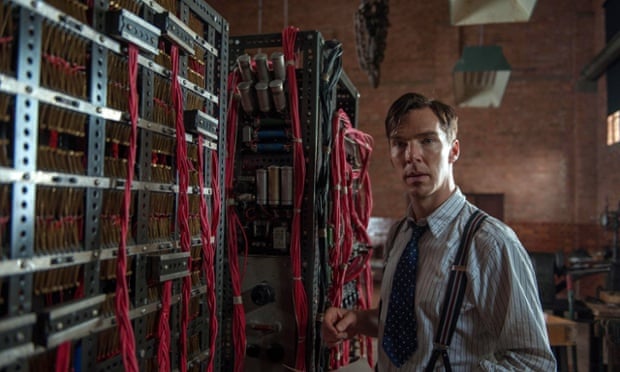
Review: The Imitation Game

The Imitation Game (2014): Written by Graham Moore, directed by Morten Tyldum.  Starring: Benedict Cumberbatch, Keira Knightley, Matthew Goode, Mark Strong, Charles Dance, Allen Leech, Matthew Beard, and Rory Kinnear.  Running Time: 114 minutes. 

Rating: 3/4


**in case you know nothing of the life of Alan Turing, and wish to see the film without knowing anything that happens beforehand, which is not the worst idea in the world in this instance, this review contains many spoilers.  No other way for me to really talk about what works/doesn’t work without being maddeningly vague.**

            Some of you may recall that I referred to Benedict Cumberbatch’s voice-over role as Smaug in the second Hobbit film as his best performance of 2013, and I still stand by that statement.  He became ubiquitous last year, appearing in nearly half a dozen screen roles, while also coming dangerously close to breaking the internet with a particularly shameless scene from Sherlock.  Sadly, many of the films ended up being not terribly good, or had a shockingly awful ending, or were just plain average, while his presence in the otherwise excellent Best-Picture-Winner 12 Years A Slave was spared the ignominy of being the film’s most out-of-place casting choice only by the late appearance of Brad Pitt’s hilariously awful stab at a Canadian accent.  This year he is testing the awards waters again, but this time around with the much sturdier choice of a historical biopic set in the Second World War, which, if the term “Oscar Bait” were a black hole, would form the singularity at the very center.  Thankfully, Alan Turing- a misunderstood and emotionally tortured yet singularly brilliant genius, whose utter lack of people skills and seeming absence of human empathy caused many people to hate him like a particularly virulent strain of the Black Death- turns out to be a much better fit for Cumberbatch’s unique talents than a southern plantation owner.  I can't possibly fathom why. 

            First, the story, for those of you who are not familiar with the Tragic Tale of Turing; Alan Turing, a math prodigy (or “maths,” as Britons still insist on calling it) was hired shortly after the war began to join a team of elite codebreakers with the sole task of cracking Enigma, the system used by the Germans to encode every single radio message they send involving troop movements, battle plans, etc.  The concept of cracking it is not that difficult- one merely has to test all possible combinations within the system- but since there are millions upon millions upon millions of possible solutions, and the entire system is reset every single night at midnight, there is nowhere near enough time for a team of human minds, no matter how sharp, to crack more than a few messages in a given day.  Hence the need for an alternative solution. 

            Turing had worked in the past on theories regarding the development a machine that would have the mechanical capacity to handle the calculations needed for just such a scenario, and despite opposition from others within his team (and from his constantly irate higher-ups), he pursues this objective with single-minded furor, eventually winning the respect and admiration from the others on his team and the precious friendship of the group’s lone female (to whom he briefly becomes engaged), Joan Clarke, who had to fight through her own barriers to get there.  After several years, they are successful in building the first of what come to be called “Turing Machines” (or as they are called today, “digital computers”), and are able to figure out the daily combinations of Enigma almost instantly.  It is estimated that the intelligence gleaned in this way shortened the war (the European war, that is) by as much as two years, saving tens of millions of additional lives in the process. 

            That is only part of the story being told, however.  In one of the film’s few moments of truly clever storytelling, much of the beginning is broken up between the war years, Turing’s childhood (when he was turned on to codebreaking), and his post-war years, when his homosexuality (still illegal at that time) was discovered by the law, leading to a sentence forcing him to undergo chemical castration, a process that ultimately broke him and led him to commit suicide at 41.  The edits between the different phases of his life are very well done, and will pack a decent punch for anyone who genuinely doesn’t know how the story will end

            It very is a typical historical biopic in this sense- slickly made and very well acted (the cast is excellent through and through), but very formulaic in its style and presentation, even including the scenes where Turing is first betrayed, and then stuck up for by his team of codebreakers later on, and numerous lines regarding his tastes and character there solely to be brought back as one-shot punchlines later on.  All of that was to be expected though.  What does drag are the sometimes rather random cuts to either reels of actual news footage, or digitally-enhanced flash shots of the aftermath of real battles, starkly tinted in such a way that none of them would look out of place in a Medal of Honor cut scene.  The effect is similar to if the otherwise-solid The King’s Speech had randomly spliced in clips from Ken Burns’ WWII documentary series. 

            That the scenes do not gel at all with the rest of the film is problematic enough, but they also tend to cut away the support of the biggest emotional punch the film has- as Turing points out in his narration, once they cracked the code, they then had to make the excruciating choice to not reveal even some of the most devastating attacks planned, since acting on more than a certain amount of intelligence (they use cold statistics to determine exactly how much) would quickly alert the Germans to the fact that Enigma has been cracked, and they would have to start from scratch yet again.  The first scene where they realize this is a powerful testament to how the horrors of war can stretch far beyond the battlefield, and cutting to scenes of actual battle actually lessens their effect in a number of cases. 

            However, as with any decent biopic, the linchpin is whether or not Cumberbatch is able to effectively bring across the triumphs and struggles of Alan Turing, and his performance alone is more than enough reason to see this movie.  The man can deliver a lot of emotion, and this time around, he finally has a character and script that give him the tools he needs.  And despite the expected inaccuracies, it is a welcome window onto a remarkable tale of one of the most important minds of the last century, someone who has only recently begun to receive his historical due.  It is far from my favorite film of the year, but I am grateful for its presence. 


-Noah Franc 

Wednesday, November 19, 2014

Review: Interstellar

Interstellar (2014): Written by Jonathan and Christopher Nolan, directed by Christopher Nolan.  Starring: Matthew McConaughey, Anne Hathaway, Jessica Chastain, Billy Irwin, Michael Caine, Ellen Burstyn.  Running Time: 169 minutes. 

Rating: 3/4


            Any of us who have avidly followed the trajectory of Chris Nolan’s career have no reason to be surprised at the subject matter of Interstellar.  The man has always eschewed the normal “rules” of storytelling; out of the 9 films he has helmed so far, only 3 (Insomnia, The Dark Knight, and The Dark Knight Rises) follow the typical pattern of presenting the story to us straight, from start to finish.  And Insomnia was a studio-ordered remake, not one of his original screenplays.  Given his tendency to break his narratives into as many pieces as rational sense would allow, it was only a matter of time before he threw all caution to the wind and proclaimed Time Itself to be his new stomping grounds.  It was an inevitable next step in the life of a man determined to cinematically question every facet of self-perception imaginable, and the result is Interstellar. 

            But I am getting ahead of myself.  We open on Earth an unknown number of years in the future.  A blight, possibly-though-never-explicitly aided by global warming (kudos to the film for not going for the easy points), has wiped out all crops on earth except for corn, which is heavily harvested by a small number of farmers in the American Midwest.  Times are so desperate that teachers and other authority figures openly refer to themselves as a “caretaker generation,” blatantly lying about past space exploration to keep their children focused on how to better cultivate the Earth.  None of this sits well with Cooper (Matthew McConaughey), a former NASA pilot and engineer who tries to raise his kids, especially his preternaturally brilliant daughter Murph, to have a sense of wonder at life and at the stars.  When strange goings-on (ghostlike, according to Murph’s description) in Murph’s room seem to be sending them coordinates of some sort in Morse code, they follow them to what, it turns out, is the remaining base of NASA, forced to operate in secret after the tide of public opinion forced governments to abandon any open support for space exploration.  There he finds his old mentor Dr. Brand (Michael Caine) and his daughter Amelia (Anne Hathaway).  From them he learns that another blight is soon to come, one that will both destroy all remaining corn and will also consume so much oxygen that the remainder of humanity will suffocate as a result. 

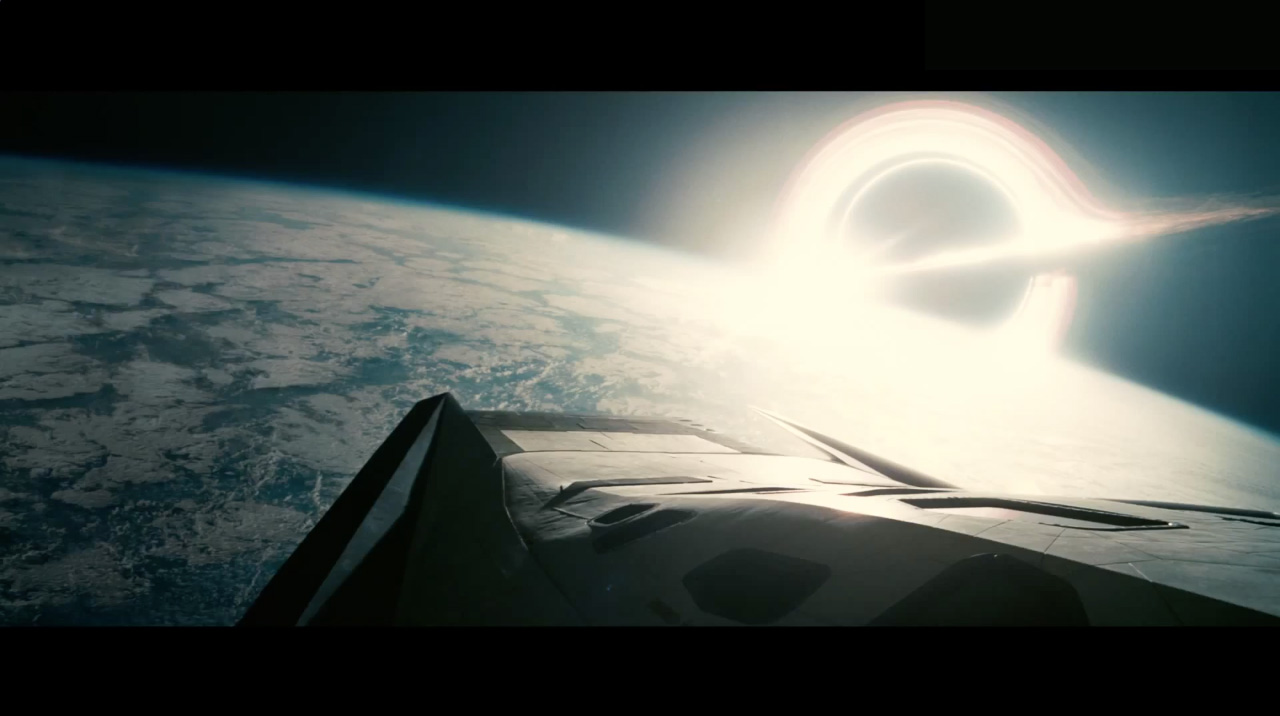
            That said, a lone form of salvation has appeared near Saturn- a wormhole leading to another galaxy, where a handful of potentially habitable world circle a massive black hole.  Cooper is convinced to lead the final team, which will include Amelia, to seek out the best one (several teams have been sent out before, and a few have sent back positive return signals).  The elder Brand will stay behind to complete an equation that should allow him to solve gravity itself, thus allowing humanity to leave Earth en masse in massive space stations before zero hour hits.  Murph is obviously heartbroken by her Dad’s decision to leave, and their agonizing separation is perfectly timed with the countdown for the final lift off.  As she sobs into her grandfather’s arms while Cooper drives off, we hear simultaneously hear the launch countdown.  The crew is lifted off into the recesses of space, preparing themselves for whatever they may find through the wormhole. 

            By now, a great number of cinephiles are solidly split between those who adore the general body of Chris Nolan’s work, and those who may admire his technical prowess but loathe his seemingly incontrollable urge to explain EVERYTHING about the complexities he thinks up for each of his films (the rest, to judge by appearances, do not give half a rat’s tail either way).  This film will change the minds of no one in either camp, and if anything is likely to reinforce and harden any preconceived notions or attitudes towards the man that a particular viewer walks into the film with.  The characters are, for the most part, the same stock archetypes of stoic professionalism willing to sacrifice their own humanity for any great ideal of their choosing.  This is very often the point in his films- his stories tend to both respect or even revere such a mentality while also being brutally honest about the price that must be paid as a result.  Thankfully, much to film’s salvation, Matthew McConaughey and Anne Hathaway end up being fairly inspired casting choices; both are able to bring along more than enough pathos to overcome the clunkier bits of exposition they are handed (and was there every any doubt that Michael Caine would sell his biggest scene like DiCaprio huckstering bad stocks?). 

            I was also rather amused to see the first effort we’ve ever gotten at straight humor from Chris Nolan (of the non-pitch-black variety, that is) in the form of…...a snarky AI robot (named TARS) voiced by Billy Irwin.  Like with his decision to finally turn to time itself as a plot device, it is ironically fitting that Nolan’s first comic character is not, in fact, a human, but a robot programmed to simulate human humor and emotion.  Interpret that as you will.  And the result is a character all its own in recent sci-fi memory, one that would easily outrank all the flesh-and-blood creatures gamboling about as the most emotionally-engaging persona on screen were it not for McConaughey opening up every last gate holding back his tear ducts.  This will be another factor in the film dividing audiences, but I enjoyed TARS immensely, not least because of the unique style of movement the designers came up with for how the robots move.  I’m not sure what’s supposed to hold their various constituent parts together, but based on my experience with a certain trick wallet, I would guess magnetism of some kind. 

            There are, to be sure, stumbles other than the standard Nolan-isms on full display, ones that are harder to ignore.  Unlike in a number of my past reviews, I will not delve into spoilers for this film- like many of Nolan’s films, there are several twists built into the story’s structure that are best experienced cold- but I sadly cannot ignore one smaller twist where two of the human characters (without saying who or where or why) turn antagonistic to Cooper’s mission, in ways that very much feel as if they are only there for the purpose of adding clearly identifiable bad guys with human faces.  Given that the stakes for the entire affair were already pretty damn high, this was entirely unnecessary, and is a strange distraction from the otherwise very solid third-act, where the various plot points and story pieces Nolan has set up come together beautifully in one of the most visually and thematically interesting mashups of actual scientific theory and more mythical sci-fi wonderings we’ve gotten in….hell, I can’t remember the last time we had a big-budget movie try to push a discussion like this.  This, combined with the looming threat of human extinction, was more than adequate for the purpose of creating dramatic and nervous tension.  The fistfight in spacesuits was just extraneous.   

            And yet…for all the ways Nolan seems to inadvertently trip over his own toes in his eagerness to match the transcendent splendor of the final sequences in Kubrick’s 2001, there is a staying power in the film’s more potent scenes that it’s slower parts and occasionally punishing length can never undo.  Cooper’s final goodbyes with his family, the buildup to and subsequent journey through the wormhole, a sequence involving a spinning station, and a major third-act segment involving the giant black hole itself are all the sort of scenes that could easily become sci-fi legend, given a little time for the film to make its impact felt.  There has been a bevy of criticism leveled at the film for the ways it holds itself back, and while many complaints are not without merit, it should bear remembering that the reason sci-fi as a genre exist in the first place is to make whatever leaps, however halting, into the future of both mankind in general and the art of cinema specifically a writer or director can dream up.  Interstellar takes more than a few leaps of logic and daring, and the simple experience of watching the jumps in action is its own special treat, even when it can’t always stick the landings. 


-Noah Franc  

Tuesday, November 11, 2014

Review: Im Labyrinth des Schweigens (In the Labyrinth of Silence)

In the Labyrinth of Silence (2014): Written by Giulio Ricciarelli and Elisabeth Bartel, directed by Giulio Ricciarelli.  Starring: Alexander Fehling, Johannes Kirsch, Friederike Becht, Hansi Jochmann, Johann von Buelow, Gert Voss, Robert Hunger-Buehler, and Andre Szymanski.  Running Time: 122 minutes. 

Rating: 3/4


            One of the most enduring debates in our world is how to approach reconciliation and healing after great crimes are committed, especially on a national or state level.  There is no one clear answer, no one path or set of rules that can be universally applied to all situations.  Sometimes great conflicts or crimes are maintained in an uneasy, “stable” status quo, like in Korea.  Some are only resolved when a particular side wins decisively on the field of battle, like in Sri Lanka.  Some societies choose to tackle the wounds of the past directly through formal organizations like South Africa’s Truth and Reconciliation Commission.  And some, like the German government in the years immediately following WWII and the revelations of the Holocaust, choose silence. 

            This is the world that a young lawyer, Johann Radmann, has grown up in, experiencing only the non-confrontational post-war world of Konrad Adenauer and the German “Economic Miracle.”  Currently paying his legal dues in the rather dull world of legal traffic violations, he yearns for the chance to do something of substance, inspired by the example set by his father, himself a lawyer prior to his disappearance during the War.  He seizes his chance when an aggressive journalist, Thomas Gnielka, confronts his colleagues with a claim by a friend of his, a survivor of Auschwitz survivor named Simon Kirsch.  Having been not old enough to grasp his circumstances during the war itself, he is almost completely unaware of the true extent of Nazi brutality, and holds only a hazy notion of Auschwitz as a POW camp of sorts. 

            Despite his profound naiveté, or perhaps because of it, a senior member of the office named Fritz Bauer enlists him, another lawyer, and a secretary to fully investigate all leads that the journalist and his friend can provide regarding any surviving guards from Auschwitz that can be tried murder.  And they have to have convincing proof that the people were either complicit in or fully aware of the extent of the killing that went on, since actual murder charges are the only ones not affected by a previously agreed-upon statute of limitations.  Bauer has been chomping at the bit for years, looking for the chance to strike back at the former Nazis he knows are still free at every level of German society, but has been helpless to do anything about it due to the agreement reached among the Western powers following the Nuremberg Trials that any further members of Hitler’s government would either be ignored, or if they proved useful against the growing strength of the Soviet Union, protected.  The goal is a single, massive trial, with as many survivors testifying against as many former SS members as possible, so as to finally break the veil of silence that has descended upon the country, resulting in a generation growing up entirely ignorant of the blood on their country’s hands. 

            Johann’s lack of comprehension of the scale of the tragedy is brutally rectified in his very first interview with another survivor.  Surprised at the blasé nature of his questions, the man stares incredulously at him and asks (through an interpreter), “You want to know what crimes I saw?  Do you not realize what Auschwitz was?  They murdered hundreds of thousands of people!”  After hearing this, a look of realization can be seen striking Johann right between the eyes; an abyss of unending darkness has opened up beneath his feet, and he almost dares not look down for fear of what he may see in the void below. 

            But look he must, and he does, even as the work begins to wear him down and affect his relationship with friends and his love for a young seamstress named Marlene.  Through his interviews with survivors and his scouring of leftover records in the IG-Farbenhaus in Frankfurt (now the official offices for the US 5th Corps), he slowly develops both the case they need and his own terrifying understanding of both the extent of German atrocities and of the parallel terrors of silence imposed on the topic since then.  He learns of the experiments (and continued freedom) of Josef Mengele, aka the Angel of Death, delves into his own father’s connection to the Nazi party, and as a result begins to lose his own ability to trust anyone he knows with even tangential connections to the war. 

            Like with another German film from earlier this year, Phoenix, Im Labyrinth des Schweigens never needs to resort to explicit depictions of the sufferings of the camps to have the desired effect.  We have all seen the photos and the videos.  We have seen movies like Schindler’s List, making the horrors of Auschwitz more real to us than any book or documentary could.  Any piling on top of that would be redundant and numbing.  Instead, the director chose deliberately to focus on the people themselves, as they tell their stories, with long close-ups of their faces as they struggle to reconcile themselves with the terrible events they have no choice but to remember.  It’s almost a way to regain the humanity of those who suffered, to show them as individuals, something that can easily be lost amidst talk of the massive numbers of dead involved. 

            Johann’s emotional journey through the experience of preparing the trial, in many ways written to reflect the spiritual struggles of the entire country in its efforts to be able to face these crimes, is portrayed flawlessly by Alexander Fehling.  The man comes fully equipped at all times with a beautifully trembling lower lip for whenever a moment of pure, emotional pathos is needed.  His character is in many ways a stand-in for us as the audience.  Any of us raised with a proper understanding of history have had to experience the same moments he does: the unknowing innocence in our early years of what people are capable of, the sense of unspeakable horror when we first confront the darkness or potential in us and those around us, and the daily struggle to be able to reconcile the conflicting natures of humanity so as to not allow ourselves to be dragged down into the abyss as well. 

            Given that the film, the first feature-length work by Giulio Ricciarelli, is attempting to shed light on a crucial aspect of German social development and reconciliation during the Cold War that has been ignored up ‘til now, I do feel that it could have delved further into the legal and cultural challenges facing everyone involved in the process.  As a vehicle for conveying the evils of Nazism, it is certainly more muted in its approach than more explicit films dealing with the same subject matter, which will perhaps rob it of a deep emotional impact on many.  Nonetheless, this is also a part of the tale of Germany and the Holocaust, and is therefore every bit as much worth remembering as the chilling memories of death in the camps themselves.  It needs a place in our collective memories as an example of the little bits of good than can be done in our daily lives to counter such awful acts, to rebuild what others would destroy. 


-Noah Franc