Thursday, July 18, 2013

Review: Paulette

Paulette (2013): Written by Laurie Aubanel, Jerome Enrico, Bianca Olsen, and Cyril Rambour.  Directed by Jerome Enrico.  Starring: Bernadette Lafont, Carmen Maura, Dominique Lavanant, Andre Penvern, and Ismael Drame.  Running Time: 87 Minutes. 

Rating: 3/4 Stars

            Do you recall those ads about not judging by appearance?  Where they show you the photo of a seemingly sweet old grandma before telling you that Granny was arrested for selling drugs?  Apparently someone saw one of those and thought to themselves, “Now THAT is the stuff of screwball comedy legend!”  While, sad to say, this movie never approaches the realm of legend, Paulette does have enough wit and clever visual gagery to earn its screwball cred, despite a story that ends up being a touch too airy for its own good. 

            Paulette is a hilariously racist old widower, feeling increasingly angry and bitter at the modern, multi-ethnic France that surrounds her.  Her husband apparently died from alcoholism.  Her restaurant has been taken over by a Japanese couple.  Her daughter had the gall to marry an African and have a child with him, whom she “zanily” refers to as her “little nigger.”  On top of all that, she is now flat out of cash, and has to find food and furniture by rummaging through the garbage.  She senses a chance to change her luck, however, when her son-in-law, a police detective, mentions to her the insane profits the drug-dealers he tracks down make.  Smelling green (both literally and figuratively), she tracks down a local dealer and slowly worms her way into his trust by selling more dope faster than anyone else under him.  Eventually, she stumbles onto the idea of using her skills from her restaurant days to make pastries laced with the drugs.  The explosion of success this brings catches the attention of both the “big boss” (read Russian) and her son-in-law detective, setting the stage for some hy-LAIR-eyous third-act hijinks. 

            My inane sarcasm aside, this movie works very well.  Lafont does an excellent job of creating a character that you just love hating, but can still understand.  I mean, racism is racism no matter what, but when it’s been a part of someone’s life for so long, it makes sense that it would only slowly dissipate, even in the face of overwhelming evidence that their previous assumptions are just plain wrong- her grandchild has to literally save her life before she starts seeing him as something other than black.  The rest of the cast is serviceable, but the only other person who manages to make an impression is Paulette’s neighbor across the hall, a widower who is obscenely, almost pathetically, in love with her- in a fantastically cruel twist of fate, for their first date he takes her to the (Japanese) restaurant that ran hers out of business.  The rest- the family, her retired friends, the dealers- fill out the screen well enough without giving offense, but this movie could have benefited greatly from a few more memorable side characters. 

            From a visual standpoint the only thing of note that makes Paulette stand out is its clever use of doorway peepholes.  The inherent distortion that they give to the image makes for some excellent gags, including one where the son-in-law trips over the neighbor that we can see, but he can’t.  I wish there was more I could offer than that, but from a technical standpoint the movie stays pretty basic.  Again, like with the cast, this does not lessen it, but some more creativity with the camerawork/lighting/sets/etc. could have also elevated the movie a bit more above its plot. 

            I won’t delve into specific spoilers, but I really shouldn’t have to- there are no major twists or turns that take the movie out of the realm of the comedy.  Which, in a way, works against it, because a movie about old ladies getting into drug rings should not be nearly as rosy as this movie is.  The humor and jokes never stop working, but its refusal to make more than token gestures of seriousness give the film an air of dispassionate detachment.  Lafont’s Paulette is witty enough to keep you laughing, but, as I said before, this is the sort of character who is interesting only insofar that it’s a lot of fun hating her.  Her bitterness, her racism, and the fact that she is doing all sorts of illegal and dangerous things never make her someone most people could sympathize with.  As a result, not only does the movie feel detached, but we, the audience, become detached as well, and thus are less likely to care about what happens.    


            This is not helped by the fact that there are never any real consequences for her actions.  There are a lot of moments where the movie could veer into dark or grim territory, forcing Paulette to really reexamine her priorities in life.  If her “conversions” were accompanied or paralleled by the sort of real tragedy that could so easily result from being a drug dealer- the sort of tragedy that actually DOES happen to plenty of real people- then Paulette would be a much more memorable experience.  As it is, it’s a fun way to kill an hour and a half, one that won’t tax your brain too hard.  It may be fluff, but when it’s funny, it’s really funny.  

Thursday, July 11, 2013

Review: First Position

First Position (2011/2012): Directed by Bess Kargman.  Featuring: Michaela DePrince, Aran Bell, Miko Fogarty, Jules Fogarty, Joan Sebastian Zamora, and Rebecca Hausknecht.  Running Time: 90 minutes. 

Rating: 3/4 Stars

            The common stereotype of ballet is, of course, that it’s just for girls.  I was spared having such a misconception at a pretty early age thanks to my cousin, a lifelong dance enthusiast who currently does ballet professionally (and whose physique makes me hang my head in shame at every family gathering).  So I never had any hang-ups about the idea that ballet was something for both men and women.  Nevertheless, it is virtually impossible to truly understand what ballet dancers must endure day in and day out unless you’ve either a) done professional ballet yourself at any point or b) watched a close friend or immediate family member do so.  First Position is a documentary intended to correct such understandable ignorance in its audience by looking at a small group of contestants at the 2010 Youth America Grand Prix, one of the premiere competitions for young, aspiring ballet dancers (young in this case being under 19). 

            The film begins by showing a stage crew sweeping a dance floor covered in the rubber mats used for ballet performances.  I have had to prepare those mats myself.  Such mats are around three feet wide, and long, long enough that each one can reach across an entire professional stage.  The mats must all be laid down side by side.  There can be no gaps, cracks, bumps, or inconsistencies in how the mats are set up- they must form a perfectly smooth, clean surface.  Any imperfections are potential catalysts for disaster- stubbed toes, ruined numbers, or even (God forbid) serious falls and injuries.  Once laid down, the mats must be taped to each other and to the floor.  They must then be swept and mopped, and re-swept between each performance.  Dust, dirt, and water are just as dangerous for the dancers as a bumpy mat. 

            It is precisely that perfectionist attention to detail, magnified exponentially, that is required to perform ballet well enough just to be able to compete in the Youth America Grand Prix, much less actually place at the competition or win one of its coveted scholarships.  First Position takes us into this world of unyielding competition, brutal mental stress, and constant, body-breaking work through the eyes of six children of various ages, detailing their lives before their selection, during their training, and after the competition.  All six- Michaela, Aran, Jules, Miko, Joan Sebastian, and Rebecca- hope to land either a medal or a scholarship at the 2010 Prix.  For some of them, this is their single, best chance at professional recognition- if they win something, their chances for success soar.  If they fail to impress, do poorly, or are seriously injured, it can be a mortal blow to their odds. 

            Their stories are as varied as their dancing styles.  Aran is an “military brat” living in Italy, Rebecca, a blond-haired, pink-wearing “princess” in a typical high school.  Joan Sebastian is the oldest son of a poor family in South America, training in New York, Michaela, an African girl adopted by a white, Jewish couple in the States.  Miko and her brother Jules are young children of Asian-American parentage.  They are all clearly talented, and are far more physically fit than I will ever be, even though some of them are only half my age.  They all push themselves through immensely difficult training just to have a shot at maybe making it professionally one day.  They must bend and twist their legs in ways they aren’t supposed to.  Their feet must be just as dexterous as their hands.  They must be hard on themselves to want to correct mistakes and perfect techniques, but too much emotional pressure, from either themselves or others, can be just as destructive as a physical injury. 

            It's inspiring to hear their stories and to see their obvious passion for what they do.  They all admit it’s hard, even agonizing at times- but it’s what they want to do, and they could never live with themselves if they didn’t at least try to make it.  Ballet dancers like these kids (not to mention my cousin) are blessed in that, from their earliest years, they know what direction they want their lives to take.  While the rest of us (myself firmly included) are mired in youthful indecision exacerbated by the limitless choices presented to us, these kids are not just exercising a whole lot- they are literally breaking down and rebuilding not just their bodies, but themselves as people, and seeing this group do that, each in their own ways and for their own reasons, is a powerful reminder of what is possible when you have that level of passion for something. 

            If I had to level a criticism at First Position from a cinematic standpoint, it would be that the whole endeavor is often unfocused.  Beyond showing us the six people, there is little effort to offer a comprehensive view of the world of youth ballet and its various effects (both good and bad) on the body.  There are sporadic interviews with teachers that discuss the physical threat of injury, but the viewer leaves the film no more informed about how often and how serious various injuries are in the world of ballet than before they saw the film.  No statistics are presented to show whether or not ballet is a growing activity among younger generations.  Even the film's attention to its main subjects is uneven and choppy.  A few of them are given lots of screen time with their families, and their results at the Prix are delved into in great detail, while the rest are relegated to a brief summary after the credits have already started rolling.  One of the dancers, Miko’s brother Jules, quits ballet halfway through the film and disappears altogether.  Meanwhile, a close friend of Aran’s from Israel is given more and more screen time as the film progresses, but is never credited as one of the “six dancers” the film claims to follow- neither she nor her family are ever interviewed directly.  Snippets of interviews with other dancers are shown, but only briefly, leaving the impression that a lot more people were interviewed for this project and got cut or edited out somewhere along the line, giving more than a few spots of the film an unfinished feel.  

            This is not a criticism of something that detracts from the film, but it does distract, if only sporadically.  The film’s subject matter- six children struggling to make their dreams comes true, never stops making you want to see what happens next, and the clips of them dancing are amazing and beautiful to watch.  If you have ever had an interest in dancing, specifically ballet, this is a must-see. 


-Noah Franc 

Wednesday, July 3, 2013

Review: Man of Steel

Man of Steel (2013): Written by David S. Goyer (and Chris Nolan), directed by Zach Snyder (but really Chris Nolan).  Starring: Henry Cavill, Michael Shannon, Kevin Costner, Diane Lane, Russell Crowe, Laurence Fishburne, Christopher Meloni, and Amy Adams.  Rated PG-13 for: intense action and violence.  Running Time: 143 Minutes.  Based on The Dark Knight Trilogy by Chris Nolan. 

Rating:  2/4 Stars

            I will state up front that I very much enjoyed watching Man of Steel.  It is a deeply flawed movie, and it reveals the cracks in Chris Nolan’s vision of superhero movies far more than last year’s Dark Knight Rises did.  And yet, even though it fell short of my expectations (as well as those of many others), even though the whole project is so very symptomatic of everything wrong and getting worse about the current bubble of superhero movies bloating up this year’s release schedule, I just can’t work up too many hard feelings about it.  I say this now to partially blunt the somewhat barbed (yet sadly necessary) critiques I am about to level at what is easily the weakest movie Chris Nolan’s name has yet been attached to. 

            Repeat after me if you already know this bit- Krypton is literally being torn apart by the reckless energy policies of its leaders.  Jor-El, whose wife has given birth to the first natural child on Krypton in centuries, tries to get the Council to alter their policies in time to save their race while simultaneously planning to send his son, Kal-El, off alone to ensure that he survives.  His efforts are thwarted by General Zod, who attempts a coup to save the planet, although how exactly his plan would accomplish this is a wibbly-wobbly ball of shut-the-hell-up.  He fails to stop Jor-El from launching the pod with his son, however, along with a Magic McGuffin that apparently contains the….stuff….needed to recreate Krypton.  Zod’s coup fails, and he and his crew are locked away off-world just in time for the exploding volcanoes to break up the planet, conveniently leaving Zod and his cohorts the only surviving Kryptonians left (along with Kal-El).  Kal-El, as we all know, arrives in Kansas and is found by a conveniently-childless All American couple, who raise him as their own and instill in him a sense that his powers are a gift, which he must carefully contain and hide until the time is right.  The time to decide who and what he is, though, is quickly forced upon him when General Zod finally manages to track him down, determined to recover the…thingy…that will allow him to rebuild Krypton.  On Earth, of course.  Also, without humans around.  Of course. 

            You might have noticed that I’ve already thrown Chris Nolan’s name around a lot in this review, even though he neither directed the movie nor wrote the screenplay.  The reason for this is that Man of Steel looks, sounds, and feels a LOT more like a Nolan film than it does a Snyder film, from the overly-explained plot devices, to the shaky-cam, right down to the backstory told in disjointed, non-chronological flashbacks.  Say what you will about movies like 300 (hated it) and Watchmen (a faithful if flawed adaptation), they both had enough visual and aesthetic similarities that they were undoubtedly from the mind of Zach Snyder- washed-out color schemes, insanely gratuitous slow-mo’s during every action scene, and a still and steady camera, letting you soak in the visual design enough to really feel like you’d entered a comic-book world.  The production design here is equally detailed and interested, but I can’t say I was able to really enjoy the sets more than sporadically because the damn camera wouldn’t stop wobbling.  Needless to say, both Nolan and Snyder should know better at this point. 

            This is a relatively small nit-pick though.  The occasionally shoddy camera-work aside, visually this film is as strong as it gets.  Copied though they are, the designs are good, and the visual effects are every bit as spectacular and awe-inspiring as you would expect from a movie that had 220 million and change to throw around.  The fight scenes are fantastic to watch, especially the final smack-down between Superman and Zod, even if it doesn’t measure up to the pure exhilaration of The Avengers, or the mind-bending, they-totally-just-went-there insanity of Cabin In The Woods.  So, on a purely superficial level, there’s really not much in the way of major problems with the film.  Many aspects of the film are even really, really good.  Hans Zimmer’s score is excellent, as always.  Michael Shannon makes a great Zod, and I actually really like Cavill’s Superman.  One of the best scenes in the film is of Clark having a panic attack as a child, and running out of class- his abilities cause him to sense everything around him to an overwhelming degree, and his mother has to find a way to help him “make the world small.”  The real problems with it lie with the plot and screenplay. 

            This is not to say that the story itself is bad, because it isn’t.  Superman trying to learn to control/hide his powers, and being forced to do so quickly by the arrival of Zod and his minions, is a perfectly fine story.  It allows for plenty of philosophical soul-searching on Superman’s part, it lets you show his growth, and then when Zod arrives, you can jump right into the flying and punching and humanity-saving.  And we get plenty of the punching and the flying (the humanity-saving part is up for debate), and as I said above, it looks great.  The issues lie with the first two-thirds of the film, where we’re supposed to see Clark/Kal/Superman’s development as an alien on another world, striving to find an identity for himself, before taking up the mantle of a watchful guardian.  The biggest problem is that we never really see Clark decide much on his own.  Instead, the Superman mantle comes across as something decided for him, at his birth, by his father back on Krypton, which wreaks havoc with the idea that Superman has the free will to decide his own fate, as opposed to Zod, who was genetically pre-programmed to obsessively “defend” Krypton and its people. 

            Russell Crowe’s preaching is given further dense weight by Kevin Costner’s preaching as Clark’s human father, who seems remarkably in sync with Jor-El despite the two of them living on opposite ends of the known universe.  I can recall very few scenes where Clark really delves into what he’s feeling or thinking at any given time, and the one time he does, he’s interrupted by a tornado (no, really).  This is partly why I liked Cavill’s performance- he’s given almost no room in which to develop his own Superman character, and yet despite this, he still manages to carry himself well enough to make an impression in all of his scenes.  The same can be said for most of the cast, nearly all of whom have been placed into similar pits of having no room to breathe and just exist as characters- instead, they are all given speeches on “The Meaning of Superman for Dummies.”  The worst cases in the movie are Amy Adams and Laurence Fishburne as the Lois Lane and her boss from the Daily Planet, who literally have no other purpose other than to make sure the words “Daily Planet” are uttered together several times in the movie.  They clearly tried to make Lois Lane more of a “strong, independent woman” in this version, but the fact that she has to be saved by Superman no less than 3 times pretty much shoots their efforts right in the feet. 

            The crushing density of its plot and its lack of solid character development aside, I still don’t think this is a bad film.  I don’t even think it’s a too dark or too violent rendition of Superman, although they would do well to tie up certain loose ends in the event they do a sequel, which now looks like a near-certainty.  For all the dumb and clichéd moments in the film, there’s nothing as shockingly stupid as the ending of Into Darkness, or as deal-breaking as the abuse of Pepper Pots in Ironman 3.  What it noticeably lacks though, and I’m not the first to point this out, is a sense of fun and wonder at the idea of Superman and his powers.  And that, ultimately, is really the only wish I had for this movie- to get caught up in the wonder of Superman, something I was resistant to for most of my childhood. 

            There is a single scene in the movie that comes very, very close to doing this- after discovering an old Kryptonian ship, Clark is able to speak with a hologram of his dead father, learns of his real identity, and is presented with a suit crafted on Krypton.  He then walks out onto a cold, Arctic plane and, for the first time, pushes himself to fly, as high and as fast as he can.  It’s the lone moment of pure adrenaline rush that I got from the entire film, which not even the spectacular fistfights could provide.  A few more of those scenes would have taken the film a long way.  Without them, we are left with a film that is well-made and structurally sound, for the most part, but one that will leave an awful lot of people wanting something more. 

-Noah Franc


Monday, June 17, 2013

Nippon Reviews: Thermae Romae

Thermae Romae:  Written by Shogo Muto, directed by Hideki Takeuchi.  Starring: Hiroshi Abe, Aya Ueto, Masahika Ishimura, and Kazuki Kitamura.  Running Time: 108 minutes.  Based on the manga by Mari Yamazaki. 

Rating:  2.5/4 Stars

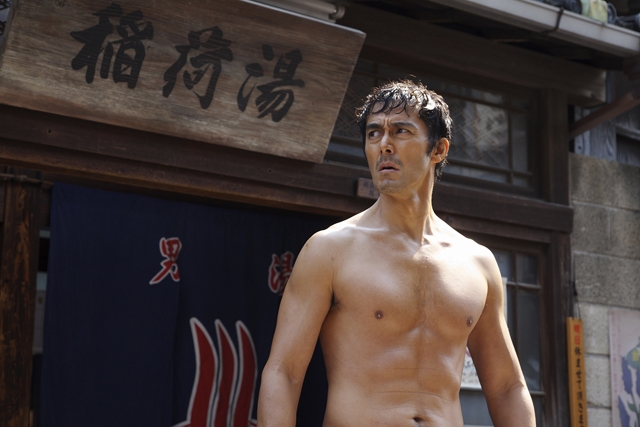
                Hiroshi Abe is a Roman architect, specializing in bathhouses, crucial social gathering places in ancient Rome.  However, he feels outstripped by the new, more garish designs gaining popularity.  This, he fears, is ruining Romans' traditional reverence for bathing and the myriad ways it can both cleanse and heal.  On top of that, his wife is dissatisfied with him (and eventually leaves him), and the person he loves and respects more than any other, the Emperor Hadrianus, is slowly being weighed down by a frustrating war on the border and concerns over who his successor will be. 

                While visiting a competitor’s bath to think up a plan, Hiroshi finds himself sucked into a crack at the bottom of the bath.  Said crack is apparently a leftover rift in the space-time continuum from Doctor Who, as he suddenly finds himself in a bathhouse in modern-day Japan.  Obviously, he doesn’t realize this at first, and believes that he is simply in the bathhouse of a provincial ethnic group being used as servants (his references to the modern-day Japanese as “slaves” and “The Flat-Faced Clan” are a running gag throughout the entirety of the film).  However, as an experienced cultural architect, he quickly realizes he’s in a land far more advanced than Rome, as well as one with far more reverence for bathing, which often leaves him despondent and depressed. 

                He pushes his worries aside, however, and uses his skills as an engineer to replicate what he sees in Japan upon his return to Rome- over a series of trips to and from Japan (through ever-more inventive means of tossing him into water), he figures out how to replicate bubbles, clothing baskets, wash buckets, hoses, private bathtubs, toilets, and even mini-aquariums, all of which cause his popularity in Rome to skyrocket.  However, things get complicated when a young Japanese woman (Aya Ueto), whom he keeps running into when he travels to the 21st century, accidentally gets sucked back to Rome with him, along with a gang of old men who apparently spend all of their time bathing at the hotel owned by Aya’s family.  Hiroshi and his time-traveling friends must figure out together how to stop Hadrianus’ womanizing son from succeeding the throne, how to revitalize the soldiers losing the war on the front, and how to get Aya and her friends back home, while still making it back in time for supper. 

                This is a fun movie.  The fish-out-of-water scenarios in the first two parts of the film are very well-done- Hiroshi’s stoic, un-ironic seriousness in the face of modern-day technology gets a lot of laughs (his best reaction might be his discovery of a toilet’s butt-washing device- no, I’m not kidding, that exists).  He does a fine acting job here, and the gaggle of old “real” Japanese are a lot of fun (the other Roman characters never left an impression on me).  The time-travel mechanism remains blissfully unexplained- this is not sci-fi, so any attempt to rationalize Hiroshi’s journeys would simply bog down a story that’s too flimsy to handle such scrutiny.  Suffice it to say that I wouldn’t be surprised if Hiroshi’s character went on to develop a severe case of aquaphobia.  The subplots that revolve around ancient Rome as a setting are cute, and move the story along well enough, but they ultimately serve little purpose other than to say to the audience, “Look!  Romans and Japanese!  They both really, really like taking baths!” 

                It’s possible that Thermae Romae is a film that would be funniest to either Japanese people themselves or to people intimately familiar with Japanese society, but although my knowledge of Japanese culture is relatively limited, I got all the bathing jokes and laughed plenty.  It never reaches the subtle, witty brilliance of Key of Life, but there’s some great bits of comedy here (my favorites are the shots of a European tenor belting out an aria during the time-travel sequences).  The film tries a bit too hard to be seriously “about” something towards the end, which feels a bit too disconnected from the tone in the first two-thirds of the film, but it does keep up the good humor long enough that it doesn’t really matter.  Not a must-see by any stretch, but if you do get the chance to watch it, you won’t leave unhappy. 


-Noah Franc 

Saturday, June 15, 2013

Nippon Reviews: Asura

Asura:  Written by Ikuko Takahashi, directed by Keiichi Sato.  Starring: Masako Nozawa, Kinya Kitaoji, Megumi Hayashibara, Tessho Genda, Hiraoki Hirata.  Running Time: 75 minutes.  Based on the manga by George Akiyama. 

Rating:  4/4 Stars

                It’s 15th-century Japan, and the countryside is ravaged by civil war, drought, and famine.  In the midst of this hell, a lone woman, her village destroyed and her family most probably dead, gives birth to a boy in a desecrated temple.  From literally the very first seconds of his life, the mother must use brutal force to protect the life of her child.  That is, however, until hunger overwhelms her, and in a moment of insanity, she attempts to eat her own son to survive.  Realizing what she’s about to do, however, she runs off in horror, leaving the child alone and abandoned. 

                The movie then cuts to an unknown number of years later.  The abandoned child is now a wandering barbarian, incapable of speech, killing and eating every form of life he encounters, be it animal or human.  He tries to change his ways, however, after being subdued by a powerful monk.  The monk feeds the child, teaches him a Buddhist mantra, and gives him a name- Asura (pronounced “Ashura”), roughly translated as “Demon God.”  Although still prone to violence and murderous rage, Asura tries to learn to tame his violent instincts, especially after his life is saved by Wasaka, a beautiful and sweet girl from a nearby village ruled over by a vengeful lord.  Obviously, overcoming instinct is no easy feat, and Asura is soon forced to confront the terrible nature of his earlier behavior. 

                I was unsure what to think of Asura right after I saw it, but for some reason, this film has stuck with me in a way few others manage to do.  It is a graphic, bloody, brutal, and dark movie, but so are a thousand others.  What makes Asura different?  I suppose one reason is its distinct visual style- it is a hybrid animation film, a new style developed by Toei Animation.  The backgrounds are watercolor, but the characters themselves are rendered in 3D, and the result is something truly astounding to look at.  There is also an excellent use of light and shadows.  This is a land that can be green and blue, but at a moment’s notice it can switch to black, gray, or bloody red.  Sunlight can be peaceful and life-giving, but also brutally harsh and revealing.  Several shots use shadows brilliantly, revealing a lone, broken figure clawing its way across a barren land. 

                The rawness of the animation matches the rawness of its story and characters.  This is a harsh country full of harsh people, living in harsh times.  Some of this is explained in monologues by the monk who saves Asura (and who also provides the opening and closing narration), but most of it, thankfully, is shown- in one scene, the monk comes across a village devastated by flood.  There is no dialogue, and I recall no music, simply a shot of the monk putting his hands together in grieved prayer.  The desperation of their circumstances provokes brutal violence by many of the characters, not just Asura, although his crimes are clearly seen as the worst- it is established early on that he has committed both cannibalism and vampirism (of the real-world variety).  It is these acts for which he must pay the ultimate price, and I’m not talking about death. 

                Asura is a hard film to watch, but it is one of the best movies I have seen thus far this year.  Its animation is high-quality, but I cannot call it a “beautiful” movie, at least not in the sense that a Ghibli movie is beautiful.  It challenges, and sometimes depresses, but despite that, despite the cynicism that one might be tempted to draw from the depravity depicted on-screen, Asura still manages to end on a note of qualified optimism.  Terrible crimes have been committed, and lives have been destroyed, but as the monk quietly observes- “Although we all bear our own sins, we shall always carry on.  And this makes life beautiful."  


-Noah Franc 

Friday, June 14, 2013

Nippon Reviews: Key of Life

Key of Life:  Written and directed by Kenji Uchida.  Starring:  Masato Sakai, Teruyuki Kagawa, Ryoko Hirosue, Yoshiyoshi Arakawa.  Running Time:  128 minutes. 

Rating:  4/4 Stars

                Sometimes, I despair about the state of comedy in film.  Sometimes, the franchises of series like Scary Movie, or The Hangover (which I still can’t believe is a trilogy), loom so large over comedic films that it’s no longer possible to even come up with great comedy, let alone write it, present it, and get the green light to make it.  Sometimes, just hearing that a film is billing itself as a “comedy” makes me cringe. 

                Then, I see a movie like Key of Life.  Then, I am reminded that yes, there are STILL great comedic films to be made.  I am reminded that being genuinely funny doesn’t require swearing, boob/penis humor, or “shocking” graphic content.  I am reminded that comedic characters can be as wacky, quirky, or strange as can be, and yet still feel like real people.  I am reminded that a movie can be roll-on-the-ground funny and still have the skill to bring real emotional depth into play when it has to.  I am reminded just how much fun a movie can be when it never stops having fun with itself. 

                Sakurai is an out-of-work actor, seriously contemplating suicide.  After one failed attempt, he tries to revise his spirits by going to a nearby bathhouse, which an elite hit man fresh from his latest “job” happens to be frequenting as well.  Through a series of accidents, the hit man slips on Sakurai’s soap and hits his head (in hilariously over-the-top fashion), giving him a severe case of amnesia.  Seeing this as his chance to alter his fortunes, Sakurai takes the man’s identity (by quietly changing his own locker key/ID with the man), and uses the hoard of cash he finds in the man’s car and apartment to start paying off the personal debts that had been weighing on him.  However, he soon realizes the extent of his mistake when the man’s Yakuza contacts suddenly appear and order him to do another hit. 

                Meanwhile, the hit man (whose “name,” we learn, is Kondo) wakes up in the hospital bed, believing that he is Sakurai, and slowly attempts to regain his memory in ways that are sometimes hilarious, and sometimes rather heartbreaking.  His efforts are aided by the editor of a local magazine, a woman in her mid-30’s desperately searching for a husband so she can meet her wedding deadline- when asked who her fiancé is by her colleagues, she responds, “I don’t know.  But I’ve scheduled two months to find the right candidate.”  Sakurai (the real one) tracks down Kondo (the real one) as well, feeling both increasingly remorseful for his subterfuge and increasingly terrified that the Yakuza will find out who he really is and kill him. 

                That sounds like a classically absurd identity-swap setup, and that’s because it is.  Thankfully, the writing is consistently hilarious enough that it doesn’t matter how often you’ve seen this sort of film, or how quickly you call the ending- I don’t think I went more than 3-4 minutes at a stretch without laughing out loud, and during the movie’s best scenes, I was howling about every 15 seconds.  Scions of Shakespeare can tell you that there’s nothing wrong with using a standard setup as long as you do it well, and bring something of your own to the table.  The biggest strength of the movie is how much you find yourself caring about its oddball crew of characters- without his memory, the rough-and-tough hit man is pretty much a big teddy bear, and despite how hapless he is, you do understand Sakurai’s despair. 

                Key of Life, like nearly all movies, is by no means perfect- I kept expecting it to spin into an In Bruges-esque black comedy, but aside from a few faints in that direction in the first act, the movies stays quite strictly within the bounds of a thematically-gentle screwball comedy.  It also slows down towards the end more than I would have liked (although it parlays that with an absolutely perfect final shot).  There’s a vague subplot about a possible connection between Sakurai and the fiancé of one of Kondo’s past hits, but it never really goes anywhere (at least not to my satisfaction).  However, as I have said before, it is not perfection that makes a film deserving of four stars- it’s how much of a genuinely satisfying experience watching the film provides, and Key of Life was the most satisfying movie experience I had at Nippon.  With the possible exception of Asura, but we’ll get to that in my next review. 


-Noah Franc 

Wednesday, June 12, 2013

Nippon Reviews: The Life Of Budori Gusuko

The Life of Budori Gusuko:  Written and directed by Gisaburo Sugii.  Starring:  Shun Oguri, Shiori Kutsuna, Akira Emoto, Kuranosuke Sasaki, Tamiyo Kusakari.  Running Time:  108 minutes.  Based on a novel by Kenji Miyazawa.   

Rating: 3/4 Stars

                Budori Gusuko lives in a world of cats.  I don’t mean that there are humans, who are dominated by cats, I mean that cats are the people themselves.  They walk on their hind legs and use their front paws as hands, but aside from that, they look like perfectly normal cats.  He and his family live in the woods on a mountainside, where the father is a popular lumberjack.  The land is rich and fertile, and although their life is simple, they lack for nothing.  Until the cold comes, that is- a combination of freezing, snowy  winters and too-short summers prevent anything from growing for a long time, until, in the midst of a desperately bitter snowstorm, Budori loses his entire family- the father wanders off, the mother goes missing searching for him, and his little sister vanishes shortly afterward. 

                As a result, when the winter finally ends, Budori lacks any reason to stay in the mountain, and he begins traveling and searching the world for a purpose in his life.  This leads to a series of adventures where he meets an assortment of oddball characters- a red-bearded cat who is way too cheerful about how terrible his business skills are, a zany professor in a top-hat who gives what is either the stupidest or the most accurate breakdown of the study of history ever uttered, and a tall, demonically wide-eyed cat in a swirling, dark cloak, who may or may not be Death himself. 

                The animation is one of the primary strengths of the film- it’s a more traditional hand drawn style with watercolor backgrounds (although there was some CGI thrown in at times).  We start in a peaceful, idyllic forest, and finish in a massive, futuristic city filled with enough flying machines to make Miyazaki green with envy.  Each new setting is detailed, and interesting, the flying machines are quite memorable, and the designs of the cats-as-people look surprisingly natural.  Despite the vast difference in the settings of the story, every location feels like an organic part of the same world. 

                The overall plot of Budori, much like the animation style, is very episodic- the audience simply follows Budori himself through the major events of his life.  His presence is more or less the only connecting thread between the three major sections of the film, with previous experiences rarely, if ever, mentioned.  I was flummoxed by this at first, but then I reminded myself that two of my favorite films of all time are 2001 and Waking Life , both of which utterly defy traditional narrative interpretation, so I can hardly criticize Budori for splitting up the narrative like a TV show.  Where the film definitely delves into the realm of the bewildering, however, is in the cracks between the major story arcs.  Between each part of Budori’s journey (and sometimes during one), he falls asleep and (seemingly without cause) begins to have fantasies that should make acid-trippers feel quite at home.  These fantasies themselves bear no clear connection to the “real-life” experiences in the rest of the movie, so the purpose they are supposed to serve is very much up to individual interpretation.  They are at least intriguing to try and pick apart, and they also feature the appearance of the wonderfully designed Cat That May Signify Death mentioned above. 

                What ultimately does hurt the film is Budori himself, who very much comes across as an empty vessel for most of the film.  I’ve racked my brain for several days, but I still can’t recall a single expression crossing his face other than a very faint smile.  And that’s not something I can pin on the animation, because the other characters are plenty expressive- part of what makes the aforementioned bearded cat so much fun is the idiotic grin that never leaves his face.  The voice actor is also rather underwhelming, barely emoting more than Budori’s face does.  It’s not a deal-breaker, and it doesn’t make him a weak character, but it does limit the extent to which the audience can really identify with him. 

                Both Budori’s personality and actions in the movie as a whole made a lot more sense to me after I shoehorned the whole film into my own highly-probably interpretation; I posit that the loss of Budori’s family has left him with a severe case of PTSD.  The repression of his guilt, as a result, leads to both the bizarre fantasies and the decisions he ultimately makes about his life.  Is that what Sugii intended?  I highly doubt it, but it certainly made the film a lot more interested for me.  I don’t know if or when this film will get a release in the States, but I definitely recommend this film for its sheer strangeness- I suspect this movie could be another one that people either love or hate, but it will get you thinking regardless. 


-Noah Franc