Monday, November 26, 2012

Review: Wreck-It-Ralph

Wreck-It-Ralph (2012):  Written by Phil Johnston and Jennifer Lee, directed by Rich Moore.  Starring: John C. Reilly, Sarah Silverman, Jane Lynch, and Jack McBrayer.  Rated PG.  Running Time: 108 minutes.   

Rating:  3/4 stars


    It’s been a pretty decent year for animation thus far.  First we had Arrietty, the simple but solid latest entry from the wizards at Ghibli.  Next came Pixar’s latest project, Brave, somewhat schizophrenic, but beautifully made and full of interesting characters and ideas.  And although I was not able to see it while it was in theaters, I have heard nothing but good things about Paranorman, the newest film from the promising group that made Coraline.  Now, we have Wreck-It-Ralph, the video-game-centered nostalgia bomb from Walt Disney Studios. 

    Before my ignorance betrays itself, allow me to state for the record that I am not, and have never been, a gamer.  Having never owned a system of my own, my video game experience has been limited almost exclusively to Pokemon Red, Blue, Yellow, and Gold, Legen of Goku II, Civ III, Portal, and the occasional Brawl/Halo/COD team games at friends’ houses.  So, as you can tell, I do not fall within the primary demographics this film is clearly aimed at.  Thankfully, that turned out to not be an issue, as the film, though filled with gaming references, cameos, and side jokes, is well-made enough and the characters broad enough that this movie can be a joyride for just about anyone. 

    The movie begins by revealing that the individual characters of the various arcade games are all self-aware entities, for whom their game roles are basically day jobs (somewhat in the vain of Reboot, if anyone other than myself remembers that show).  They live within their respective game boxes and can travel to the other games and visit each other via the connecting cords and power strips.  This carries a danger though, since, while the characters can die and regenerate endlessly within their own games, if they die outside their game, that’s it, and the game will be unplugged, leaving the other characters completely job- and homeless in the central game hub (or so we are told by an animated Sonic the Hedgehog Poster).  

    The main character, Wreck-It-Ralph, at a wonderfully assorted gathering of old-school video-game villains at an AA-esque therapy and support group, explains that he’s grown tired of being treated as stupid and evil, not just during open hours, but also by his fellow characters after-hours.  After he awkwardly stumbles upon the rest of his game (including the irrepressibly noble “good-guy” character, Fix-It-Felix Jr.) celebrating the game’s 30th anniversary without him, he storms off determined to win a hero’s medal in another game so that the other characters will finally respect him.  After stumbling through the COD-style shooter Hero’s Duty, where he meets the hardline Sergeant Calhoun (voiced by Jane Lynch), he finds himself in Sugar Rush, a new, top-of-the-line racing game, where he befriends a small girl racer named Vanellope von Schweetz (played rather effectively by Sarah Silverman) and has to find his medal and get back home before his game is unplugged for good. 

    It’s a fairly basic story of friendship and self-confidence, built (for the most part) from the standard Disney formula, with just enough twists to keep it fresh.  John Reilly’s Ralph is sympathetic without being melodramatic or overly depressed, and I find it refreshing that the main character of a Disney film finally gets to do something other than be pulled into a finding-love-where-they-least-expect-it story arc (said arc being left to the side characters this time around).  Sarah Silverman as a little child, sounds, on paper, like the sort of odd-ball casting that would try too hard to be its own running gag, but she actually turns in a great performance, managing to balance between being an amusingly smart-aleck and a likeable character you genuinely want to see win her race.  The biggest accolades, however, go to Jane Lynch (surprise surprise), who can play the hardass fem-fatale like few others.  Here too, however, Lynch’s performance surpasses her character’s initial superficiality, giving Calhoun some real depth. 
   
    The fun characters aside (and they are all fun), the strength of the film is easily the video-game universe it invents for itself.  The characters from older games, even up close, move with old-fashioned herky-jerkiness, while the high res new characters are fully-formed and walk more naturally.  The film avoids drowning itself in its own nostalgia, including plenty of Easter eggs for the old-school gamers, but never to the point of obscuring its own humor from regular viewers (that said, I did get my fair share of the gaming humor- my favorite was a passing GLaDOS joke).  When the film is being serious, it’s really moving, and when it’s being funny, it’s friggin’ hilarious. 

    Sadly, it took me a lot longer to see Wreck-It-Ralph than I’d planned (thanks to Sandy), so showtimes for this film are already giving way to Twilight, Skyfall, and Lincoln, but it’s still pulling in a profit, so if you have the chance the next week or two and aren’t in the mood for Hitchcock, definitely go check this one out.  I had a blast, and I’m sure pretty much anyone else will too. 

-Judge Richard

Wednesday, November 21, 2012

Review: Lincoln


  Lincoln (2012):  Written by Tony Kushner and directed by Steven Spielberg.  Starring: Daniel Day-Lewis, Sally Field, Tommy Lee Jones, David Strathairn, Joseph Gordon-Levitt, James Spader, Hal Holbrook, and Jackie Earle Haley.  Rated PG-13 for: an intense scene of war violence, some images of carnage, and brief strong language.  Running Time: 150 minutes.  Based on Team of Rivals: The Political Genius of Abraham Lincoln, by Doris Kearns Goodwin.

Rating:  4/4 stars

 Abraham Lincoln has always been a difficult person to approach in any medium, be it fiction or historical.  How do you take one of the most well-known and beloved figures in American history, the man who led the United States through its greatest catastrophe, brought slavery to an end in the process, and ultimately paid for it with his life, and make him relate-able?  How do you reconcile the man whose poetic speeches rank as some of the greatest oratory of all time with the gangly, withdrawn lawyer who could reel off one lewd joke after another with relish?  How do you take the legend, and turn him into a man? 

    Lincoln, to my great joy, adroitly manages all of the above.  Day-Lewis, looking and sounding nothing like Daniel Plainview (thank Heavens) turns out one of the best performances of his career to date, ensuring himself at least a fifth nomination for Best Actor, and possibly his third win.  Abraham Lincoln is an easy person to portray simplistically, as a moral crusader ahead of his time, and a genius always above the mere mortals around him.  Spielberg’s masterful direction and Day-Lewis’ incredible acting, however, take us past the romanticizations and show us a man struggling with depression, a troubled marriage, and the unimaginable duress of trying to save a country literally tearing itself apart. 

    Based largely on the excellent biography by Doris Kearns Goodwin, Lincoln focuses on the last months of the man’s life in 1865, specifically the push to pass the Thirteenth Amendment to officially abolish slavery.  After winning an election that also saw Republicans gain huge majorities in the House and Senate, Lincoln faces a difficult choice- should he push for passage of the Amendment now, despite Democratic opposition in the House, or wait until after the inauguration, when huge Republican majorities in both Houses will allow him to do virtually anything he could want?  Believing immediate passage of the Amendment to be both a moral right and, pragmatically, another blow to the already reeling Confederacy, Lincoln decides to push for a bipartisan vote on the Amendment within a month, risking the success of the Amendment, his own reputation and legacy, and potentially the outcome of the war itself on what easily amounts to one of the biggest political gambits of his life. 

    Since passage by the lame-duck Congress would require at least 20 of the recently defeated Democrats to break ranks and vote “yay,” Lincoln, working closely with Secretary of State William Seward (played by Edward R. Murr....I mean, David Strathairn) and Thaddeus Stevens, leader of the pro-equality Radical Republicans (Tommy Lee Jones), engages in an endless string of behind-the-scenes convincing, strong-arming, and downright deception and bribery that jars wonderfully with his traditional “Honest Abe” moniker and shows off his genuine brilliance as a politician.  Tommy Lee Jones’ Stevens, as angry and in-your-face as Lincoln is calm and reserved, carries every scene he’s in, leaving small doubt as to why he was often called “the Dictator of Congress.” 

    While debate in the House rages (literally) over the coming vote, the audience is given the occasional glimpse into the personal lives of Lincoln and Mary Todd, still suffering from the early death of their son William (by that time two of their four children were dead).  While Day-Lewis’ performance is the most engrossing of the film, Sally Field’s as Mary Todd is easily the most haunting.  Sobbing inconsolably in a darkened room one scene and smiling cheerfully to guests in the next, Field brings home more than any actor in the film the tragedy that dogged her and her husband throughout their married life, and the strain it put on both them as public figures who were, at a deep, personal level, intensely private people. 

    And that’s one of the things I appreciated the most about this film; it doesn’t attempt to wave away or hide the many flaws, prejudices, and trials of its protagonists.  The Civil War leaders were some of the most remarkable people this country (and indeed the world) has ever seen, but they were also just as much products of their own times.  It’s all too easy, looking back now, to project our own 21st-century sensibilities onto 19th-century men and women.  For most people today, it is far more self-evident that, yes, all races ARE equal, and, yes, we all deserve the right to vote, live, and marry as we please (and though plenty may still think otherwise, few would dare say so out loud). 

    Such was not the case during the Civil War, and to forget that these people were both admirable and imperfect is to do a disservice to their memories, and thankfully this movie embraces that wholeheartedly.  Lincoln, although a life-long opponent of slavery, had much murkier (and more prejudiced) views on race equality and amalgamation, and vocally supported the idea of sending freed slaves to colonies like Liberia in Africa.  This more complex aspect of his character is captured in what could be one of the most under-appreciated scenes of the entire film; when Mary’s black maid directly asks Lincoln about what he thinks “her people” should do after emancipation, he quietly (one might say cagily) ducks around giving a direct answer.  In another scene, on the floor of the House, the mere suggestion that emancipation could lead to voting rights for not just blacks, but even WOMEN as well (gasp!) nearly causes a riot. 

    What the film also takes pains to remind us, though, is that such differences between our respective eras in no way diminishes the significance of the Thirteenth Amendment’s passing or its relevance to today, nor blight the legacies and characters of those who made it happen.  Progress, it gently reminds us, can be slow, agonizing, and painful, and even those with the best of characters and intentions can be hard-pressed to bring it about.  The passage of the Thirteenth Amendment did not “cure” the ills of racial prejudice and inequality that plagued America at the time, just as the ascension of a black man to the Presidency a century and a half later has not “cured” our own prejudices and inequalities.

    Lincoln is an opus of a film, easily one of the finest of Spielberg’s already stellar career, and will probably be a heavy favorite for Best Picture come Oscar time.  What one might easily imagine as a huge, sweeping, romantic love letter to one of the greatest Presidents in history is actually a tight and surprisingly intense political drama about one of the cleverest politicians this country has ever seen.  And I cannot recommend it enough.  Even if, and maybe especially if, you’re sick of the very thought of politics and Congressional bickering (and understandably so).  Sometimes, it’s worth remembering that ours are hardly the hardest of times.

-Judge Richard

Tuesday, November 13, 2012

Review: Cloud Atlas

Cloud Atlas (2012):  Written and directed by Tom Tykwer, Lana Wachowski, and Andy Wachowski.  Starring: Tom Hanks, Halle Berry, Jim Broadbent, Hugo Weaving, Jim Sturgess, Hugh Grant, Doona Bae, Ben Whishaw, and Susan Sarandon.  Rated R for: violence, language, sexuality, nudity, and some drug use.  Running Time: 172 minutes.  Based on the novel by David Mitchell.

Rating:  4/4 stars

    After an entire weekend spent brooding, I’m still not sure what to say about Cloud Atlas.  It is a film that many movies try to be, and very few actually succeed in becoming, taking the viewer on a unique, interesting, and visually dazzling journey that reaches across genres.  Is it the best movie of 2012?  I’m not sure yet.  However, I feel certain that it will be remembered as one of the most significant films of the past few years.  It is certainly one of the most ambitious I’ve ever seen.  The closest comparison my scrambling mind can come up with is the broken-timeline structure of Pulp Fiction, but even that cult classic can’t hold a candle to Cloud Atlas in terms of its sheer audacity and determination to fly in the face of storytelling convention. 

    As you can easily pick up on from the trailers, Cloud Atlas tells not just one story, but several (six, to be precise), encompassing a roughly 500-year time span, from the mid-19th century to after the Apocalypse.  On top of that, rather than simply showing these various stories chronologically, the film cuts in and out of each at powerful, climactic, or poignant moments, challenging the audience at each turn to keep up with six different narratives simultaneously.  That each of the six stories would function as perfectly good short films in their own right is impressive enough, but the film goes one step further of attempting to make the ideas and events in each one overlap with and reflect upon the others, creating a tapestry out of themes like love, reincarnation, human companionship, and the superficiality of race, gender, and sexuality.  And, even more amazingly, it works.  The editing and direction are clever and tight enough to keep the whole enterprise from spinning out of control, or buckling under its own dense weight. 

    On top of offering the audience a bevy of fun stories to follow along with, the movie further reinforces the constant theme of reincarnation by using primarily the same core group of actors as the main characters in each storyline, with each actor switching between main roles and brief cameos, good guys and bad guys, and, on occasion, appearing as different races and even genders.  Hugh Grant, Tom Hanks, Jim Sturgess, Hugo Weaving, and Halle Berry alone can be found in all six segments, and Jim Broadbent and Ben Whishaw are seen in five.  Thankfully, there is not a single dull or lackluster performance to be heard, as every single member of the cast brings their all to each and every role they’re given. 

    The aforementioned changes between historical eras, races, and genders are accomplished by a truly jaw-dropping variety of what are easily the best makeup effects of the year.  What’s truly wonderful to watch is how the makeup is just enough to convey the switch from the character’s previous role, but is always subtle enough that you can usually tell which actor is playing which character.  I will not spoil a single one of the major makeup accomplishments here.  Trust me, this film is better seen when you don’t know what’s coming.  Even if none of the actors get nomination nods come Oscar season, I can’t begin to imagine another film taking Best Makeup (if another one does, then the Academy is in more dire straights than I thought). 

    The end result of all this is something expansive, challenging, and immensely rewarding to sit through.  I was not bored or distracted for a minute watching this film- there was always something to look at, always a past scene to compare with what I was seeing, always something in the shot or dialogue to make me think.  Cloud Atlas is that rare film that genuinely makes me feel like I’ve been on a long, fascinating journey.  From the opening shot of an aged Tom Hanks ruminating over a fire to his final monologue, I sat in my chair in the middle of the theater and felt myself fly across the ages, from a classic ship adventure to a political thriller to a Matrix-style futuristic revolution and beyond.  And it was one hell of a ride.  
   
    Cloud Atlas is a film that many people will disagree on.  Plenty of viewers are certain to be turned off by the constant jumps between timelines and the subsequent demands made on one's attention.  Critics seem divided as well, with many panning the film for being shallow or too dense to really signify anything.  While everyone is free to have their own opinion, I must say I could not disagree more.  Cloud Atlas never lacks for things to say, and if the overarching, final “message” (if, indeed, there is one to be found) is not immediately obvious, all the better I say. 

    As I said before, I have not yet decided if this is my new Best Film of the year.  I don’t think it’s an objectively “better” movie than The Master, or Moonrise Kingdom, or even Seven Psychopaths.  What I do think is that it is a perfect example of the wonderful potential of the cinema.  It is a film that shoots for the stars, that lives large and takes huge risks.  But while making its broad strokes, it never forgets to fill in the smaller details that make watching it an act of discovery, and not just simple entertainment.  In the space of just under three hours, I felt joy, sadness, longing, awe, wonder, hope, and dread.  I would feel my heart break during one scene, and by the end of the next I’d be howling with laughter.  And, as the final shot of a star-filled sky faded away into darkness, my eyes began to fill with tears. 

    I can’t ask more from a movie that than.

-Judge Richard 

Sunday, November 4, 2012

Damnit, Sorkin

   I think it’s safe to say I’m pretty much over The Newsroom.  I mean, I knew it was never going to be a “good” show, strictly speaking.  The storylines were completely unoriginal, the characters were broad, paper-thin stereotypes who spoke and acted like aliens pretending to be humans, and Will McAvoy (despite the earnest efforts of Jeff Daniels) couldn’t respond to even the most simple of questions without churning out a hammy tirade about how “great” America used to be. 

    So no, I knew it would never be “good.”  But, honestly, I was willing to forgive all of that, for one, single reason- it was angry.  Angry at the flimsy circus our 24-hour news world has become.  Angry at the Tea Party.  Angry at Congressional gridlock.  Angry at all the utter junk that clogs up day to day life in this country.  It burned through the very fiber of Will McAvoy’s being.  And, since I share every bit of this anger, I was all on board.  The show could be as crappy as it wanted, so long as it provided catharsis. 

    Sadly, that has not happened.  Oh the rants are there, and they are great fun to watch (McAvoy’s deconstruction of the Tea Party as the “American Taliban” is my personal favorite).  The problem is that they are almost completely buried.  Buried in the bullshitty, who’s-sleeping-with-who drama that most of every episode has been devoted to.  Instead of being the focus of the show, the anger has been mere sprinkles on a greasy, tasteless donut. 
   
    Take the bit about the Tea Party, part of the very last episode of the first season.  All of the clips concerning the Tea Party, when combined, run for 6 strong minutes.  In the actual episode, however, those 6 minutes are spread out through the entire 45-minute plus episode, so far apart that when another segment comes up, you’ve forgotten what he talked about in the last one. 

    And what fills in the gaps between these tiny gems of political rage?  Relationship drama.  Some drug references.  And, astonishingly, a Sex In The City-themed subplot.  I wish I was making that up, but I’m sober.  And to top it all off, Sorkin pulls a Glee by refusing to close the cast-member couplings that are so obviously going to happen, just to leave enough filler-fuel for another season (or two, or three, or giiyaaaah...).  The characters that are clearly going to get together all say to each other some variant of the following;
“Yeah, we are clearly head-over-heels for each other!” 
“But we can’t be together now.” 
“Why?” 
“Hell if I know.” 

    I could go on listing my frustrations with this for some time, but the election isn’t over yet, so my blood pressure can’t take it.  Suffice it to say, I am disappointed.  It’s not even the fact that the filler in the show exists- all shows have filler of some kind (even Avatar).  What’s grating is how staggeringly unoriginal it is.  There is seriously nothing noteworthy about any of these characters outside of their astonishing self-righteousness.  And that just isn’t about to make a show worth watching. 

    So, in a nutshell.  I’m done.  I’m sure the show will remain popular for awhile, and may Sorkin get all the money he can out of the show.  I will no longer take part.  I will content myself with watching the good bits on Youtube (pretty much all of which can be found filler-free, thank God).  And while I have resigned myself to this, I still can’t help but feel that twinge of disappointment.  Goddamnit Sorkin.  You came so close. 

-Judge Richard

Sunday, October 21, 2012

Review: Seven Psychopaths

Seven Psychopaths (2012):  Written and directed by Martin McDonagh.  Starring:  Colin Farrell, Sam Rockwell, Christopher Walken, Woody Harrelson, and Abbie Cornish.  Rated R for: Strong violence, bloody images, pervasive language, sexuality/nudity and some drug use.  Running time: 110 minutes.

Rating: 3.5/4 stars


    This may be a consequence of my utter lack of knowledge concerning overall trends in film, but I’m honestly not sure if we’ve ever had two films quite like these come out in the same year, much less within 6 months of each other.  The first film I’m thinking of is Cabin In The Woods, still tied with Moonrise Kingdom as my favorite film of 2012 thus far.  The second, obviously, is Seven Psychopaths.  Before delving into an explanation of that particular train of thought, let’s talk about the Psychopaths first. 

    Seven Psychopaths is the third-ever film to be written and directed by Irish playwright Martin McDonagh, and only the second to be feature-length (his first, Six Shooter, was an Oscar-winning short film).  The respective middle child in this trio, and his first feature length, is the 2008 masterpiece In Bruges, currently my second favorite movie of all time.  So, as you can imagine, I had considerably high expectations for his next project.  Did I expect it to be on the same level of cinematic artistry as In Bruges?  Of course I didn’t (and it’s not), but what I did expect was unique, off-beat characters, dark and violent moments offset by strangely comic ones without feeling imbalanced, and a fun, clever screenplay, and that’s pretty much exactly what I got, plus a bit more. 

    In this new voyage into Martin’s strange mind, we see the efforts of “Marty” (hehe), played by Colin Farrell, a struggling, alcoholic writer trying to overcome his latest round of writer’s block so he can finish his newest screenplay, called, funnily enough, “Seven Psychopaths”.  His best friend Billy, a dognapper by trade and played by Sam Rockwell, is energetically (and, yes, psychotically) determined to see his friend finish the manuscript.  To this end he pushes into motion a chain of events that eventually take himself, his fellow dognapper Hans (brought to us by the indefatigable Walken himself), and Marty from their everyday Los Angeles lives and into a journey of violent mobsters, stolen dogs, serial killers, serial killer killers, meta-movie references, and shootouts (both real and imagined).  The result is something strange, uncertain, and often confusing, but also unforgettable. 

    For all of the excellent actors McDonagh manages to squeeze into the movie (and they are all very, very good), the standout performance comes courtesy of Sam Rockwell as Best Friend Billy.  Not since Christian Bale in American Psycho have I seen such a compulsively watchable lunatic in a film.  Rockwell adroitly manages to fill the screen and chew scenery in a way that switches from the hilarious to the shocking without ever upstaging or stealing the show from the rest of the cast, a feat that is not to be underestimated.  Not only does he set much of the plot in motion on his own, but his compulsive and driving need to have everything turn out “his way” also dominates the conclusion, to the point that, by the end, you wouldn’t be surprised if McDonagh revealed he’d planned everything out himself from the word go. 

    It is a graphically violent and crude movie, make no mistake, so if copious blood and swearing is not your style, you should probably give this one a pass.  However, what I admire about McDonagh is his ability to bring shocking violence and depravity into this films without it being senseless.  He never shows blood or jots an F-bomb into the script just for the hell of it.  Every act of violence, every horridly crude joke, is geared towards his overall purpose in making the film.  In this case, that purpose is to offer a broad satire of both the standard shock-and-gore tactics typical of many modern action films, and our own insatiable desire for cinematic blood.  This brings me back to the beginning of this review and my reference to Joss Whedon’s Cabin In The Woods.  Like Cabin, Psychopaths is ultimately more than a simple parody of the standard tropes of its genre.  It pokes fun (both subtly and not so subtly) at them, but also tries to explore why they exist in the first place. 

    While this is the aspect of Seven Psychopaths that is probably the most thought-provoking, it is also, depending on your interpretation of its critique, the primary weakness with the film.  Cabin opted to attack the standard formulas in the horror genre by wading up to its eyeballs in them, drenching the Blazing Saddles-esque third act in so much gore than you couldn’t help but laugh at the ultimate emptiness of such tactics.  In Psychopaths, the characters go out of their way to avoid the cliches that their respective characters usually provide.  However, despite the clear effort to avoid these cliches, many of them are there anyway.  For example, Hans and Marty wonder aloud why so many female characters in action films are shallow and poorly-written, yet the 3 named women in the film have little more than a scene apiece.  And when Marty, Hans, and Billy start arguing about the idea of shootouts....well, you can probably imagine where that leads. 

    These seemingly obvious contradictions beg the following questions; is the fact that the film falls back on many of the very cliches it denigrates an unintended failing on the part of McDonagh’s writing or directing ability, a subconscious surrender to the pressure of what’s “expected?”  Does he include them hoping that, shown next to the dialogue criticizing such cliches, the viewers will simply find them humorously ironic?  Is he just lazy?  Or, perhaps, is he purposely including them to show that the demand for cliches is so overwhelming, so unyielding, that they are, to some extent, unavoidable or inevitable?  And if he is, does he see that as a good or bad thing?  The answer you come up with will depend on your own interpretation of the film. 

    Perhaps the scene that best defines Seven Psychopaths (as well as its spiritual kin Cabin) and its approach towards their respective genres occurs towards the very end of the film.  Anyone who has seen the trailer knows the part where Christopher Walken refuses to put up his hands when told to do so by one of Harrelson’s henchmen.  After trying to figure out why his demand (in and of itself a huge cliche) is not being obeyed, the henchman says in a quiet, confused, almost desperate voice;
“But....it doesn’t make any sense!”  
To which Christopher Walken, coolly and bluntly, replies;
“Too bad.” 

Amen to that. 

-Judge Richard

Sunday, October 7, 2012

Nostalgia Critic Follow-Up

This will not be a particularly long post, since I already waxed rhapsodic on the Nostalgia Critic last month.  However, I felt a follow-up was in order, since, in the process of making my Top 11 NC list, I was forced to cross off literally dozens of his videos that are just as good as those I eventually put on the list.  I honestly think that every one of his episodes, even the stranger, less funny ones, are worth taking the time to watch, because all of them are unique, and have Doug’s unique brand of humor in them. So this is basically just basically a follow-up list of what I consider to be some of the other top Nostalgia Critic episodes.  The full collection of his videos can be found at http://thatguywiththeglasses.com/videolinks/thatguywiththeglasses/nostalgia-critic.   

Enjoy. 

First of all, the milestones: 

Transformers The Movie: Review (the first episode)- April 06, 2008
Battlefield Earth (the 100th episode) - February 02, 2010
Ponyo (the 200th episode) - February 22, 2012
Scooby Doo (the last episode) - August 14, 2012


And then the others: 

1. Harry Potter Book 7 Launch- April 10, 2008
2. The Top 11 Naughtiest Moments in Animaniacs- May 11, 2008
3. Top 11 Catchiest Theme Songs- June 01, 2008
4. Top 11 Drug PSAs- June 22, 2008
5. Captain Planet- July 06, 2008
6. Surf Ninjas- September 18, 2008
7. Top 11 Nostalgic Animated Shows- September 29, 2008
8. Top 11 Underrated Nostalgic Classics- November 04, 2008
9. Top 12 Greatest Christmas Specials- December 22, 2008
10. Jingle All the Way- December 30, 2009
11. Ferngully- February 03, 2009
12. A Kid in King Arthur's Court- February 11, 2009
13. Titanic - Animated Musical- March 24, 2009
14. Red Sonja- May 05, 2009
15. Full House- May 26, 2009
16. North- June 03, 2009
17. Critic and Nerd: TMNT Making of Coming Out of Their Shells- June 10, 2009
18. Sidekicks- June 17, 2009
19. Gargoyles- June 24, 2009
20. LOTR Animated vs LOTR- July 22, 2009
21. Alone In The Dark- September 08, 2009
22. Star Wars Christmas- December 22, 2009
23. Commando- January 05, 2010
24. Quest for Camelot- March 02, 2010
25. The Care Bears Movie- May 11, 2010
26. Independence Day- July 06, 2010
27. Animaniacs Tribute- August 11, 2010
28. Rocky IV- August 31, 2010
29. Top 11 Scariest Performances- October 12, 2010
30. IT- October 19, 2010
31. Nostalgia Critic and Cinema Snob: Leprechaun- October 26, 2010
32. Secret of NIMH 2- January 18, 2011
33. Care Bears 2- January 25, 2011
34. Dungeons and Dragons- February 01, 2011
35. The Lost World - Jurassic Park- February 15, 2011
36. The Langoliers- March 15, 2011
37. The OTHER Animated Titanic Movie- May 17, 2011
38. Old vs New - True Grit- June 14, 2011
39. Milk Money- July 12, 2011
40. Top 11 Batman TAS Episodes- August 16, 2011
41. The Haunting- October 11, 2011
42. The Cell- November 09, 2011
43. The Grinch- December 16, 2011

-Judge Richard

Thursday, October 4, 2012

Review: The Master

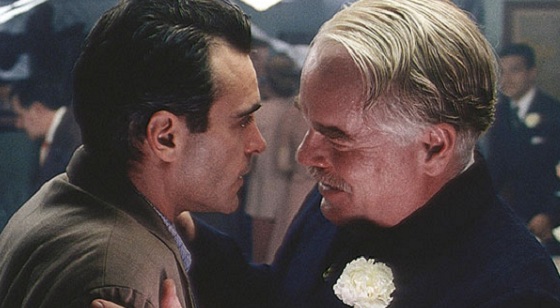
The Master (2012): Written and directed by Paul Thomas Anderson.  Starring: Joaquin Phoenix, Philip Seymour Hoffman, Amy Adams, and Laura Dern.  Rated R for: Sexual content, graphic nudity, and language.  Running time: 137 minutes.

Rating:  3.5/4 stars

    Having spent the better part of a week going over The Master in my head, I am still hard-pressed to say exactly what I think about it.  I can definitely say that it was not what I expected it to be.  Although similarities with Anderson’s last film, There Will Be Blood, are there- a strange and off-beat acoustic soundtrack, rampant alcoholism, and a cast of strange, twisted, and yet relatable characters- The Master is very much its own film, with own story to tell and its own style in doing so.  Whereas There Will Be Blood offered wide, sweeping shots of the American West as a crucial backdrop to its story, The Master provides one close-up after another of the people’s faces, and trades Blood’s consistently bleak browns for shots ranging from vividly colorful to stark and shadow-filled. 

    At the heart of Anderson’s new tale is Freddie Quell, a struggling, alcoholic WWII veteran, whose every twitch, glare, and nervous tic is brilliantly brought to life by a shaved Joaquin Phoenix.  After an opening segment that depicts several spectacular failures on  Freddie’s part to adjust to civilian life (after being told how full of potential he is), he encounters, “a writer, a doctor, a nuclear physicist and a theoretical philosopher, but above all a man”, otherwise known as Lancaster Dodd, played by Philip Seymour Hoffman. 

    Dodd is the leader of a social/religious/scientific movement called “The Cause,” based loosely (very loosely) on the real-life origins of Scientology.  Quell, who we learn has clear issues with commitment in his life, becomes devoutly, and sometimes violently, attached to (and protective of) Dodd, although what he thinks of The Causes’ various teachings themselves is never made very clear.  Dodd accepts Quell into the movement despite his constant trouble-making, arguing that he and his wife (the ever-engaging Amy Adams) can “cure” him of his troubles. 

    The Cause itself, however, is ultimately not the real focus of the film.  Its similarities to scientology do provide a limited frame of reference, but its hardly an expose or a broad parody of scientology in the same way that Book of Mormon was for Mormonism.  Some of Dodd’s teachings and ideas- that life is trillions of years old, and that “recalling” past lives can cure terminal illnesses, to name a few- are discussed intermittently, but the audience is never given a tangible, solid outline of the what the Cause really is, and whether it can be called a scientific movement or a religious one (both are implied).  Rather than picking out and critiquing a particular philosophy, religion, or way of thinking, Anderson instead uses both the Cause and the complex relationship between Dodd and Quell to take a broader look at the very idea of belief itself, wondering (but never directly asking) why so many people feel the need to “follow” something, be it scientific, religious, or something else entirely. 

    In so many ways, Dodd and Quell are perfect foils for each other.  Dodd is a loquacious, charming, and cultured Don Quixote, walking with his head held high in both  confidence and defiance, earnestly asserting that man is a cut above the rest of the animal kingdom.  Quell, on the other hand, is an animalistic, instinctive, and unhinged Pablo, embodying everything Dodd seems to fight against.  After joining the Cause, one of the first things he does is pass a note to a women he’s never met asking if she wants to fuck.  He stumbles on his words, grimacing angrily at almost everyone and everything around him.  His nonstop pacing, and the constance presence of his hands on his hips, bring to mind an impatient, hungry dog, hurt and anxious, but at the same time cowed and fearful. 

    Strange and inexplicable though it may be, it is ultimately Dodds and Quell’s brotherly relationship to each other that drives the film.  Anderson is the rare director who prefers to show rather than tell, who really uses the art of film in all its aspects, both visual and auditory, to tell a story.  The Master is a prime example of this.  Each character says just as much (and sometimes more) with their silences as they do with their words.  The result is a powerful and thought-provoking film that leaves you unsure of what, exactly, you just saw. 

    Sadly, this could easily result in many people simply dismissing the film as not having any real substance at all, that it’s all arthouse with no story.  While I can understand why someone might think that, I must respectfully disagree.  No, it is not a movie that tells you directly what it is about or what it is trying to say.  The true mastery of the film (pun intended) is that it manages to suggest so much about leadership, faith, and human nature without ever feeling the need to offer any definite answers.  Is Dodd a genuinely good person, or a deliberate manipulator of people’s emotions for his own gain?  Should we despise Quell for his violence and aggression, or pity him for the pain etched in every line of his face?  Is The Cause a sinister movement, or a beneficial one?  Can any movement be considered good or bad?  Rather than saying one or the other, The Master offers itself to its audience, and as the credits roll, asks, “What do you think?” 

    Although I am still not certain what I took away from The Master, few films this year have forced me to think so hard and so long.  It may not be in theaters for long, so if you have not seen it yet, do yourself a favor and get out as soon as possible.  There’s been no other movie like it thus far in 2012, and even if you don’t like or “get” it, you definitely won’t forget it.  What more could you ask for?

-Judge Richard